A
SEMINOR ON
HAIR CONDITIONERS
BY
L.PURNACHANDER
H NO:636216881040
COSMATIC TECHNOLOGY
Under the guidance of
Dr. G.GANESH KUMAR . M Pharm , PhD
Department of pharmacuitics
SRI KRUPAINSTITUTE OF PHARMACUITICALSCIENCES.
AFFILIATED TO OSMANIA UNIVERSITY.
CONTENTS…
➢INTRODUCTION & DEFINATION
➢PURPOSE
➢IDEAL PROPERTIES
➢TYPES OF CONDITIONERS
➢FORMULATION
➢METHOD OF PREPARATION
➢EVALUATIONS
INTRODUCTION
Hair conditioners are viscous liquid that is applied to the hair &
usually used after washing the hair with shampoo.
➢ Conditioners are based on cationic detergency &fatty
Material like lanolin (or) mineral oil.
➢ It is designed to restore hair to its natural state.
➢ it has the ability to repair damaged hair by providing shiny look
to the hair fiber.
➢ Hair conditioners restores the texture & appearance of the rough
& harsh hair.
➢ Hair conditioners are used to render the hair shiny ,easy to comb &
free from dryness.
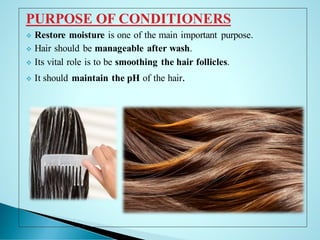
PURPOSE OF CONDITIONERS
❖ Restore moisture is one of the main important purpose.
❖ Hair should be manageable after wash.
❖ Its vital role is to be smoothing the hair follicles.
❖ It should maintain the pH of the hair.
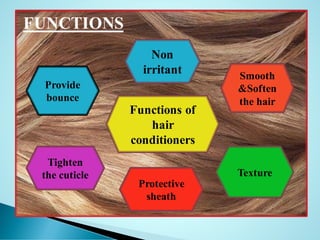
FUNCTIONS
Functions of
hair
conditioners
Provide
bounce
Smooth
&Soften
the hair
Non
irritant
Tighten
the cuticle Texture
Protective
sheath
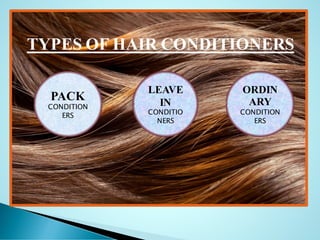
TYPES OF HAIR CONDITIONERS
PACK
CONDITION
ERS
LEAVE
IN
CONDITIO
NERS
ORDIN
ARY
CONDITION
ERS
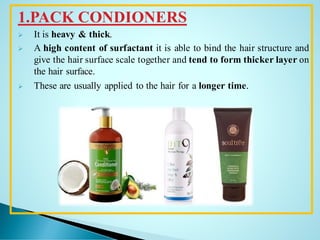
1.PACK CONDIONERS
➢ It is heavy & thick.
➢ A high content of surfactant it is able to bind the hair structure and
give the hair surface scale together and tend to form thicker layer on
the hair surface.
➢ These are usually applied to the hair for a longer time.
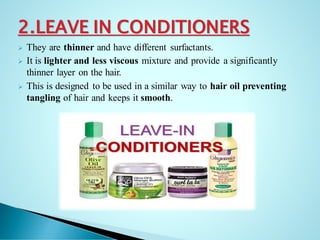
2.LEAVE IN CONDITIONERS
➢ They are thinner and have different surfactants.
➢ It is lighter and less viscous mixture and provide a significantly
thinner layer on the hair.
➢ This is designed to be used in a similar way to hair oil preventing
tangling of hair and keeps it smooth.
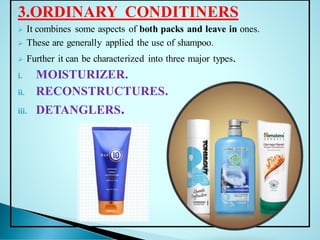
3.ORDINARY CONDITINERS
➢ It combines some aspects of both packs and leave in ones.
➢ These are generally applied the use of shampoo.
➢ Further it can be characterized into three major types.
i. MOISTURIZER.
ii. RECONSTRUCTURES.
iii. DETANGLERS.
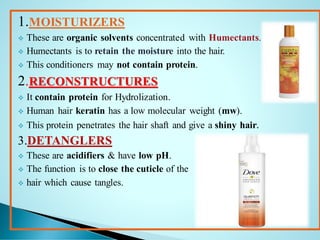
1.MOISTURIZERS
❖ These are organic solvents concentrated with Humectants.
❖ Humectants is to retain the moisture into the hair.
❖ This conditioners may not contain protein.
2.RECONSTRUCTURES
❖ It contain protein for Hydrolization.
❖ Human hair keratin has a low molecular weight (mw).
❖ This protein penetrates the hair shaft and give a shiny hair.
3.DETANGLERS
❖ These are acidifiers & have low pH.
❖ The function is to close the cuticle of the
❖ hair which cause tangles.
INGRIDIENTS:
1.SURFACTANTS:
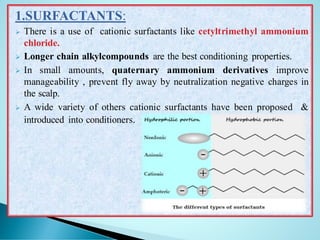
➢ There is a use of cationic surfactants like cetyltrimethyl ammonium
chloride.
➢ Longer chain alkylcompounds are the best conditioning properties.
➢ In small amounts, quaternary ammonium derivatives improve
manageability , prevent fly away by neutralization negative charges in
the scalp.
➢ A wide variety of others cationic surfactants have been proposed &
introduced into conditioners.
3.PARTIALLY OR TOTALLY HYDROLYZED
PROTIENS
❖ They are mainly used to protect , enrich or repair hair fiber.
❖ They are hydrolysates of collagen , keratin & milk casein..
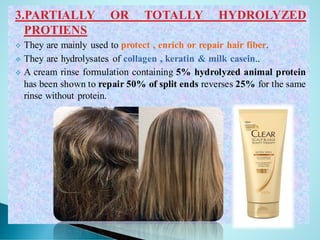
❖ A cream rinse formulation containing 5% hydrolyzed animal protein
has been shown to repair 50% of split ends reverses 25% for the same
rinse without protein.
3.OILY MATERIALS
➢ It is used to improve hair condition.
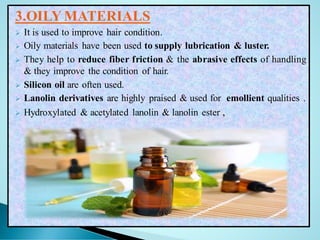
➢ Oily materials have been used to supply lubrication & luster.
➢ They help to reduce fiber friction & the abrasive effects of handling
& they improve the condition of hair.
➢ Silicon oil are often used.
➢ Lanolin derivatives are highly praised & used for emollient qualities .
➢ Hydroxylated & acetylated lanolin & lanolin ester ,
4.GLOSSERS :
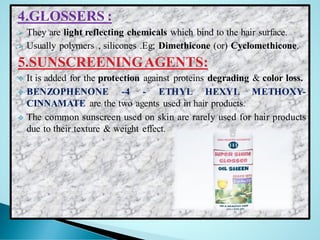
➢ They are light reflecting chemicals which bind to the hair surface.
➢ Usually polymers , silicones .Eg; Dimethicone (or) Cyclomethicone.
5.SUNSCREENINGAGENTS:
❖ It is added for the protection against proteins degrading & color loss.
❖ BENZOPHENONE -4 - ETHYL HEXYL METHOXY-
CINNAMATE are the two agents used in hair products.
❖ The common sunscreen used on skin are rarely used for hair products
due to their texture & weight effect.
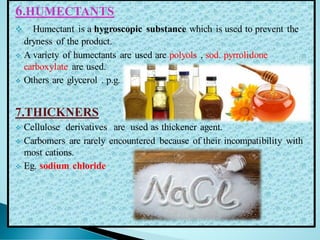
6.HUMECTANTS
❖ Humectant is a hygroscopic substance which is used to prevent the
dryness of the product.
❖ A variety of humectants are used are polyols , sod. pyrrolidone
carboxylate are used.
❖ Others are glycerol . p.g.
7.THICKNERS
❖ Cellulose derivatives are used as thickener agent.
❖ Carbomers are rarely encountered because of their incompatibility with
most cations.
❖ Eg. sodium chloride
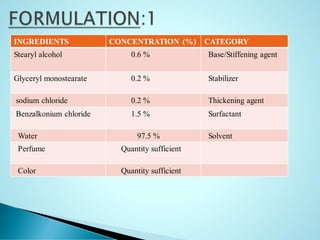
INGREDIENTS CONCENTRATION (%) CATEGORY
Stearyl alcohol 0.6 % Base/Stiffening agent
Glyceryl monostearate 0.2 % Stabilizer
sodium chloride 0.2 % Thickening agent
Benzalkonium chloride 1.5 % Surfactant
Water 97.5 % Solvent
Perfume Quantity sufficient
Color Quantity sufficient
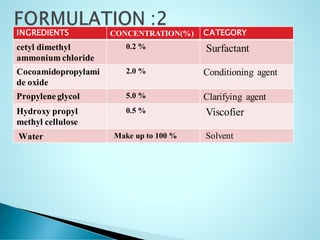
INGREDIENTS CONCENTRATION(%) CATEGORY
cetyl dimethyl
ammonium chloride
0.2 % Surfactant
Cocoamidopropylami
de oxide
2.0 % Conditioning agent
Propyleneglycol 5.0 % Clarifying agent
Hydroxy propyl
methyl cellulose
0.5 % Viscofier
Water Make up to 100 % Solvent
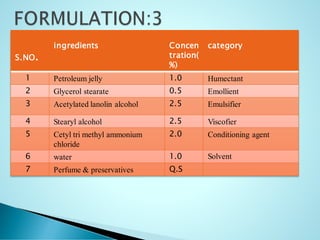
S.NO.
ingredients Concen
tration(
%)
category
1 Petroleum jelly 1.0 Humectant
2 Glycerol stearate 0.5 Emollient
3 Acetylated lanolin alcohol 2.5 Emulsifier
4 Stearyl alcohol 2.5 Viscofier
5 Cetyl tri methyl ammonium
chloride
2.0 Conditioning agent
6 water 1.0 Solvent
7 Perfume & preservatives Q.S
 Melt the cetyl alcohol in a jacketed side vessel.
 Heat to 70-750C. When both phases are at 70-75°C.
 Add the oil phase to the water phase with homogenization to
form an emulsion.
 When the emulsion has formed, commence cooling to 4O°C
with paddle stirring only.
 Add Preservatives and fragnance.
 Adjust pH and viscocity.
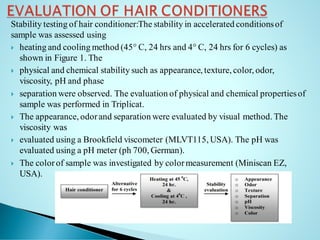
Stability testing of hair conditioner:The stability in accelerated conditionsof
sample was assessed using
 heating and cooling method (45° C, 24 hrs and 4° C, 24 hrs for 6 cycles) as
shown in Figure 1. The
 physical and chemical stability such as appearance, texture, color, odor,
viscosity, pH and phase
 separation were observed. The evaluation of physical and chemical propertiesof
sample was performed in Triplicat.
 The appearance, odorand separation were evaluated by visual method. The
viscosity was
 evaluated using a Brookfield viscometer (MLVT115, USA). The pH was
evaluated using a pH meter (ph 700, German).
 The colorof sample was investigated by colormeasurement (Miniscan EZ,
USA).
 Poucher’s perfumes, cosmetics & soaps.By H. Butler,
chapman & Hall, London.
 Cosmetics formulation manufacturing & quality control. By
P.P. Sharma, vandana publications Delhi.
HAIR CONDITIONERS.pdf

HAIR CONDITIONERS.pdf

  • 1.
    A SEMINOR ON HAIR CONDITIONERS BY L.PURNACHANDER HNO:636216881040 COSMATIC TECHNOLOGY Under the guidance of Dr. G.GANESH KUMAR . M Pharm , PhD Department of pharmacuitics SRI KRUPAINSTITUTE OF PHARMACUITICALSCIENCES. AFFILIATED TO OSMANIA UNIVERSITY.
  • 3.
    CONTENTS… ➢INTRODUCTION & DEFINATION ➢PURPOSE ➢IDEALPROPERTIES ➢TYPES OF CONDITIONERS ➢FORMULATION ➢METHOD OF PREPARATION ➢EVALUATIONS
  • 4.
    INTRODUCTION Hair conditioners areviscous liquid that is applied to the hair & usually used after washing the hair with shampoo. ➢ Conditioners are based on cationic detergency &fatty Material like lanolin (or) mineral oil. ➢ It is designed to restore hair to its natural state. ➢ it has the ability to repair damaged hair by providing shiny look to the hair fiber. ➢ Hair conditioners restores the texture & appearance of the rough & harsh hair. ➢ Hair conditioners are used to render the hair shiny ,easy to comb & free from dryness.
  • 5.
    PURPOSE OF CONDITIONERS ❖Restore moisture is one of the main important purpose. ❖ Hair should be manageable after wash. ❖ Its vital role is to be smoothing the hair follicles. ❖ It should maintain the pH of the hair.
  • 6.
  • 7.
    TYPES OF HAIRCONDITIONERS PACK CONDITION ERS LEAVE IN CONDITIO NERS ORDIN ARY CONDITION ERS
  • 8.
    1.PACK CONDIONERS ➢ Itis heavy & thick. ➢ A high content of surfactant it is able to bind the hair structure and give the hair surface scale together and tend to form thicker layer on the hair surface. ➢ These are usually applied to the hair for a longer time.
  • 9.
    2.LEAVE IN CONDITIONERS ➢They are thinner and have different surfactants. ➢ It is lighter and less viscous mixture and provide a significantly thinner layer on the hair. ➢ This is designed to be used in a similar way to hair oil preventing tangling of hair and keeps it smooth.
  • 10.
    3.ORDINARY CONDITINERS ➢ Itcombines some aspects of both packs and leave in ones. ➢ These are generally applied the use of shampoo. ➢ Further it can be characterized into three major types. i. MOISTURIZER. ii. RECONSTRUCTURES. iii. DETANGLERS.
  • 11.
    1.MOISTURIZERS ❖ These areorganic solvents concentrated with Humectants. ❖ Humectants is to retain the moisture into the hair. ❖ This conditioners may not contain protein. 2.RECONSTRUCTURES ❖ It contain protein for Hydrolization. ❖ Human hair keratin has a low molecular weight (mw). ❖ This protein penetrates the hair shaft and give a shiny hair. 3.DETANGLERS ❖ These are acidifiers & have low pH. ❖ The function is to close the cuticle of the ❖ hair which cause tangles.
  • 12.
  • 13.
    1.SURFACTANTS: ➢ There isa use of cationic surfactants like cetyltrimethyl ammonium chloride. ➢ Longer chain alkylcompounds are the best conditioning properties. ➢ In small amounts, quaternary ammonium derivatives improve manageability , prevent fly away by neutralization negative charges in the scalp. ➢ A wide variety of others cationic surfactants have been proposed & introduced into conditioners.
  • 14.
    3.PARTIALLY OR TOTALLYHYDROLYZED PROTIENS ❖ They are mainly used to protect , enrich or repair hair fiber. ❖ They are hydrolysates of collagen , keratin & milk casein.. ❖ A cream rinse formulation containing 5% hydrolyzed animal protein has been shown to repair 50% of split ends reverses 25% for the same rinse without protein.
  • 15.
    3.OILY MATERIALS ➢ Itis used to improve hair condition. ➢ Oily materials have been used to supply lubrication & luster. ➢ They help to reduce fiber friction & the abrasive effects of handling & they improve the condition of hair. ➢ Silicon oil are often used. ➢ Lanolin derivatives are highly praised & used for emollient qualities . ➢ Hydroxylated & acetylated lanolin & lanolin ester ,
  • 16.
    4.GLOSSERS : ➢ Theyare light reflecting chemicals which bind to the hair surface. ➢ Usually polymers , silicones .Eg; Dimethicone (or) Cyclomethicone. 5.SUNSCREENINGAGENTS: ❖ It is added for the protection against proteins degrading & color loss. ❖ BENZOPHENONE -4 - ETHYL HEXYL METHOXY- CINNAMATE are the two agents used in hair products. ❖ The common sunscreen used on skin are rarely used for hair products due to their texture & weight effect.
  • 17.
    6.HUMECTANTS ❖ Humectant isa hygroscopic substance which is used to prevent the dryness of the product. ❖ A variety of humectants are used are polyols , sod. pyrrolidone carboxylate are used. ❖ Others are glycerol . p.g. 7.THICKNERS ❖ Cellulose derivatives are used as thickener agent. ❖ Carbomers are rarely encountered because of their incompatibility with most cations. ❖ Eg. sodium chloride
  • 18.
    INGREDIENTS CONCENTRATION (%)CATEGORY Stearyl alcohol 0.6 % Base/Stiffening agent Glyceryl monostearate 0.2 % Stabilizer sodium chloride 0.2 % Thickening agent Benzalkonium chloride 1.5 % Surfactant Water 97.5 % Solvent Perfume Quantity sufficient Color Quantity sufficient
  • 19.
    INGREDIENTS CONCENTRATION(%) CATEGORY cetyldimethyl ammonium chloride 0.2 % Surfactant Cocoamidopropylami de oxide 2.0 % Conditioning agent Propyleneglycol 5.0 % Clarifying agent Hydroxy propyl methyl cellulose 0.5 % Viscofier Water Make up to 100 % Solvent
  • 20.
    S.NO. ingredients Concen tration( %) category 1 Petroleumjelly 1.0 Humectant 2 Glycerol stearate 0.5 Emollient 3 Acetylated lanolin alcohol 2.5 Emulsifier 4 Stearyl alcohol 2.5 Viscofier 5 Cetyl tri methyl ammonium chloride 2.0 Conditioning agent 6 water 1.0 Solvent 7 Perfume & preservatives Q.S
  • 21.
     Melt thecetyl alcohol in a jacketed side vessel.  Heat to 70-750C. When both phases are at 70-75°C.  Add the oil phase to the water phase with homogenization to form an emulsion.  When the emulsion has formed, commence cooling to 4O°C with paddle stirring only.  Add Preservatives and fragnance.  Adjust pH and viscocity.
  • 22.
    Stability testing ofhair conditioner:The stability in accelerated conditionsof sample was assessed using  heating and cooling method (45° C, 24 hrs and 4° C, 24 hrs for 6 cycles) as shown in Figure 1. The  physical and chemical stability such as appearance, texture, color, odor, viscosity, pH and phase  separation were observed. The evaluation of physical and chemical propertiesof sample was performed in Triplicat.  The appearance, odorand separation were evaluated by visual method. The viscosity was  evaluated using a Brookfield viscometer (MLVT115, USA). The pH was evaluated using a pH meter (ph 700, German).  The colorof sample was investigated by colormeasurement (Miniscan EZ, USA).
  • 23.
     Poucher’s perfumes,cosmetics & soaps.By H. Butler, chapman & Hall, London.  Cosmetics formulation manufacturing & quality control. By P.P. Sharma, vandana publications Delhi.