Null-hypothesis for a 
Independent-Sample t-test 
Conceptual Explanation
With hypothesis testing we are setting up a null-hypothesis
With hypothesis testing we are setting up a null-hypothesis 
– the probability that there is no effect or 
relationship –
With hypothesis testing we are setting up a null-hypothesis 
– the probability that there is no effect or 
relationship – and then we collect evidence that leads 
us to either accept or reject that null hypothesis.
As you may recall, an independent-sample t-test 
attempts to compare an independent sample with 
another independent sample.
Here is a template for writing a independent sample t-test 
null hypothesis.
There is no significant difference in [insert the 
Dependent Variable] between [insert Level 1 of the 
Independent Variable] and [insert Level 2 of the 
Independent Variable]
Example #1
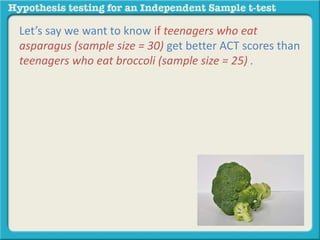
Let’s say we want to know if teenagers who eat 
asparagus (sample size = 30) get better ACT scores than 
teenagers who eat broccoli (sample size = 25) .
Here is the hypothesis:
Here is the hypothesis: 
There is a significant difference in ACT 
scores between students who eat 
asparagus and those who eat broccoli.
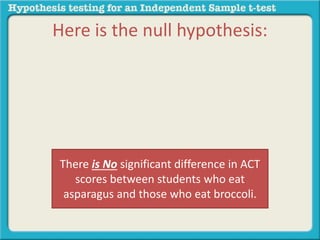
Here is the null hypothesis: 
There is No significant difference in ACT 
scores between students who eat 
asparagus and those who eat broccoli.
Example #2
Let’s say we want to know if IQ scores of teenagers 
listening to elevator music on their iPods and teenagers 
who listen to screaming rock.
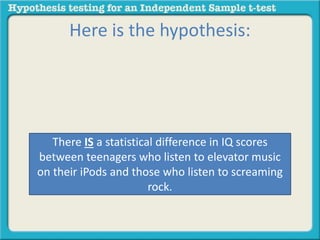
Here is the hypothesis:
Here is the hypothesis: 
There IS a statistical difference in IQ scores 
between teenagers who listen to elevator music 
on their iPods and those who listen to screaming 
rock.
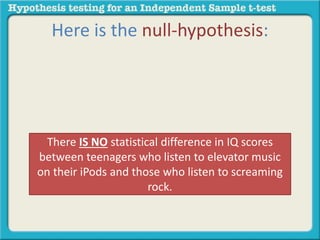
Here is the null-hypothesis: 
There IS NO statistical difference in IQ scores 
between teenagers who listen to elevator music 
on their iPods and those who listen to screaming 
rock.
Here is the Template Again 
There is no significant difference in [insert the 
Dependent Variable] between [insert Level 1 of the 
Independent Variable] and [insert Level 2 of the 
Independent Variable]

Null hypothesis for an independent-sample t-test

  • 1.
    Null-hypothesis for a Independent-Sample t-test Conceptual Explanation
  • 2.
    With hypothesis testingwe are setting up a null-hypothesis
  • 3.
    With hypothesis testingwe are setting up a null-hypothesis – the probability that there is no effect or relationship –
  • 4.
    With hypothesis testingwe are setting up a null-hypothesis – the probability that there is no effect or relationship – and then we collect evidence that leads us to either accept or reject that null hypothesis.
  • 5.
    As you mayrecall, an independent-sample t-test attempts to compare an independent sample with another independent sample.
  • 6.
    Here is atemplate for writing a independent sample t-test null hypothesis.
  • 7.
    There is nosignificant difference in [insert the Dependent Variable] between [insert Level 1 of the Independent Variable] and [insert Level 2 of the Independent Variable]
  • 8.
  • 9.
    Let’s say wewant to know if teenagers who eat asparagus (sample size = 30) get better ACT scores than teenagers who eat broccoli (sample size = 25) .
  • 10.
    Here is thehypothesis:
  • 11.
    Here is thehypothesis: There is a significant difference in ACT scores between students who eat asparagus and those who eat broccoli.
  • 12.
    Here is thenull hypothesis: There is No significant difference in ACT scores between students who eat asparagus and those who eat broccoli.
  • 13.
  • 14.
    Let’s say wewant to know if IQ scores of teenagers listening to elevator music on their iPods and teenagers who listen to screaming rock.
  • 15.
    Here is thehypothesis:
  • 16.
    Here is thehypothesis: There IS a statistical difference in IQ scores between teenagers who listen to elevator music on their iPods and those who listen to screaming rock.
  • 17.
    Here is thenull-hypothesis: There IS NO statistical difference in IQ scores between teenagers who listen to elevator music on their iPods and those who listen to screaming rock.
  • 18.
    Here is theTemplate Again There is no significant difference in [insert the Dependent Variable] between [insert Level 1 of the Independent Variable] and [insert Level 2 of the Independent Variable]