Downloaded 68 times
![Here is a template for writing a single sample t-test null
hypothesis:
There is no significant difference in [insert the Dependent Variable]
between [insert description of the sample and the time information
on the dependent variable was collected] and [insert information
on the dependent variable that was collected the second time]](https://image.slidesharecdn.com/null-hypothesisforpairedsamplet-test-140917091649-phpapp01/75/Null-hypothesis-for-paired-sample-t-test-5-2048.jpg)
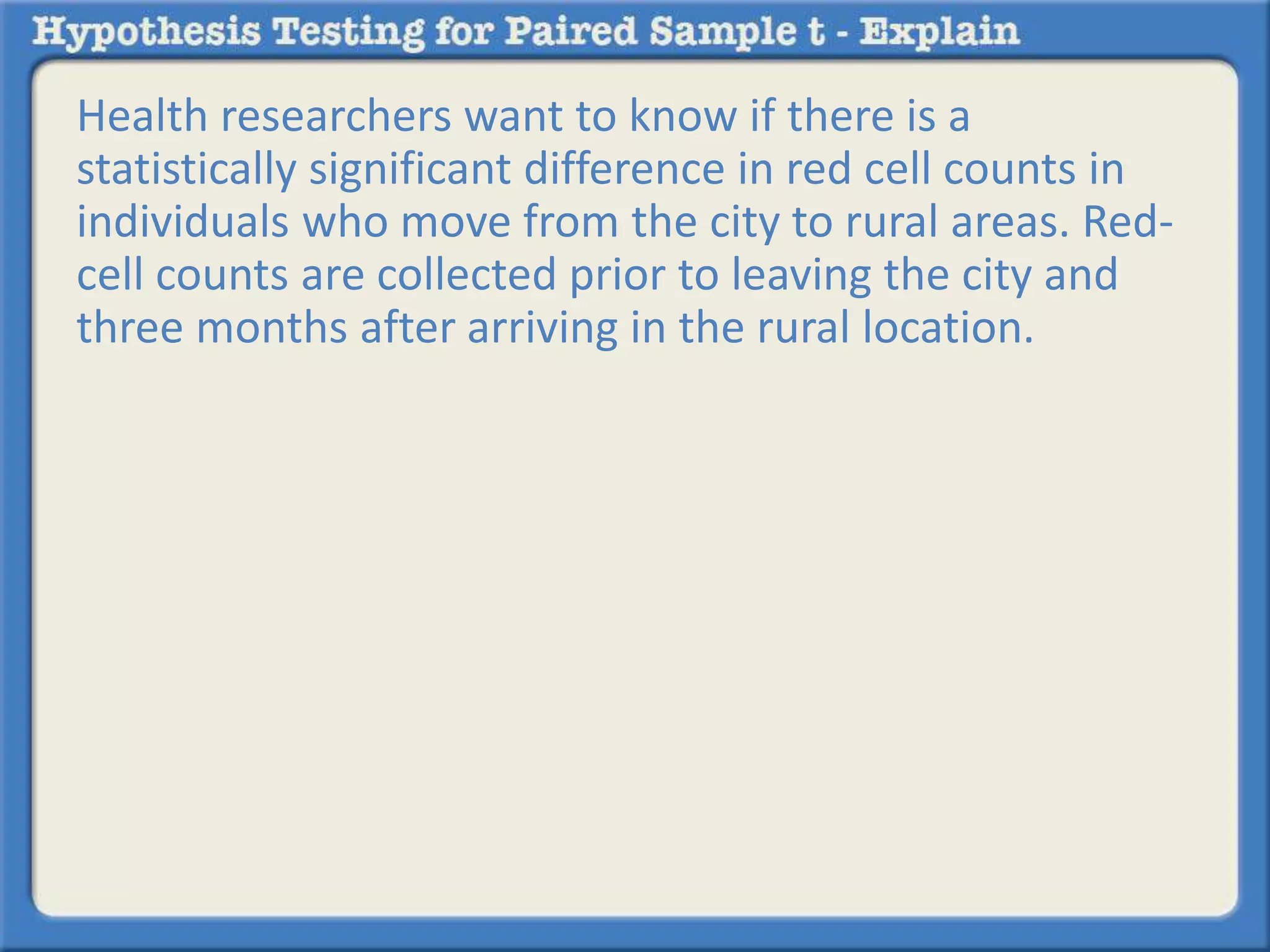
![Health researchers want to know if there is a
statistically significant difference in red cell counts in
individuals who move from the city to rural areas. Red-cell
counts are collected prior to leaving the city and
three months after arriving in the rural location.
Here is the template:
There is no significant difference in [insert the Dependent Variable]
between [insert description of the sample and the time information
on the dependent variable was collected] and [insert information
on the dependent variable that was collected the second time]](https://image.slidesharecdn.com/null-hypothesisforpairedsamplet-test-140917091649-phpapp01/75/Null-hypothesis-for-paired-sample-t-test-8-2048.jpg)
![Health researchers want to know if there is a
statistically significant difference in red cell counts in
individuals who move from the city to rural areas. Red-cell
counts are collected prior to leaving the city and
three months after arriving in the rural location.
Here is the template:
There is no significant difference in [insert the Dependent Variable]
between [insert description of the sample and the time information
on the dependent variable was collected] and [insert information
on the dependent variable that was collected the second time]
Null-hypothesis:
There is no significant difference in red cell count between
individuals who live in the city and those same individuals after
moving to a rural community three months later.](https://image.slidesharecdn.com/null-hypothesisforpairedsamplet-test-140917091649-phpapp01/75/Null-hypothesis-for-paired-sample-t-test-9-2048.jpg)
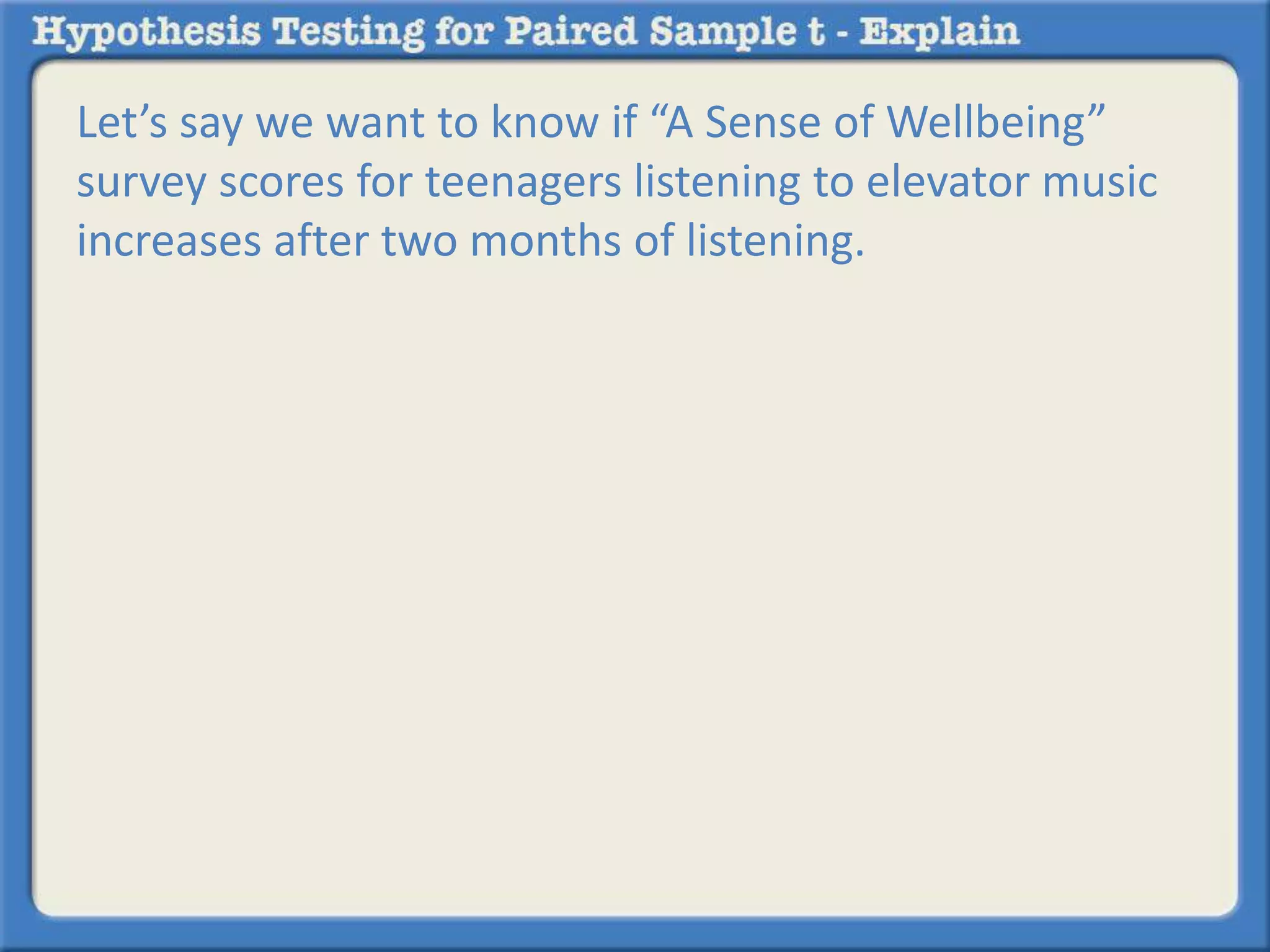
![Let’s say we want to know if “A Sense of Wellbeing”
survey scores for teenagers listening to elevator music
increases after one month of listening.
Template:
There is no significant difference in [insert the Dependent Variable]
between [insert description of the sample and the time information
on the dependent variable was collected] and [insert information
on the dependent variable that was collected the second time]](https://image.slidesharecdn.com/null-hypothesisforpairedsamplet-test-140917091649-phpapp01/75/Null-hypothesis-for-paired-sample-t-test-12-2048.jpg)
![Let’s say we want to know if “A Sense of Wellbeing”
survey scores for teenagers listening to elevator music
increases after one month of listening.
Template:
There is no significant difference in [insert the Dependent Variable]
between [insert description of the sample and the time information
on the dependent variable was collected] and [insert information
on the dependent variable that was collected the second time]
Null Hypothesis:
There is no significant difference for “A Sense of Wellbeing” scores
across two survey administrations separated by one month.](https://image.slidesharecdn.com/null-hypothesisforpairedsamplet-test-140917091649-phpapp01/75/Null-hypothesis-for-paired-sample-t-test-13-2048.jpg)

The document discusses the null hypothesis for a paired sample t-test. It explains that a paired sample t-test compares a dependent variable between two measurements of the same sample. It provides a template for writing the null hypothesis as "There is no significant difference in [dependent variable] between [first measurement] and [second measurement]." Two examples applying this template to compare red blood cell counts before and after moving locations, and wellbeing survey scores before and after listening to music, are given.


