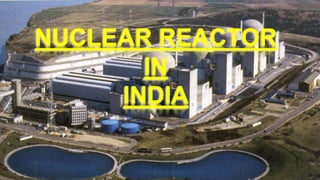
NUCLEAR REACTOR 
IN 
INDIA
INTRODUCTION : 
 Nuclear Reactor : A nuclear reactor is a device to initiate and control a 
sustained nuclear chain reaction. 
 Nuclear reactors are used at nuclear power plants for electricity 
generation. 
 Heat from nuclear fission is passed to a working fluid (water or gas), 
which runs through turbines. 
 Today there are about 450 nuclear power reactors that are used to 
generate electricity in about 30 countries around the world.
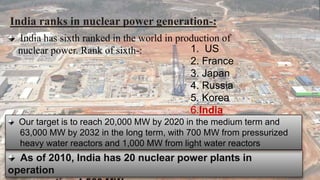
India ranks in nuclear power generation-: 
India has sixth ranked in the world in production of 
nuclear power. Rank of sixth-: 
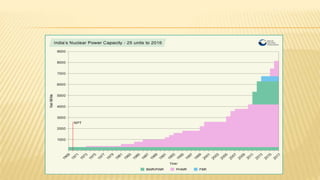
Our target is to reach 20,000 MW by 2020 in the medium term and 
63,000 MW by 2032 in the long term, with 700 MW from pressurized 
heavy water reactors and 1,000 MW from light water reactors 
As of 2010, India has 20 nuclear power plants in 
operation 
generating 4,560 MW. 
1. US 
2. France 
3. Japan 
4. Russia 
5. Korea 
6.India
TYPES OF NUCLEAR REACTOR 
 Pressurized water reactor (PWR) 
 Boiling water reactor (BWR) 
 Voda voda energo reactor (VVER) 
 Fast breeder reactor (FBR) 
 Pressurized heavy water reactor 
“CANDU”(PHWR)
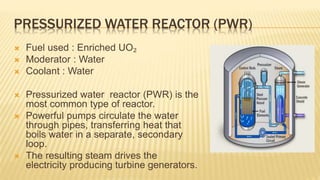
PRESSURIZED WATER REACTOR (PWR) 
 Fuel used : Enriched UO₂ 
 Moderator : Water 
 Coolant : Water 
 Pressurized water reactor (PWR) is the 
most common type of reactor. 
 Powerful pumps circulate the water 
through pipes, transferring heat that 
boils water in a separate, secondary 
loop. 
 The resulting steam drives the 
electricity producing turbine generators.
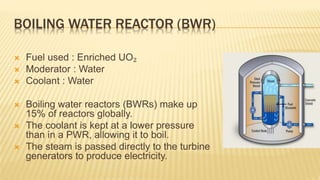
BOILING WATER REACTOR (BWR) 
 Fuel used : Enriched UO₂ 
 Moderator : Water 
 Coolant : Water 
 Boiling water reactors (BWRs) make up 
15% of reactors globally. 
 The coolant is kept at a lower pressure 
than in a PWR, allowing it to boil. 
 The steam is passed directly to the turbine 
generators to produce electricity.
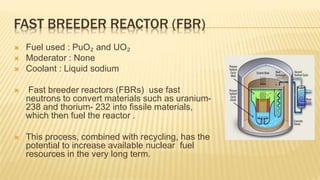
FAST BREEDER REACTOR (FBR) 
 Fuel used : PuO₂ and UO₂ 
 Moderator : None 
 Coolant : Liquid sodium 
 Fast breeder reactors (FBRs) use fast 
neutrons to convert materials such as uranium- 
238 and thorium- 232 into fissile materials, 
which then fuel the reactor . 
 This process, combined with recycling, has the 
potential to increase available nuclear fuel 
resources in the very long term.
VODA VODA ENERGO REACTOR (VVER) 
 Voda voda energo reactor meaning water 
cooled, water moderator energy reactor. 
 The VVER belongs to the family of the 
Pressurized water reactors (PWRs) 
 Currently VVER power stations are used 
by Armenia, Bulgaria, China, Finland, 
Hungary, India, Iran, Slovakia, Ukraine and 
Russia.
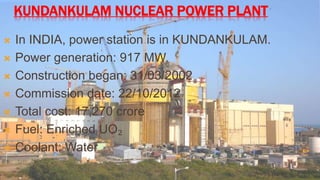
KUNDANKULAM NUCLEAR POWER PLANT 
 In INDIA, power station is in KUNDANKULAM. 
 Power generation: 917 MW. 
 Construction began: 31/03/2002 
 Commission date: 22/10/2012 
 Total cost: 17,270 crore 
 Fuel: Enriched UO₂ 
 Coolant: Water
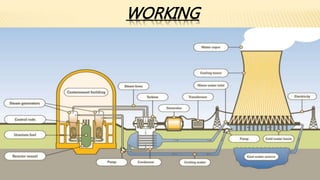
WORKING
INTRODUCTION OF “CANDU” 
 CANDU reactors were first developed in the late 1950s 
and 1960s. 
 It was developed under partnership between Atomic 
Energy of Canada Limited(AECL), the Hydro-Electric 
Power Commission of Ontario, Canadian General 
Electric. 
 The reactor is also marketed abroad and there are 
CANDU-type units operating 
in India, Pakistan, Argentina, South 
Korea, Romania and China.
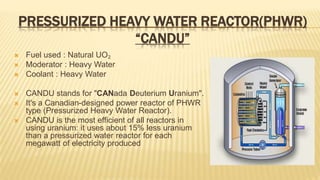
PRESSURIZED HEAVY WATER REACTOR(PHWR) 
“CANDU” 
 Fuel used : Natural UO₂ 
 Moderator : Heavy Water 
 Coolant : Heavy Water 
 CANDU stands for "CANada Deuterium Uranium". 
 It's a Canadian-designed power reactor of PHWR 
type (Pressurized Heavy Water Reactor). 
 CANDU is the most efficient of all reactors in 
using uranium: it uses about 15% less uranium 
than a pressurized water reactor for each 
megawatt of electricity produced
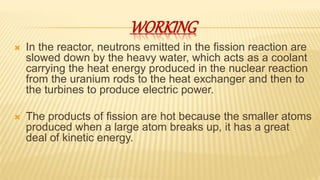
WORKING 
 In the reactor, neutrons emitted in the fission reaction are 
slowed down by the heavy water, which acts as a coolant 
carrying the heat energy produced in the nuclear reaction 
from the uranium rods to the heat exchanger and then to 
the turbines to produce electric power. 
 The products of fission are hot because the smaller atoms 
produced when a large atom breaks up, it has a great 
deal of kinetic energy.
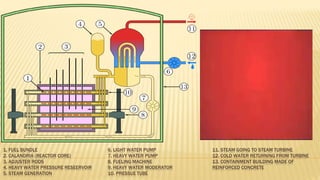
1. FUEL BUNDLE 
2. CALANDRIA (REACTOR CORE) 
3. ADJUSTER RODS 
4. HEAVY WATER PRESSURE RESEERVOIR 
5. STEAM GENERATION 
6. LIGHT WATER PUMP 
7. HEAVY WATER PUMP 
8. FUELING MACHINE 
9. HEAVY WATER MODERATOR 
10. PRESSUE TUBE 
11. STEAM GOING TO STEAM TURBINE 
12. COLD WATER RETURNING FROM TURBINE 
13. CONTAINMENT BUILDING MADE OF 
REINFORCED CONCRETE
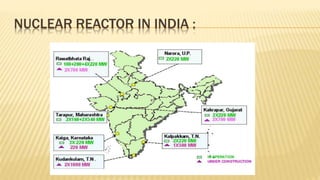
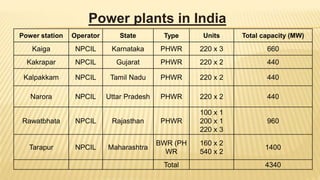
NUCLEAR REACTOR IN INDIA :
Power plants in India 
Power station Operator State Type Units Total capacity (MW) 
Kaiga NPCIL Karnataka PHWR 220 x 3 660 
Kakrapar NPCIL Gujarat PHWR 220 x 2 440 
Kalpakkam NPCIL Tamil Nadu PHWR 220 x 2 440 
Narora NPCIL Uttar Pradesh PHWR 220 x 2 440 
Rawatbhata NPCIL Rajasthan PHWR 
100 x 1 
200 x 1 
220 x 3 
960 
Tarapur NPCIL Maharashtra 
BWR (PH 
WR 
160 x 2 
540 x 2 
1400 
Total 4340
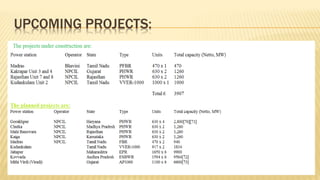
UPCOMING PROJECTS:
Nuclear reactor in india

Nuclear reactor in india

  • 1.
  • 2.
    INTRODUCTION : Nuclear Reactor : A nuclear reactor is a device to initiate and control a sustained nuclear chain reaction.  Nuclear reactors are used at nuclear power plants for electricity generation.  Heat from nuclear fission is passed to a working fluid (water or gas), which runs through turbines.  Today there are about 450 nuclear power reactors that are used to generate electricity in about 30 countries around the world.
  • 3.
    India ranks innuclear power generation-: India has sixth ranked in the world in production of nuclear power. Rank of sixth-: Our target is to reach 20,000 MW by 2020 in the medium term and 63,000 MW by 2032 in the long term, with 700 MW from pressurized heavy water reactors and 1,000 MW from light water reactors As of 2010, India has 20 nuclear power plants in operation generating 4,560 MW. 1. US 2. France 3. Japan 4. Russia 5. Korea 6.India
  • 4.
    TYPES OF NUCLEARREACTOR  Pressurized water reactor (PWR)  Boiling water reactor (BWR)  Voda voda energo reactor (VVER)  Fast breeder reactor (FBR)  Pressurized heavy water reactor “CANDU”(PHWR)
  • 5.
    PRESSURIZED WATER REACTOR(PWR)  Fuel used : Enriched UO₂  Moderator : Water  Coolant : Water  Pressurized water reactor (PWR) is the most common type of reactor.  Powerful pumps circulate the water through pipes, transferring heat that boils water in a separate, secondary loop.  The resulting steam drives the electricity producing turbine generators.
  • 6.
    BOILING WATER REACTOR(BWR)  Fuel used : Enriched UO₂  Moderator : Water  Coolant : Water  Boiling water reactors (BWRs) make up 15% of reactors globally.  The coolant is kept at a lower pressure than in a PWR, allowing it to boil.  The steam is passed directly to the turbine generators to produce electricity.
  • 7.
    FAST BREEDER REACTOR(FBR)  Fuel used : PuO₂ and UO₂  Moderator : None  Coolant : Liquid sodium  Fast breeder reactors (FBRs) use fast neutrons to convert materials such as uranium- 238 and thorium- 232 into fissile materials, which then fuel the reactor .  This process, combined with recycling, has the potential to increase available nuclear fuel resources in the very long term.
  • 8.
    VODA VODA ENERGOREACTOR (VVER)  Voda voda energo reactor meaning water cooled, water moderator energy reactor.  The VVER belongs to the family of the Pressurized water reactors (PWRs)  Currently VVER power stations are used by Armenia, Bulgaria, China, Finland, Hungary, India, Iran, Slovakia, Ukraine and Russia.
  • 9.
    KUNDANKULAM NUCLEAR POWERPLANT  In INDIA, power station is in KUNDANKULAM.  Power generation: 917 MW.  Construction began: 31/03/2002  Commission date: 22/10/2012  Total cost: 17,270 crore  Fuel: Enriched UO₂  Coolant: Water
  • 10.
  • 11.
    INTRODUCTION OF “CANDU”  CANDU reactors were first developed in the late 1950s and 1960s.  It was developed under partnership between Atomic Energy of Canada Limited(AECL), the Hydro-Electric Power Commission of Ontario, Canadian General Electric.  The reactor is also marketed abroad and there are CANDU-type units operating in India, Pakistan, Argentina, South Korea, Romania and China.
  • 12.
    PRESSURIZED HEAVY WATERREACTOR(PHWR) “CANDU”  Fuel used : Natural UO₂  Moderator : Heavy Water  Coolant : Heavy Water  CANDU stands for "CANada Deuterium Uranium".  It's a Canadian-designed power reactor of PHWR type (Pressurized Heavy Water Reactor).  CANDU is the most efficient of all reactors in using uranium: it uses about 15% less uranium than a pressurized water reactor for each megawatt of electricity produced
  • 13.
    WORKING  Inthe reactor, neutrons emitted in the fission reaction are slowed down by the heavy water, which acts as a coolant carrying the heat energy produced in the nuclear reaction from the uranium rods to the heat exchanger and then to the turbines to produce electric power.  The products of fission are hot because the smaller atoms produced when a large atom breaks up, it has a great deal of kinetic energy.
  • 14.
    1. FUEL BUNDLE 2. CALANDRIA (REACTOR CORE) 3. ADJUSTER RODS 4. HEAVY WATER PRESSURE RESEERVOIR 5. STEAM GENERATION 6. LIGHT WATER PUMP 7. HEAVY WATER PUMP 8. FUELING MACHINE 9. HEAVY WATER MODERATOR 10. PRESSUE TUBE 11. STEAM GOING TO STEAM TURBINE 12. COLD WATER RETURNING FROM TURBINE 13. CONTAINMENT BUILDING MADE OF REINFORCED CONCRETE
  • 16.
  • 17.
    Power plants inIndia Power station Operator State Type Units Total capacity (MW) Kaiga NPCIL Karnataka PHWR 220 x 3 660 Kakrapar NPCIL Gujarat PHWR 220 x 2 440 Kalpakkam NPCIL Tamil Nadu PHWR 220 x 2 440 Narora NPCIL Uttar Pradesh PHWR 220 x 2 440 Rawatbhata NPCIL Rajasthan PHWR 100 x 1 200 x 1 220 x 3 960 Tarapur NPCIL Maharashtra BWR (PH WR 160 x 2 540 x 2 1400 Total 4340
  • 18.