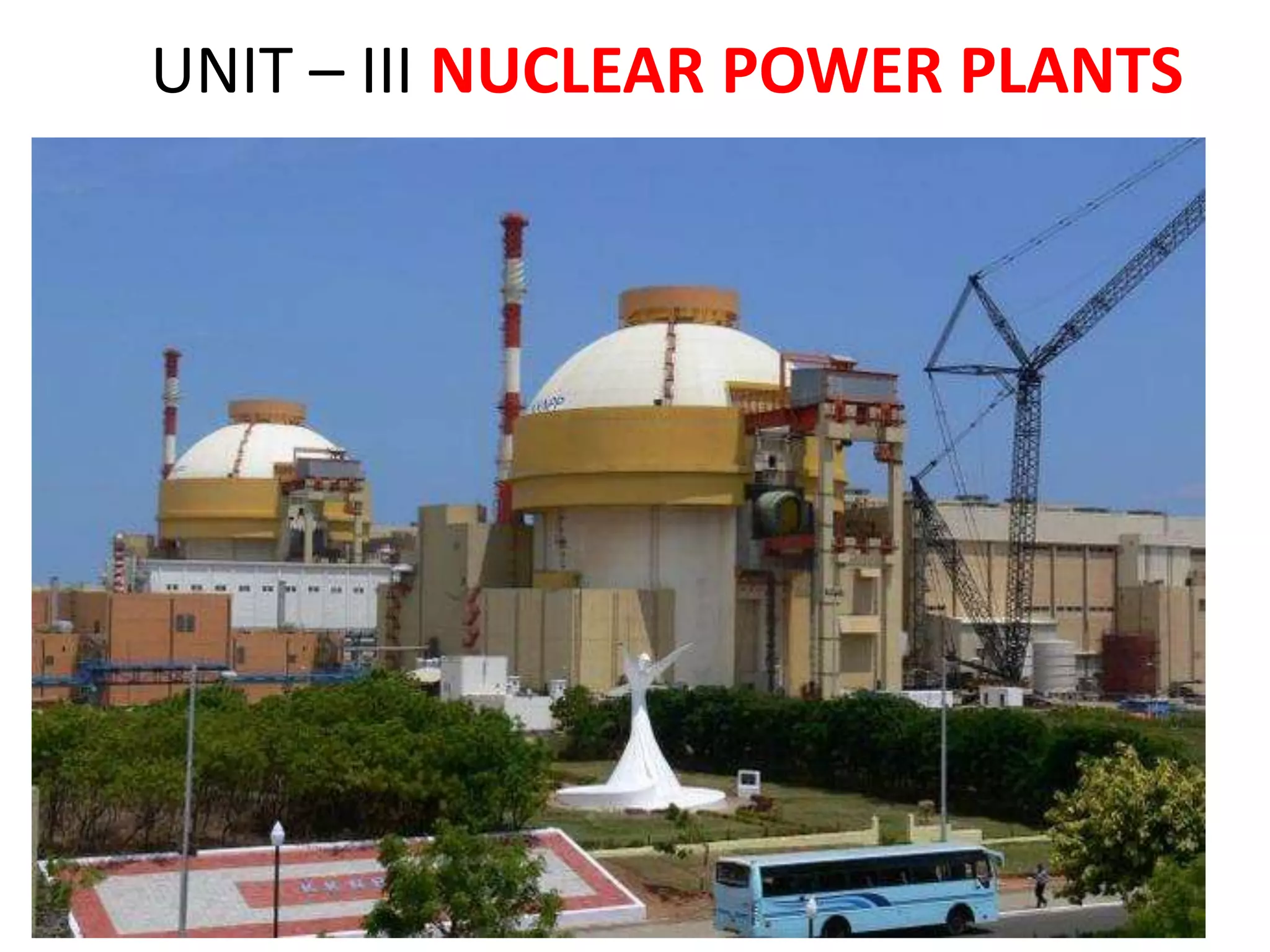
UNIT – III NUCLEAR POWER PLANTS
Atomic Structure
Atomic Number
The number of protons in the nucleus.
Mass Number
Total number of nucleons in the nucleus.
Isotopes
Mass number different forms is different and atomic number is same.
Binding Energy
Energy released at the moment of combination of two nucleons to form
nucleus of an atom.
1 eV = 1.602 x 10⁻⁹J
Radioactivity
It is phenomenon of spontaneous emission of powerful radiations exhibited by
heavy elements.
Nuclear Fuels
•Uranium-233
•Uranium-235
•Plutonium-238
•Plutonium-239
•Plutonium-241
•Neptunium-237
•Curium-244
The most often used fuels are Uranium-235 and Plutonium-239.
Uranium-233 was used in a couple of test bombs in USA and it is supposed to
be the main component in India’s bombs.
92U238
• 92 represents number of protons or electrons
• 238 represents mass number
• 146 represents number of neutrons
• U represents Uranium
Uranium-235
General Facts
• The most often isotope of Uranium found in Nature is U-238,
U-235 is only found in low proportions (0.71%).
• U-235 is created from U-238 via isotope separation.
• The critical mass for an unreflected sphere of U-235 is about
50 kg (17 cm of diameter).
Fission Process
• One slow neutron strikes a U-235 atom; the result is U-236.
• U-236 is highly unstable and it fissions. There are twenty
different fission processes, the products masses always add up
236.
• Example: U-235 + 1 neutron -> 2 neutrons + Kr-92 + Ba-142 +
ENERGY
Plutonium-239
General Facts
• Plutonium is very rare in nature.
• For military purposes, it is obtained processing Uranium-238 in
breeder reactors.
• It has a reasonably low rate of neutron emission due to
spontaneous fission.
• It is usually contaminated with Plutanium-240 which is more
unstable (4%-7% of plutanium-240 is considered bomb-grade). This
is the reason why plutonium-based weapons must be implosion-
type, rather than gun-type.
• The critical mass for an unreflected sphere of Plutonium is 16 kg.
Fission process: When Platinium-239 absorbs a slow neutron it
becomes Platinium-240, which decays fast via different processes
emitting at least two neutrons.
Nuclear Fission
• Nuclear fission is the
process of splitting a
nucleus into two nuclei
with smaller masses.
• Fission means “to
divide”
Nuclear Fission
Nuclear Fusion
• Nuclear fusion is the
combining of two nuclei
with low masses to form
one nucleus of larger
mass.
• Nuclear fusion reactions
are also called
thermonuclear reactions.
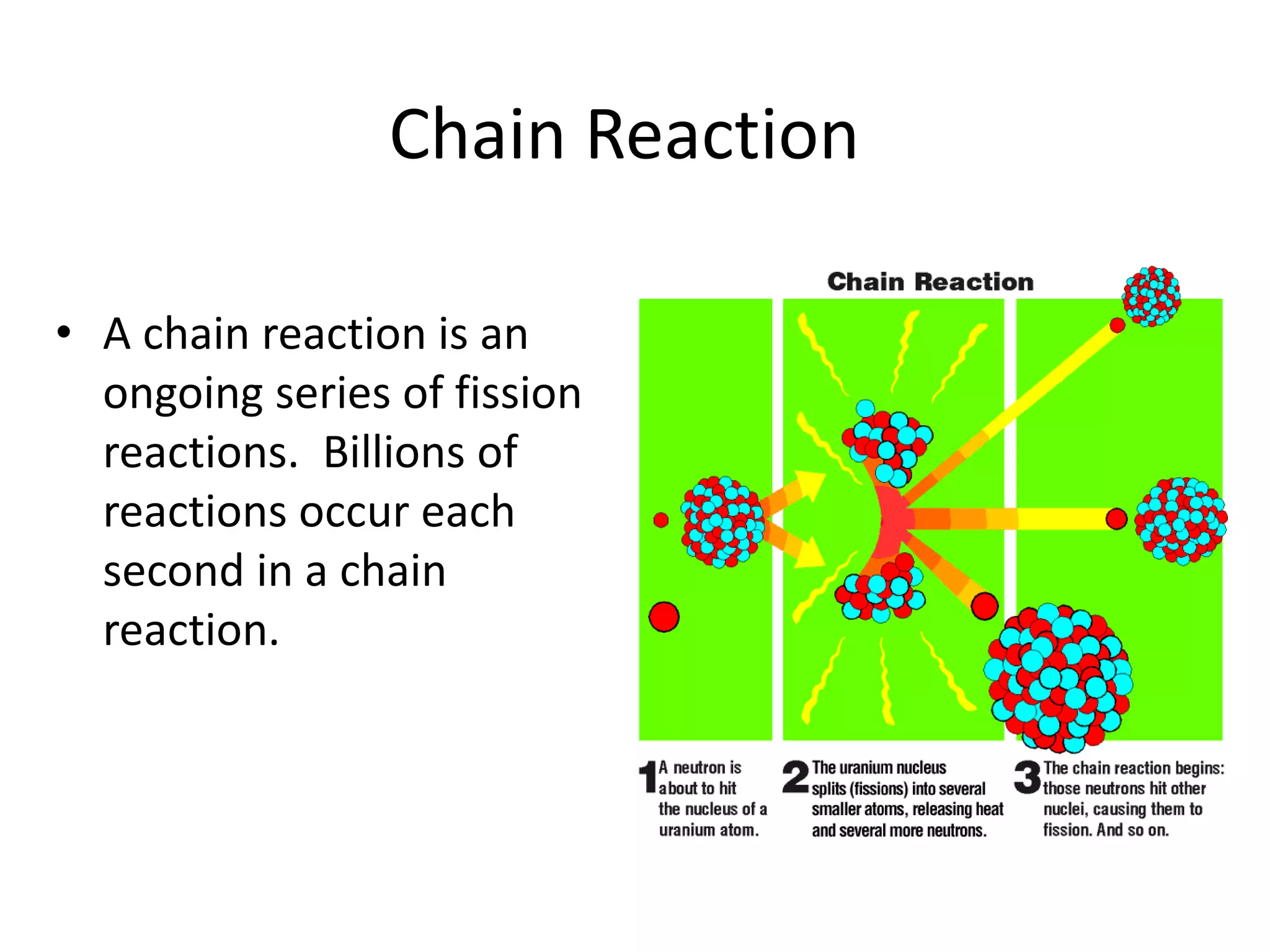
Chain Reaction
• A chain reaction is an
ongoing series of fission
reactions. Billions of
reactions occur each
second in a chain
reaction.
Nuclear power plant
Components
of
Nuclear
power
Plant
Fuel:
The fissionable material used in the reactor is called as fuel. The commonly used fuels are Uranium, Plutonium
or Thorium. It can be U-235, U-238, Pu-236 or Th-232. Uranium is mostly preferred as it has high melting point.
Moderators:
Only neutrons of a fairly low speed should be used to have controlled chain reaction. To slow down the speed
fast moving neutrons produced during the fission process, moderators are used. Moderator reduces the speed
of the neutron by absorbing its energy but not absorb neutron. Graphite, Heavy water and Beryllium are
common moderators.
Control Rods:
These rods absorb neutrons and stop the chain reaction to proceed further. These are made up of steel
containing a high percentage of material like cadmium or boron which can absorb neutrons. When control rods
are completely inserted into the moderator block then all the neutrons is absorbed and reaction comes to halt.
Shielding:
Shielding prevents radiations to reach outside the reactor. Lead blocks and concrete enclosure that is strong
enough of several meters thickness are used for shielding.
Coolant:
The coolant is substance in a pipe to the steam generator where water is boiled. This is where heat-exchange
process occurs. Heat is absorbed by the coolant that is produced in the reactor. Typical coolants are water,
carbon dioxide gas or liquid sodium.
Turbines:
Steam produced in the boiler is now passes to a turbine. The force of the steam jet causes the turbine to rotate.
Heat energy (steam) is converted to mechanical energy (moving turbine).
Types of Reactors
Boiling Water Reactor - BWR
Pressurized Water Reactor- PWR
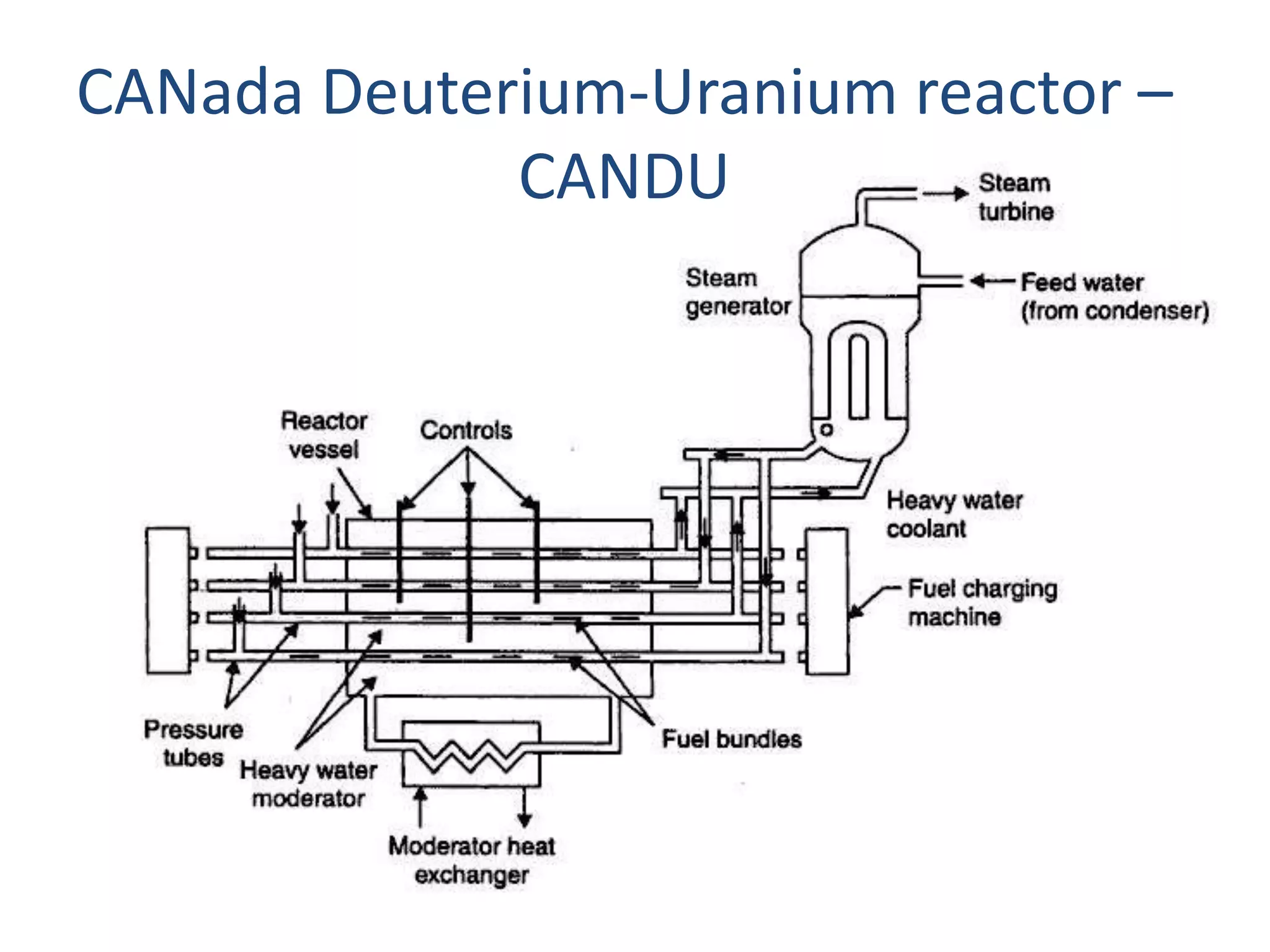
CANada Deuterium-Uranium reactor – CANDU
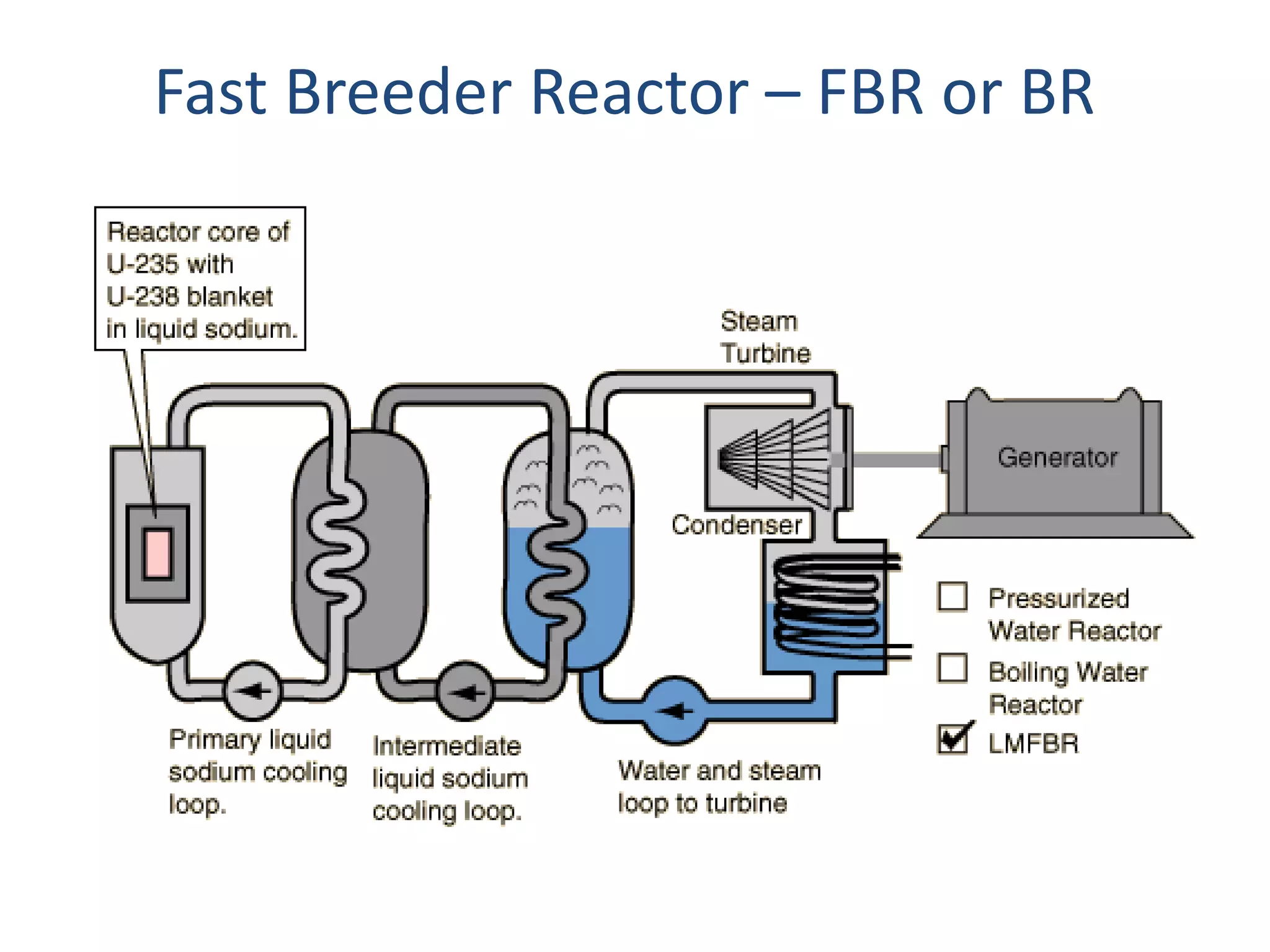
Fast Breeder Reactor – FBR or BR
Gas Cooled Reactor - GCR
Liquid Metal Cooled Reactor - LMFBR
Boiling Water Reactor - BWR
Pressurized Water Reactor- PWR
CANada Deuterium-Uranium reactor –
CANDU
Fast Breeder Reactor – FBR or BR
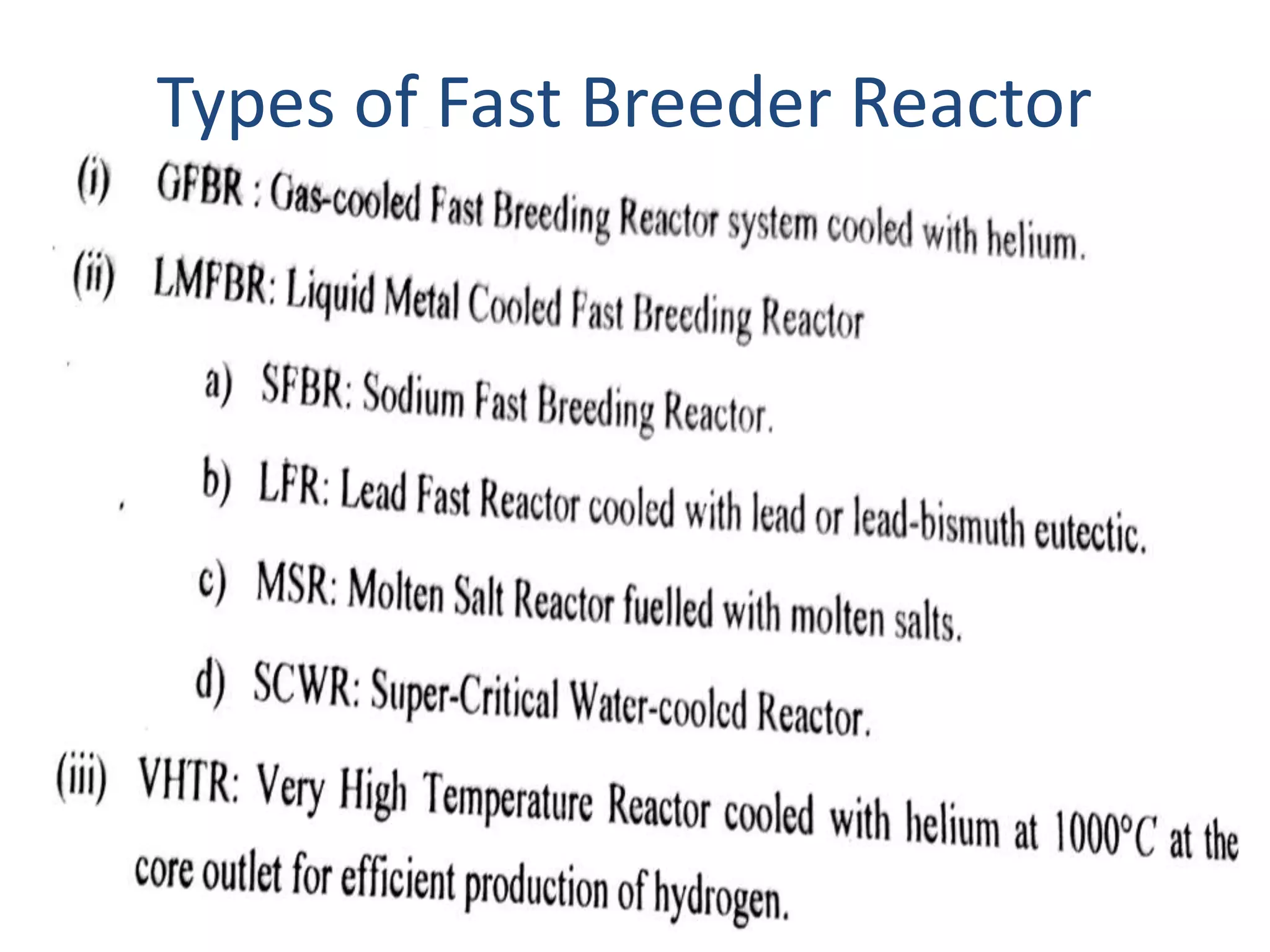
Types of Fast Breeder Reactor
Gas Cooled Reactor – GCR
Liquid Metal Cooled Reactor
Sodium Cooled Reactor (SFBR)
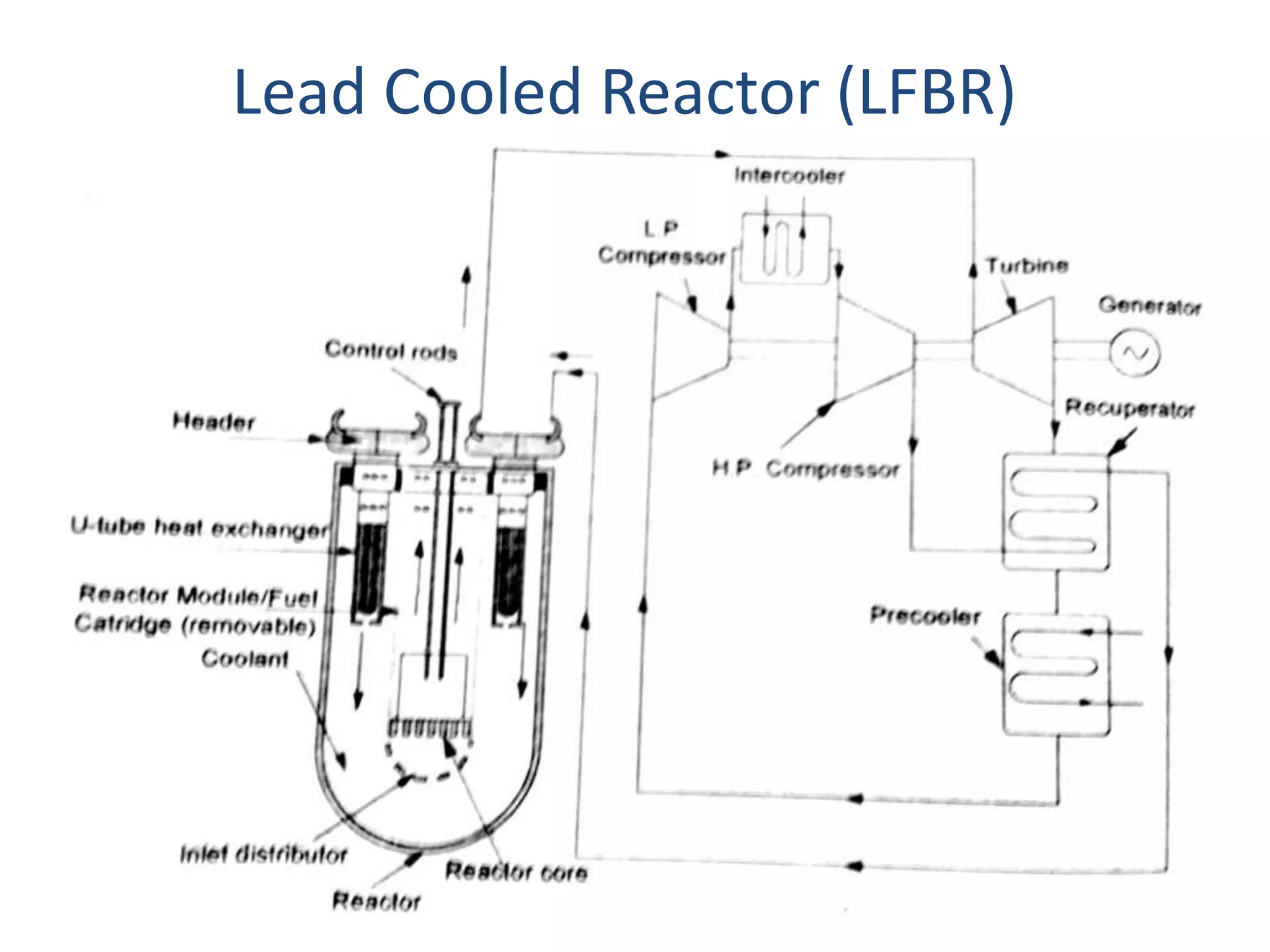
Lead Cooled Reactor (LFBR)
Molten Salt Reactor (MSR)
Very High temperature Reactor (VHTR)
• Reactor protection system (RPS) - A reactor protection
system is designed to immediately terminate the
nuclear reaction. By breaking the chain reaction, the
source of heat is eliminated.
• Control rods - Control rods are a series of rods that can
be quickly inserted into the reactor core to
absorb neutrons and rapidly terminate the nuclear
reaction.
• Safety injection - boric acid, which acts as a neutron
poison and rapidly floods the core in case of problems
with the stopping of the chain reaction.
Nuclear Power Plant Safety
Reactor protection system
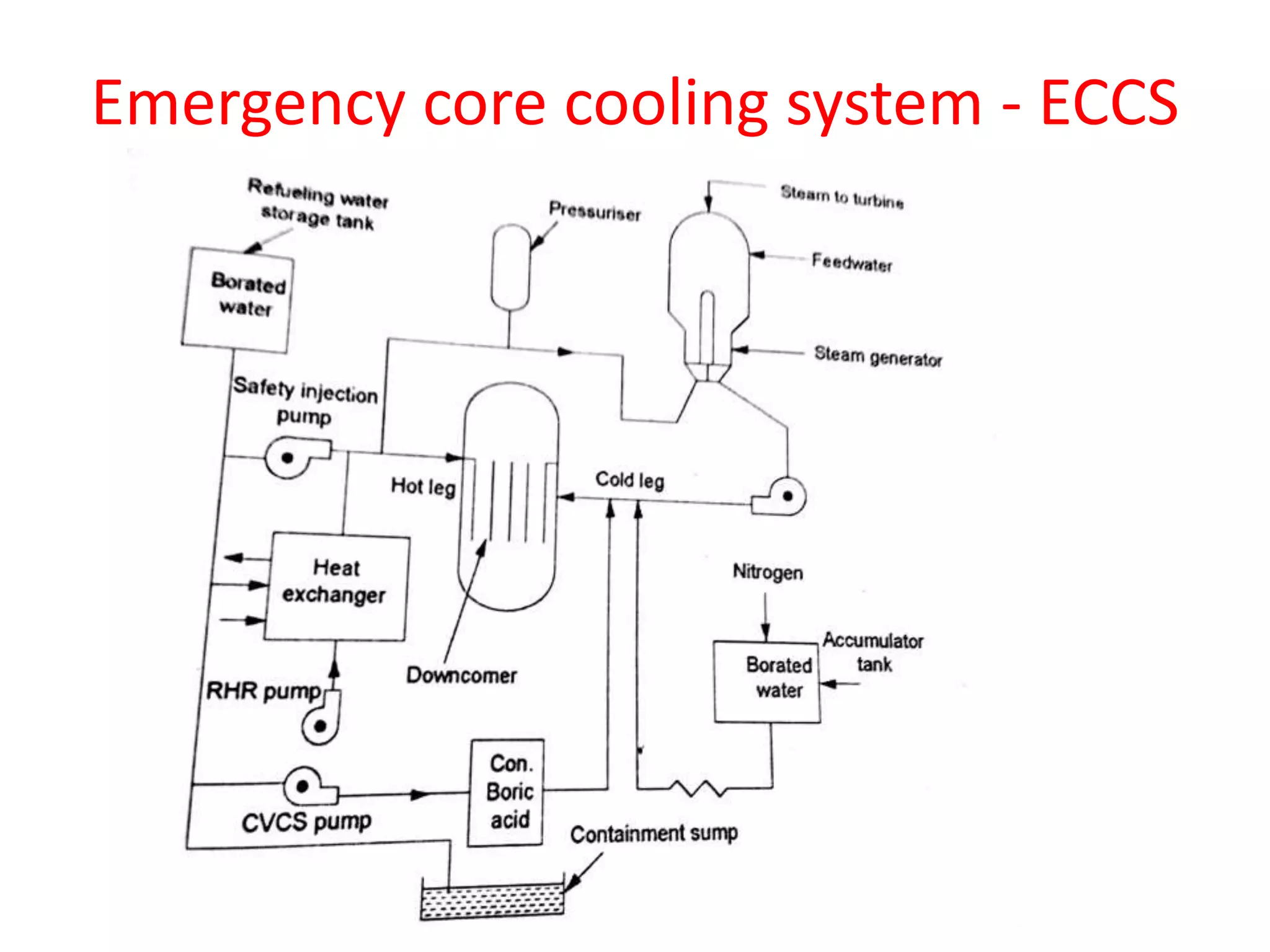
Emergency core cooling system - ECCS
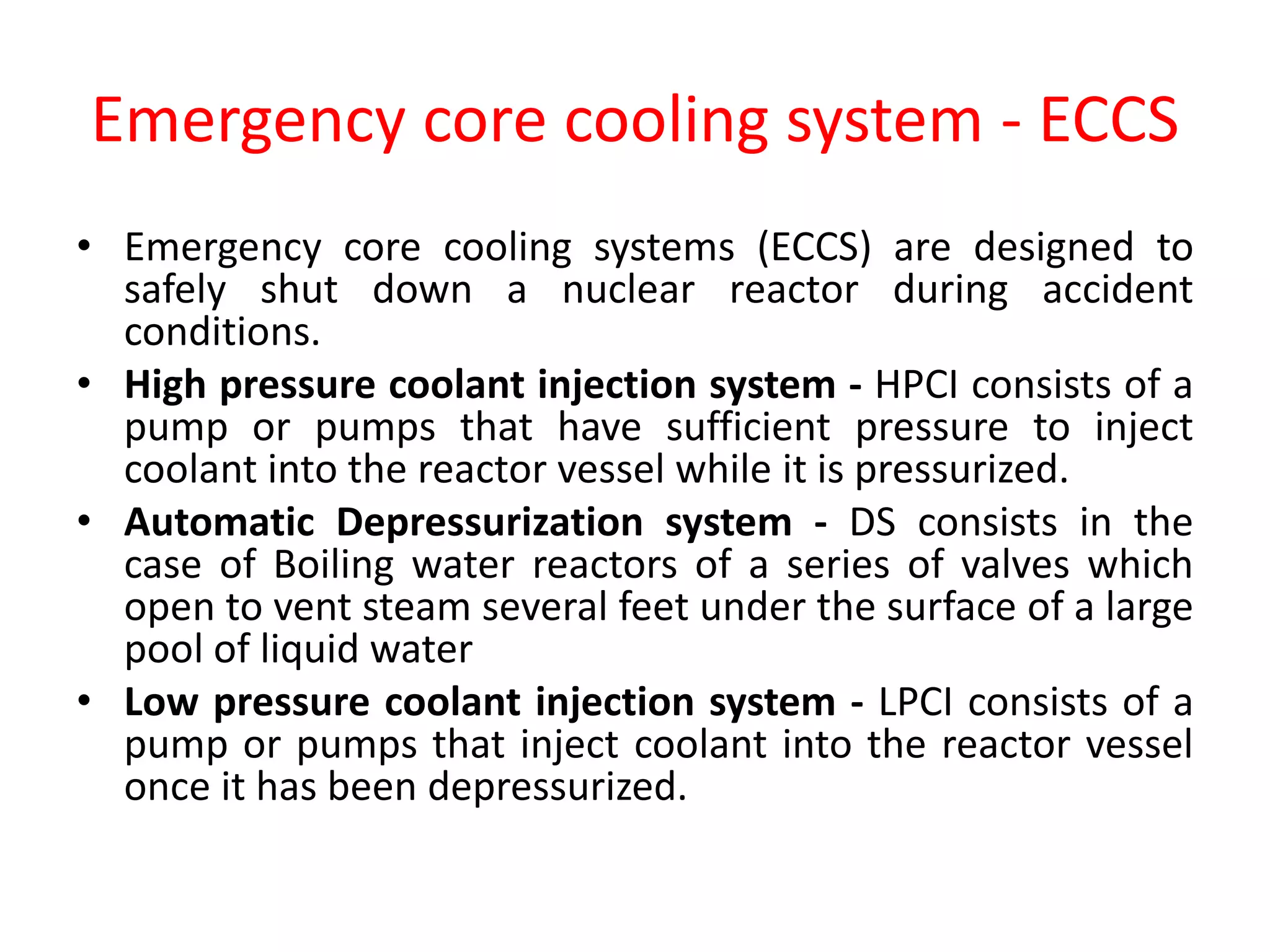
• Emergency core cooling systems (ECCS) are designed to
safely shut down a nuclear reactor during accident
conditions.
• High pressure coolant injection system - HPCI consists of a
pump or pumps that have sufficient pressure to inject
coolant into the reactor vessel while it is pressurized.
• Automatic Depressurization system - DS consists in the
case of Boiling water reactors of a series of valves which
open to vent steam several feet under the surface of a large
pool of liquid water
• Low pressure coolant injection system - LPCI consists of a
pump or pumps that inject coolant into the reactor vessel
once it has been depressurized.
Emergency core cooling system - ECCS
Ventilation and radiation protection
• In case of a radioactive release, most plants
have a system designed to remove
radioactivity from the air to reduce the effects
of the radioactivity release on the employees
and public. This system usually consists of
containment ventilation that removes
radioactivity and steam from primary
containment. Control room ventilation
ensures that plant operators are protected.

Unit iii nuclear power plants

  • 1.
    UNIT – IIINUCLEAR POWER PLANTS
  • 2.
  • 3.
    Atomic Number The numberof protons in the nucleus. Mass Number Total number of nucleons in the nucleus. Isotopes Mass number different forms is different and atomic number is same. Binding Energy Energy released at the moment of combination of two nucleons to form nucleus of an atom. 1 eV = 1.602 x 10⁻⁹J Radioactivity It is phenomenon of spontaneous emission of powerful radiations exhibited by heavy elements.
  • 4.
    Nuclear Fuels •Uranium-233 •Uranium-235 •Plutonium-238 •Plutonium-239 •Plutonium-241 •Neptunium-237 •Curium-244 The mostoften used fuels are Uranium-235 and Plutonium-239. Uranium-233 was used in a couple of test bombs in USA and it is supposed to be the main component in India’s bombs.
  • 5.
    92U238 • 92 representsnumber of protons or electrons • 238 represents mass number • 146 represents number of neutrons • U represents Uranium
  • 6.
    Uranium-235 General Facts • Themost often isotope of Uranium found in Nature is U-238, U-235 is only found in low proportions (0.71%). • U-235 is created from U-238 via isotope separation. • The critical mass for an unreflected sphere of U-235 is about 50 kg (17 cm of diameter). Fission Process • One slow neutron strikes a U-235 atom; the result is U-236. • U-236 is highly unstable and it fissions. There are twenty different fission processes, the products masses always add up 236. • Example: U-235 + 1 neutron -> 2 neutrons + Kr-92 + Ba-142 + ENERGY
  • 7.
    Plutonium-239 General Facts • Plutoniumis very rare in nature. • For military purposes, it is obtained processing Uranium-238 in breeder reactors. • It has a reasonably low rate of neutron emission due to spontaneous fission. • It is usually contaminated with Plutanium-240 which is more unstable (4%-7% of plutanium-240 is considered bomb-grade). This is the reason why plutonium-based weapons must be implosion- type, rather than gun-type. • The critical mass for an unreflected sphere of Plutonium is 16 kg. Fission process: When Platinium-239 absorbs a slow neutron it becomes Platinium-240, which decays fast via different processes emitting at least two neutrons.
  • 9.
    Nuclear Fission • Nuclearfission is the process of splitting a nucleus into two nuclei with smaller masses. • Fission means “to divide”
  • 10.
  • 11.
    Nuclear Fusion • Nuclearfusion is the combining of two nuclei with low masses to form one nucleus of larger mass. • Nuclear fusion reactions are also called thermonuclear reactions.
  • 12.
    Chain Reaction • Achain reaction is an ongoing series of fission reactions. Billions of reactions occur each second in a chain reaction.
  • 13.
  • 14.
  • 15.
    Fuel: The fissionable materialused in the reactor is called as fuel. The commonly used fuels are Uranium, Plutonium or Thorium. It can be U-235, U-238, Pu-236 or Th-232. Uranium is mostly preferred as it has high melting point. Moderators: Only neutrons of a fairly low speed should be used to have controlled chain reaction. To slow down the speed fast moving neutrons produced during the fission process, moderators are used. Moderator reduces the speed of the neutron by absorbing its energy but not absorb neutron. Graphite, Heavy water and Beryllium are common moderators. Control Rods: These rods absorb neutrons and stop the chain reaction to proceed further. These are made up of steel containing a high percentage of material like cadmium or boron which can absorb neutrons. When control rods are completely inserted into the moderator block then all the neutrons is absorbed and reaction comes to halt. Shielding: Shielding prevents radiations to reach outside the reactor. Lead blocks and concrete enclosure that is strong enough of several meters thickness are used for shielding. Coolant: The coolant is substance in a pipe to the steam generator where water is boiled. This is where heat-exchange process occurs. Heat is absorbed by the coolant that is produced in the reactor. Typical coolants are water, carbon dioxide gas or liquid sodium. Turbines: Steam produced in the boiler is now passes to a turbine. The force of the steam jet causes the turbine to rotate. Heat energy (steam) is converted to mechanical energy (moving turbine).
  • 16.
    Types of Reactors BoilingWater Reactor - BWR Pressurized Water Reactor- PWR CANada Deuterium-Uranium reactor – CANDU Fast Breeder Reactor – FBR or BR Gas Cooled Reactor - GCR Liquid Metal Cooled Reactor - LMFBR
  • 17.
  • 18.
  • 19.
  • 20.
    Fast Breeder Reactor– FBR or BR
  • 21.
    Types of FastBreeder Reactor
  • 22.
  • 23.
  • 24.
  • 25.
  • 26.
  • 27.
    Very High temperatureReactor (VHTR)
  • 28.
    • Reactor protectionsystem (RPS) - A reactor protection system is designed to immediately terminate the nuclear reaction. By breaking the chain reaction, the source of heat is eliminated. • Control rods - Control rods are a series of rods that can be quickly inserted into the reactor core to absorb neutrons and rapidly terminate the nuclear reaction. • Safety injection - boric acid, which acts as a neutron poison and rapidly floods the core in case of problems with the stopping of the chain reaction. Nuclear Power Plant Safety
  • 29.
  • 30.
    Emergency core coolingsystem - ECCS • Emergency core cooling systems (ECCS) are designed to safely shut down a nuclear reactor during accident conditions. • High pressure coolant injection system - HPCI consists of a pump or pumps that have sufficient pressure to inject coolant into the reactor vessel while it is pressurized. • Automatic Depressurization system - DS consists in the case of Boiling water reactors of a series of valves which open to vent steam several feet under the surface of a large pool of liquid water • Low pressure coolant injection system - LPCI consists of a pump or pumps that inject coolant into the reactor vessel once it has been depressurized.
  • 31.
  • 32.
    Ventilation and radiationprotection • In case of a radioactive release, most plants have a system designed to remove radioactivity from the air to reduce the effects of the radioactivity release on the employees and public. This system usually consists of containment ventilation that removes radioactivity and steam from primary containment. Control room ventilation ensures that plant operators are protected.