Chapter - Four
Nuclear Power Plants
‘First man splitted the atom now the atom splits man’.
Gerhard Uhlenbruck (German physist)
Introduction:
• A nuclear power plant is similar to a conventional thermal
power plant: Each type uses steam to drive a turbine
generator that produces electricity.
• Unlike a fossil-fueled plant, the nuclear plant’s energy
does not come from the combustion of fuel, but from the
fissioning (splitting) of fuel atoms.
Nuclear Fuels
• In nuclear plants, no burning or combustion process is
takes place but nuclear fission is used instead.
• The fission reaction generates heat, and this heat is
transferred to the water that produces the steam.
• The fission process requires a particular kind of heavy
element, such as uranium or plutonium, as a basic
material.
Cont.…
• The most common fuel for the electrical producing
reactor plants is uranium element.
• The U-235 is a more desirable atom for fuel, because
it is easier to cause the U-235 atoms for fission (split)
process.
• 1 kg of Uranium U235 can produce as much energy as the
burning of4500 tones ofhighgrade variety ofcoal.
Fission and Fusion Process
• All of the energy we produce comes from basic
chemical and physical processes.
• Fission and fusion are two physical processes that
produce massive amounts of energy from atoms (U-
235).
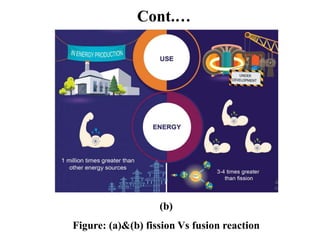
• They yield millions of times more energy than other
sources through nuclear reactions.
Cont.…
Fission
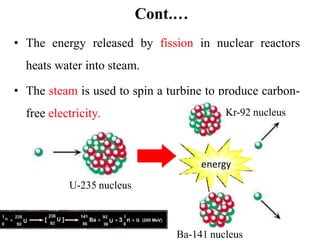
• It occurs when a neutron slams into a larger atom,
forcing it to excite and spilt into two smaller atoms-
also known as fission products.
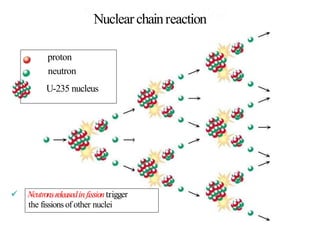
• Additional neutrons are also released that can initiate
a chain reaction.
• When each atom splits, a large amount of energy is
released.
Cont.…
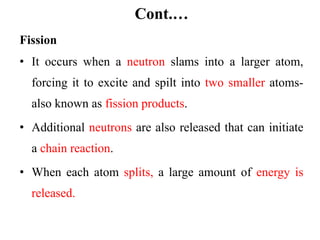
• The energy released by fission in nuclear reactors
heats water into steam.
• The steam is used to spin a turbine to produce carbon-
free electricity.
U-235 nucleus
Ba-141 nucleus
energy
Kr-92 nucleus
Nuclear chainreaction
proton
neutron
U-235 nucleus
 Neutronsreleasedinfissiontrigger
the fissions of other nuclei
Cont.…
Fusion:
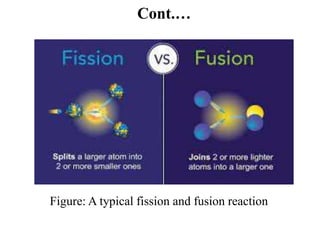
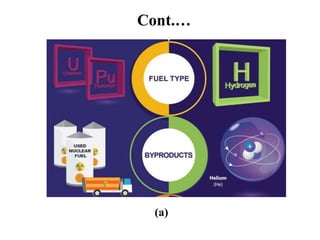
• Fusion occurs when two atoms slam together to form a
heavier atom, like when two hydrogen atoms fuse to
form one helium atom.
Cont.…
Figure: A typical fission and fusion reaction
Cont.…
(a)
Cont.…
(b)
Figure: (a)&(b) fission Vs fusion reaction
Nuclear Reactor
• Nuclear reactors are the heart of a nuclear power plant
which contain and control nuclear chain reactions that
produce heat through a physical process called fission.
• The main job of a reactor is to house and control nuclear
fission, a process where atoms split and release energy.
• Reactors use uranium for nuclear fuel.
• The uranium is processed into small ceramic pellets and
stacked together into sealed metal tubes called fuel rods.
Cont.…
• A reactor core is typically made up of a couple hundred
assemblies, depending on power level.
• Inside the reactor vessel, the fuel rods are immersed in
water which acts as both a coolant and moderator.
• The moderator helps slow down the neutrons produced
by fission to sustain the chain reaction.
• The coolant is used to transfers heat in to another medium.
• Control rods can then be inserted into the reactor core
to reduce the reaction rate.
Cont..
• The heat created by fission turns the water into steam,
which spins a turbine to produce carbon-free electricity.
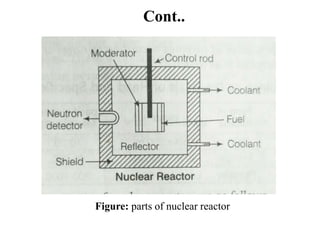
• Generally The essential components of a reactor are:
The fuel, which fissions to produce neutrons and to
release energy;
The control elements, which are used to set the energy
release rate; and
The cooling fluid, which removes the heat generated in
the reactor.
Cont..
Figure: parts of nuclear reactor
Cont..
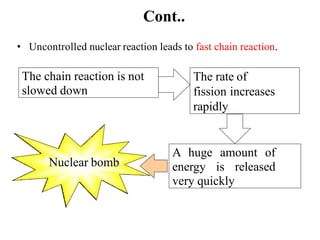
• Uncontrolled nuclear reaction leads to fast chain reaction.
The chain reaction is not
slowed down
The rate of
fission increases
rapidly
A huge amount of
energy is released
very quickly
Nuclear bomb
Types of Water Reactor
• There are two types of water reactors which is used by
nuclear reaction process.
Boiling-Water Reactors
Pressurized-Water Reactors
Boiling Water Reactors
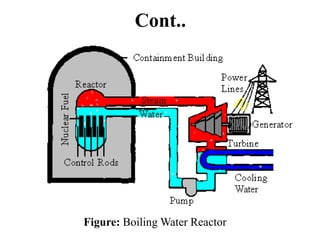
• In this reactor, water enters the reactor and is heated as
it passes up between the elements of nuclear fuel.
• Soon steam collects in the upper portion of the reactor
and leaves through an outlet pipe.
• The pipes identified as "steam" and "water " would be
connected to those similarly labelled in Figure below
to form a complete power plant.
Figure: Boiling Water Reactor
Cont..
Pressurized-Water Reactors
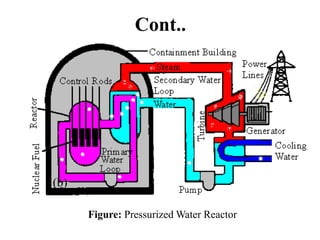
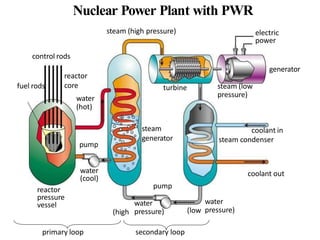
• A PWR generates steam indirectly by using two water circuits,
a primary one and a secondary one.
• In a PWR (Fig below), heat from the reactor core is used to heat
the primary water circuit at temperatures over 300°C.
• This water is kept liquid under high pressure.
• The heat from the primary water circuit is then transferred to
the secondary circuit by way of the pressurized liquid. The
secondary circuit then uses this heat to convert liquid water into
steam for the turbine via steam generator.
• The steam is later condensed and recycled.
Figure: Pressurized Water Reactor
(b)
Cont..
Nuclear Power Plant with PWR
control rods
fuel rods
reactor
pressure
vessel
water
(cool)
(high
water
pressure) (low
water
pressure)
coolant out
coolant in
steam condenser
steam (low
pressure)
turbine
electric
power
steam
generator
steam (high pressure)
pump
reactor
core
water
(hot)
primary loop secondary loop
generator
pump
Radioactivity
A Review of Atomic Terms
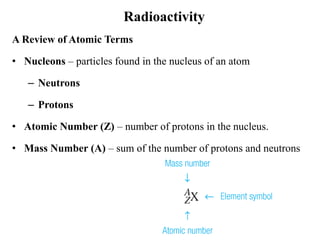
• Nucleons – particles found in the nucleus of an atom
– Neutrons
– Protons
• Atomic Number (Z) – number of protons in the nucleus.
• Mass Number (A) – sum of the number of protons and neutrons
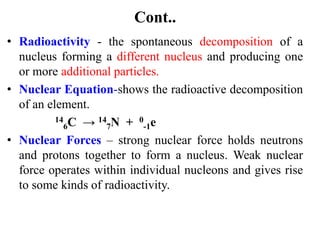
• Radioactivity - the spontaneous decomposition of a
nucleus forming a different nucleus and producing one
or more additional particles.
• Nuclear Equation-shows the radioactive decomposition
of an element.
14
6C → 14
7N + 0
-1e
• Nuclear Forces – strong nuclear force holds neutrons
and protons together to form a nucleus. Weak nuclear
force operates within individual nucleons and gives rise
to some kinds of radioactivity.
Cont..
Cont.…
• Radioactivity is essentially a nuclear phenomenon and is a
drastic process becausethe element changesits kind.
• It is spontaneous and an irreversible self- disintegrating
activity because the element breaks itself.
• Those elements which exhibit this activity are called radioactive
elements.
• Examples:
Uranium,polonium,radium,radon,ionium,thorium,actinium
and mesotheorium
Cont.…
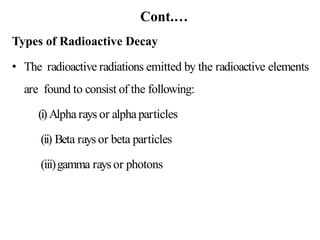
Types of Radioactive Decay
• The radioactive radiations emitted by the radioactive elements
are found to consist of the following:
(i)Alpha rays or alphaparticles
(ii) Beta rays or beta particles
(iii)gamma rays or photons
Cont.…
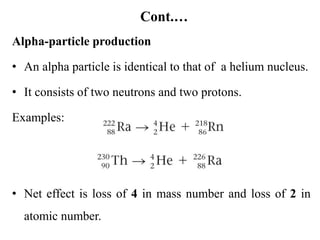
Alpha-particle production
• An alpha particle is identical to that of a helium nucleus.
• It consists of two neutrons and two protons.
Examples:
• Net effect is loss of 4 in mass number and loss of 2 in
atomic number.
Cont.…
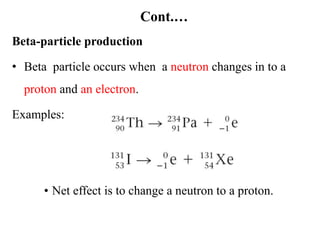
Beta-particle production
• Beta particle occurs when a neutron changes in to a
proton and an electron.
Examples:
• Net effect is to change a neutron to a proton.
Cont.…
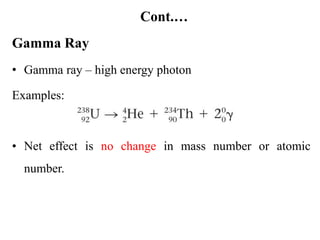
Gamma Ray
• Gamma ray – high energy photon
Examples:
• Net effect is no change in mass number or atomic
number.
Application of Radio Active Decay
Medical use:
• Many diseases such as cancer are cured by radio
therapy. Sterilization of medical instruments and food is
another common application of radiation.
Scientific use:
• Alpha particles emitted from the radio isotopes are used for
nuclear reactions.
Industrial use:
• Radio isotopes are used as fuel for atomic energy reactors.
Thank you!

Nuclear Energy or Nuclear power conversion Technology

  • 1.
    Chapter - Four NuclearPower Plants ‘First man splitted the atom now the atom splits man’. Gerhard Uhlenbruck (German physist) Introduction: • A nuclear power plant is similar to a conventional thermal power plant: Each type uses steam to drive a turbine generator that produces electricity. • Unlike a fossil-fueled plant, the nuclear plant’s energy does not come from the combustion of fuel, but from the fissioning (splitting) of fuel atoms.
  • 2.
    Nuclear Fuels • Innuclear plants, no burning or combustion process is takes place but nuclear fission is used instead. • The fission reaction generates heat, and this heat is transferred to the water that produces the steam. • The fission process requires a particular kind of heavy element, such as uranium or plutonium, as a basic material.
  • 3.
    Cont.… • The mostcommon fuel for the electrical producing reactor plants is uranium element. • The U-235 is a more desirable atom for fuel, because it is easier to cause the U-235 atoms for fission (split) process. • 1 kg of Uranium U235 can produce as much energy as the burning of4500 tones ofhighgrade variety ofcoal.
  • 4.
    Fission and FusionProcess • All of the energy we produce comes from basic chemical and physical processes. • Fission and fusion are two physical processes that produce massive amounts of energy from atoms (U- 235). • They yield millions of times more energy than other sources through nuclear reactions.
  • 5.
    Cont.… Fission • It occurswhen a neutron slams into a larger atom, forcing it to excite and spilt into two smaller atoms- also known as fission products. • Additional neutrons are also released that can initiate a chain reaction. • When each atom splits, a large amount of energy is released.
  • 6.
    Cont.… • The energyreleased by fission in nuclear reactors heats water into steam. • The steam is used to spin a turbine to produce carbon- free electricity. U-235 nucleus Ba-141 nucleus energy Kr-92 nucleus
  • 7.
    Nuclear chainreaction proton neutron U-235 nucleus Neutronsreleasedinfissiontrigger the fissions of other nuclei
  • 8.
    Cont.… Fusion: • Fusion occurswhen two atoms slam together to form a heavier atom, like when two hydrogen atoms fuse to form one helium atom.
  • 9.
    Cont.… Figure: A typicalfission and fusion reaction
  • 10.
  • 11.
  • 12.
    Nuclear Reactor • Nuclearreactors are the heart of a nuclear power plant which contain and control nuclear chain reactions that produce heat through a physical process called fission. • The main job of a reactor is to house and control nuclear fission, a process where atoms split and release energy. • Reactors use uranium for nuclear fuel. • The uranium is processed into small ceramic pellets and stacked together into sealed metal tubes called fuel rods.
  • 13.
    Cont.… • A reactorcore is typically made up of a couple hundred assemblies, depending on power level. • Inside the reactor vessel, the fuel rods are immersed in water which acts as both a coolant and moderator. • The moderator helps slow down the neutrons produced by fission to sustain the chain reaction. • The coolant is used to transfers heat in to another medium. • Control rods can then be inserted into the reactor core to reduce the reaction rate.
  • 14.
    Cont.. • The heatcreated by fission turns the water into steam, which spins a turbine to produce carbon-free electricity. • Generally The essential components of a reactor are: The fuel, which fissions to produce neutrons and to release energy; The control elements, which are used to set the energy release rate; and The cooling fluid, which removes the heat generated in the reactor.
  • 15.
    Cont.. Figure: parts ofnuclear reactor
  • 16.
    Cont.. • Uncontrolled nuclearreaction leads to fast chain reaction. The chain reaction is not slowed down The rate of fission increases rapidly A huge amount of energy is released very quickly Nuclear bomb
  • 17.
    Types of WaterReactor • There are two types of water reactors which is used by nuclear reaction process. Boiling-Water Reactors Pressurized-Water Reactors
  • 18.
    Boiling Water Reactors •In this reactor, water enters the reactor and is heated as it passes up between the elements of nuclear fuel. • Soon steam collects in the upper portion of the reactor and leaves through an outlet pipe. • The pipes identified as "steam" and "water " would be connected to those similarly labelled in Figure below to form a complete power plant.
  • 19.
    Figure: Boiling WaterReactor Cont..
  • 20.
    Pressurized-Water Reactors • APWR generates steam indirectly by using two water circuits, a primary one and a secondary one. • In a PWR (Fig below), heat from the reactor core is used to heat the primary water circuit at temperatures over 300°C. • This water is kept liquid under high pressure. • The heat from the primary water circuit is then transferred to the secondary circuit by way of the pressurized liquid. The secondary circuit then uses this heat to convert liquid water into steam for the turbine via steam generator. • The steam is later condensed and recycled.
  • 21.
    Figure: Pressurized WaterReactor (b) Cont..
  • 22.
    Nuclear Power Plantwith PWR control rods fuel rods reactor pressure vessel water (cool) (high water pressure) (low water pressure) coolant out coolant in steam condenser steam (low pressure) turbine electric power steam generator steam (high pressure) pump reactor core water (hot) primary loop secondary loop generator pump
  • 23.
    Radioactivity A Review ofAtomic Terms • Nucleons – particles found in the nucleus of an atom – Neutrons – Protons • Atomic Number (Z) – number of protons in the nucleus. • Mass Number (A) – sum of the number of protons and neutrons
  • 24.
    • Radioactivity -the spontaneous decomposition of a nucleus forming a different nucleus and producing one or more additional particles. • Nuclear Equation-shows the radioactive decomposition of an element. 14 6C → 14 7N + 0 -1e • Nuclear Forces – strong nuclear force holds neutrons and protons together to form a nucleus. Weak nuclear force operates within individual nucleons and gives rise to some kinds of radioactivity. Cont..
  • 25.
    Cont.… • Radioactivity isessentially a nuclear phenomenon and is a drastic process becausethe element changesits kind. • It is spontaneous and an irreversible self- disintegrating activity because the element breaks itself. • Those elements which exhibit this activity are called radioactive elements. • Examples: Uranium,polonium,radium,radon,ionium,thorium,actinium and mesotheorium
  • 26.
    Cont.… Types of RadioactiveDecay • The radioactive radiations emitted by the radioactive elements are found to consist of the following: (i)Alpha rays or alphaparticles (ii) Beta rays or beta particles (iii)gamma rays or photons
  • 27.
    Cont.… Alpha-particle production • Analpha particle is identical to that of a helium nucleus. • It consists of two neutrons and two protons. Examples: • Net effect is loss of 4 in mass number and loss of 2 in atomic number.
  • 28.
    Cont.… Beta-particle production • Betaparticle occurs when a neutron changes in to a proton and an electron. Examples: • Net effect is to change a neutron to a proton.
  • 29.
    Cont.… Gamma Ray • Gammaray – high energy photon Examples: • Net effect is no change in mass number or atomic number.
  • 30.
    Application of RadioActive Decay Medical use: • Many diseases such as cancer are cured by radio therapy. Sterilization of medical instruments and food is another common application of radiation. Scientific use: • Alpha particles emitted from the radio isotopes are used for nuclear reactions. Industrial use: • Radio isotopes are used as fuel for atomic energy reactors.
  • 31.