Nuclear
Power
A Presentation By Mohd Faiz
Kali Charan Nigam Institute of
Technology Banda UP
What is nuclear
power?
• Power plants use heat to
produce electricity. Nuclear
energy produces electricity
from heat through a process
called fission. Nuclear power
plants use the heat produced
by fission of certain atoms.
Nuclear Fusion
and Fission
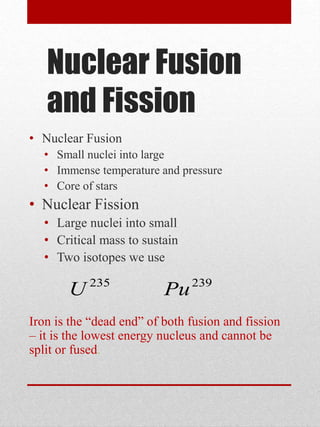
• Nuclear Fusion
• Small nuclei into large
• Immense temperature and pressure
• Core of stars
• Nuclear Fission
• Large nuclei into small
• Critical mass to sustain
• Two isotopes we use
Iron is the “dead end” of both fusion and fission
– it is the lowest energy nucleus and cannot be
split or fused.
235
U 239
Pu
Nuclear Fission
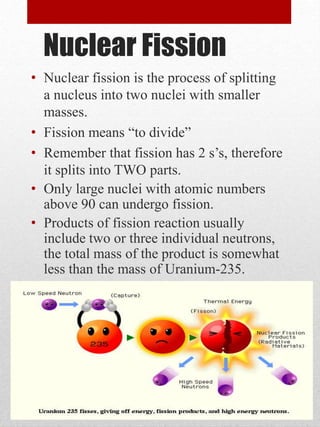
• Nuclear fission is the process of splitting
a nucleus into two nuclei with smaller
masses.
• Fission means “to divide”
• Remember that fission has 2 s’s, therefore
it splits into TWO parts.
• Only large nuclei with atomic numbers
above 90 can undergo fission.
• Products of fission reaction usually
include two or three individual neutrons,
the total mass of the product is somewhat
less than the mass of Uranium-235.
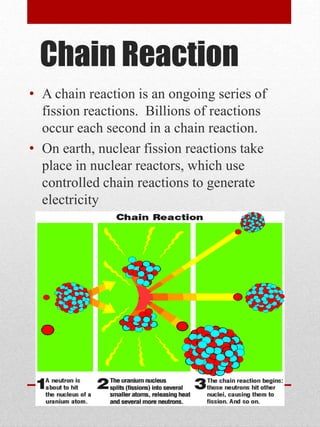
Chain Reaction
• A chain reaction is an ongoing series of
fission reactions. Billions of reactions
occur each second in a chain reaction.
• On earth, nuclear fission reactions take
place in nuclear reactors, which use
controlled chain reactions to generate
electricity
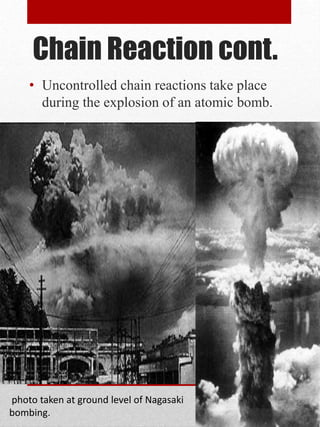
Chain Reaction cont.
• Uncontrolled chain reactions take place
during the explosion of an atomic bomb.
photo taken at ground level of Nagasaki
bombing.
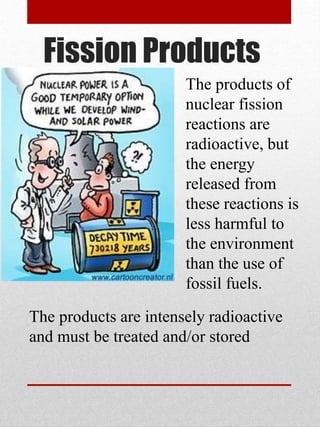
Fission Products
The products of
nuclear fission
reactions are
radioactive, but
the energy
released from
these reactions is
less harmful to
the environment
than the use of
fossil fuels.
The products are intensely radioactive
and must be treated and/or stored
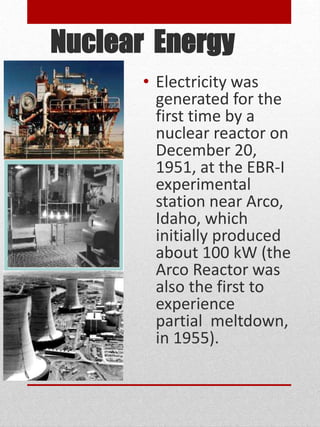
Nuclear Energy
• Electricity was
generated for the
first time by a
nuclear reactor on
December 20,
1951, at the EBR-I
experimental
station near Arco,
Idaho, which
initially produced
about 100 kW (the
Arco Reactor was
also the first to
experience
partial meltdown,
in 1955).
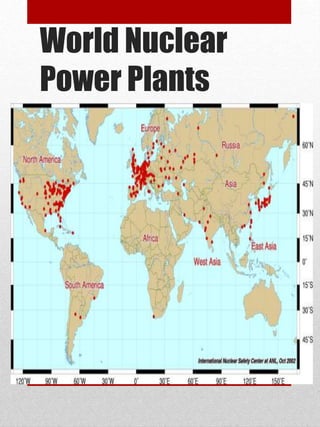
World Nuclear
Power Plants
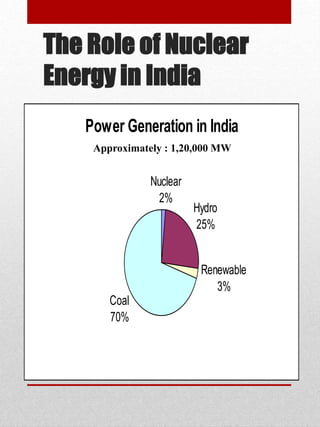
The Role of Nuclear
Energy in India
Power Generation in India
Nuclear
2%
Hydro
25%
Renewable
3%
Coal
70%
Approximately : 1,20,000 MW
How a Nuclear
Reactor works
• 235U fissions by absorbing a neutron and
producing 2 to 3 neutrons, which initiate on
average one more fission to make a controlled
chain reaction
• Normal water is used as a moderator to slow
the neutrons since slow neutrons take longer
to pass by a U nucleus and have more time to
be absorbed
• The protons in the hydrogen in the water have
the same mass as the neutron and stop them
by a billiard ball effect
• The extra neutrons are taken up by protons to
form deuterons
• 235U is enriched from its 0.7% in nature to
about 3% to produce the reaction, and is
contained in rods in the water
• Boron control rods are inserted to absorb
neutrons when it is time to shut down the
reactor
• The hot water is boiled or sent through a heat
exchanger to produce steam. The steam then
powers turbines.
Working of reactor
Requirement of natural
uranium for a 1000
MWe Nuclear Power
Plant: ~ 160 t /Year.
Requirement of coal for a
1000 MWe Coal fired
plant ~ 2.6 million t /
Year (i.e. 5 trains of 1400
t /Day)
Energy scenario
in India
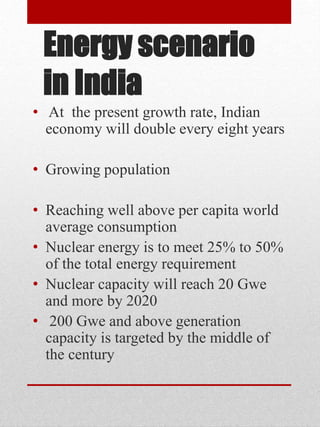
• At the present growth rate, Indian
economy will double every eight years
• Growing population
• Reaching well above per capita world
average consumption
• Nuclear energy is to meet 25% to 50%
of the total energy requirement
• Nuclear capacity will reach 20 Gwe
and more by 2020
• 200 Gwe and above generation
capacity is targeted by the middle of
the century
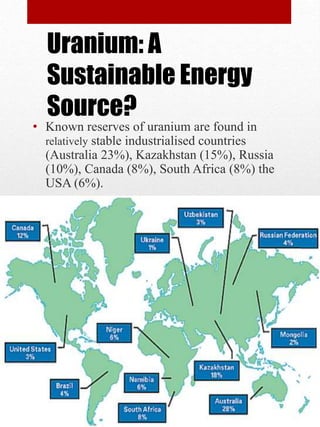
• Known reserves of uranium are found in
relatively stable industrialised countries
(Australia 23%), Kazakhstan (15%), Russia
(10%), Canada (8%), South Africa (8%) the
USA (6%).
Uranium: A
Sustainable Energy
Source?
Nuclear Power
Economics
• Nuclear power plants are very expensive
to build relative to all other forms of
electricity production, with a Front-loaded
cost structure (high initial investment then
relatively low running cost)
• A recent MIT report argues that:
• ‘‘The track record for the construction
costs of nuclear plants completed in the
USA during the 1980s and early 1990s
was poor. Actual costs were far higher
than had been projected . . . The first few
US plants will be a critical test for all
parties involved’’.
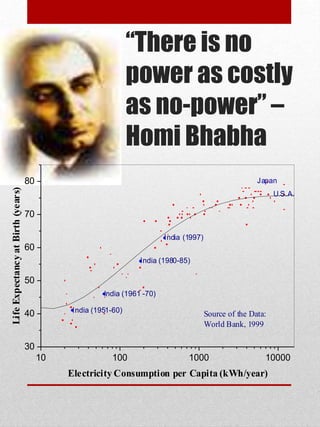
“There is no
power as costly
as no-power” –
Homi Bhabha
10 100 1000 10000
30
40
50
60
70
80 Japan
U.S.A.
India (1951-60)
India (1961 -70)
India (1980-85)
India (1997)
Source of the Data:
World Bank, 1999
LifeExpectancyatBirth(years)
Electricity Consumption per Capita (kWh/year)
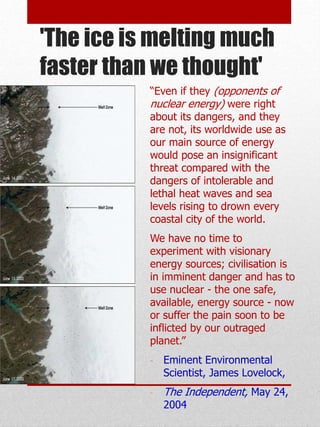
'The ice is melting much
faster than we thought'
“Even if they (opponents of
nuclear energy) were right
about its dangers, and they
are not, its worldwide use as
our main source of energy
would pose an insignificant
threat compared with the
dangers of intolerable and
lethal heat waves and sea
levels rising to drown every
coastal city of the world.
We have no time to
experiment with visionary
energy sources; civilisation is
in imminent danger and has to
use nuclear - the one safe,
available, energy source - now
or suffer the pain soon to be
inflicted by our outraged
planet.”
- Eminent Environmental
Scientist, James Lovelock,
- The Independent, May 24,
2004
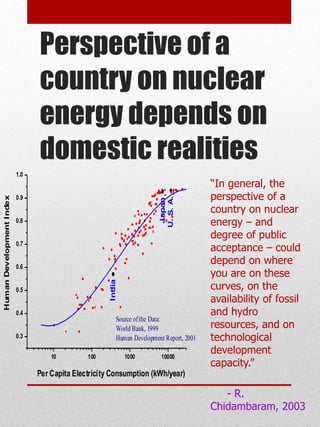
Perspective of a
country on nuclear
energy depends on
domestic realities
10 100 1000 10000
0.3
0.4
0.5
0.6
0.7
0.8
0.9
1.0
India
Japan
U.S.A.
HumanDevelopmentIndex
Per Capita Electricity Consumption (kWh/year)
Source ofthe Data:
World Bank, 1999
Human Development Report, 2001
“In general, the
perspective of a
country on nuclear
energy – and
degree of public
acceptance – could
depend on where
you are on these
curves, on the
availability of fossil
and hydro
resources, and on
technological
development
capacity.”
- R.
Chidambaram, 2003
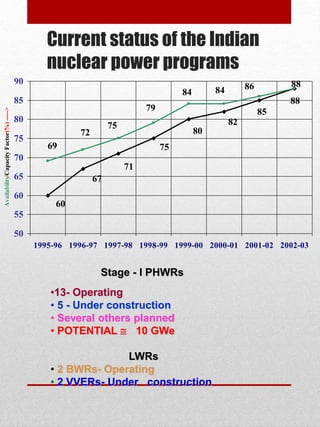
Current status of the Indian
nuclear power programs
85
82
80
75
71
67
60
88
868484
79
75
69
72
88
50
55
60
65
70
75
80
85
90
1995-96 1996-97 1997-98 1998-99 1999-00 2000-01 2001-02 2002-03
Availability/CapacityFactor(%)----->
Stage - I PHWRs
•13- Operating
• 5 - Under construction
• Several others planned
• POTENTIAL  10 GWe
LWRs
• 2 BWRs- Operating
• 2 VVERs- Under construction
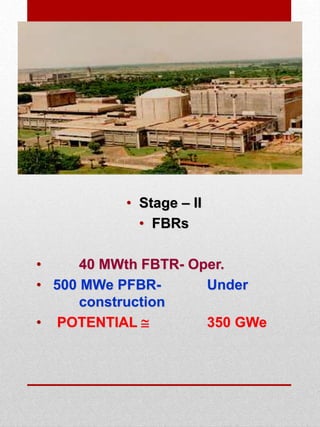
• Stage – II
• FBRs
• 40 MWth FBTR- Oper.
• 500 MWe PFBR- Under
construction
• POTENTIAL  350 GWe
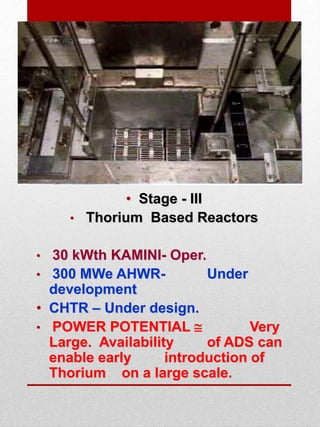
• Stage - III
• Thorium Based Reactors
• 30 kWth KAMINI- Oper.
• 300 MWe AHWR- Under
development
• CHTR – Under design.
• POWER POTENTIAL  Very
Large. Availability of ADS can
enable early introduction of
Thorium on a large scale.
Nuclear Plant
Future
• The countries of the world are each
planning their own course of nuclear plant
development or decline
• Nuclear power is competitive with natural
gas
• It is non-polluting
• It does not contribute to global warming
• Obtaining the fuel only takes 5% of the
energy output
• Plant licenses have been extended from 20
years to an additional 20 years
Nuclear Plant
Future
• Newer designs are being sought to make
them more economical and safer
• Preapproval of a few designs will hasten
development
• Disposal of high level radioactive waste
still being studied, but scientists believe
deep burial would work
• Because they are have large electrical
output, their cost at $2 billion is hard to
obtain and guarantee with banks
• Replacing plants may be cheaper using
the same sites and containment vessels
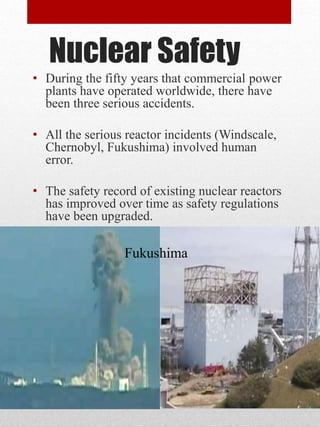
Nuclear Safety
• During the fifty years that commercial power
plants have operated worldwide, there have
been three serious accidents.
• All the serious reactor incidents (Windscale,
Chernobyl, Fukushima) involved human
error.
• The safety record of existing nuclear reactors
has improved over time as safety regulations
have been upgraded.
Fukushima
Fukushima:
Consequences

Nuclear power

  • 1.
    Nuclear Power A Presentation ByMohd Faiz Kali Charan Nigam Institute of Technology Banda UP
  • 2.
    What is nuclear power? •Power plants use heat to produce electricity. Nuclear energy produces electricity from heat through a process called fission. Nuclear power plants use the heat produced by fission of certain atoms.
  • 3.
    Nuclear Fusion and Fission •Nuclear Fusion • Small nuclei into large • Immense temperature and pressure • Core of stars • Nuclear Fission • Large nuclei into small • Critical mass to sustain • Two isotopes we use Iron is the “dead end” of both fusion and fission – it is the lowest energy nucleus and cannot be split or fused. 235 U 239 Pu
  • 4.
    Nuclear Fission • Nuclearfission is the process of splitting a nucleus into two nuclei with smaller masses. • Fission means “to divide” • Remember that fission has 2 s’s, therefore it splits into TWO parts. • Only large nuclei with atomic numbers above 90 can undergo fission. • Products of fission reaction usually include two or three individual neutrons, the total mass of the product is somewhat less than the mass of Uranium-235.
  • 5.
    Chain Reaction • Achain reaction is an ongoing series of fission reactions. Billions of reactions occur each second in a chain reaction. • On earth, nuclear fission reactions take place in nuclear reactors, which use controlled chain reactions to generate electricity
  • 6.
    Chain Reaction cont. •Uncontrolled chain reactions take place during the explosion of an atomic bomb. photo taken at ground level of Nagasaki bombing.
  • 7.
    Fission Products The productsof nuclear fission reactions are radioactive, but the energy released from these reactions is less harmful to the environment than the use of fossil fuels. The products are intensely radioactive and must be treated and/or stored
  • 8.
    Nuclear Energy • Electricitywas generated for the first time by a nuclear reactor on December 20, 1951, at the EBR-I experimental station near Arco, Idaho, which initially produced about 100 kW (the Arco Reactor was also the first to experience partial meltdown, in 1955).
  • 9.
  • 10.
    The Role ofNuclear Energy in India Power Generation in India Nuclear 2% Hydro 25% Renewable 3% Coal 70% Approximately : 1,20,000 MW
  • 11.
    How a Nuclear Reactorworks • 235U fissions by absorbing a neutron and producing 2 to 3 neutrons, which initiate on average one more fission to make a controlled chain reaction • Normal water is used as a moderator to slow the neutrons since slow neutrons take longer to pass by a U nucleus and have more time to be absorbed • The protons in the hydrogen in the water have the same mass as the neutron and stop them by a billiard ball effect • The extra neutrons are taken up by protons to form deuterons • 235U is enriched from its 0.7% in nature to about 3% to produce the reaction, and is contained in rods in the water • Boron control rods are inserted to absorb neutrons when it is time to shut down the reactor • The hot water is boiled or sent through a heat exchanger to produce steam. The steam then powers turbines.
  • 12.
    Working of reactor Requirementof natural uranium for a 1000 MWe Nuclear Power Plant: ~ 160 t /Year. Requirement of coal for a 1000 MWe Coal fired plant ~ 2.6 million t / Year (i.e. 5 trains of 1400 t /Day)
  • 13.
    Energy scenario in India •At the present growth rate, Indian economy will double every eight years • Growing population • Reaching well above per capita world average consumption • Nuclear energy is to meet 25% to 50% of the total energy requirement • Nuclear capacity will reach 20 Gwe and more by 2020 • 200 Gwe and above generation capacity is targeted by the middle of the century
  • 14.
    • Known reservesof uranium are found in relatively stable industrialised countries (Australia 23%), Kazakhstan (15%), Russia (10%), Canada (8%), South Africa (8%) the USA (6%). Uranium: A Sustainable Energy Source?
  • 15.
    Nuclear Power Economics • Nuclearpower plants are very expensive to build relative to all other forms of electricity production, with a Front-loaded cost structure (high initial investment then relatively low running cost) • A recent MIT report argues that: • ‘‘The track record for the construction costs of nuclear plants completed in the USA during the 1980s and early 1990s was poor. Actual costs were far higher than had been projected . . . The first few US plants will be a critical test for all parties involved’’.
  • 16.
    “There is no poweras costly as no-power” – Homi Bhabha 10 100 1000 10000 30 40 50 60 70 80 Japan U.S.A. India (1951-60) India (1961 -70) India (1980-85) India (1997) Source of the Data: World Bank, 1999 LifeExpectancyatBirth(years) Electricity Consumption per Capita (kWh/year)
  • 17.
    'The ice ismelting much faster than we thought' “Even if they (opponents of nuclear energy) were right about its dangers, and they are not, its worldwide use as our main source of energy would pose an insignificant threat compared with the dangers of intolerable and lethal heat waves and sea levels rising to drown every coastal city of the world. We have no time to experiment with visionary energy sources; civilisation is in imminent danger and has to use nuclear - the one safe, available, energy source - now or suffer the pain soon to be inflicted by our outraged planet.” - Eminent Environmental Scientist, James Lovelock, - The Independent, May 24, 2004
  • 18.
    Perspective of a countryon nuclear energy depends on domestic realities 10 100 1000 10000 0.3 0.4 0.5 0.6 0.7 0.8 0.9 1.0 India Japan U.S.A. HumanDevelopmentIndex Per Capita Electricity Consumption (kWh/year) Source ofthe Data: World Bank, 1999 Human Development Report, 2001 “In general, the perspective of a country on nuclear energy – and degree of public acceptance – could depend on where you are on these curves, on the availability of fossil and hydro resources, and on technological development capacity.” - R. Chidambaram, 2003
  • 19.
    Current status ofthe Indian nuclear power programs 85 82 80 75 71 67 60 88 868484 79 75 69 72 88 50 55 60 65 70 75 80 85 90 1995-96 1996-97 1997-98 1998-99 1999-00 2000-01 2001-02 2002-03 Availability/CapacityFactor(%)-----> Stage - I PHWRs •13- Operating • 5 - Under construction • Several others planned • POTENTIAL  10 GWe LWRs • 2 BWRs- Operating • 2 VVERs- Under construction
  • 20.
    • Stage –II • FBRs • 40 MWth FBTR- Oper. • 500 MWe PFBR- Under construction • POTENTIAL  350 GWe
  • 21.
    • Stage -III • Thorium Based Reactors • 30 kWth KAMINI- Oper. • 300 MWe AHWR- Under development • CHTR – Under design. • POWER POTENTIAL  Very Large. Availability of ADS can enable early introduction of Thorium on a large scale.
  • 22.
    Nuclear Plant Future • Thecountries of the world are each planning their own course of nuclear plant development or decline • Nuclear power is competitive with natural gas • It is non-polluting • It does not contribute to global warming • Obtaining the fuel only takes 5% of the energy output • Plant licenses have been extended from 20 years to an additional 20 years
  • 23.
    Nuclear Plant Future • Newerdesigns are being sought to make them more economical and safer • Preapproval of a few designs will hasten development • Disposal of high level radioactive waste still being studied, but scientists believe deep burial would work • Because they are have large electrical output, their cost at $2 billion is hard to obtain and guarantee with banks • Replacing plants may be cheaper using the same sites and containment vessels
  • 24.
    Nuclear Safety • Duringthe fifty years that commercial power plants have operated worldwide, there have been three serious accidents. • All the serious reactor incidents (Windscale, Chernobyl, Fukushima) involved human error. • The safety record of existing nuclear reactors has improved over time as safety regulations have been upgraded. Fukushima
  • 25.