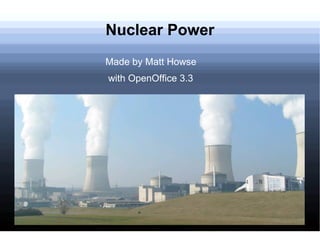
Nuclear Power Made by Matt Howse with OpenOffice 3.3
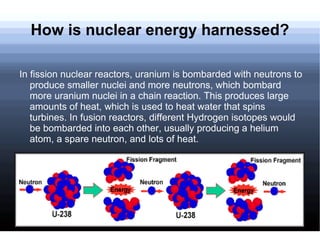
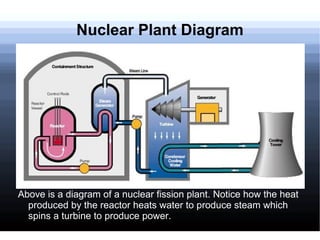
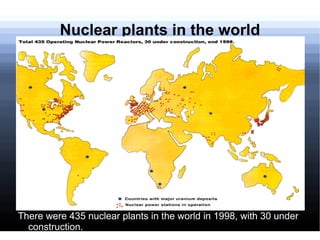
What is Nuclear Power? Nuclear Power is electricity that is made by harnessing the internal power of some types of atoms. There are two types of nuclear power-producing methods. Nuclear fission, which involves splitting the nucleus of a large atom, and nuclear fusion, which is about fusing two small nuclei together and is only in experimental stages. Nuclear fission reactors involving Uranium-235 are very common throughout the world.
Uses in the past Nuclear energy has been harnessed before in both devastating and enlightening ways. Nuclear bombs, sometimes called “nukes”, are extremely dangerous due to the following: Explosion of a nuclear warhead produces a very large and hot blast.
Radiation, or “nuclear fallout”, can cause DNA mutations and death.
The first successful chain reaction was achieved in a graphite-uranium reactor in a squash court under the west stands of the athletic at the University of Chicago. It was rebuilt in 1943 at a site southwest of Chicago then was decommissioned in 1954. This was the first use of nuclear energy to generate power. In 1956, the first major nuclear power plant was opened in England.
Future uses In the future, it is likely that fusion reactors will be common while fission reactors won't. Fission reactors are much more dangerous than fusion reactors, and they require slightly more complex processes to produce the fuel. Fusion fuel is found rather abundantly in water, while fission fuel is a rare isotope of Uranium that's produced by reactions of other radioactive elements. Our world may be powered by fusion reactors on earth, and solar power made by the sun's fusion reactions.
Advantages Nuclear reactions produce lots of energy-One pound of Uranium has the heat power content of 2,300,000 pounds of coal.
Nuclear plants can be dual purpose-It is possible to desalinate water by the reaction process.
Little or no air pollution.
One plant can generate power for a huge amount of people.
The Earth has limited amounts of coal, oil, and other fossil fuels. Nuclear energy could still produce electricity after fossil fuels become scarce.

Nuclear energy

  • 1.
    Nuclear Power Madeby Matt Howse with OpenOffice 3.3
  • 2.
    What is NuclearPower? Nuclear Power is electricity that is made by harnessing the internal power of some types of atoms. There are two types of nuclear power-producing methods. Nuclear fission, which involves splitting the nucleus of a large atom, and nuclear fusion, which is about fusing two small nuclei together and is only in experimental stages. Nuclear fission reactors involving Uranium-235 are very common throughout the world.
  • 3.
    Uses in thepast Nuclear energy has been harnessed before in both devastating and enlightening ways. Nuclear bombs, sometimes called “nukes”, are extremely dangerous due to the following: Explosion of a nuclear warhead produces a very large and hot blast.
  • 4.
    Radiation, or “nuclearfallout”, can cause DNA mutations and death.
  • 5.
    The first successfulchain reaction was achieved in a graphite-uranium reactor in a squash court under the west stands of the athletic at the University of Chicago. It was rebuilt in 1943 at a site southwest of Chicago then was decommissioned in 1954. This was the first use of nuclear energy to generate power. In 1956, the first major nuclear power plant was opened in England.
  • 6.
    Future uses Inthe future, it is likely that fusion reactors will be common while fission reactors won't. Fission reactors are much more dangerous than fusion reactors, and they require slightly more complex processes to produce the fuel. Fusion fuel is found rather abundantly in water, while fission fuel is a rare isotope of Uranium that's produced by reactions of other radioactive elements. Our world may be powered by fusion reactors on earth, and solar power made by the sun's fusion reactions.
  • 7.
    Advantages Nuclear reactionsproduce lots of energy-One pound of Uranium has the heat power content of 2,300,000 pounds of coal.
  • 8.
    Nuclear plants canbe dual purpose-It is possible to desalinate water by the reaction process.
  • 9.
    Little or noair pollution.
  • 10.
    One plant cangenerate power for a huge amount of people.
  • 11.
    The Earth haslimited amounts of coal, oil, and other fossil fuels. Nuclear energy could still produce electricity after fossil fuels become scarce.