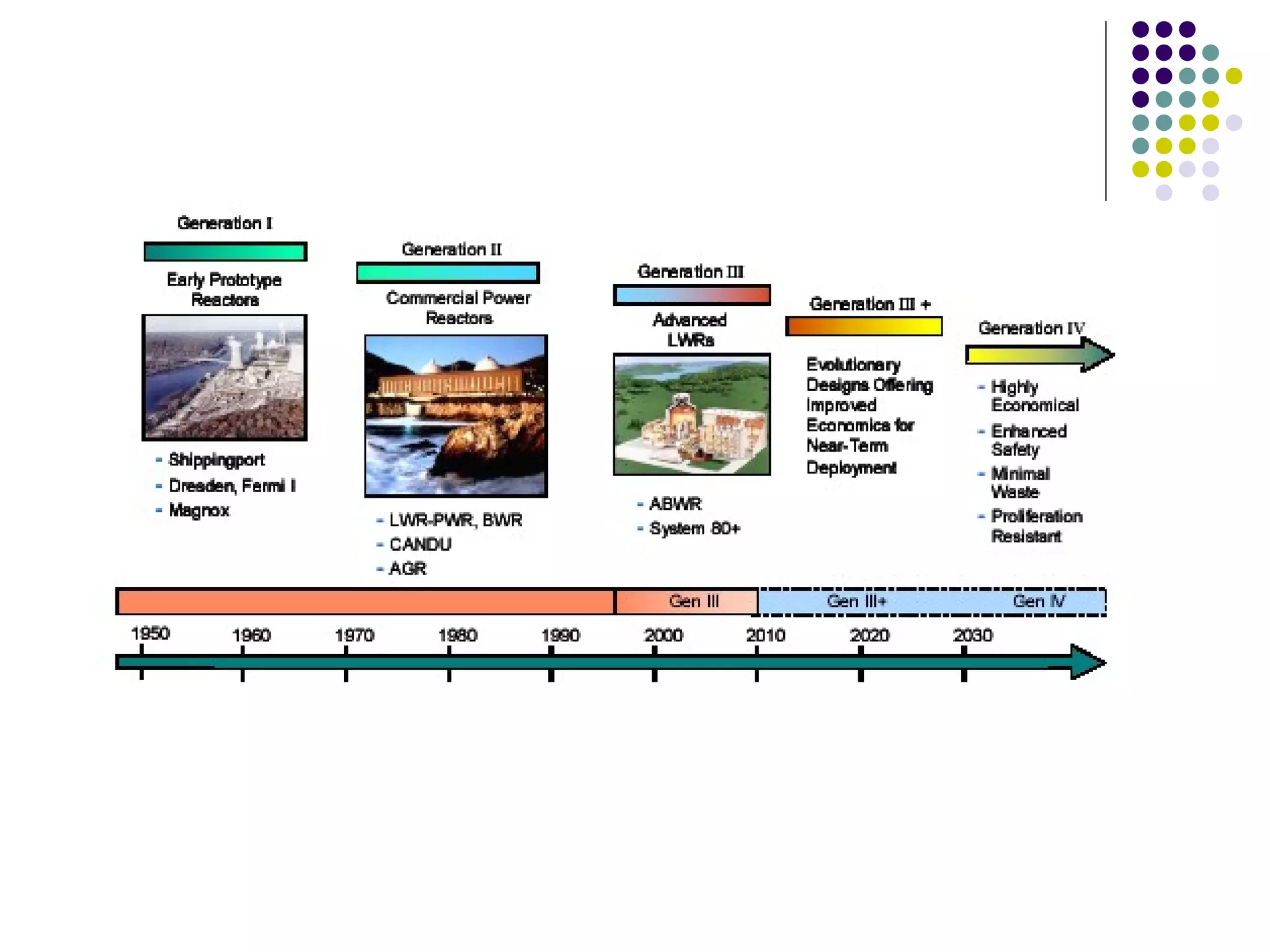
Nuclear Power
Vishal Shukla

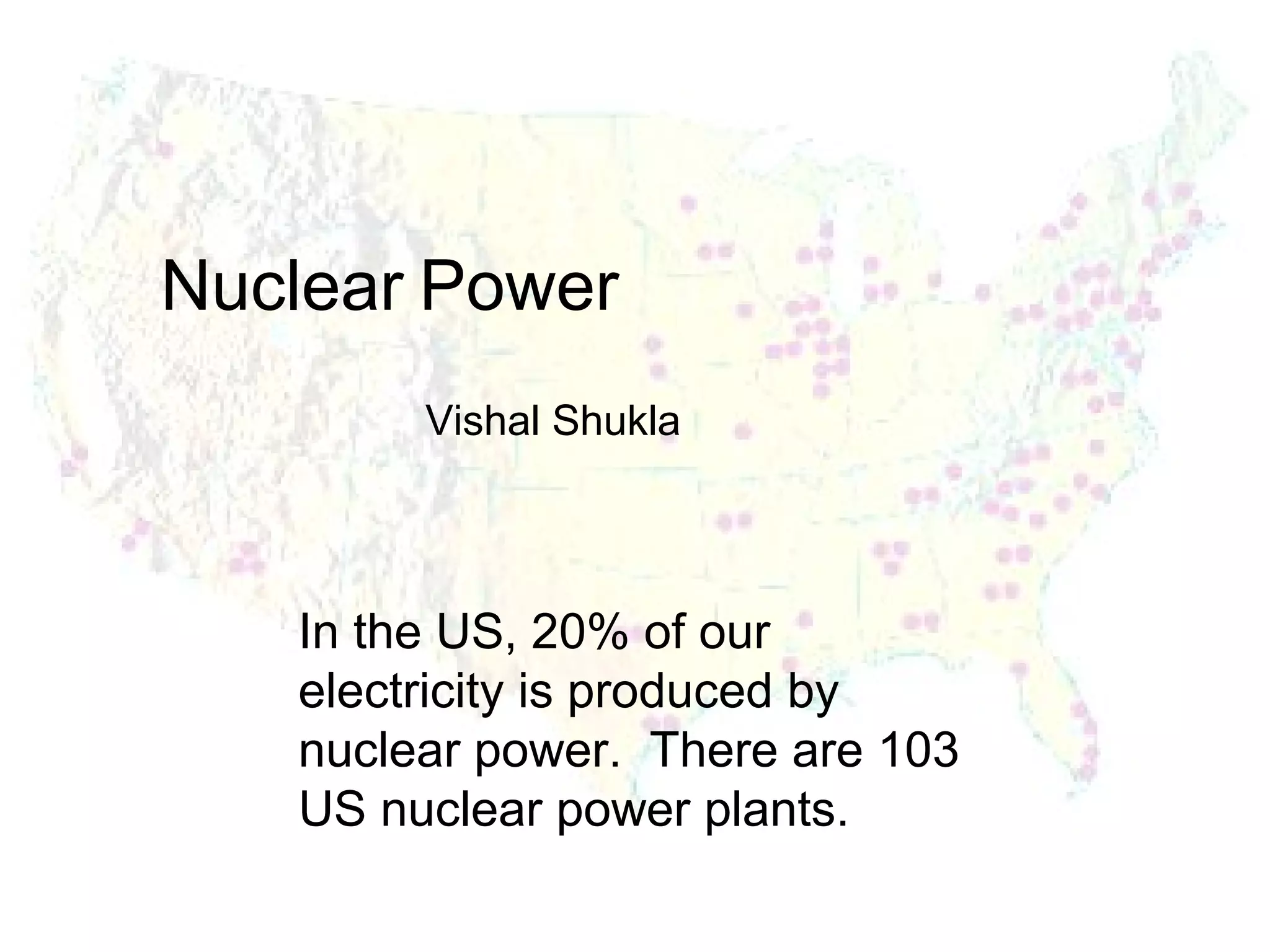
In the US, 20% of our
electricity is produced by
nuclear power. There are 103
US nuclear power plants.
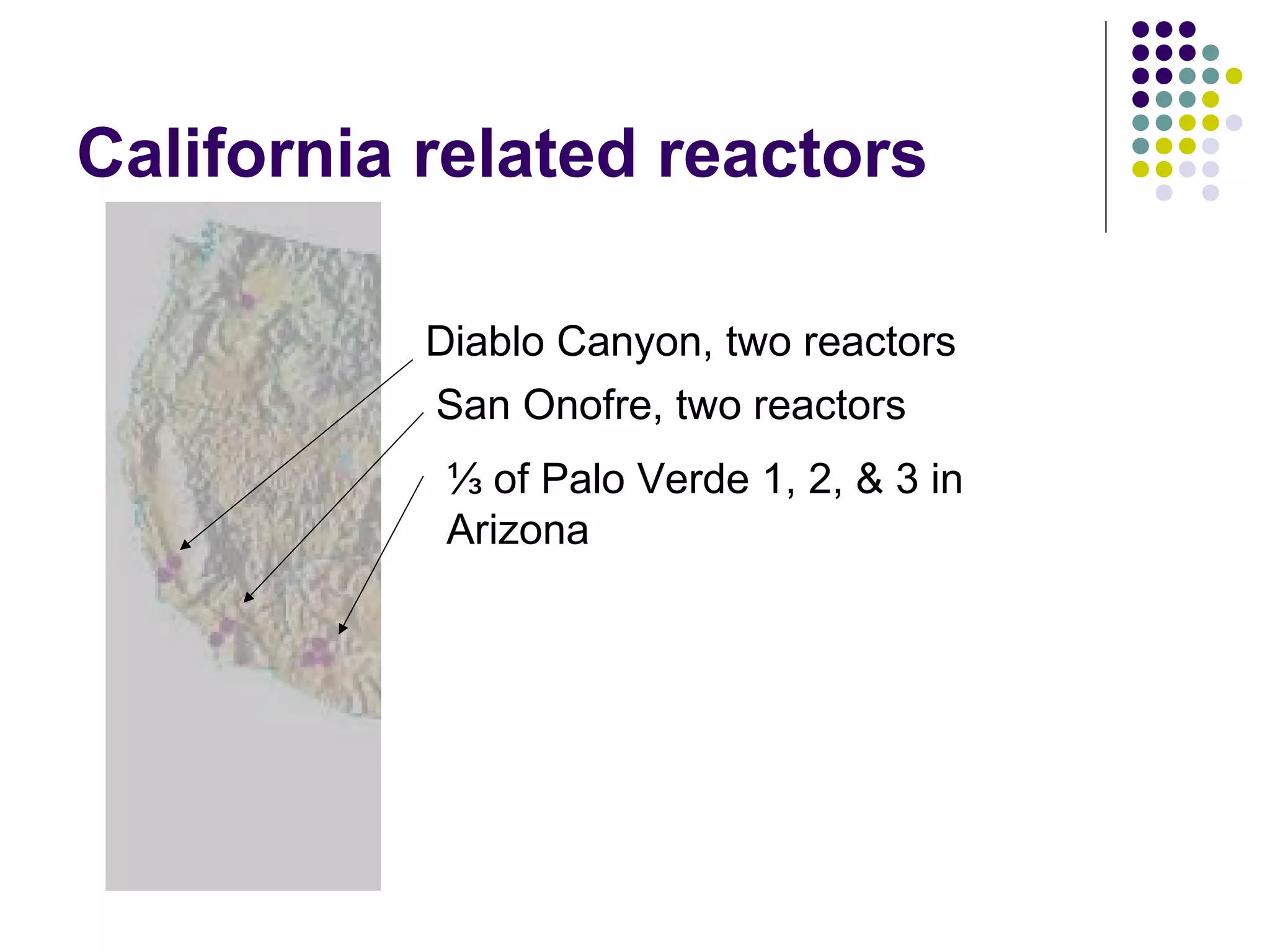
California related reactors
Diablo Canyon, two reactors
San Onofre, two reactors
⅓ of Palo Verde 1, 2, & 3 in
Arizona
California Nuclear energy








Each of the five reactors produces about 1,100
million watts (megawatts) of electricity
This is enough to power one million homes per
reactor
Each reactor’s production is equivalent to 15 million
barrels of oil or 3.5 million tons of coal a year.
The total 5,500 reactor produced megawatts is out
of a peak state electrical power of 30,000 – 40,000
megawatts.
Worldwide Nuclear Power
Reactors
 There

are 440 nuclear power reactors in 31
countries.
 30 more are under construction.
 They account for 16% of the world’s
electricity.
 They produce a total of 351 gigawatts (billion
watts) of electricity.
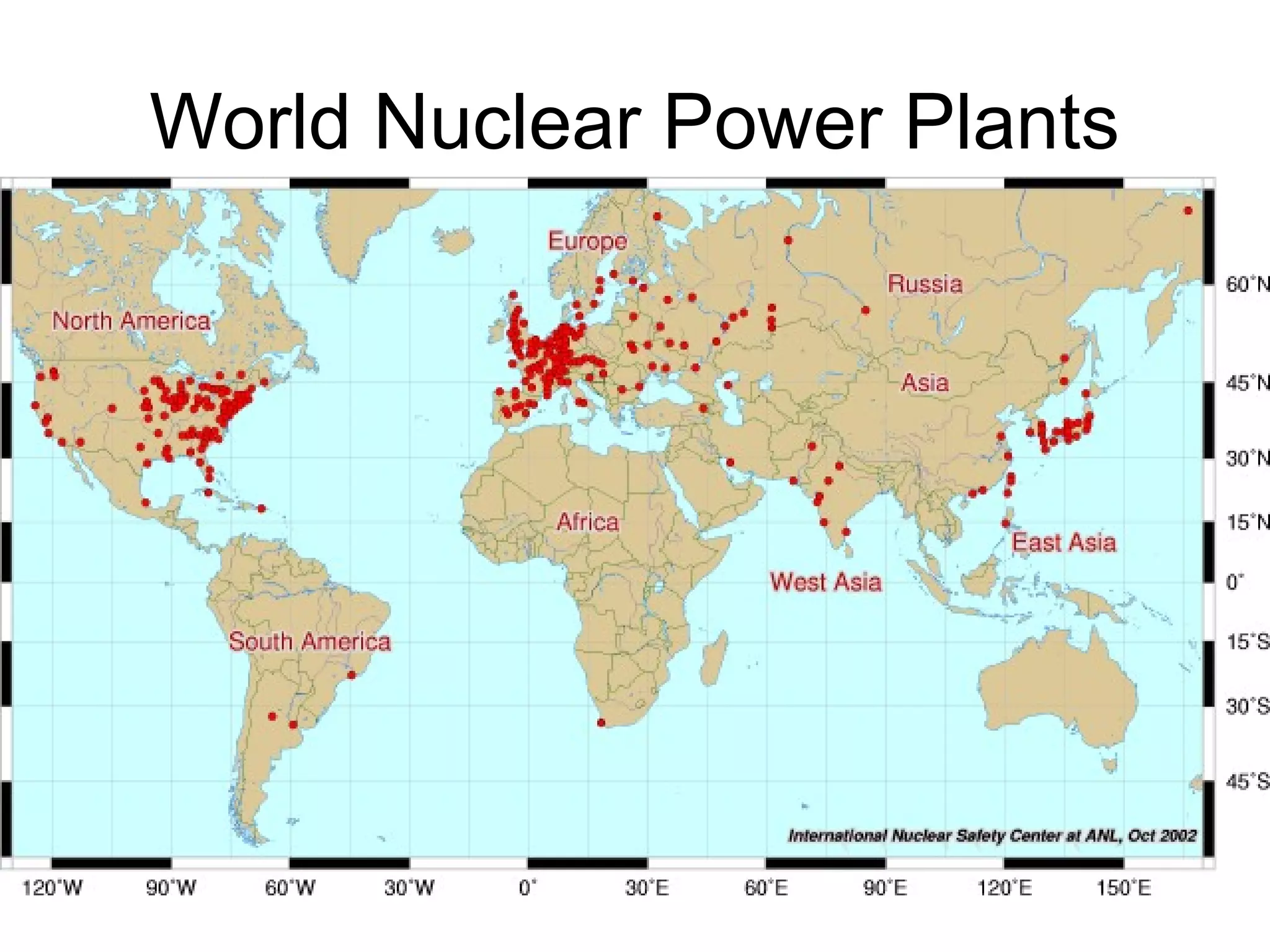
World Nuclear Power Plants
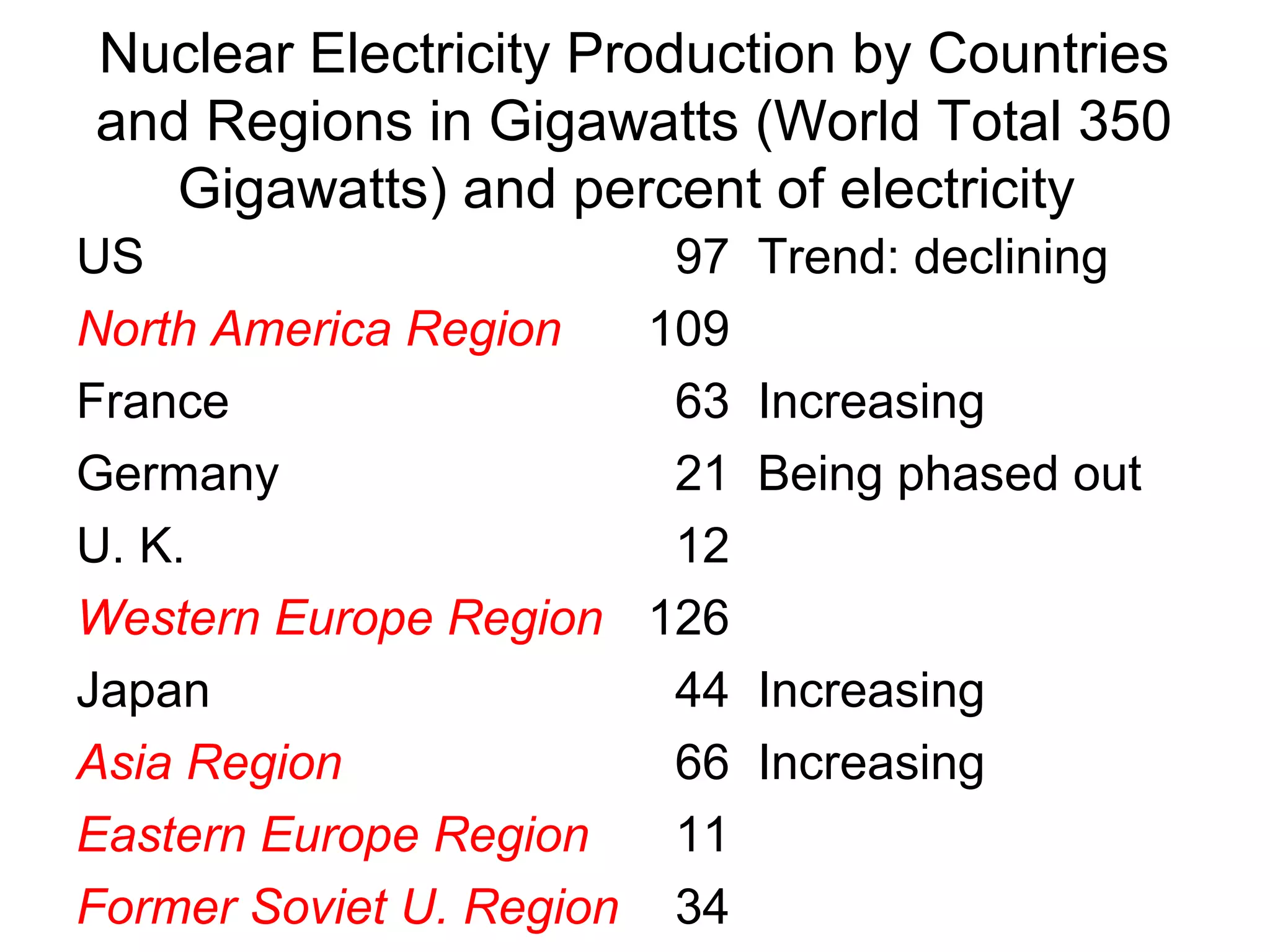
Nuclear Electricity Production by Countries
and Regions in Gigawatts (World Total 350
Gigawatts) and percent of electricity
US
97 Trend: declining
North America Region
109
France
63 Increasing
Germany
21 Being phased out
U. K.
12
Western Europe Region 126
Japan
44 Increasing
Asia Region
66 Increasing
Eastern Europe Region
11
Former Soviet U. Region 34
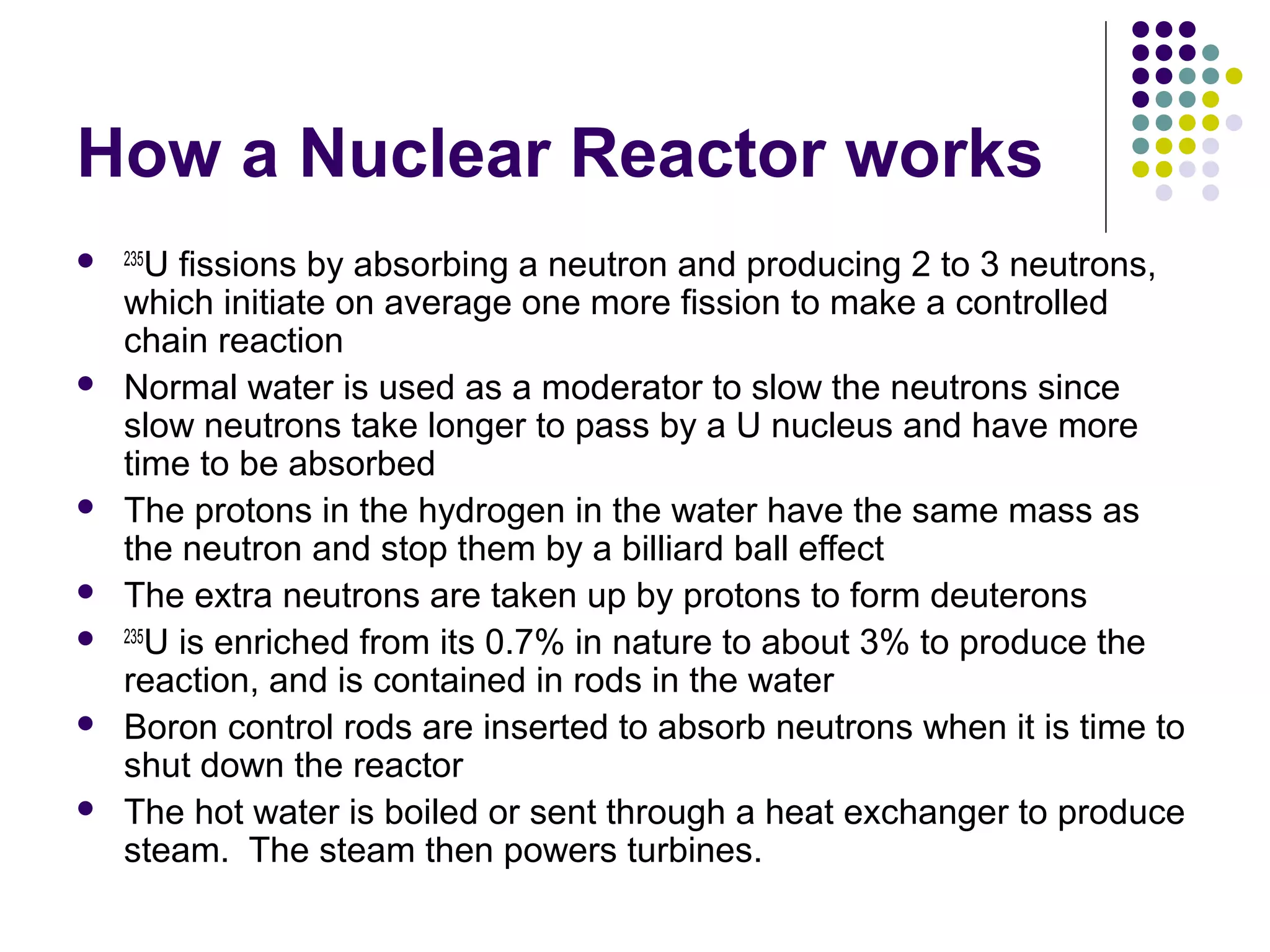
How a Nuclear Reactor works
 235U









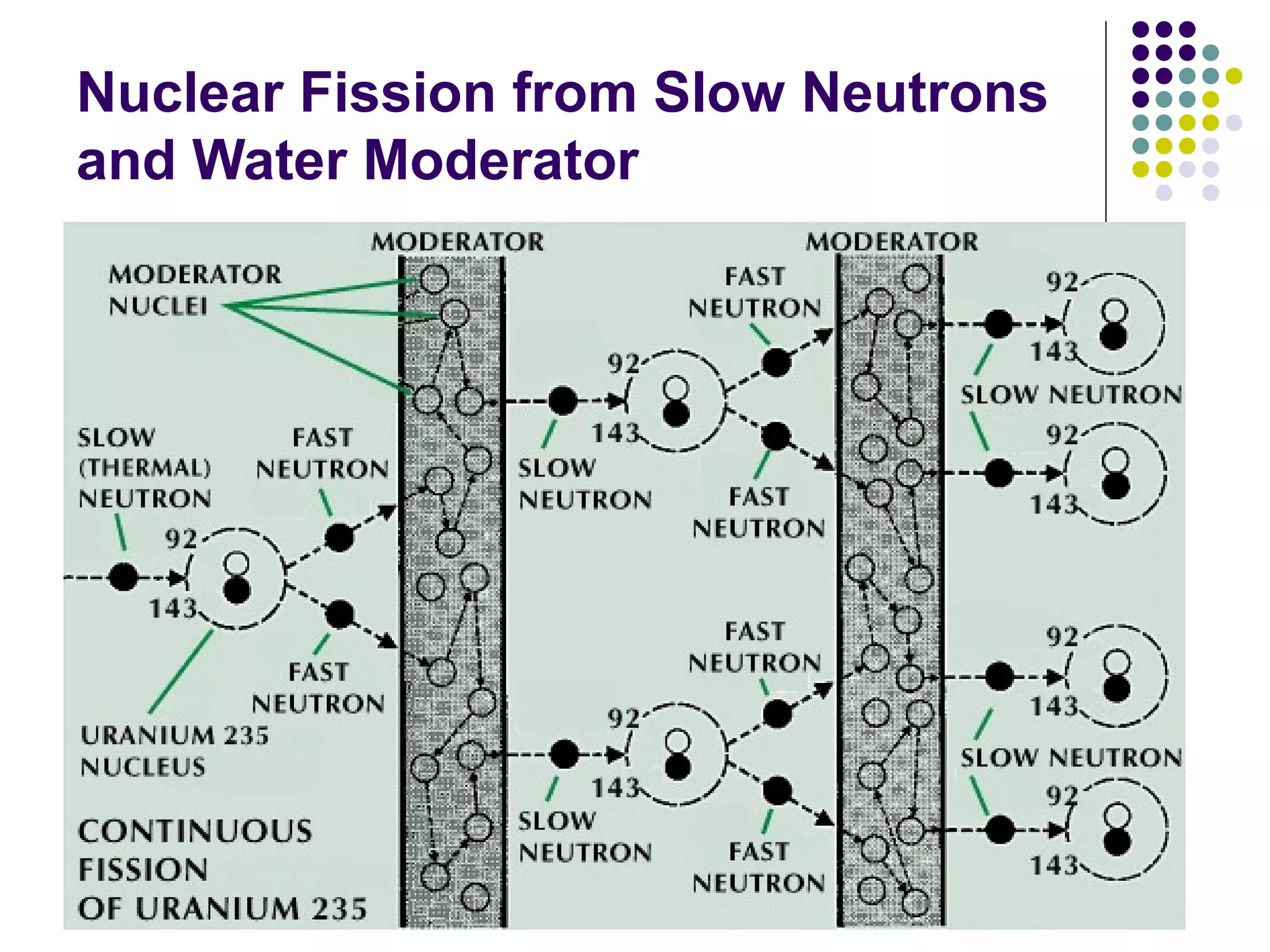
fissions by absorbing a neutron and producing 2 to 3 neutrons,
which initiate on average one more fission to make a controlled
chain reaction
Normal water is used as a moderator to slow the neutrons since
slow neutrons take longer to pass by a U nucleus and have more
time to be absorbed
The protons in the hydrogen in the water have the same mass as
the neutron and stop them by a billiard ball effect
The extra neutrons are taken up by protons to form deuterons
235
U is enriched from its 0.7% in nature to about 3% to produce the
reaction, and is contained in rods in the water
Boron control rods are inserted to absorb neutrons when it is time to
shut down the reactor
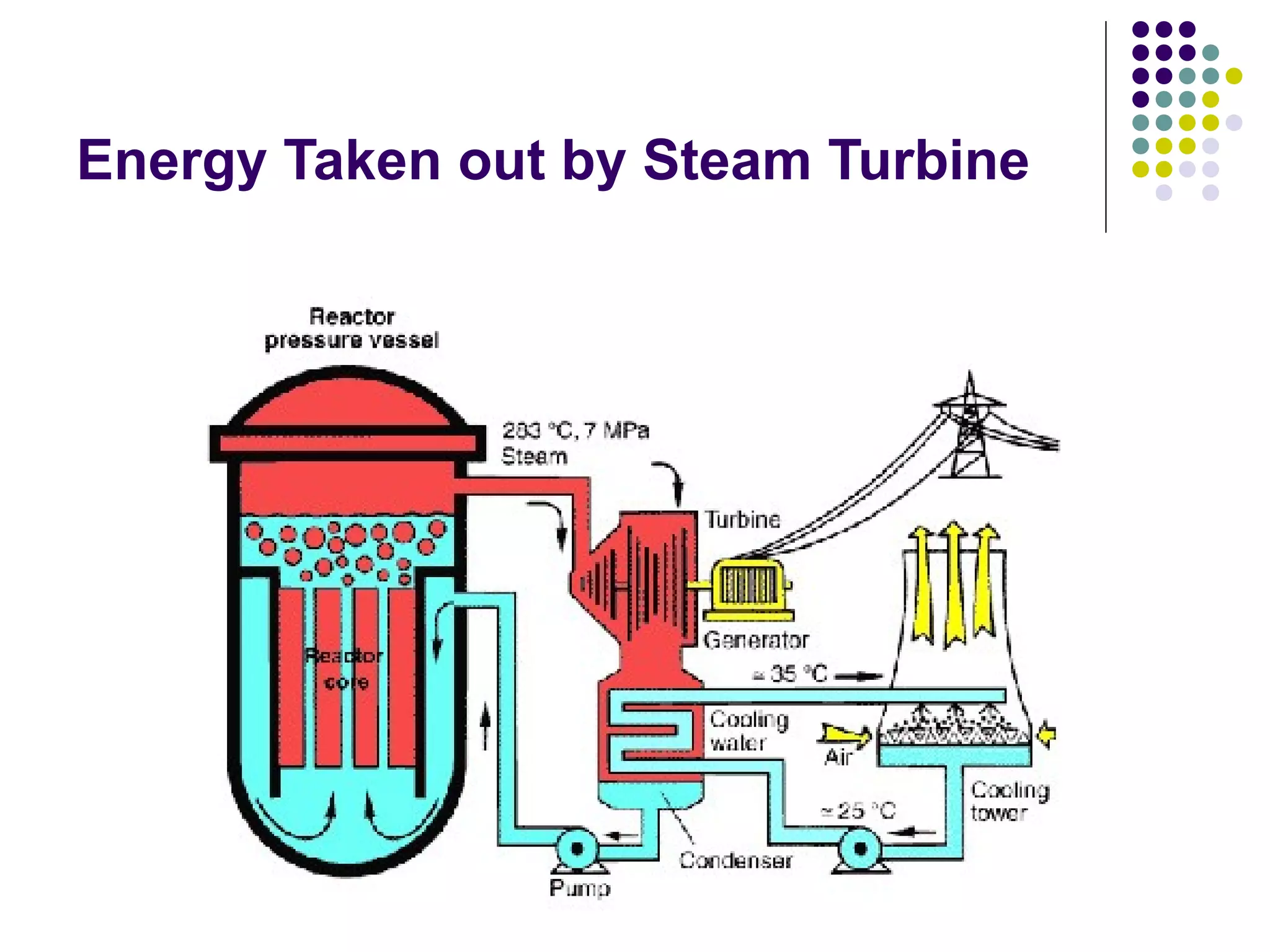
The hot water is boiled or sent through a heat exchanger to produce
steam. The steam then powers turbines.
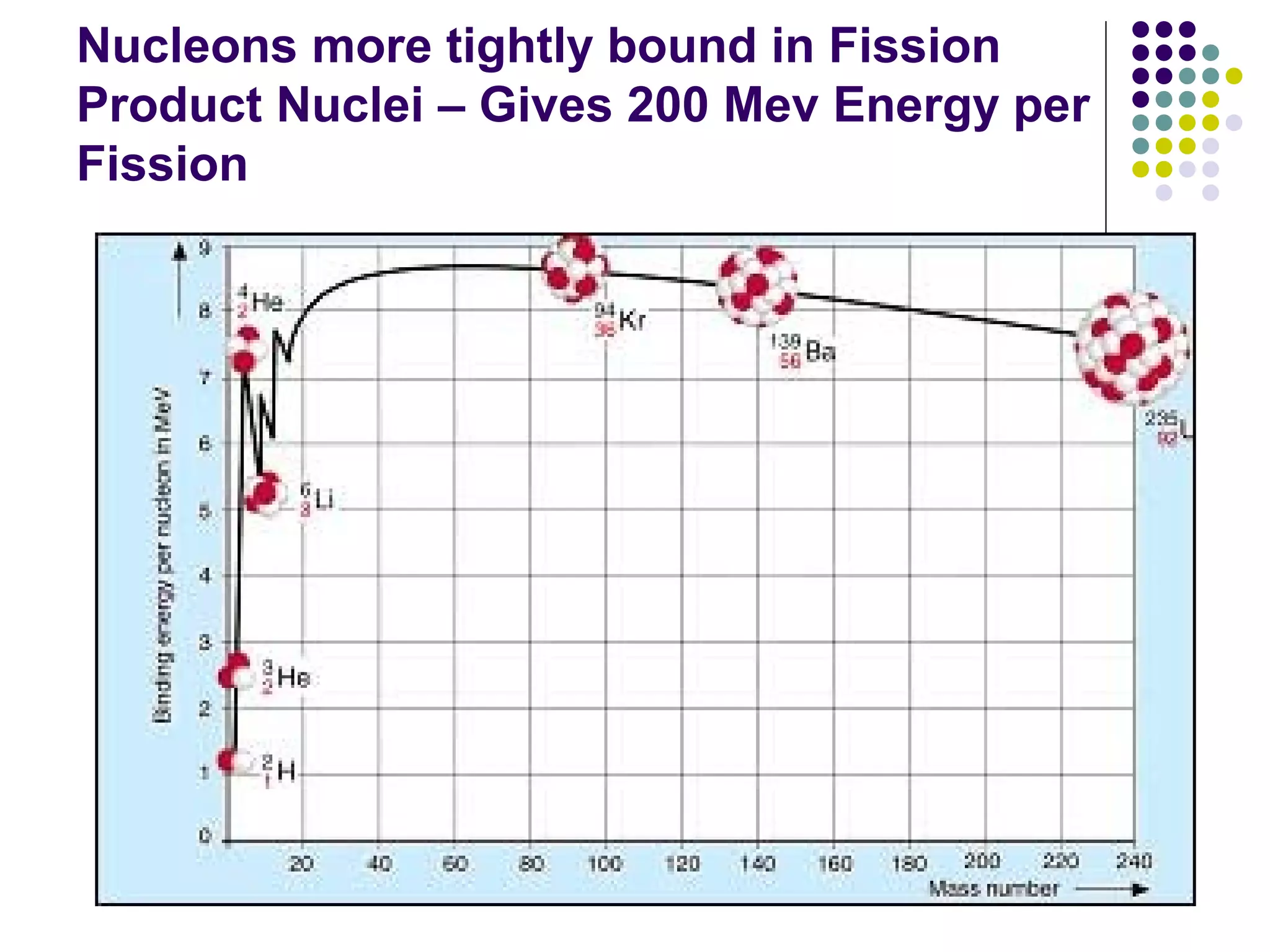
Nucleons more tightly bound in Fission
Product Nuclei – Gives 200 Mev Energy per
Fission
Nuclear Fission from Slow Neutrons
and Water Moderator
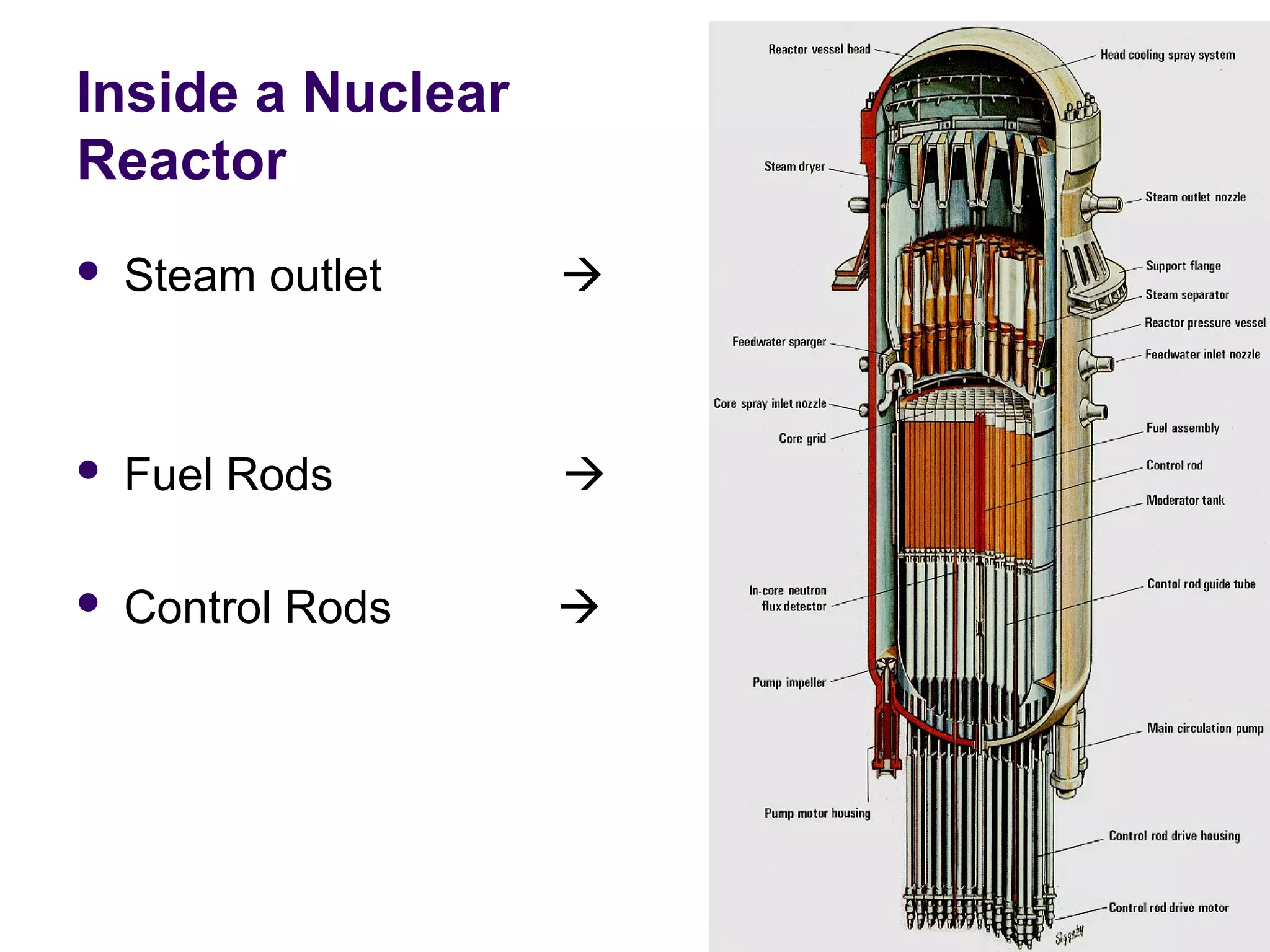
Inside a Nuclear
Reactor


Steam outlet





Fuel Rods





Control Rods


Energy Taken out by Steam Turbine
Production of Plutonium (Pu) in
Nuclear Reactors
 239Pu








is produced in nuclear reactors by the
absorption of a neutron on 238U, followed by two beta
decays
239
Pu also fissions by absorbing a thermal neutron,
and on average produces 1/3 of the energy in a fuel
cycle.
239
Pu is relatively stable, with a half life of 24
thousand years.
It is used in nuclear weapons
It can be bred for nuclear reactors
Nuclear Weapons to Reactor
Fuel
 We

are buying highly enriched uranium (20%
235
U) from the former Soviet Union’s nuclear
weapons for 20 years from 1993--2013
 Converting it to low enriched uranium (3%
235
U) for reactor fuel
 It will satisfy 9 years of US reactor fuel
demand
 It comes from 6,855 Soviet nuclear warheads
so far
Nuclear Plant Future








The countries of the world are each planning their own
course of nuclear plant development or decline
Nuclear power is competitive with natural gas
It is non-polluting
It does not contribute to global warming
Obtaining the fuel only takes 5% of the energy output
Plant licenses have been extended from 20 years to an
additional 20 years
Nuclear Plant Future









Newer designs are being sought to make them more
economical and safer
Preapproval of a few designs will hasten development
Disposal of high level radioactive waste still being
studied, but scientists believe deep burial would work
Because they are have large electrical output, their cost
at $2 billion is hard to obtain and guarantee with banks
Replacing plants may be cheaper using the same sites
and containment vessels
Nuclear Problems and Solutions


Three Mile Island 1979






50% core meltdown, stuck valve with no indicator released
water, but containment vessel held
More sensors added, better communication to experts in
Washington, don’t turn off emergency cooling
28 year US safety record since accident

Chernobyl 1986





Human stupidity turned off cooling system
Poor steam cooling reactor design allowed unstable steam
pocket to explode
Graphite caught fire
Design not used in other countries
Yucca Mountain Project: Nuclear Fuel
and High Level Waste Repository











Much more secure repository than leaving high level waste at 60 reactor
sites around the country.
On old atomic bomb testing base, inside a mountain.
The storage is above the water table.
The Yucca Mountain site would be 60% filled by present waste.
US has legal commitment to the reactor industry.
Site has been studied extensively by scientists for over 20 years.
Will store waste during its 10,000 year decay time.
Questions of how to deflect dripping water around and under the
storage vessels.
Questions of radioactive decay weakening storage containers.
A solution would be to build containers that can be opened and
reincased, or to which surrounded casings could be added.
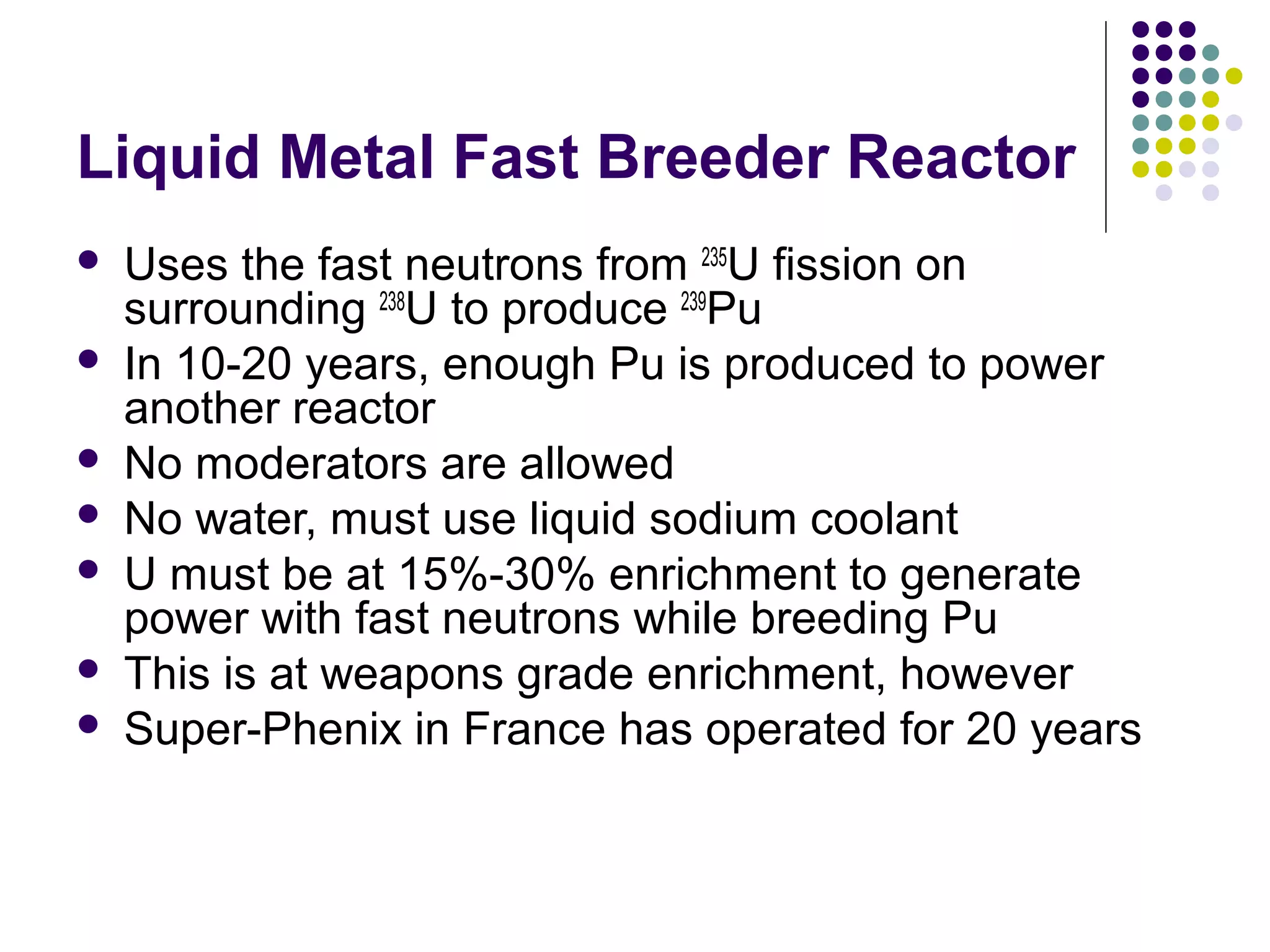
Liquid Metal Fast Breeder Reactor








Uses the fast neutrons from 235U fission on
surrounding 238U to produce 239Pu
In 10-20 years, enough Pu is produced to power
another reactor
No moderators are allowed
No water, must use liquid sodium coolant
U must be at 15%-30% enrichment to generate
power with fast neutrons while breeding Pu
This is at weapons grade enrichment, however
Super-Phenix in France has operated for 20 years
Nuclear Power Proposed
Solution?











Richard Garwin , MIT and industry propose:
If 50 years from now the world uses twice as much energy, and half
comes from nuclear power
Need 4,000 nuclear reactors, using about a million tons of Uranium a
year
With higher cost terrestrial ore, would last for 300 years
Breeder reactors creating Plutonium could extend the supply to 200,000
years
Nonpolluting, non-CO2 producing source
Need more trained nuclear engineers and sites
Study fuel reprocessing, waste disposal, and safer designs.
While nuclear reactors have to be on all day and night, and power use
is less at night, they could be used to charge up electric cars.
Until electric cars or a hydrogen generation economy, they might only
be used for the 40% of generation used at night, up from the present
20% that they generate.
Fusion Reactors
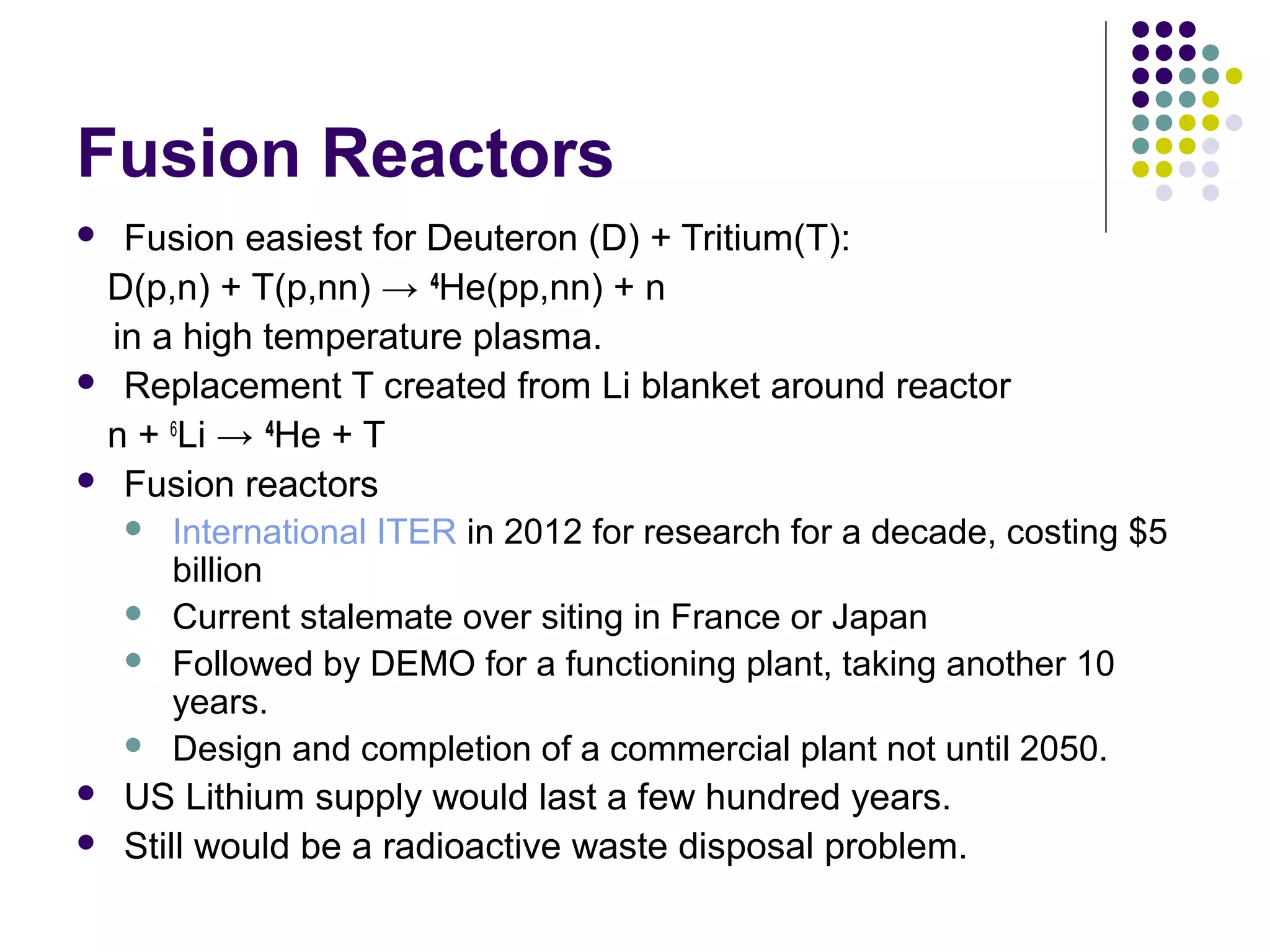
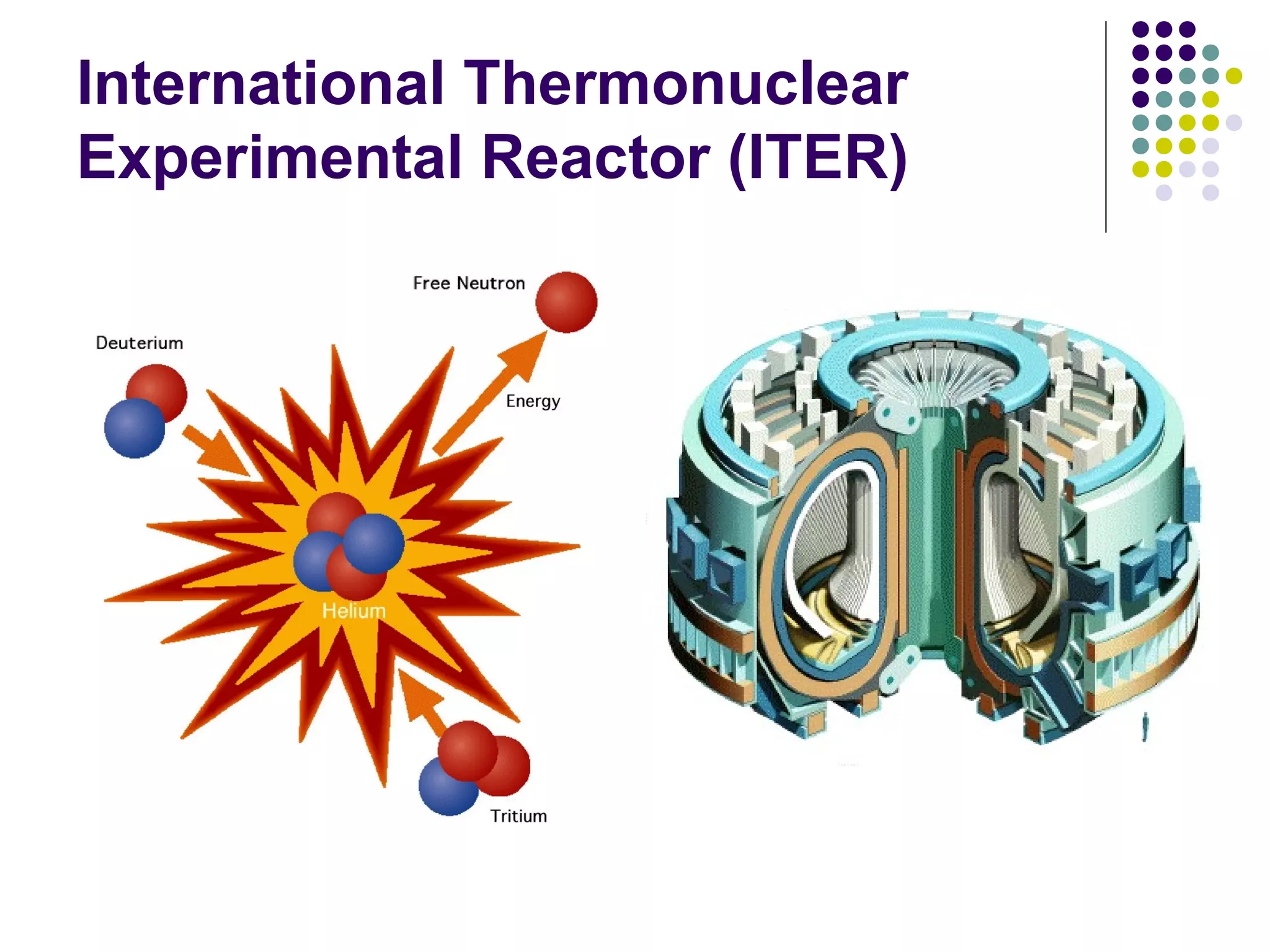
Fusion easiest for Deuteron (D) + Tritium(T):
D(p,n) + T(p,nn) → 4He(pp,nn) + n
in a high temperature plasma.
 Replacement T created from Li blanket around reactor
n + 6Li → 4He + T
 Fusion reactors
 International ITER in 2012 for research for a decade, costing $5
billion
 Current stalemate over siting in France or Japan
 Followed by DEMO for a functioning plant, taking another 10
years.
 Design and completion of a commercial plant not until 2050.
 US Lithium supply would last a few hundred years.
 Still would be a radioactive waste disposal problem.

International Thermonuclear
Experimental Reactor (ITER)

Nuclear powersem

  • 1.
    Nuclear Power Vishal Shukla Inthe US, 20% of our electricity is produced by nuclear power. There are 103 US nuclear power plants.
  • 2.
    California related reactors DiabloCanyon, two reactors San Onofre, two reactors ⅓ of Palo Verde 1, 2, & 3 in Arizona
  • 3.
    California Nuclear energy     Eachof the five reactors produces about 1,100 million watts (megawatts) of electricity This is enough to power one million homes per reactor Each reactor’s production is equivalent to 15 million barrels of oil or 3.5 million tons of coal a year. The total 5,500 reactor produced megawatts is out of a peak state electrical power of 30,000 – 40,000 megawatts.
  • 4.
    Worldwide Nuclear Power Reactors There are 440 nuclear power reactors in 31 countries.  30 more are under construction.  They account for 16% of the world’s electricity.  They produce a total of 351 gigawatts (billion watts) of electricity.
  • 5.
  • 6.
    Nuclear Electricity Productionby Countries and Regions in Gigawatts (World Total 350 Gigawatts) and percent of electricity US 97 Trend: declining North America Region 109 France 63 Increasing Germany 21 Being phased out U. K. 12 Western Europe Region 126 Japan 44 Increasing Asia Region 66 Increasing Eastern Europe Region 11 Former Soviet U. Region 34
  • 7.
    How a NuclearReactor works  235U       fissions by absorbing a neutron and producing 2 to 3 neutrons, which initiate on average one more fission to make a controlled chain reaction Normal water is used as a moderator to slow the neutrons since slow neutrons take longer to pass by a U nucleus and have more time to be absorbed The protons in the hydrogen in the water have the same mass as the neutron and stop them by a billiard ball effect The extra neutrons are taken up by protons to form deuterons 235 U is enriched from its 0.7% in nature to about 3% to produce the reaction, and is contained in rods in the water Boron control rods are inserted to absorb neutrons when it is time to shut down the reactor The hot water is boiled or sent through a heat exchanger to produce steam. The steam then powers turbines.
  • 8.
    Nucleons more tightlybound in Fission Product Nuclei – Gives 200 Mev Energy per Fission
  • 9.
    Nuclear Fission fromSlow Neutrons and Water Moderator
  • 10.
    Inside a Nuclear Reactor  Steamoutlet   Fuel Rods   Control Rods 
  • 11.
    Energy Taken outby Steam Turbine
  • 12.
    Production of Plutonium(Pu) in Nuclear Reactors  239Pu     is produced in nuclear reactors by the absorption of a neutron on 238U, followed by two beta decays 239 Pu also fissions by absorbing a thermal neutron, and on average produces 1/3 of the energy in a fuel cycle. 239 Pu is relatively stable, with a half life of 24 thousand years. It is used in nuclear weapons It can be bred for nuclear reactors
  • 13.
    Nuclear Weapons toReactor Fuel  We are buying highly enriched uranium (20% 235 U) from the former Soviet Union’s nuclear weapons for 20 years from 1993--2013  Converting it to low enriched uranium (3% 235 U) for reactor fuel  It will satisfy 9 years of US reactor fuel demand  It comes from 6,855 Soviet nuclear warheads so far
  • 14.
    Nuclear Plant Future       Thecountries of the world are each planning their own course of nuclear plant development or decline Nuclear power is competitive with natural gas It is non-polluting It does not contribute to global warming Obtaining the fuel only takes 5% of the energy output Plant licenses have been extended from 20 years to an additional 20 years
  • 15.
    Nuclear Plant Future      Newerdesigns are being sought to make them more economical and safer Preapproval of a few designs will hasten development Disposal of high level radioactive waste still being studied, but scientists believe deep burial would work Because they are have large electrical output, their cost at $2 billion is hard to obtain and guarantee with banks Replacing plants may be cheaper using the same sites and containment vessels
  • 16.
    Nuclear Problems andSolutions  Three Mile Island 1979     50% core meltdown, stuck valve with no indicator released water, but containment vessel held More sensors added, better communication to experts in Washington, don’t turn off emergency cooling 28 year US safety record since accident Chernobyl 1986     Human stupidity turned off cooling system Poor steam cooling reactor design allowed unstable steam pocket to explode Graphite caught fire Design not used in other countries
  • 17.
    Yucca Mountain Project:Nuclear Fuel and High Level Waste Repository           Much more secure repository than leaving high level waste at 60 reactor sites around the country. On old atomic bomb testing base, inside a mountain. The storage is above the water table. The Yucca Mountain site would be 60% filled by present waste. US has legal commitment to the reactor industry. Site has been studied extensively by scientists for over 20 years. Will store waste during its 10,000 year decay time. Questions of how to deflect dripping water around and under the storage vessels. Questions of radioactive decay weakening storage containers. A solution would be to build containers that can be opened and reincased, or to which surrounded casings could be added.
  • 19.
    Liquid Metal FastBreeder Reactor        Uses the fast neutrons from 235U fission on surrounding 238U to produce 239Pu In 10-20 years, enough Pu is produced to power another reactor No moderators are allowed No water, must use liquid sodium coolant U must be at 15%-30% enrichment to generate power with fast neutrons while breeding Pu This is at weapons grade enrichment, however Super-Phenix in France has operated for 20 years
  • 20.
    Nuclear Power Proposed Solution?           RichardGarwin , MIT and industry propose: If 50 years from now the world uses twice as much energy, and half comes from nuclear power Need 4,000 nuclear reactors, using about a million tons of Uranium a year With higher cost terrestrial ore, would last for 300 years Breeder reactors creating Plutonium could extend the supply to 200,000 years Nonpolluting, non-CO2 producing source Need more trained nuclear engineers and sites Study fuel reprocessing, waste disposal, and safer designs. While nuclear reactors have to be on all day and night, and power use is less at night, they could be used to charge up electric cars. Until electric cars or a hydrogen generation economy, they might only be used for the 40% of generation used at night, up from the present 20% that they generate.
  • 21.
    Fusion Reactors Fusion easiestfor Deuteron (D) + Tritium(T): D(p,n) + T(p,nn) → 4He(pp,nn) + n in a high temperature plasma.  Replacement T created from Li blanket around reactor n + 6Li → 4He + T  Fusion reactors  International ITER in 2012 for research for a decade, costing $5 billion  Current stalemate over siting in France or Japan  Followed by DEMO for a functioning plant, taking another 10 years.  Design and completion of a commercial plant not until 2050.  US Lithium supply would last a few hundred years.  Still would be a radioactive waste disposal problem. 
  • 22.