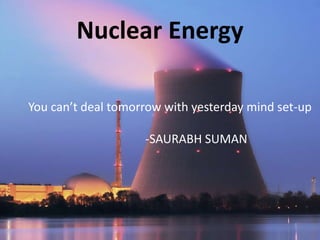
Nuclear Energy
You can’t deal tomorrow with yesterday mind set-up
-SAURABH SUMAN
Content:-
• Introduction
• Origin and History
• How it works
• Constituents of Nuclear Energy
• Advantage and Disadvantage
• Effects of Nuclear Energy
• Benefits to the society
• IAEA report and Operational Nuclear Power Plant
• Conclusion
Introduction
• Uranium was discovered in 1789 by Martin
Heinrich Kalproth, a German Chemist, and
named after the planet Uranus.
• Over 1935-45,most development was focused
on the atomic bomb.
• Uranium is a chemical element which has 92
protons and 92 electrons and denoted by “U”.
• Uranium is a silver-white in the actinide series
of the periodic table.
Origin and History
• 1950, start penetration of Nuclear power in
Electricity Market.
• 1951,ERB-I initially produced about 100kw
from nuclear reactor near Arco, Idaho.
• 1960,17 Nuclear power reactor with capacity
of 1200MW.
• 2016,49 countries,444 nuclear plant,387 GW
in operation,11.5% world electricity.
How it works
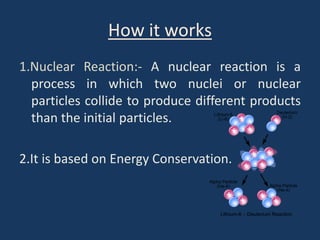
1.Nuclear Reaction:- A nuclear reaction is a
process in which two nuclei or nuclear
particles collide to produce different products
than the initial particles.
2.It is based on Energy Conservation.
3.Nuclear Fission Reaction:-
Nuclear fission is the process in which a nucleus is
divided into two or more fragments, and neutrons
and energy are released.
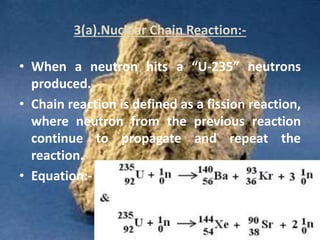
3(a).Nuclear Chain Reaction:-
• When a neutron hits a “U-235” neutrons
produced.
• Chain reaction is defined as a fission reaction,
where neutron from the previous reaction
continue to propagate and repeat the
reaction.
• Equation:-
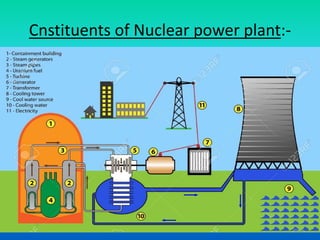
Cnstituents of Nuclear power plant:-
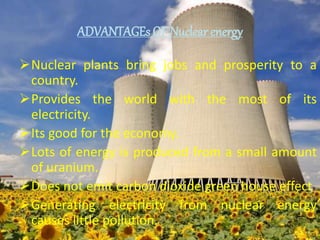
ADVANTAGEs OF Nuclear energy
Nuclear plants bring jobs and prosperity to a
country.
Provides the world with the most of its
electricity.
Its good for the economy.
Lots of energy is produced from a small amount
of uranium.
Does not emit carbon dioxide green house effect
Generating electricity from nuclear energy
causes little pollution.
Disadvantage of nuclear energy
Disposing the nuclear waste is very difficult and
needs to be done after a lot of planning by the
experts.
The radioactive waste takes years to be no longer
hazardous.
Waste must be stored very carefully for a long
time.
Nuclear power plants are very expensive to build.
Uranium is not renewable and can lead to
environmental problems through mining and
processing.
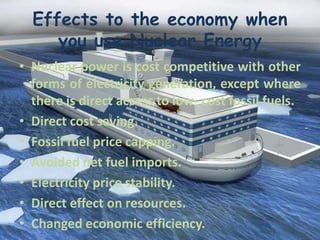
Effects to the economy when
you use Nuclear Energy
• Nuclear power is cost competitive with other
forms of electricity generation, except where
there is direct access to low- cost fossil fuels.
• Direct cost saving.
• Fossil fuel price capping.
• Avoided net fuel imports.
• Electricity price stability.
• Direct effect on resources.
• Changed economic efficiency.
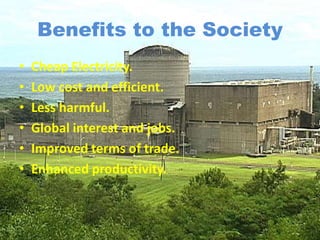
Benefits to the Society
• Cheap Electricity.
• Low cost and efficient.
• Less harmful.
• Global interest and jobs.
• Improved terms of trade.
• Enhanced productivity.
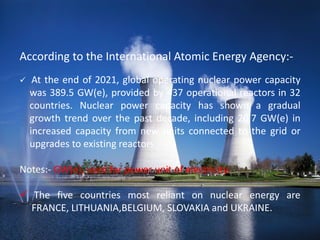
According to the International Atomic Energy Agency:-
 At the end of 2021, global operating nuclear power capacity
was 389.5 GW(e), provided by 437 operational reactors in 32
countries. Nuclear power capacity has shown a gradual
growth trend over the past decade, including 20.7 GW(e) in
increased capacity from new units connected to the grid or
upgrades to existing reactors.
Notes:- GW(e), used for power unit of electricity.
 The five countries most reliant on nuclear energy are
FRANCE, LITHUANIA,BELGIUM, SLOVAKIA and UKRAINE.
Operational nuclear power plants in India
Power station Operator State Type Units
Total capacity
(MW)
Kaiga NPCIL Karnataka IPHWR-220 220 × 4 880
Kakrapar NPCIL Gujarat
IPHWR-220
IPHWR-700
220 × 2700 × 1 1140
Kudankulam[116] NPCIL Tamil Nadu VVER-1000 1000 × 2 2,000
Chennai
(Kalpakkam)
NPCIL Tamil Nadu IPHWR-220 220 × 2 440
Narora NPCIL Uttar Pradesh IPHWR-220 220 × 2 440
Rajasthan NPCIL Rajasthan CANDU
IPHWR-220
200 x 1
220 × 4
1,080
Tarapur NPCIL Maharashtra
BWR
IPHWR-540
160 x 2
540 × 2
1,400
Total 7,380
Conclusion:-
• Overall , nuclear energy has proven to be most
beneficial to our society.
• No lack of CO2, greenhouse gasses, and other gasses it
emits into the atmosphere.
• The draw backs are safety, radioactive waste and
promotion of nuclear weapons.
Thank you.

Nuclear Energy.pptx

  • 1.
    Nuclear Energy You can’tdeal tomorrow with yesterday mind set-up -SAURABH SUMAN
  • 2.
    Content:- • Introduction • Originand History • How it works • Constituents of Nuclear Energy • Advantage and Disadvantage • Effects of Nuclear Energy • Benefits to the society • IAEA report and Operational Nuclear Power Plant • Conclusion
  • 3.
    Introduction • Uranium wasdiscovered in 1789 by Martin Heinrich Kalproth, a German Chemist, and named after the planet Uranus. • Over 1935-45,most development was focused on the atomic bomb. • Uranium is a chemical element which has 92 protons and 92 electrons and denoted by “U”. • Uranium is a silver-white in the actinide series of the periodic table.
  • 4.
    Origin and History •1950, start penetration of Nuclear power in Electricity Market. • 1951,ERB-I initially produced about 100kw from nuclear reactor near Arco, Idaho. • 1960,17 Nuclear power reactor with capacity of 1200MW. • 2016,49 countries,444 nuclear plant,387 GW in operation,11.5% world electricity.
  • 5.
    How it works 1.NuclearReaction:- A nuclear reaction is a process in which two nuclei or nuclear particles collide to produce different products than the initial particles. 2.It is based on Energy Conservation.
  • 6.
    3.Nuclear Fission Reaction:- Nuclearfission is the process in which a nucleus is divided into two or more fragments, and neutrons and energy are released.
  • 7.
    3(a).Nuclear Chain Reaction:- •When a neutron hits a “U-235” neutrons produced. • Chain reaction is defined as a fission reaction, where neutron from the previous reaction continue to propagate and repeat the reaction. • Equation:-
  • 8.
  • 9.
    ADVANTAGEs OF Nuclearenergy Nuclear plants bring jobs and prosperity to a country. Provides the world with the most of its electricity. Its good for the economy. Lots of energy is produced from a small amount of uranium. Does not emit carbon dioxide green house effect Generating electricity from nuclear energy causes little pollution.
  • 10.
    Disadvantage of nuclearenergy Disposing the nuclear waste is very difficult and needs to be done after a lot of planning by the experts. The radioactive waste takes years to be no longer hazardous. Waste must be stored very carefully for a long time. Nuclear power plants are very expensive to build. Uranium is not renewable and can lead to environmental problems through mining and processing.
  • 11.
    Effects to theeconomy when you use Nuclear Energy • Nuclear power is cost competitive with other forms of electricity generation, except where there is direct access to low- cost fossil fuels. • Direct cost saving. • Fossil fuel price capping. • Avoided net fuel imports. • Electricity price stability. • Direct effect on resources. • Changed economic efficiency.
  • 12.
    Benefits to theSociety • Cheap Electricity. • Low cost and efficient. • Less harmful. • Global interest and jobs. • Improved terms of trade. • Enhanced productivity.
  • 13.
    According to theInternational Atomic Energy Agency:-  At the end of 2021, global operating nuclear power capacity was 389.5 GW(e), provided by 437 operational reactors in 32 countries. Nuclear power capacity has shown a gradual growth trend over the past decade, including 20.7 GW(e) in increased capacity from new units connected to the grid or upgrades to existing reactors. Notes:- GW(e), used for power unit of electricity.  The five countries most reliant on nuclear energy are FRANCE, LITHUANIA,BELGIUM, SLOVAKIA and UKRAINE.
  • 14.
    Operational nuclear powerplants in India Power station Operator State Type Units Total capacity (MW) Kaiga NPCIL Karnataka IPHWR-220 220 × 4 880 Kakrapar NPCIL Gujarat IPHWR-220 IPHWR-700 220 × 2700 × 1 1140 Kudankulam[116] NPCIL Tamil Nadu VVER-1000 1000 × 2 2,000 Chennai (Kalpakkam) NPCIL Tamil Nadu IPHWR-220 220 × 2 440 Narora NPCIL Uttar Pradesh IPHWR-220 220 × 2 440 Rajasthan NPCIL Rajasthan CANDU IPHWR-220 200 x 1 220 × 4 1,080 Tarapur NPCIL Maharashtra BWR IPHWR-540 160 x 2 540 × 2 1,400 Total 7,380
  • 15.
    Conclusion:- • Overall ,nuclear energy has proven to be most beneficial to our society. • No lack of CO2, greenhouse gasses, and other gasses it emits into the atmosphere. • The draw backs are safety, radioactive waste and promotion of nuclear weapons.
  • 16.