IS NUCLEAR ENERGY SOULTION TO OUR POWER PROBLEMS ?Made By : HARSH GUPTA X – B Roll No. 22
INDEX:INTRODUCTION
NUCLEAR POWER TODAY
FORMATION
COST AND TIME
RISKS AND DANGERS
ALTERNATIVE RESOURCES
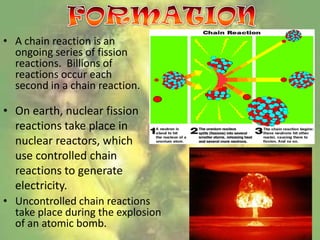
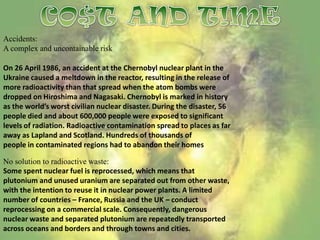
BIBLIOGRAPHYINTRODUCTIONNuclear power is energy which is produced with the use of a controlled nuclear reaction. Many nations use nuclear power plants to generate electricity for both civilian and military use, and some nations also utilize nuclear power to run parts of their naval fleets, especially submarines. Some people favor an expansion of nuclear power plants because this form of energy is considered cleaner than fossil fuels such as coal, although nuclear power comes with a number of problems which must be addressed, including the safe disposal of radioactive waste products.The process of generation nuclear power starts with the mining and processing of uranium and other radioactive elements. These elements are used to feed the reactor of a nuclear power plant, generating a reaction known as fission which creates intense heat, turning water in the plant into steam. The steam powers steam turbines, which generate electricity and feed the electricity into the electrical grid.When nuclear power is used to power something like a submarine, the reactor runs the engines, with the steam directly powering the engines. In both cases, the reactor requires careful supervision, because runaway nuclear reactions must be stopped as quickly as possible to prevent serious problems. Many nuclear power plants have extensive automated systems which help to identify potential trouble spots, and these systems can also re-routepower , turn off parts of the plant, and perform other tasks which make the plant safer and cleaner.
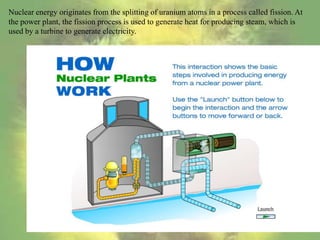
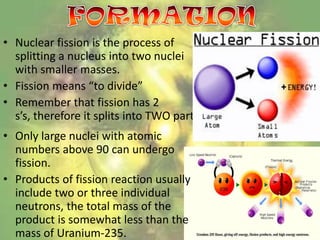
Nuclear energy originates from the splitting of uranium atoms in a process called fission. At the power plant, the fission process is used to generate heat for producing steam, which is used by a turbine to generate electricity.Nuclear energy originates from the splitting of uranium atoms in a process called fission. At the power plant, the fission process is used to generate heat for producing steam, which is used by a turbine to generate electricity.Nuclear energy originates from the splitting of uranium atoms in a process called fission. At the power plant, the fission process is used to generate heat for producing steam, which is used by a turbine to generate electricity.
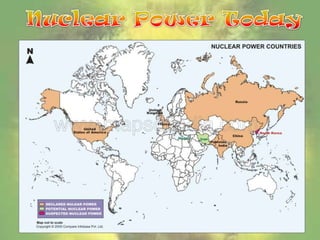
Nuclear Power Today
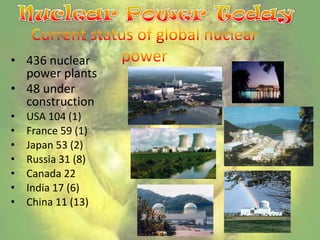
Nuclear Power Today Current status of global nuclear power436 nuclear power plants
48 under construction
USA 104 (1)
France 59 (1)
Japan 53 (2)
Russia 31 (8)
Canada 22
India 17 (6)
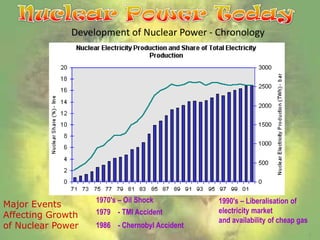
China 11 (13)Nuclear Power Today Development of Nuclear Power - Chronology1970's – Oil Shock1979    - TMI Accident 1986    - Chernobyl Accident1990's – Liberalisation of   electricity marketand availability of cheap gasMajor Events Affecting Growth of Nuclear Power7
Nuclear Power Today
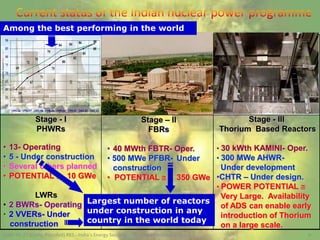
Current status of the Indian nuclear power programmeAmong the best performing in the worldLargest number of reactors under construction in any country in the world todayStage - IIIThorium  Based Reactors30 kWth KAMINI- Oper.
300 MWe AHWR-	Under development
CHTR – Under design.
POWER POTENTIAL   	Very Large.  Availability 	of ADS can enable early 	introduction of Thorium 	on a large scale.Stage - I PHWRs 	13- Operating
 	5 - Under construction
 	Several others planned
 	POTENTIAL  	10 GWe		LWRs2 BWRs- Operating
2 VVERs- Under    constructionStage – II FBRs 	40 MWth FBTR- Oper.
 500 MWe PFBR- 	Under  	construction

Is nuclear energy solution to our power problems ?

  • 1.
    IS NUCLEAR ENERGYSOULTION TO OUR POWER PROBLEMS ?Made By : HARSH GUPTA X – B Roll No. 22
  • 2.
  • 3.
  • 4.
  • 5.
  • 6.
  • 7.
  • 8.
    BIBLIOGRAPHYINTRODUCTIONNuclear power is energy whichis produced with the use of a controlled nuclear reaction. Many nations use nuclear power plants to generate electricity for both civilian and military use, and some nations also utilize nuclear power to run parts of their naval fleets, especially submarines. Some people favor an expansion of nuclear power plants because this form of energy is considered cleaner than fossil fuels such as coal, although nuclear power comes with a number of problems which must be addressed, including the safe disposal of radioactive waste products.The process of generation nuclear power starts with the mining and processing of uranium and other radioactive elements. These elements are used to feed the reactor of a nuclear power plant, generating a reaction known as fission which creates intense heat, turning water in the plant into steam. The steam powers steam turbines, which generate electricity and feed the electricity into the electrical grid.When nuclear power is used to power something like a submarine, the reactor runs the engines, with the steam directly powering the engines. In both cases, the reactor requires careful supervision, because runaway nuclear reactions must be stopped as quickly as possible to prevent serious problems. Many nuclear power plants have extensive automated systems which help to identify potential trouble spots, and these systems can also re-routepower , turn off parts of the plant, and perform other tasks which make the plant safer and cleaner.
  • 9.
    Nuclear energy originatesfrom the splitting of uranium atoms in a process called fission. At the power plant, the fission process is used to generate heat for producing steam, which is used by a turbine to generate electricity.Nuclear energy originates from the splitting of uranium atoms in a process called fission. At the power plant, the fission process is used to generate heat for producing steam, which is used by a turbine to generate electricity.Nuclear energy originates from the splitting of uranium atoms in a process called fission. At the power plant, the fission process is used to generate heat for producing steam, which is used by a turbine to generate electricity.
  • 10.
  • 11.
    Nuclear Power TodayCurrent status of global nuclear power436 nuclear power plants
  • 12.
  • 13.
  • 14.
  • 15.
  • 16.
  • 17.
  • 18.
  • 19.
    China 11 (13)NuclearPower Today Development of Nuclear Power - Chronology1970's – Oil Shock1979 - TMI Accident 1986 - Chernobyl Accident1990's – Liberalisation of electricity marketand availability of cheap gasMajor Events Affecting Growth of Nuclear Power7
  • 20.
  • 21.
    Current status ofthe Indian nuclear power programmeAmong the best performing in the worldLargest number of reactors under construction in any country in the world todayStage - IIIThorium Based Reactors30 kWth KAMINI- Oper.
  • 22.
  • 23.
  • 24.
    POWER POTENTIAL  Very Large. Availability of ADS can enable early introduction of Thorium on a large scale.Stage - I PHWRs 13- Operating
  • 25.
    5 -Under construction
  • 26.
  • 27.
    POTENTIAL  10 GWe LWRs2 BWRs- Operating
  • 28.
    2 VVERs- Under constructionStage – II FBRs 40 MWth FBTR- Oper.
  • 29.
    500 MWePFBR- Under construction