CHEMISTRY OF LIVING SYSTEMS
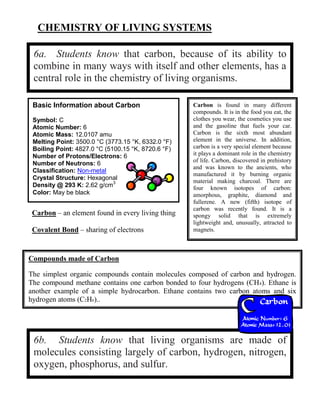
6a. Students know that carbon, because of its ability to
combine in many ways with itself and other elements, has a
central role in the chemistry of living organisms.
6b. Students know that living organisms are made of
molecules consisting largely of carbon, hydrogen, nitrogen,
oxygen, phosphorus, and sulfur.
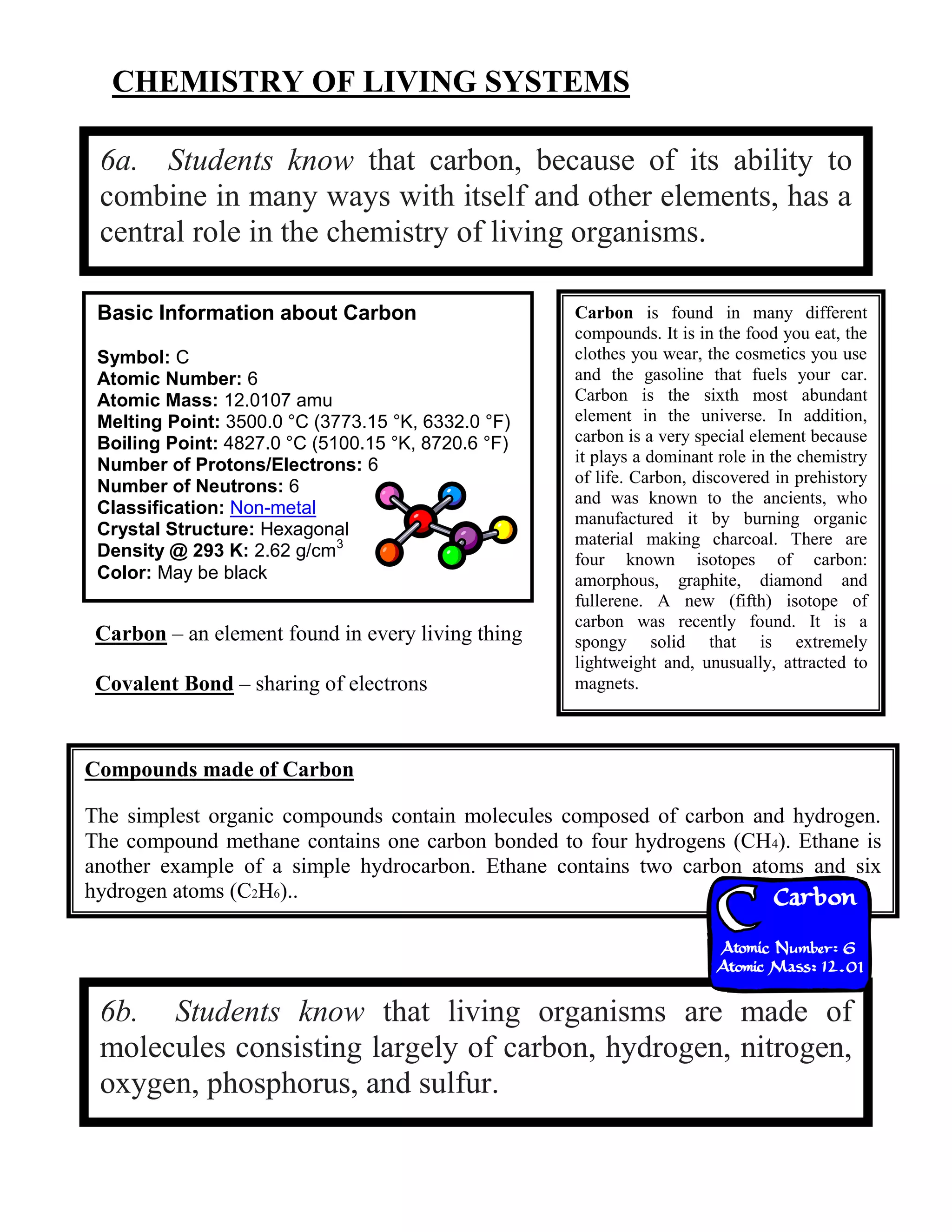
Basic Information about Carbon
Symbol: C
Atomic Number: 6
Atomic Mass: 12.0107 amu
Melting Point: 3500.0 °C (3773.15 °K, 6332.0 °F)
Boiling Point: 4827.0 °C (5100.15 °K, 8720.6 °F)
Number of Protons/Electrons: 6
Number of Neutrons: 6
Classification: Non-metal
Crystal Structure: Hexagonal
Density @ 293 K: 2.62 g/cm3
Color: May be black
Carbon is found in many different
compounds. It is in the food you eat, the
clothes you wear, the cosmetics you use
and the gasoline that fuels your car.
Carbon is the sixth most abundant
element in the universe. In addition,
carbon is a very special element because
it plays a dominant role in the chemistry
of life. Carbon, discovered in prehistory
and was known to the ancients, who
manufactured it by burning organic
material making charcoal. There are
four known isotopes of carbon:
amorphous, graphite, diamond and
fullerene. A new (fifth) isotope of
carbon was recently found. It is a
spongy solid that is extremely
lightweight and, unusually, attracted to
magnets.
Carbon – an element found in every living thing
Covalent Bond – sharing of electrons
Compounds made of Carbon
The simplest organic compounds contain molecules composed of carbon and hydrogen.
The compound methane contains one carbon bonded to four hydrogens (CH4). Ethane is
another example of a simple hydrocarbon. Ethane contains two carbon atoms and six
hydrogen atoms (C2H6)..
You can think of carbon as a bunch of red legos attached together
to form one long chain of legos. Now, you can imagine sticking
yellow, blue and green legos across the tops of the red (carbon)
legos. These other colors represent other elements like oxygen,
nitrogen or hydrogen. As you stick more and more of these
yellow, blue and green legos to the red chain, it would start to
look like a skeleton of legos with a "spine" of red legos and
"bones" of yellow, blue and green legos. This is a lot like the way
that big molecules are made in the body. Without carbon, these big molecules
could not be built.
Now, virtually every part of your body is made up of these big molecules that
are based around chains of carbon atoms. This is the reason we are known as
"carbon based life forms". Without carbon, our bodies would just be a big pile
of loose atoms with no way to be built into a person.
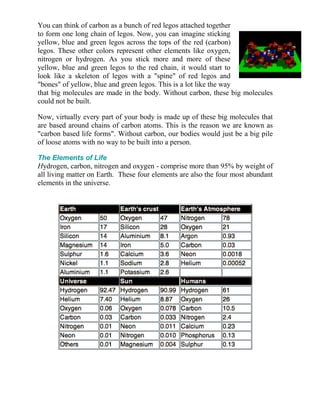
The Elements of Life
Hydrogen, carbon, nitrogen and oxygen - comprise more than 95% by weight of
all living matter on Earth. These four elements are also the four most abundant
elements in the universe.
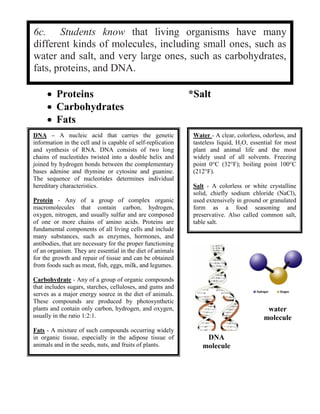
Large Molecules: Small Molecules
 DNA *Water
 Proteins *Salt
 Carbohydrates
 Fats
6c. Students know that living organisms have many
different kinds of molecules, including small ones, such as
water and salt, and very large ones, such as carbohydrates,
fats, proteins, and DNA.
DNA – A nucleic acid that carries the genetic
information in the cell and is capable of self-replication
and synthesis of RNA. DNA consists of two long
chains of nucleotides twisted into a double helix and
joined by hydrogen bonds between the complementary
bases adenine and thymine or cytosine and guanine.
The sequence of nucleotides determines individual
hereditary characteristics.
Protein - Any of a group of complex organic
macromolecules that contain carbon, hydrogen,
oxygen, nitrogen, and usually sulfur and are composed
of one or more chains of amino acids. Proteins are
fundamental components of all living cells and include
many substances, such as enzymes, hormones, and
antibodies, that are necessary for the proper functioning
of an organism. They are essential in the diet of animals
for the growth and repair of tissue and can be obtained
from foods such as meat, fish, eggs, milk, and legumes.
Carbohydrate - Any of a group of organic compounds
that includes sugars, starches, celluloses, and gums and
serves as a major energy source in the diet of animals.
These compounds are produced by photosynthetic
plants and contain only carbon, hydrogen, and oxygen,
usually in the ratio 1:2:1.
Fats - A mixture of such compounds occurring widely
in organic tissue, especially in the adipose tissue of
animals and in the seeds, nuts, and fruits of plants.
Water - A clear, colorless, odorless, and
tasteless liquid, H2O, essential for most
plant and animal life and the most
widely used of all solvents. Freezing
point 0°C (32°F); boiling point 100°C
(212°F).
Salt - A colorless or white crystalline
solid, chiefly sodium chloride (NaCl),
used extensively in ground or granulated
form as a food seasoning and
preservative. Also called common salt,
table salt.
DNA
molecule
water
molecule

Nscu 302 wk 2 2

  • 1.
    CHEMISTRY OF LIVINGSYSTEMS 6a. Students know that carbon, because of its ability to combine in many ways with itself and other elements, has a central role in the chemistry of living organisms. 6b. Students know that living organisms are made of molecules consisting largely of carbon, hydrogen, nitrogen, oxygen, phosphorus, and sulfur. Basic Information about Carbon Symbol: C Atomic Number: 6 Atomic Mass: 12.0107 amu Melting Point: 3500.0 °C (3773.15 °K, 6332.0 °F) Boiling Point: 4827.0 °C (5100.15 °K, 8720.6 °F) Number of Protons/Electrons: 6 Number of Neutrons: 6 Classification: Non-metal Crystal Structure: Hexagonal Density @ 293 K: 2.62 g/cm3 Color: May be black Carbon is found in many different compounds. It is in the food you eat, the clothes you wear, the cosmetics you use and the gasoline that fuels your car. Carbon is the sixth most abundant element in the universe. In addition, carbon is a very special element because it plays a dominant role in the chemistry of life. Carbon, discovered in prehistory and was known to the ancients, who manufactured it by burning organic material making charcoal. There are four known isotopes of carbon: amorphous, graphite, diamond and fullerene. A new (fifth) isotope of carbon was recently found. It is a spongy solid that is extremely lightweight and, unusually, attracted to magnets. Carbon – an element found in every living thing Covalent Bond – sharing of electrons Compounds made of Carbon The simplest organic compounds contain molecules composed of carbon and hydrogen. The compound methane contains one carbon bonded to four hydrogens (CH4). Ethane is another example of a simple hydrocarbon. Ethane contains two carbon atoms and six hydrogen atoms (C2H6)..
  • 2.
    You can thinkof carbon as a bunch of red legos attached together to form one long chain of legos. Now, you can imagine sticking yellow, blue and green legos across the tops of the red (carbon) legos. These other colors represent other elements like oxygen, nitrogen or hydrogen. As you stick more and more of these yellow, blue and green legos to the red chain, it would start to look like a skeleton of legos with a "spine" of red legos and "bones" of yellow, blue and green legos. This is a lot like the way that big molecules are made in the body. Without carbon, these big molecules could not be built. Now, virtually every part of your body is made up of these big molecules that are based around chains of carbon atoms. This is the reason we are known as "carbon based life forms". Without carbon, our bodies would just be a big pile of loose atoms with no way to be built into a person. The Elements of Life Hydrogen, carbon, nitrogen and oxygen - comprise more than 95% by weight of all living matter on Earth. These four elements are also the four most abundant elements in the universe.
  • 3.
    Large Molecules: SmallMolecules  DNA *Water  Proteins *Salt  Carbohydrates  Fats 6c. Students know that living organisms have many different kinds of molecules, including small ones, such as water and salt, and very large ones, such as carbohydrates, fats, proteins, and DNA. DNA – A nucleic acid that carries the genetic information in the cell and is capable of self-replication and synthesis of RNA. DNA consists of two long chains of nucleotides twisted into a double helix and joined by hydrogen bonds between the complementary bases adenine and thymine or cytosine and guanine. The sequence of nucleotides determines individual hereditary characteristics. Protein - Any of a group of complex organic macromolecules that contain carbon, hydrogen, oxygen, nitrogen, and usually sulfur and are composed of one or more chains of amino acids. Proteins are fundamental components of all living cells and include many substances, such as enzymes, hormones, and antibodies, that are necessary for the proper functioning of an organism. They are essential in the diet of animals for the growth and repair of tissue and can be obtained from foods such as meat, fish, eggs, milk, and legumes. Carbohydrate - Any of a group of organic compounds that includes sugars, starches, celluloses, and gums and serves as a major energy source in the diet of animals. These compounds are produced by photosynthetic plants and contain only carbon, hydrogen, and oxygen, usually in the ratio 1:2:1. Fats - A mixture of such compounds occurring widely in organic tissue, especially in the adipose tissue of animals and in the seeds, nuts, and fruits of plants. Water - A clear, colorless, odorless, and tasteless liquid, H2O, essential for most plant and animal life and the most widely used of all solvents. Freezing point 0°C (32°F); boiling point 100°C (212°F). Salt - A colorless or white crystalline solid, chiefly sodium chloride (NaCl), used extensively in ground or granulated form as a food seasoning and preservative. Also called common salt, table salt. DNA molecule water molecule