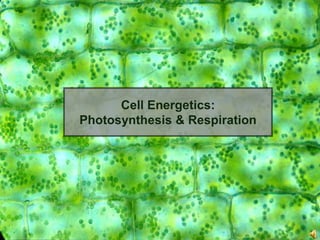
Cell Energetics:
Photosynthesis & Respiration
Carbon
• Carbon forms millions of compounds, both simple
and complex
• All living things contain carbon
• Living things cycle carbon from the air (inorganic gas
form) to the solid form (organic) and back to the air
• Light from the sun provides the energy for
photosynthesis, the process of making organic
compounds such as sugar
• The sun’s energy is stored the chemical bonds of
sugars and other carbohydrates
• Carbohydrates are used by most living things to
provide energy for LIVING
What is the Global Carbon Cycle?
• The movement of carbon between the atmosphere, soil,
ocean, living things, and fossil fuels
• Carbon exists primarily as:
- Gas, carbon dioxide (CO2), in Earth’s atmosphere
- Organic carbon in living and dead organisms.
• Atmospheric carbon is constantly recycled, mostly by
green plants and algae, to produce oxygen
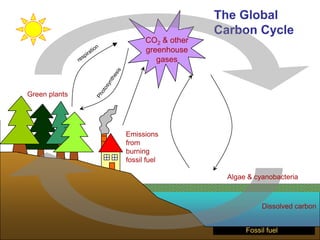
The Global
Carbon Cycle
CO2 & other
greenhouse
gases
Dissolved carbon
Fossil fuel
Green plants
Algae & cyanobacteria
Emissions
from
burning
fossil fuel
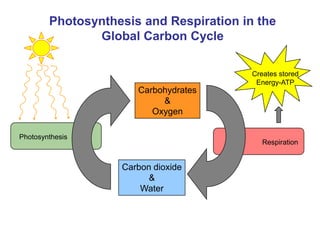
Photosynthesis and Respiration in the
Global Carbon Cycle
Carbohydrates
&
Oxygen
Carbon dioxide
&
Water
Photosynthesis
Respiration
Creates stored
Energy-ATP
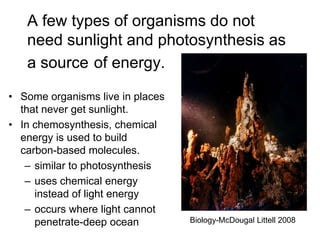
A few types of organisms do not
need sunlight and photosynthesis as
a source of energy.
• Some organisms live in places
that never get sunlight.
• In chemosynthesis, chemical
energy is used to build
carbon-based molecules.
– similar to photosynthesis
– uses chemical energy
instead of light energy
– occurs where light cannot
penetrate-deep ocean Biology-McDougal Littell 2008
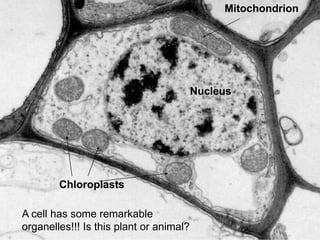
A cell has some remarkable
organelles!!! Is this plant or animal?
Chloroplasts
Mitochondrion
Nucleus
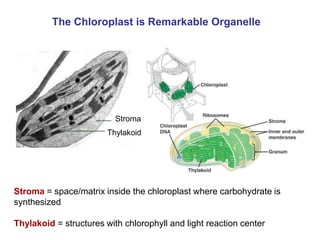
The Chloroplast is Remarkable Organelle
Stroma
Thylakoid
Stroma = space/matrix inside the chloroplast where carbohydrate is
synthesized
Thylakoid = structures with chlorophyll and light reaction center
The Basic Process of
Photosynthesis
CO2 + H2O [C6H12O6] + O2
carbon dioxide water carbohydrate
(glucose)
oxygen
light energy
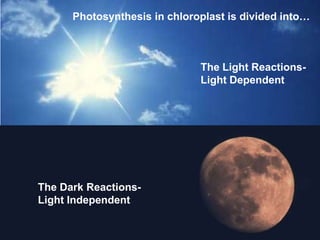
The Light Reactions-
Light Dependent
The Dark Reactions-
Light Independent
Photosynthesis in chloroplast is divided into…
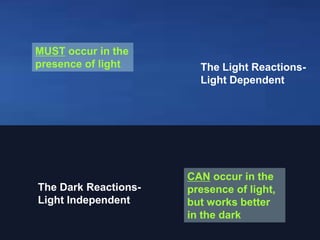
The Light Reactions-
Light Dependent
The Dark Reactions-
Light Independent
MUST occur in the
presence of light
CAN occur in the
presence of light,
but works better
in the dark
Keeping track of the oxygen atom in photosynthesis
CO2 + H2O [CH2O] + O2
carbon dioxide water carbohydrates oxygen
light energy
Cornelius van Niel (1897-1985)
Standford University
Used radioactive-labeled oxygen in water and
unlabeled carbon dioxide in photosynthesis
experiments
Found that oxygen gas produced comes from water
Postulated that the oxygen atom in carbohydrates
must be from carbon dioxide
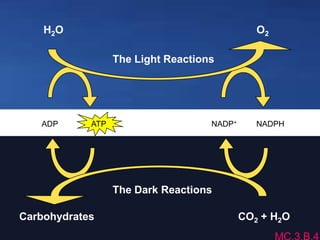
The Light Reactions
The Dark Reactions
ADP NADP+ NADPH
Carbohydrates CO2 + H2O
H2O O2
ATP
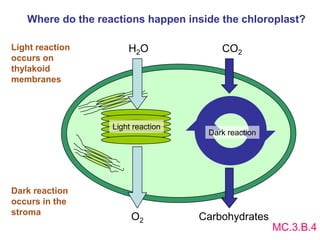
Where do the reactions happen inside the chloroplast?
Light reaction
Dark reaction
H2O
O2
CO2
Carbohydrates
Light reaction
occurs on
thylakoid
membranes
Dark reaction
occurs in the
stroma
MC.3.B.4

Nscu 302 wk 2 1

  • 1.
  • 2.
    Carbon • Carbon formsmillions of compounds, both simple and complex • All living things contain carbon • Living things cycle carbon from the air (inorganic gas form) to the solid form (organic) and back to the air • Light from the sun provides the energy for photosynthesis, the process of making organic compounds such as sugar • The sun’s energy is stored the chemical bonds of sugars and other carbohydrates • Carbohydrates are used by most living things to provide energy for LIVING
  • 3.
    What is theGlobal Carbon Cycle? • The movement of carbon between the atmosphere, soil, ocean, living things, and fossil fuels • Carbon exists primarily as: - Gas, carbon dioxide (CO2), in Earth’s atmosphere - Organic carbon in living and dead organisms. • Atmospheric carbon is constantly recycled, mostly by green plants and algae, to produce oxygen
  • 4.
    The Global Carbon Cycle CO2& other greenhouse gases Dissolved carbon Fossil fuel Green plants Algae & cyanobacteria Emissions from burning fossil fuel
  • 5.
    Photosynthesis and Respirationin the Global Carbon Cycle Carbohydrates & Oxygen Carbon dioxide & Water Photosynthesis Respiration Creates stored Energy-ATP
  • 6.
    A few typesof organisms do not need sunlight and photosynthesis as a source of energy. • Some organisms live in places that never get sunlight. • In chemosynthesis, chemical energy is used to build carbon-based molecules. – similar to photosynthesis – uses chemical energy instead of light energy – occurs where light cannot penetrate-deep ocean Biology-McDougal Littell 2008
  • 7.
    A cell hassome remarkable organelles!!! Is this plant or animal? Chloroplasts Mitochondrion Nucleus
  • 8.
    The Chloroplast isRemarkable Organelle Stroma Thylakoid Stroma = space/matrix inside the chloroplast where carbohydrate is synthesized Thylakoid = structures with chlorophyll and light reaction center
  • 9.
    The Basic Processof Photosynthesis CO2 + H2O [C6H12O6] + O2 carbon dioxide water carbohydrate (glucose) oxygen light energy
  • 10.
    The Light Reactions- LightDependent The Dark Reactions- Light Independent Photosynthesis in chloroplast is divided into…
  • 11.
    The Light Reactions- LightDependent The Dark Reactions- Light Independent MUST occur in the presence of light CAN occur in the presence of light, but works better in the dark
  • 12.
    Keeping track ofthe oxygen atom in photosynthesis CO2 + H2O [CH2O] + O2 carbon dioxide water carbohydrates oxygen light energy Cornelius van Niel (1897-1985) Standford University Used radioactive-labeled oxygen in water and unlabeled carbon dioxide in photosynthesis experiments Found that oxygen gas produced comes from water Postulated that the oxygen atom in carbohydrates must be from carbon dioxide
  • 13.
    The Light Reactions TheDark Reactions ADP NADP+ NADPH Carbohydrates CO2 + H2O H2O O2 ATP
  • 14.
    Where do thereactions happen inside the chloroplast? Light reaction Dark reaction H2O O2 CO2 Carbohydrates Light reaction occurs on thylakoid membranes Dark reaction occurs in the stroma MC.3.B.4