WHAT IS A CLAUSE?
 A CLAUSE IS A GROUP OF RELATED
WORDS USED TOGETHER AS PART OF
           A SENTENCE.
   IT CONTAINS A SUBJECT AND A
              VERB.
Phrase


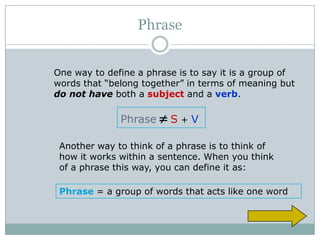
One way to define a phrase is to say it is a group of
words that “belong together” in terms of meaning but
do not have both a subject and a verb.

              Phrase  S + V

 Another way to think of a phrase is to think of
 how it works within a sentence. When you think
 of a phrase this way, you can define it as:

 Phrase = a group of words that acts like one word
Phrase
                               example


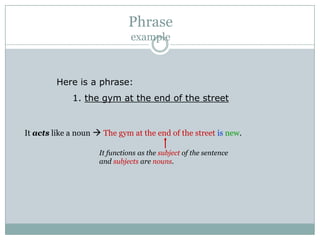
         Here is a phrase:
             1. the gym at the end of the street


It acts like a noun  The gym at the end of the street is new.

                     It functions as the subject of the sentence
                     and subjects are nouns.
KINDS OF CLAUSES

 AN INDEPENDENT OR MAIN
  CLAUSE- EXPRESSES A COMPLETE
  THOUGHT AND IT CAN STAND BY
  ITSELF.
 A DEPENDENT OR SUBORDINATE
  CLAUSE DOES NOT EXPRESS A
  COMPLETE THOUGHT AND
  CANNOT STAND BY ITSELF.
INDEPENDENT CLAUSE

 Ex….
      THE CROWD BECAME VIOLENT.
      THE POLICE WAS COMPELLED TO TAKE
      ACTION AGAINST THEM.
By joining these sentences..
1. THE CROWD BECAME VIOLENT, AND THE
   POLICE WAS COMPELLED TO TAKE ACTION
   AGAINST THEM.
INDEPENDENT CLAUSE

 INDEPENDENT CLAUSES MAY BE JOINED BY
  THE CONJUNCTIONS AND, BUT, OR, FOR, YET.
 JOHN CALLED ALL OF HIS FRIENDS.
 NOBODY TURNED UP.
By joining these sentences..
      JOHN CALLED ALL HIS FRIENDS BUT
      NOBODY TURNED UP.
DEPENDENT/ SUBORDINATE CLAUSE

 Ex.
1.   that he would work hard
2.   because the joke was funny
3.   when I was younger
4.   If you do not hurry
5.   After such hard work
6.   since I returned from Delhi
7.   as I had no money with me.
The uses of Subordinate Clauses

 Subordinate clauses are named
  according to their functions. They
  could do the work of…
1. An Adjective
2. An Adverb
3. A Noun
THE NOUN CLAUSE

 A noun clause is a subordinate clause as a Noun.
Examples….
1. I believe that hard work is the key to success.
2. I do not know who broke the window.
3. I am not sure whether he would tell the truth.
4. The law will punish whosoever is guilty.
5. He showed how the problem was solved.
6. Tell me what you think about this.
7. They do not know where he is living.
NOUN CLAUSE

 Noun clauses are usually introduced by words like..
1.   That
2.   Whether
3.   What
4.   Who
5.   Whoever
6.   Whose
7.   Where
8.   Why
9.   How
ADJECTIVE CLAUSE

 An Adjective clause is a subordinate clause used as
  an adjective to modify a noun or a pronoun . It
  always follows the noun or the pronoun it modifies.
1. The company that Sourabh worked in the last year
    is keen to have him back.
2. Our house, which was built by our grandfather, has
    been sold to them.
3. The children apologized to the man whose car they
    had damaged.
1. ADJECTIVE CLAUSE

 Adjective clauses are introduced by the
  pronouns..
1. Who
2. Whom
3. Whose
4. Which
5. That
6. With
ADVERB CLAUSE

 An Adverb clause is a subordinate clause that
  modifies a verb, an adjective or an adverb.
 Adverbial clauses express how, when, where or
  under what conditions.
 Ex.
1. If you win the contest, you will be rewarded with a
   trophy.
2. Whenever I visit you, I find your house in a mess.
3. Neera looked as if she was about to faint.
ADVERB CLAUSE

      Adverb clauses are introduced by subordinating
      conjunctions.
 Some common subordinating conjunctions are
1.    After
2.    Although
3.    As
4.    As if
5.    As long as
6.    As soon as
CONTINUED…..

1. Unless      9. Before
2. Until       10. If
3. When        11. In order that
4. Whenever    12. Since
5. Where       13. So that
6. Wherever    14. Than
7. While       15. Though
8. Because
LET’S PRACTICE
     SOME
 EXAMPLES….
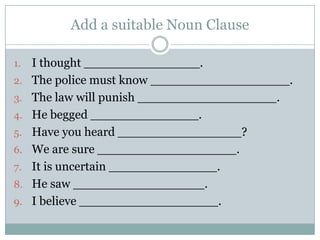
Add a suitable Noun Clause

1.   I thought _______________.
2.   The police must know __________________.
3.   The law will punish __________________.
4.   He begged ______________.
5.   Have you heard ________________?
6.   We are sure __________________.
7.   It is uncertain ______________.
8.   He saw _________________.
9.   I believe __________________.
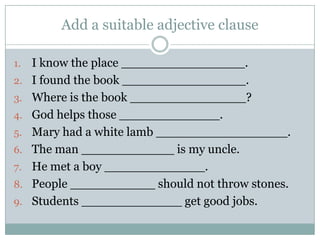
Add a suitable adjective clause

1.   I know the place ________________.
2.   I found the book ________________.
3.   Where is the book _______________?
4.   God helps those _____________.
5.   Mary had a white lamb _________________.
6.   The man ____________ is my uncle.
7.   He met a boy _____________.
8.   People ___________ should not throw stones.
9.   Students _____________ get good jobs.
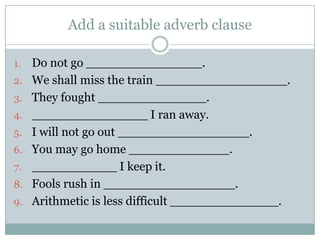
Add a suitable adverb clause

1.   Do not go _______________.
2.   We shall miss the train _________________.
3.   They fought ______________.
4.   _______________ I ran away.
5.   I will not go out _________________.
6.   You may go home _____________.
7.   ___________ I keep it.
8.   Fools rush in _________________.
9.   Arithmetic is less difficult ______________.
What is a clause

What is a clause

  • 1.
    WHAT IS ACLAUSE? A CLAUSE IS A GROUP OF RELATED WORDS USED TOGETHER AS PART OF A SENTENCE. IT CONTAINS A SUBJECT AND A VERB.
  • 2.
    Phrase One way todefine a phrase is to say it is a group of words that “belong together” in terms of meaning but do not have both a subject and a verb. Phrase  S + V Another way to think of a phrase is to think of how it works within a sentence. When you think of a phrase this way, you can define it as: Phrase = a group of words that acts like one word

  • 3.
    Phrase example Here is a phrase: 1. the gym at the end of the street It acts like a noun  The gym at the end of the street is new. It functions as the subject of the sentence and subjects are nouns.
  • 4.
    KINDS OF CLAUSES AN INDEPENDENT OR MAIN CLAUSE- EXPRESSES A COMPLETE THOUGHT AND IT CAN STAND BY ITSELF.  A DEPENDENT OR SUBORDINATE CLAUSE DOES NOT EXPRESS A COMPLETE THOUGHT AND CANNOT STAND BY ITSELF.
  • 5.
    INDEPENDENT CLAUSE  Ex…. THE CROWD BECAME VIOLENT. THE POLICE WAS COMPELLED TO TAKE ACTION AGAINST THEM. By joining these sentences.. 1. THE CROWD BECAME VIOLENT, AND THE POLICE WAS COMPELLED TO TAKE ACTION AGAINST THEM.
  • 6.
    INDEPENDENT CLAUSE  INDEPENDENTCLAUSES MAY BE JOINED BY THE CONJUNCTIONS AND, BUT, OR, FOR, YET.  JOHN CALLED ALL OF HIS FRIENDS.  NOBODY TURNED UP. By joining these sentences.. JOHN CALLED ALL HIS FRIENDS BUT NOBODY TURNED UP.
  • 7.
    DEPENDENT/ SUBORDINATE CLAUSE Ex. 1. that he would work hard 2. because the joke was funny 3. when I was younger 4. If you do not hurry 5. After such hard work 6. since I returned from Delhi 7. as I had no money with me.
  • 8.
    The uses ofSubordinate Clauses  Subordinate clauses are named according to their functions. They could do the work of… 1. An Adjective 2. An Adverb 3. A Noun
  • 9.
    THE NOUN CLAUSE A noun clause is a subordinate clause as a Noun. Examples…. 1. I believe that hard work is the key to success. 2. I do not know who broke the window. 3. I am not sure whether he would tell the truth. 4. The law will punish whosoever is guilty. 5. He showed how the problem was solved. 6. Tell me what you think about this. 7. They do not know where he is living.
  • 10.
    NOUN CLAUSE  Nounclauses are usually introduced by words like.. 1. That 2. Whether 3. What 4. Who 5. Whoever 6. Whose 7. Where 8. Why 9. How
  • 11.
    ADJECTIVE CLAUSE  AnAdjective clause is a subordinate clause used as an adjective to modify a noun or a pronoun . It always follows the noun or the pronoun it modifies. 1. The company that Sourabh worked in the last year is keen to have him back. 2. Our house, which was built by our grandfather, has been sold to them. 3. The children apologized to the man whose car they had damaged.
  • 12.
    1. ADJECTIVE CLAUSE Adjective clauses are introduced by the pronouns.. 1. Who 2. Whom 3. Whose 4. Which 5. That 6. With
  • 13.
    ADVERB CLAUSE  AnAdverb clause is a subordinate clause that modifies a verb, an adjective or an adverb.  Adverbial clauses express how, when, where or under what conditions.  Ex. 1. If you win the contest, you will be rewarded with a trophy. 2. Whenever I visit you, I find your house in a mess. 3. Neera looked as if she was about to faint.
  • 14.
    ADVERB CLAUSE  Adverb clauses are introduced by subordinating conjunctions.  Some common subordinating conjunctions are 1. After 2. Although 3. As 4. As if 5. As long as 6. As soon as
  • 15.
    CONTINUED….. 1. Unless 9. Before 2. Until 10. If 3. When 11. In order that 4. Whenever 12. Since 5. Where 13. So that 6. Wherever 14. Than 7. While 15. Though 8. Because
  • 16.
    LET’S PRACTICE SOME EXAMPLES….
  • 17.
    Add a suitableNoun Clause 1. I thought _______________. 2. The police must know __________________. 3. The law will punish __________________. 4. He begged ______________. 5. Have you heard ________________? 6. We are sure __________________. 7. It is uncertain ______________. 8. He saw _________________. 9. I believe __________________.
  • 18.
    Add a suitableadjective clause 1. I know the place ________________. 2. I found the book ________________. 3. Where is the book _______________? 4. God helps those _____________. 5. Mary had a white lamb _________________. 6. The man ____________ is my uncle. 7. He met a boy _____________. 8. People ___________ should not throw stones. 9. Students _____________ get good jobs.
  • 19.
    Add a suitableadverb clause 1. Do not go _______________. 2. We shall miss the train _________________. 3. They fought ______________. 4. _______________ I ran away. 5. I will not go out _________________. 6. You may go home _____________. 7. ___________ I keep it. 8. Fools rush in _________________. 9. Arithmetic is less difficult ______________.