Modifying nouns and pronouns
and introducing relative clauses
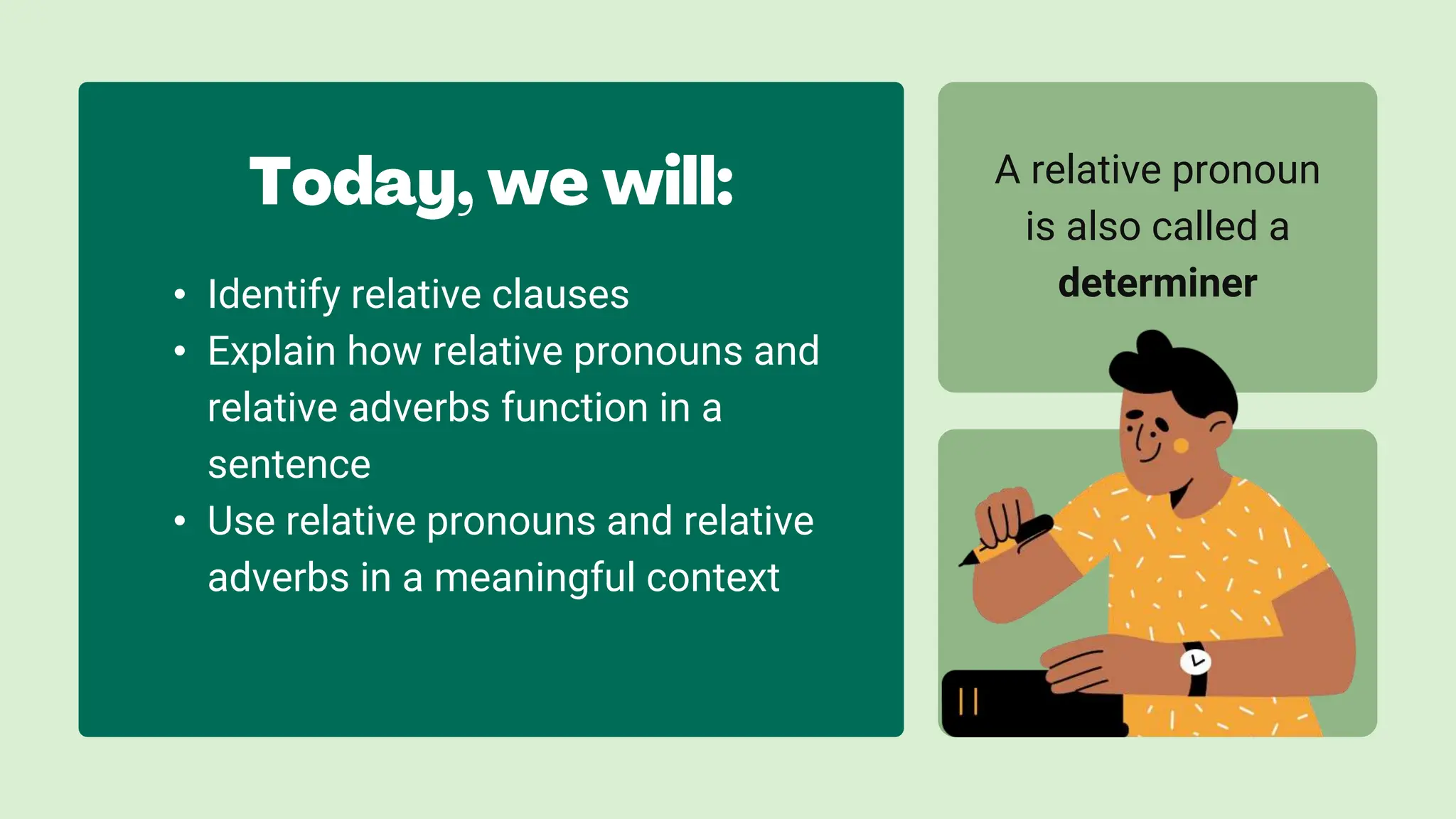
A relative pronoun
is also called a
determiner
• Identify relative clauses
• Explain how relative pronouns and
relative adverbs function in a
sentence
• Use relative pronouns and relative
adverbs in a meaningful context
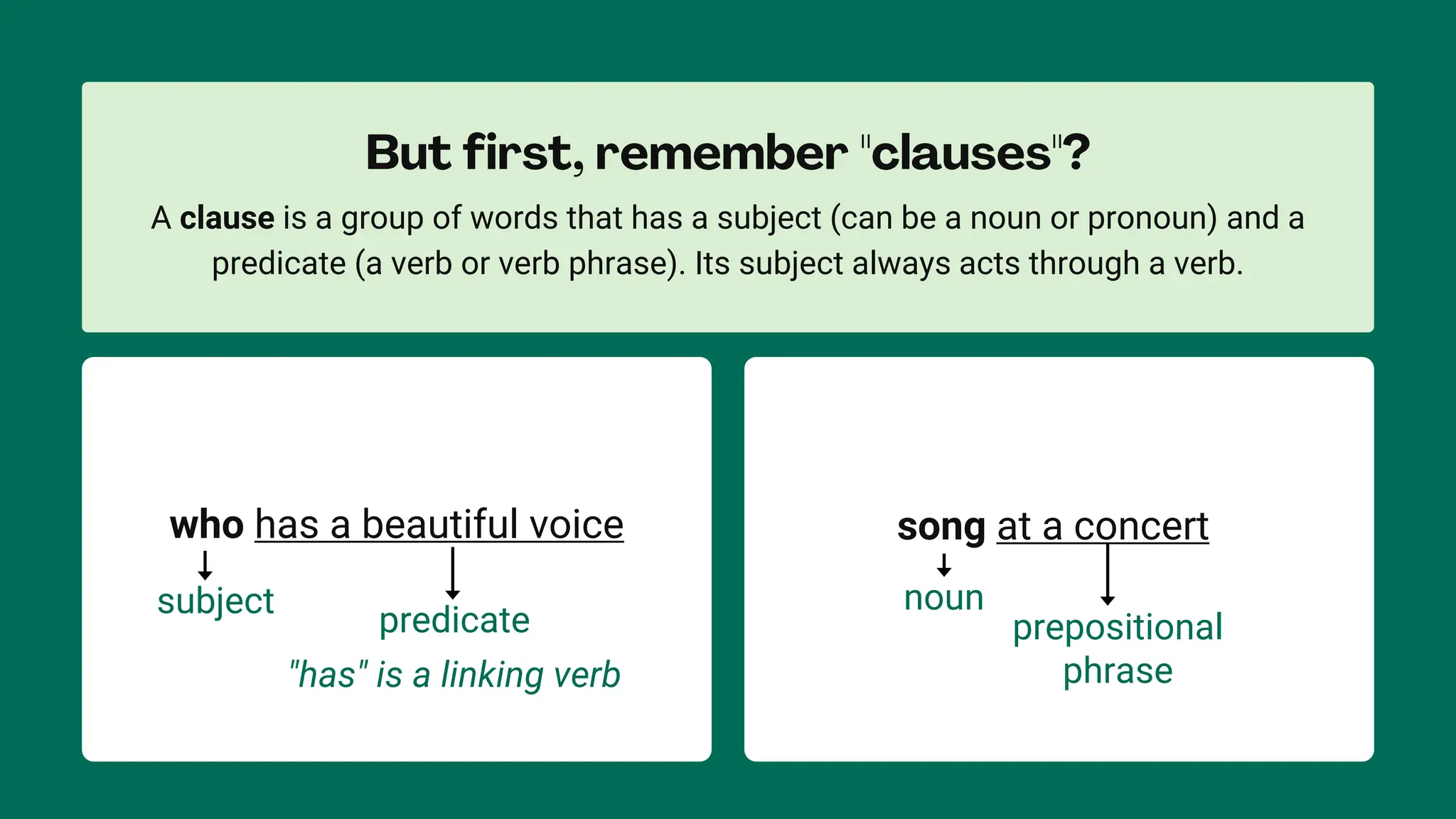
who has a beautiful voice
A clause is a group of words that has a subject (can be a noun or pronoun) and a
predicate (a verb or verb phrase). Its subject always acts through a verb.
a clause not a clause but a phrase
song at a concert
subject
predicate
"has" is a linking verb
noun
prepositional
phrase
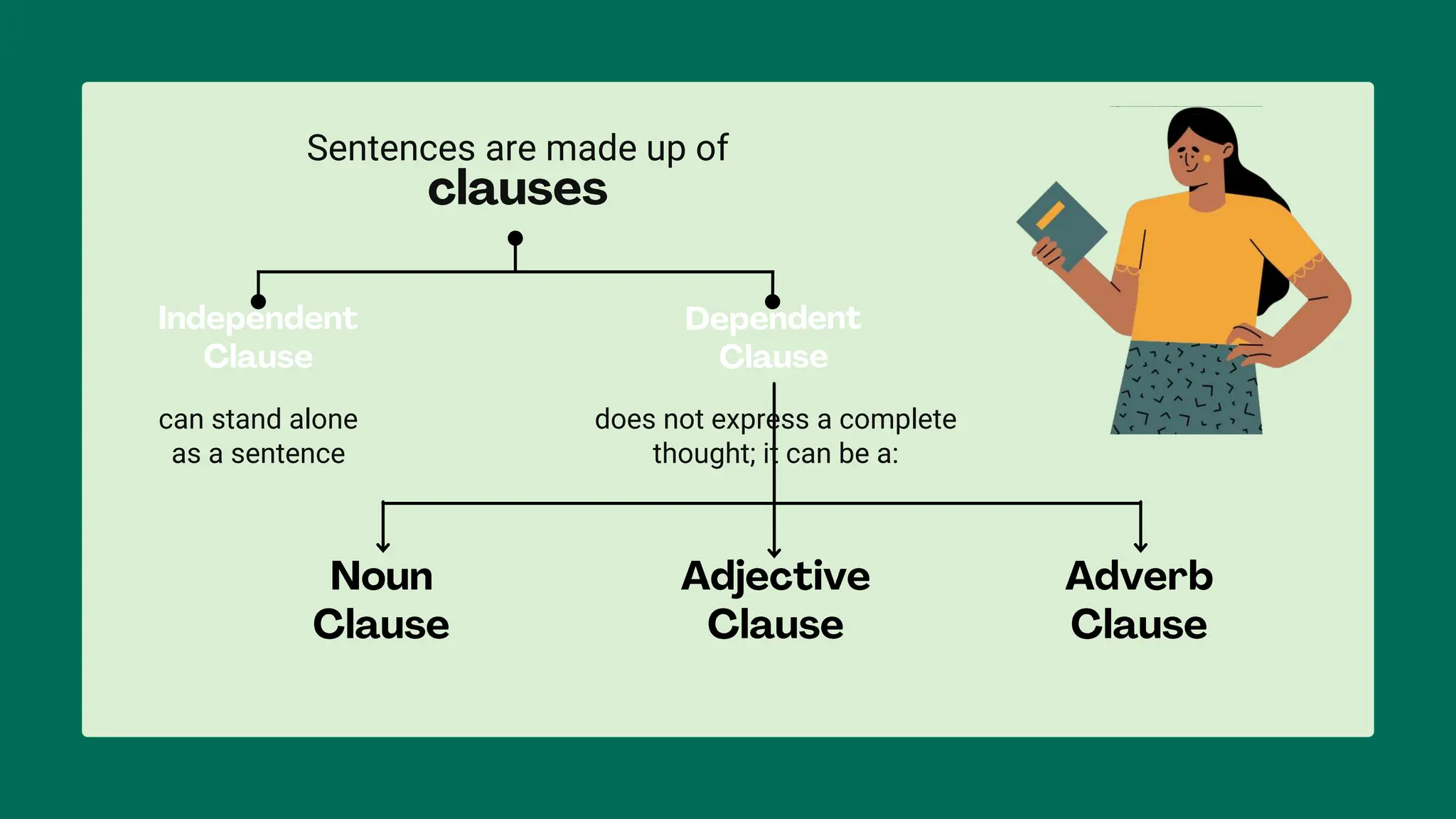
can stand alone
as a sentence
does not express a complete
thought; it can be a:
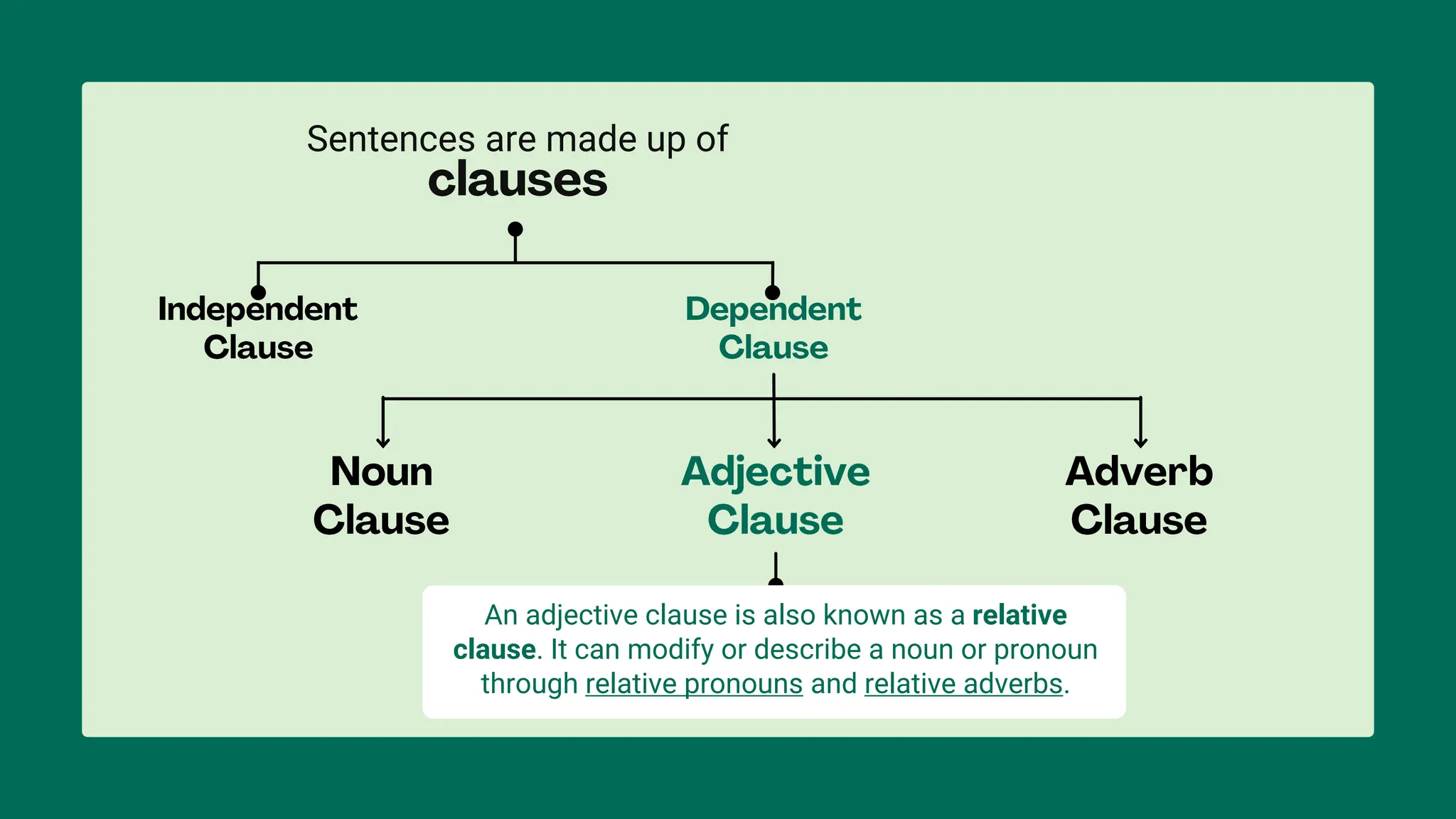
Sentences are made up of
An adjective clause is also known as a relative
clause. It can modify or describe a noun or pronoun
through relative pronouns and relative adverbs.
• Relative Pronouns
• Relative Adverbs
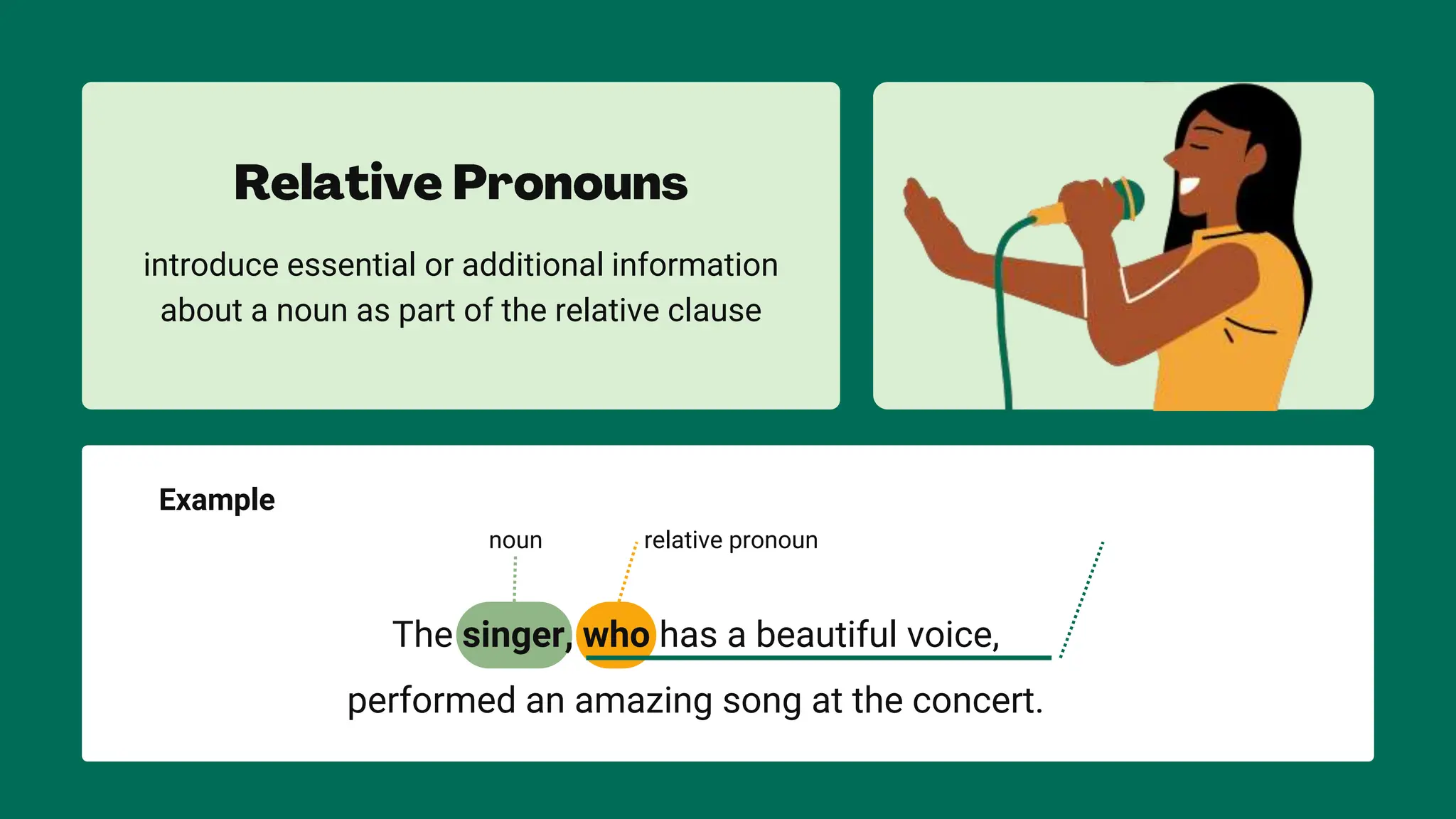
Example
introduce essential or additional information
about a noun as part of the relative clause
relative clause
noun relative pronoun
The singer, who has a beautiful voice,
performed an amazing song at the concert.
also refer back to a noun in the main
clause of a sentence
refers to people
and personified
animals and
things as
subjects
Who
used for people
when the
person is the
object of the
verb
Whom
indicates
possession for
people and
personified
animals and
things
Whose
relates to people,
animals, and
things
That
refers to animals,
things, and ideas
Which
• The musician who wrote this song is amazing.
• He thanked the audience; most of whom were
avid fans.
• That's the girl whose performance outshined all
the other singers in the show.
• The musician who wrote this song is amazing.
• He thanked the audience; most of whom were
avid fans.
• That's the girl whose performance outshined all
the other singers in the show.
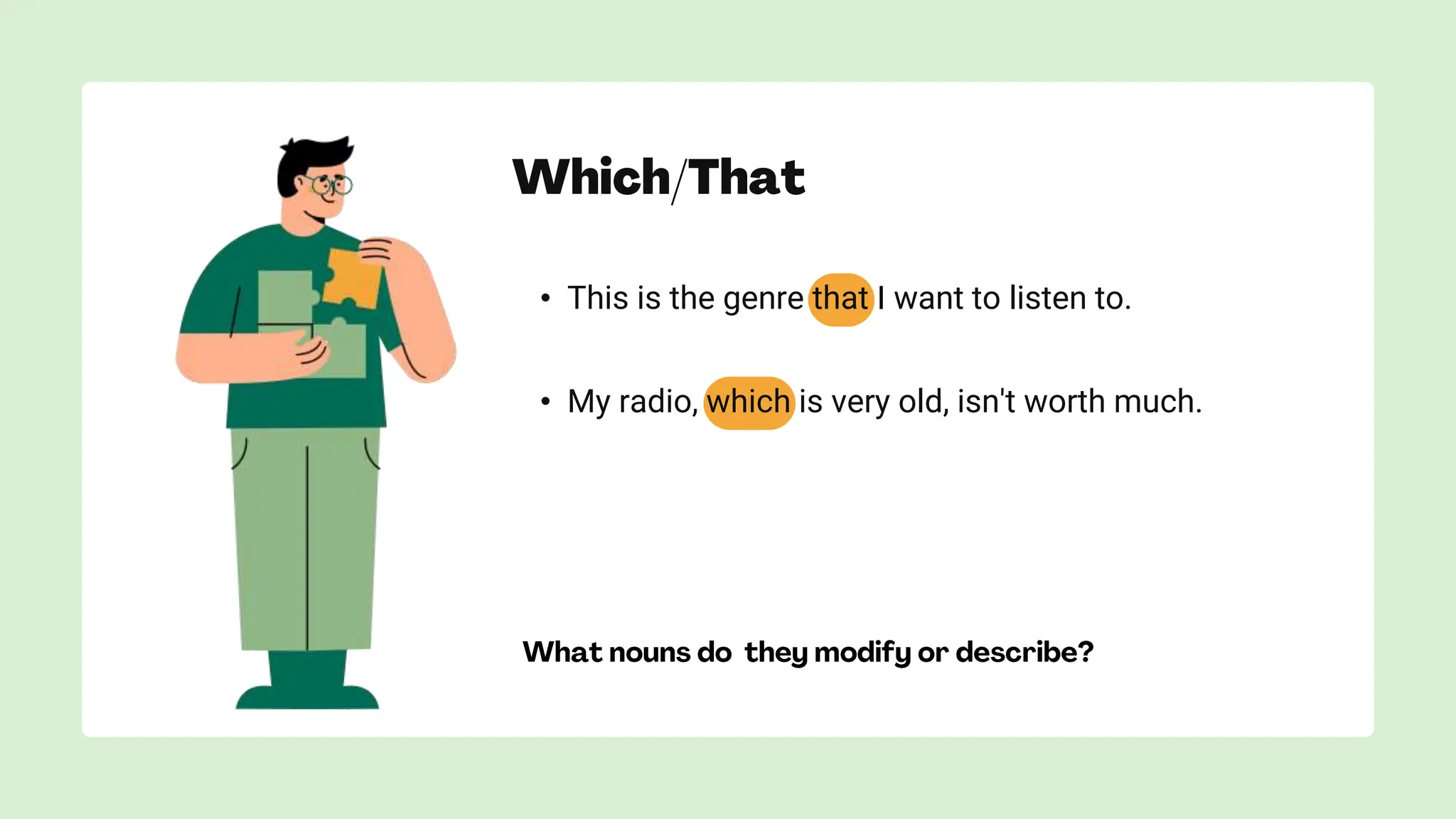
• This is the genre that I want to listen to.
• My radio, which is very old, isn't worth much.
• This is the genre that I want to listen to.
• My radio, which is very old, isn't worth much.
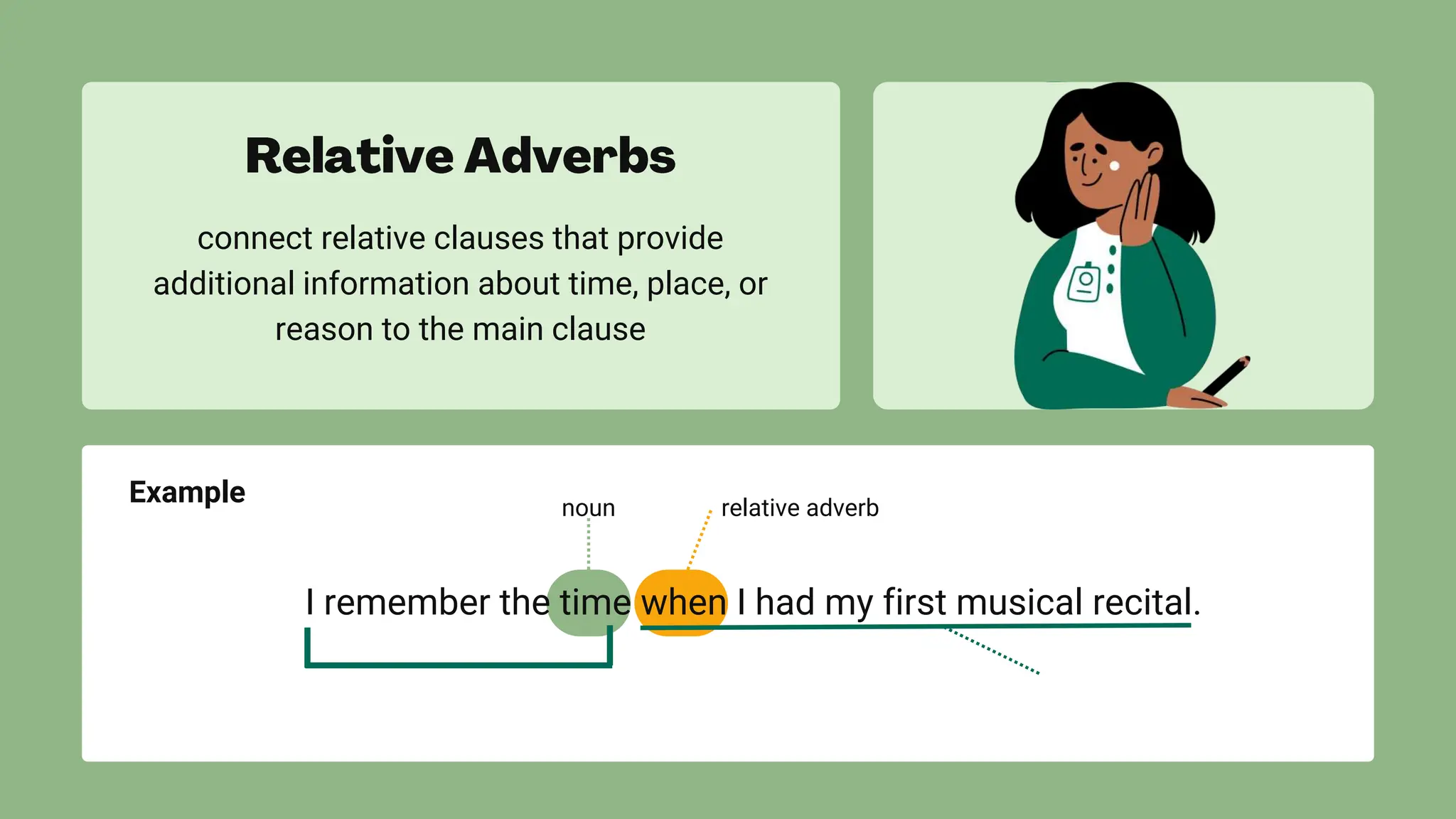
noun
I remember the time when I had my first musical recital.
Example
connect relative clauses that provide
additional information about time, place, or
reason to the main clause
relative clause
relative adverb
main clause
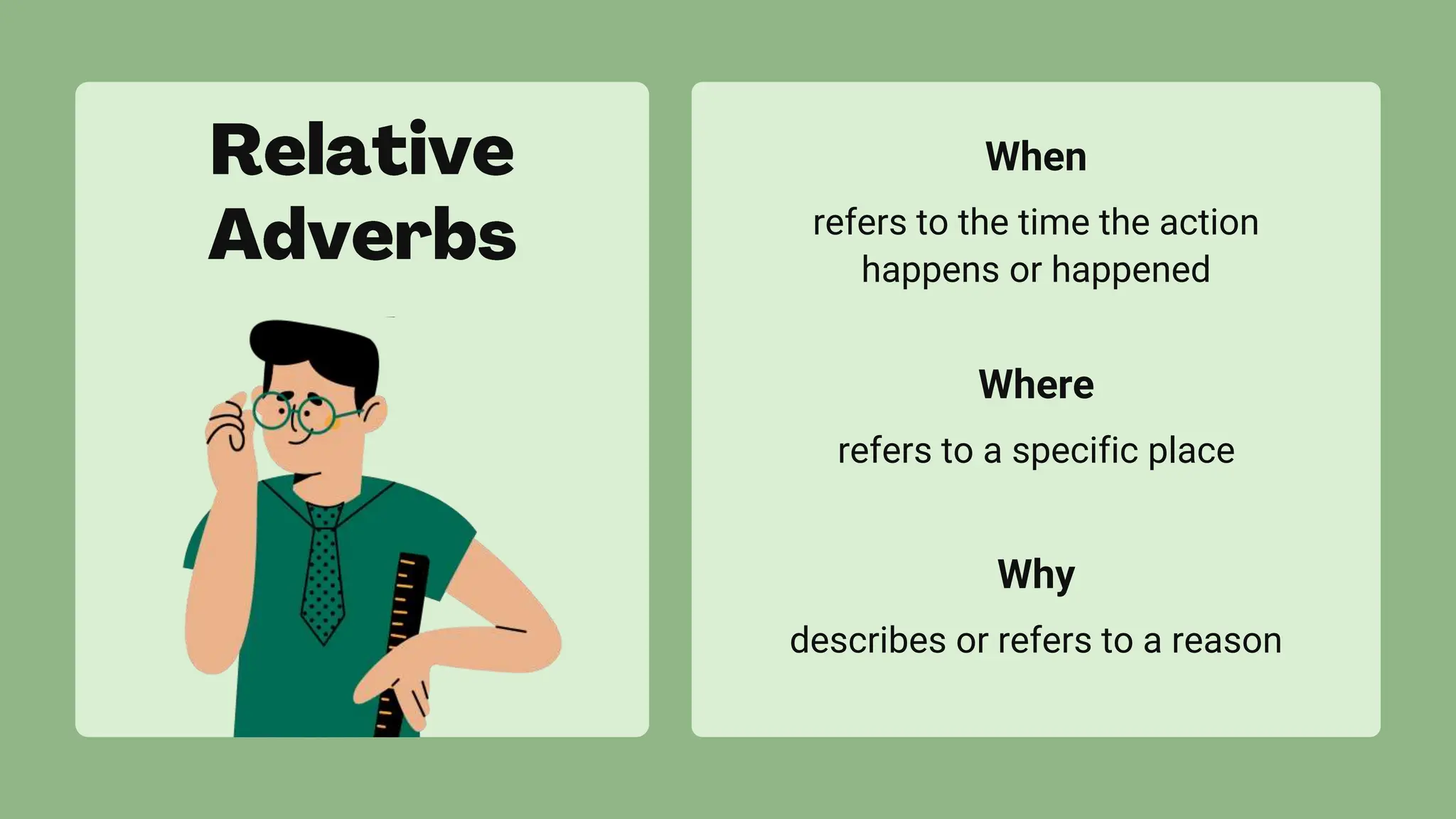
When
refers to the time the action
happens or happened
Where
refers to a specific place
Why
describes or refers to a reason
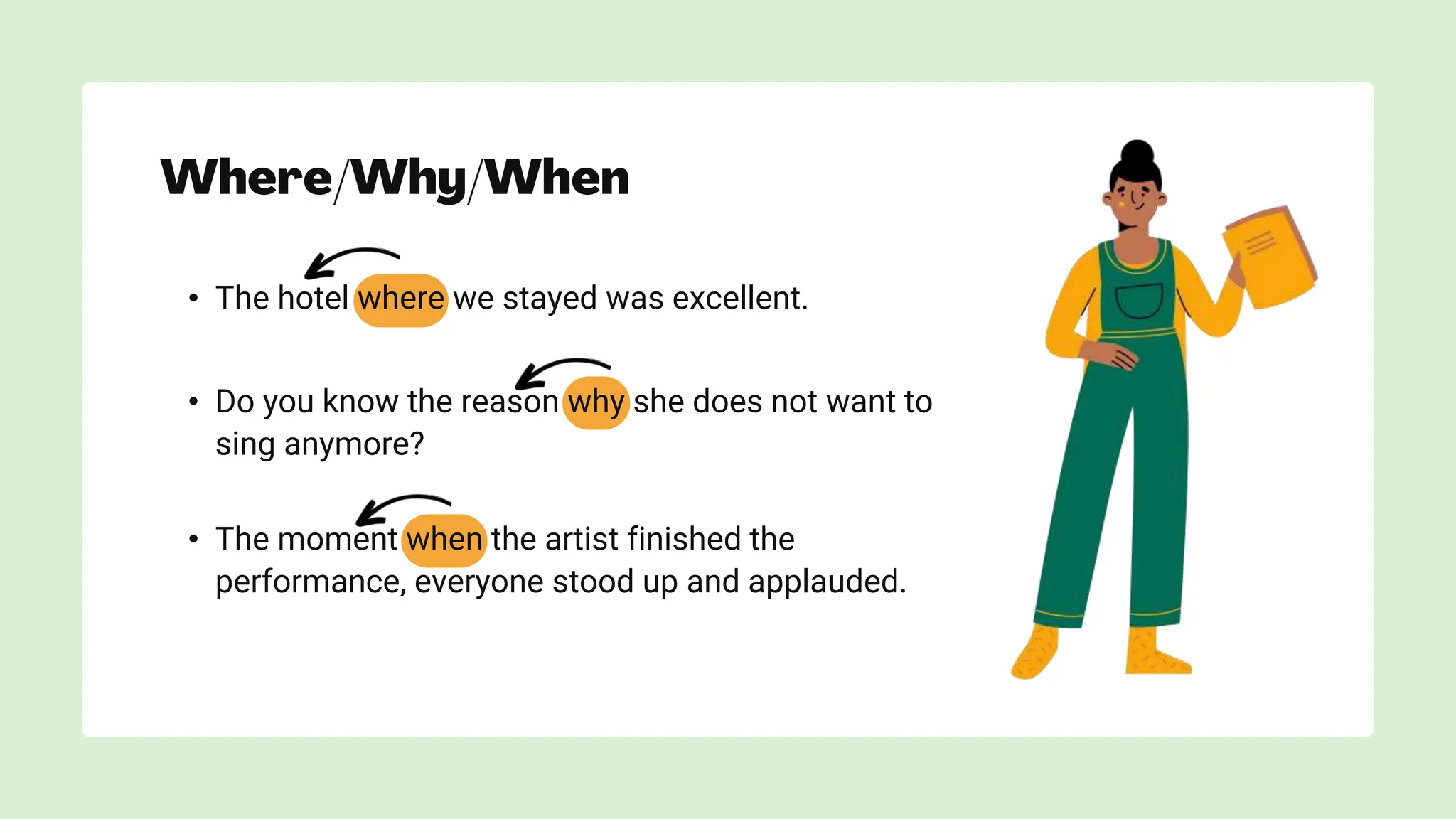
• The hotel where we stayed was excellent.
• Do you know the reason why she does not want to
sing anymore?
• The moment when the artist finished the
performance, everyone stood up and applauded.
• The hotel where we stayed was excellent.
• Do you know the reason why she does not want to
sing anymore?
• The moment when the artist finished the
performance, everyone stood up and applauded.
1. Elaine, the vocalist, is someone ___________ my brother admires.
4. It was very cold __________ the band performed a concert before the break.
5. The concert tickets, _________ my dad initially reserved, had been sold
to another person.
2. Tell me _________ you missed the choir activity.
3. I am the one _______ requested for an upbeat song.
6. That's the stop _________ we get our bus.
1. Elaine, the vocalist, is someone whom my brother admires.
4. It was very cold when the band performed a concert before the break.
5. The concert tickets, which my dad initially reserved, had been sold to
another person.
2. Tell me why you missed the choir practice.
3. I am the one who requested for an upbeat song.
6. That's the stop where we get our bus.
• Relative clause or adjective clause describes or
modifies a noun or pronoun.
• Relative pronouns and relative adverbs introduce
a relative clause and connect it to the main clause.
⚬ Relative pronouns give specific or additional
information about a noun or pronoun
⚬ Relative adverbs provide information about
time, place, or reason
*Please delete this section before downloading.
Use these icons and illustrations in
your Canva Presentation. Happy
designing! Don't forget to delete
this page before presenting.
C for confetti
D for a drumroll
O for bubbles
Any number from 0-9
for a timer
B for blur
Q for quiet
U for unveil
M for mic drop

Relative Pronouns and Relative Adverbs Education Presentation in Green Yellow Semi-Realistic Flat Graphic Style.pptx

  • 1.
    Modifying nouns andpronouns and introducing relative clauses
  • 2.
    A relative pronoun isalso called a determiner • Identify relative clauses • Explain how relative pronouns and relative adverbs function in a sentence • Use relative pronouns and relative adverbs in a meaningful context
  • 3.
    who has abeautiful voice A clause is a group of words that has a subject (can be a noun or pronoun) and a predicate (a verb or verb phrase). Its subject always acts through a verb. a clause not a clause but a phrase song at a concert subject predicate "has" is a linking verb noun prepositional phrase
  • 4.
    can stand alone asa sentence does not express a complete thought; it can be a: Sentences are made up of
  • 5.
    Sentences are madeup of An adjective clause is also known as a relative clause. It can modify or describe a noun or pronoun through relative pronouns and relative adverbs.
  • 6.
    • Relative Pronouns •Relative Adverbs
  • 7.
    Example introduce essential oradditional information about a noun as part of the relative clause relative clause noun relative pronoun The singer, who has a beautiful voice, performed an amazing song at the concert.
  • 8.
    also refer backto a noun in the main clause of a sentence refers to people and personified animals and things as subjects Who used for people when the person is the object of the verb Whom indicates possession for people and personified animals and things Whose relates to people, animals, and things That refers to animals, things, and ideas Which
  • 9.
    • The musicianwho wrote this song is amazing. • He thanked the audience; most of whom were avid fans. • That's the girl whose performance outshined all the other singers in the show.
  • 10.
    • The musicianwho wrote this song is amazing. • He thanked the audience; most of whom were avid fans. • That's the girl whose performance outshined all the other singers in the show.
  • 11.
    • This isthe genre that I want to listen to. • My radio, which is very old, isn't worth much.
  • 12.
    • This isthe genre that I want to listen to. • My radio, which is very old, isn't worth much.
  • 13.
    noun I remember thetime when I had my first musical recital. Example connect relative clauses that provide additional information about time, place, or reason to the main clause relative clause relative adverb main clause
  • 14.
    When refers to thetime the action happens or happened Where refers to a specific place Why describes or refers to a reason
  • 15.
    • The hotelwhere we stayed was excellent. • Do you know the reason why she does not want to sing anymore? • The moment when the artist finished the performance, everyone stood up and applauded.
  • 16.
    • The hotelwhere we stayed was excellent. • Do you know the reason why she does not want to sing anymore? • The moment when the artist finished the performance, everyone stood up and applauded.
  • 17.
    1. Elaine, thevocalist, is someone ___________ my brother admires. 4. It was very cold __________ the band performed a concert before the break. 5. The concert tickets, _________ my dad initially reserved, had been sold to another person. 2. Tell me _________ you missed the choir activity. 3. I am the one _______ requested for an upbeat song. 6. That's the stop _________ we get our bus.
  • 18.
    1. Elaine, thevocalist, is someone whom my brother admires. 4. It was very cold when the band performed a concert before the break. 5. The concert tickets, which my dad initially reserved, had been sold to another person. 2. Tell me why you missed the choir practice. 3. I am the one who requested for an upbeat song. 6. That's the stop where we get our bus.
  • 19.
    • Relative clauseor adjective clause describes or modifies a noun or pronoun. • Relative pronouns and relative adverbs introduce a relative clause and connect it to the main clause. ⚬ Relative pronouns give specific or additional information about a noun or pronoun ⚬ Relative adverbs provide information about time, place, or reason
  • 20.
    *Please delete thissection before downloading.
  • 21.
    Use these iconsand illustrations in your Canva Presentation. Happy designing! Don't forget to delete this page before presenting.
  • 22.
    C for confetti Dfor a drumroll O for bubbles Any number from 0-9 for a timer B for blur Q for quiet U for unveil M for mic drop