Office of Overseas Programming &
Training Support (OPATS)
Feedback and Error Correction
Global Standards for Education
Learning Objectives
 Identify: (a) what good feedback should do for
students, (b) what good feedback shouldn’t do to
students, (c) techniques that provide supportive
feedback.
 Analyze case studies of teacher-student
interactions to determine when and how to give
effective feedback.
 Practice using error correction techniques.
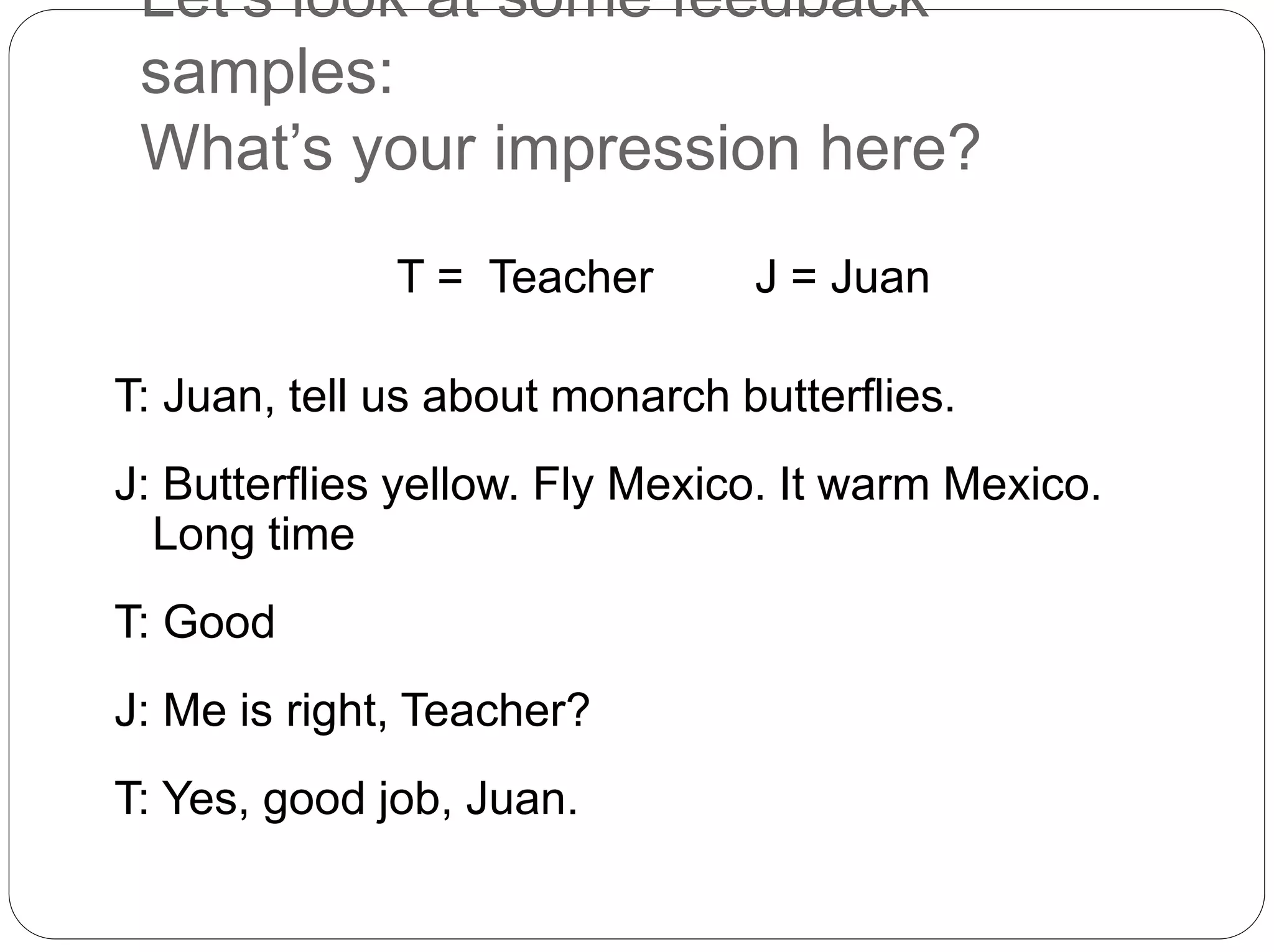
Let’s look at some feedback
samples:
What’s your impression here?
T = Teacher J = Juan
T: Juan, tell us about monarch butterflies.
J: Butterflies yellow. Fly Mexico. It warm Mexico.
Long time
T: Good
J: Me is right, Teacher?
T: Yes, good job, Juan.
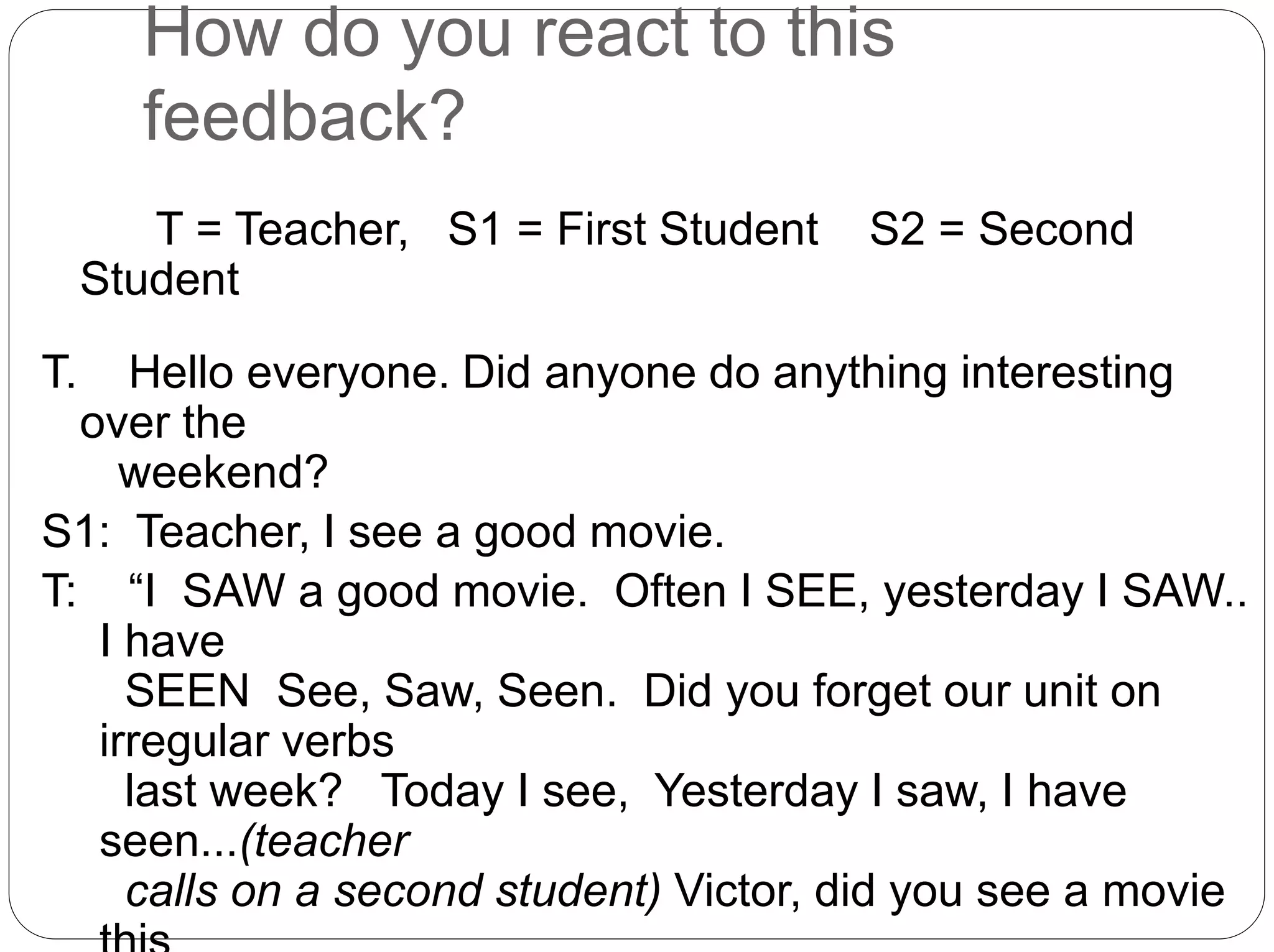
How do you react to this
feedback?
T = Teacher, S1 = First Student S2 = Second
Student
T. Hello everyone. Did anyone do anything interesting
over the
weekend?
S1: Teacher, I see a good movie.
T: “I SAW a good movie. Often I SEE, yesterday I SAW..
I have
SEEN See, Saw, Seen. Did you forget our unit on
irregular verbs
last week? Today I see, Yesterday I saw, I have
seen...(teacher
calls on a second student) Victor, did you see a movie
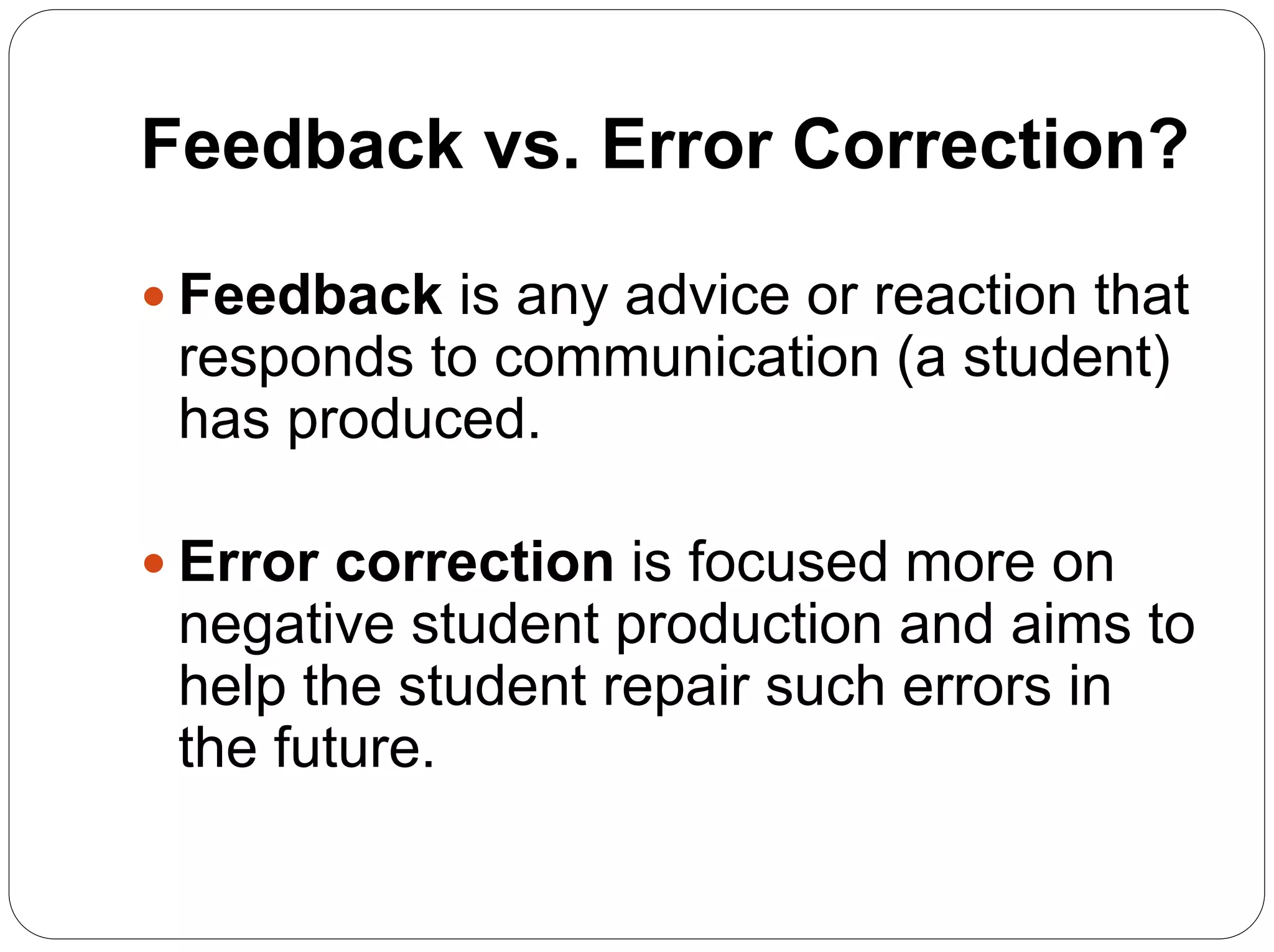
Giving Feedback
GIVING FEEDBACK
Feedback vs. Error Correction?
 Feedback is any advice or reaction that
responds to communication (a student)
has produced.
 Error correction is focused more on
negative student production and aims to
help the student repair such errors in
the future.
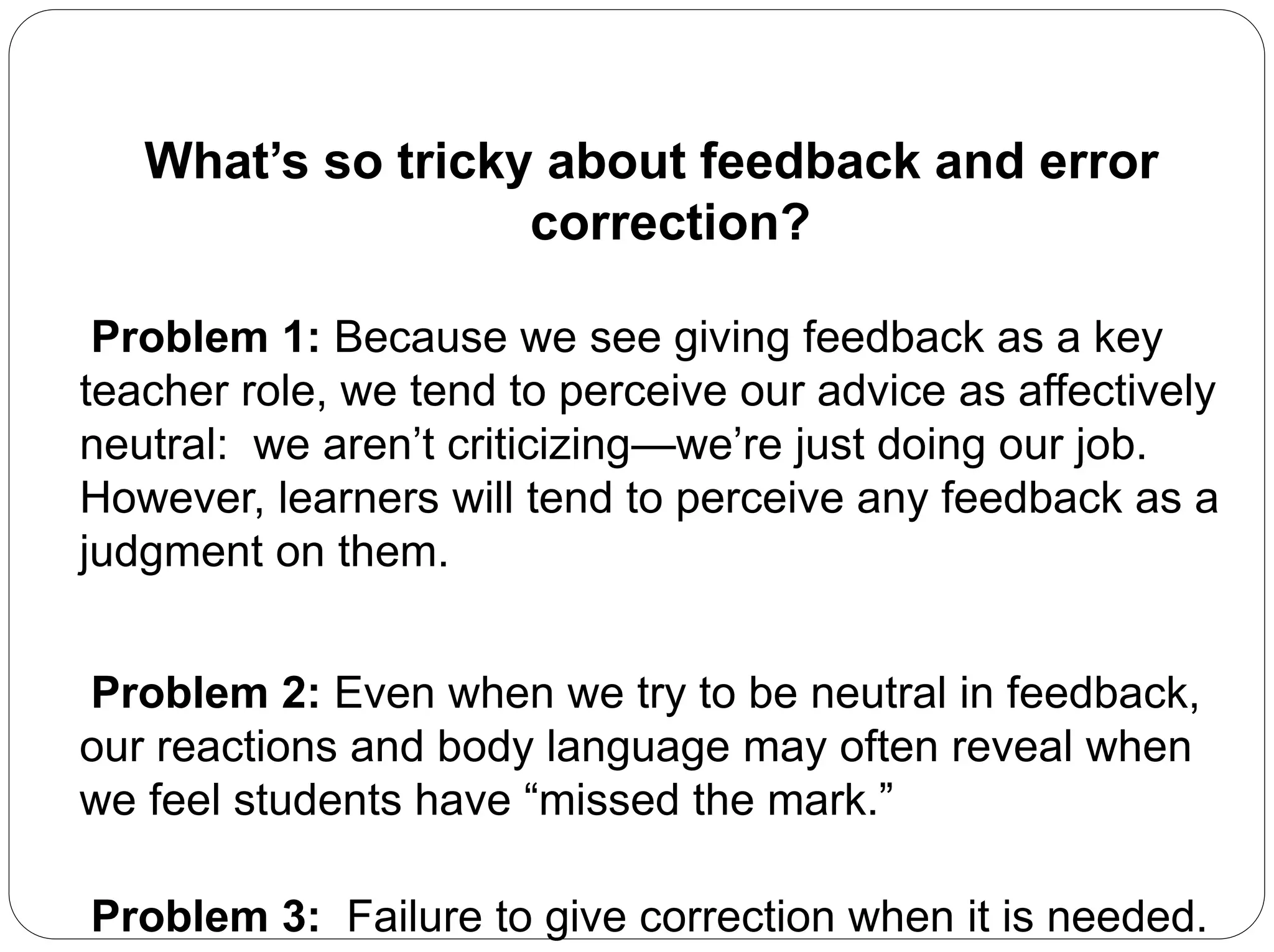
What’s so tricky about feedback and error
correction?
Problem 1: Because we see giving feedback as a key
teacher role, we tend to perceive our advice as affectively
neutral: we aren’t criticizing—we’re just doing our job.
However, learners will tend to perceive any feedback as a
judgment on them.
Problem 2: Even when we try to be neutral in feedback,
our reactions and body language may often reveal when
we feel students have “missed the mark.”
Problem 3: Failure to give correction when it is needed.
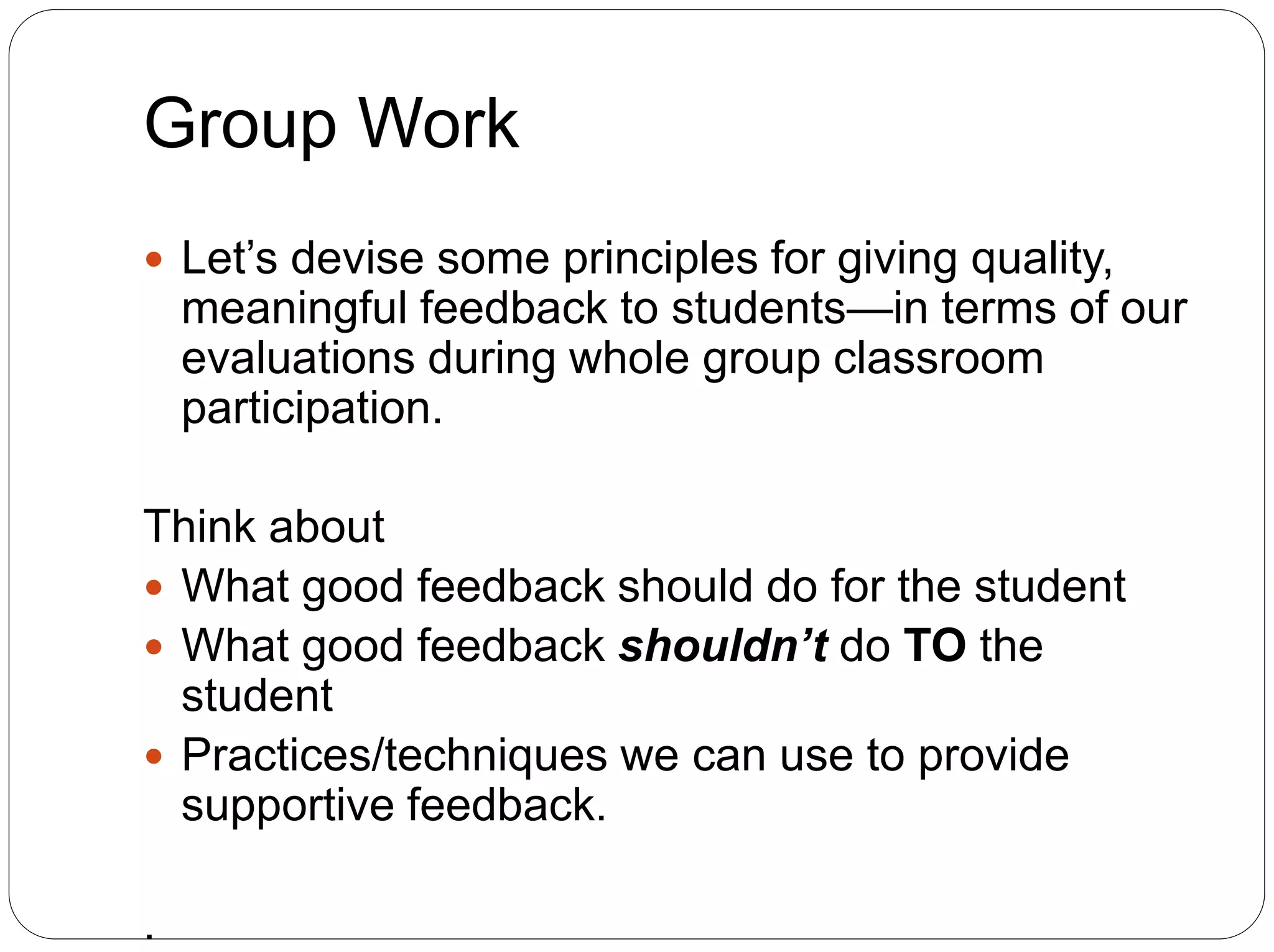
Group Work
 Let’s devise some principles for giving quality,
meaningful feedback to students—in terms of our
evaluations during whole group classroom
participation.
Think about
 What good feedback should do for the student
 What good feedback shouldn’t do TO the
student
 Practices/techniques we can use to provide
supportive feedback.
.
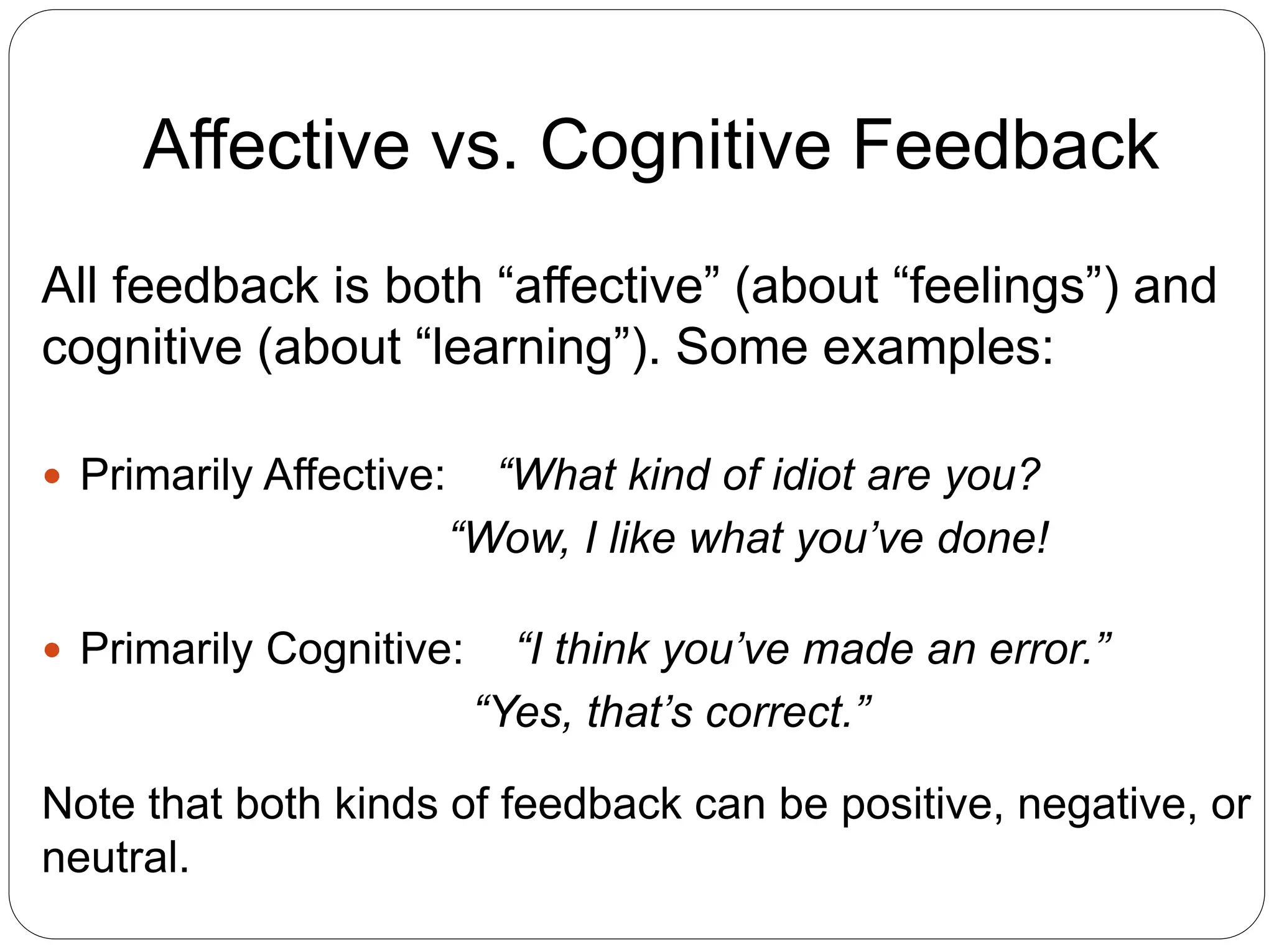
Affective vs. Cognitive Feedback
All feedback is both “affective” (about “feelings”) and
cognitive (about “learning”). Some examples:
 Primarily Affective: “What kind of idiot are you?
“Wow, I like what you’ve done!
 Primarily Cognitive: “I think you’ve made an error.”
“Yes, that’s correct.”
Note that both kinds of feedback can be positive, negative, or
neutral.
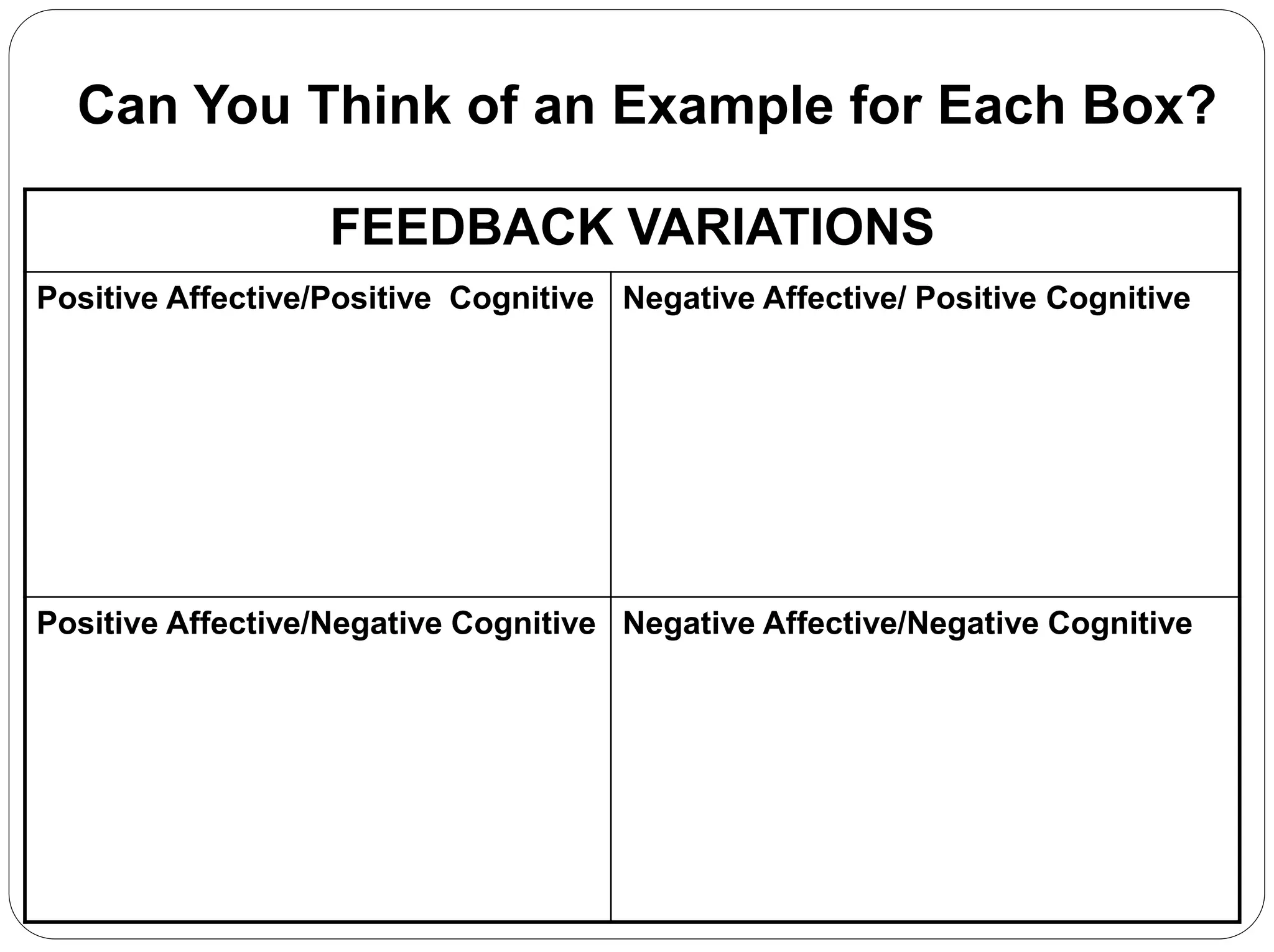
FEEDBACK VARIATIONS
Positive Affective/Positive Cognitive Negative Affective/ Positive Cognitive
Positive Affective/Negative Cognitive Negative Affective/Negative Cognitive
Can You Think of an Example for Each Box?
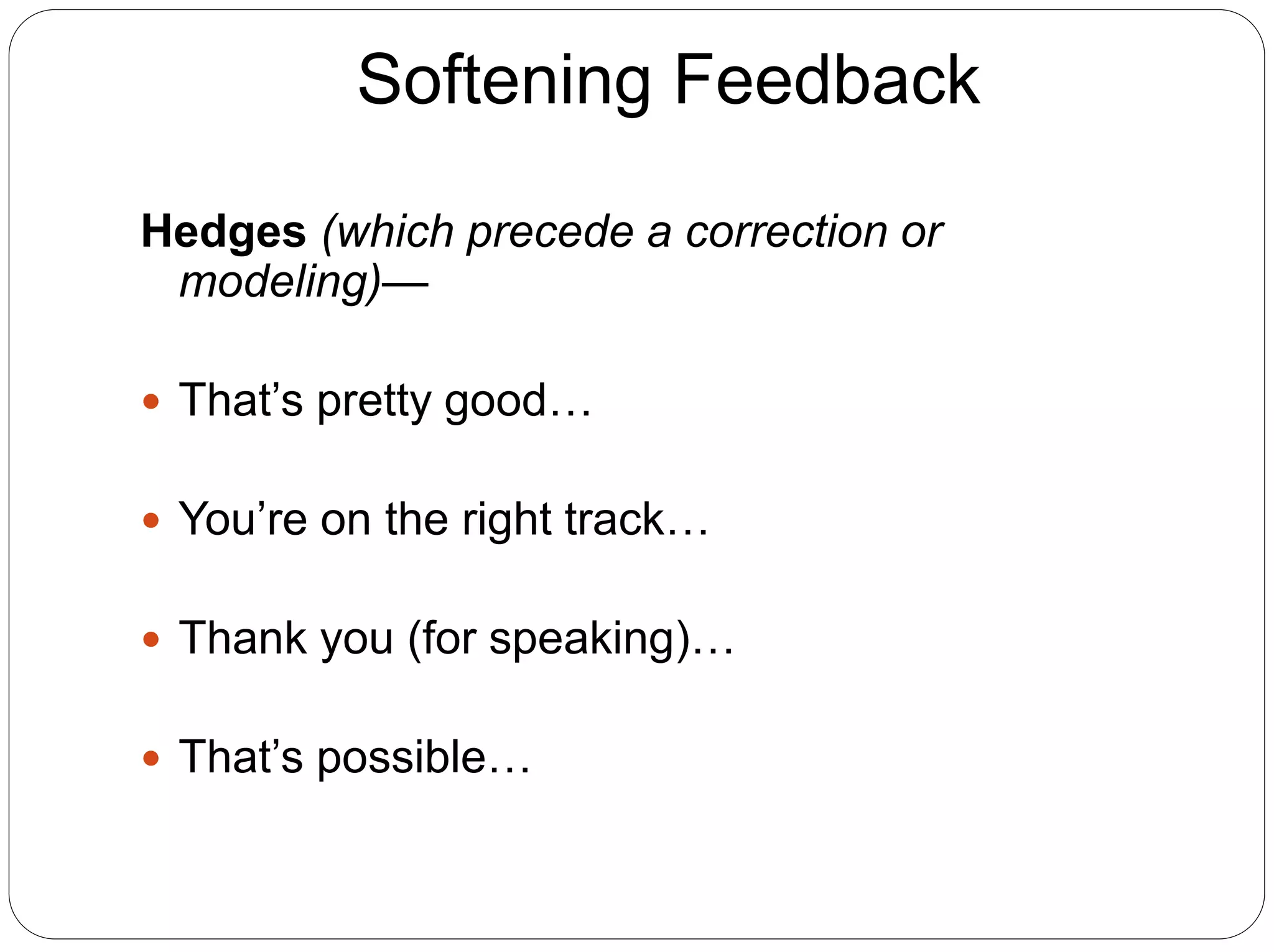
Softening Feedback
Hedges (which precede a correction or
modeling)—
 That’s pretty good…
 You’re on the right track…
 Thank you (for speaking)…
 That’s possible…
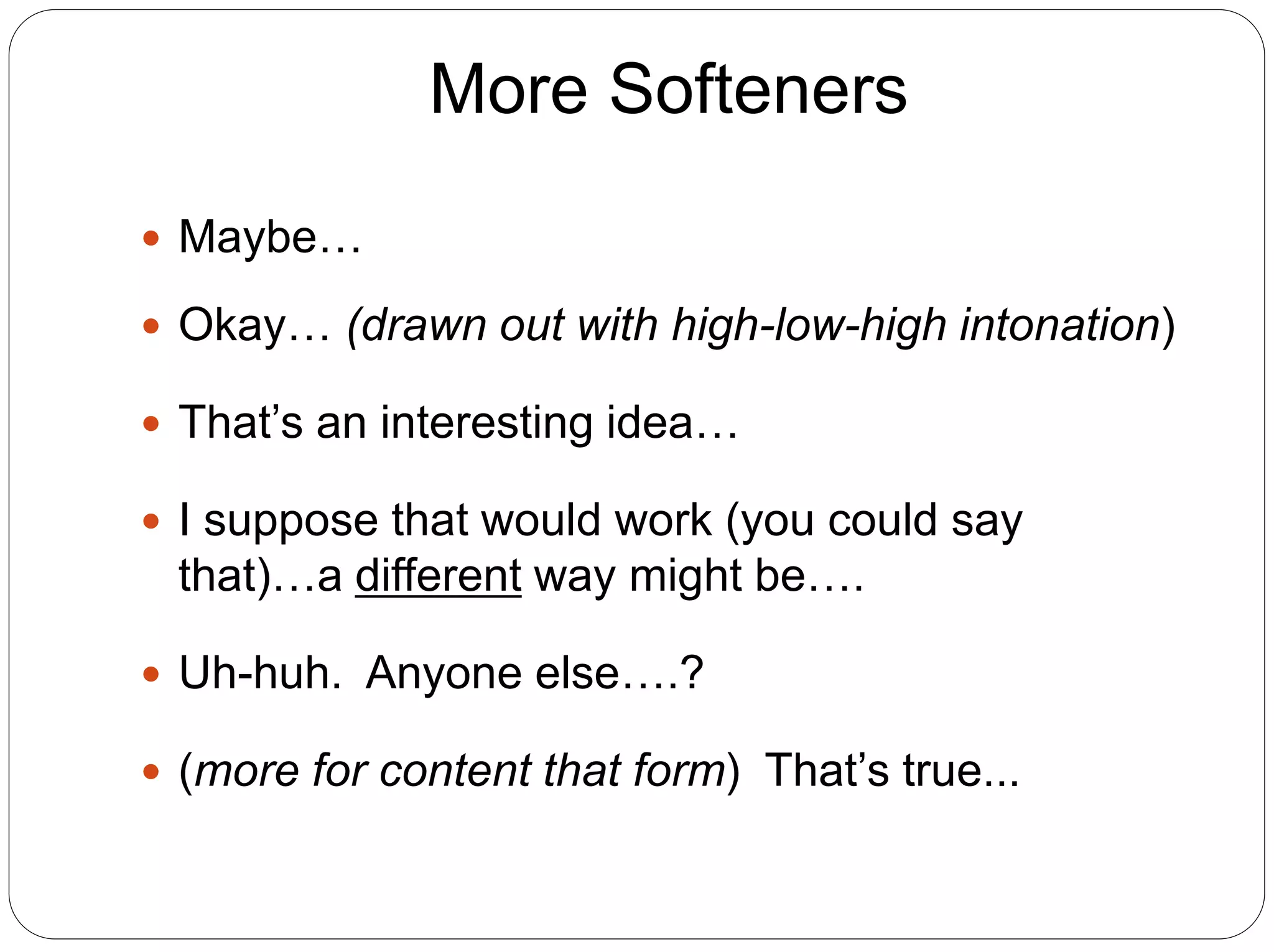
More Softeners
 Maybe…
 Okay… (drawn out with high-low-high intonation)
 That’s an interesting idea…
 I suppose that would work (you could say
that)…a different way might be….
 Uh-huh. Anyone else….?
 (more for content that form) That’s true...
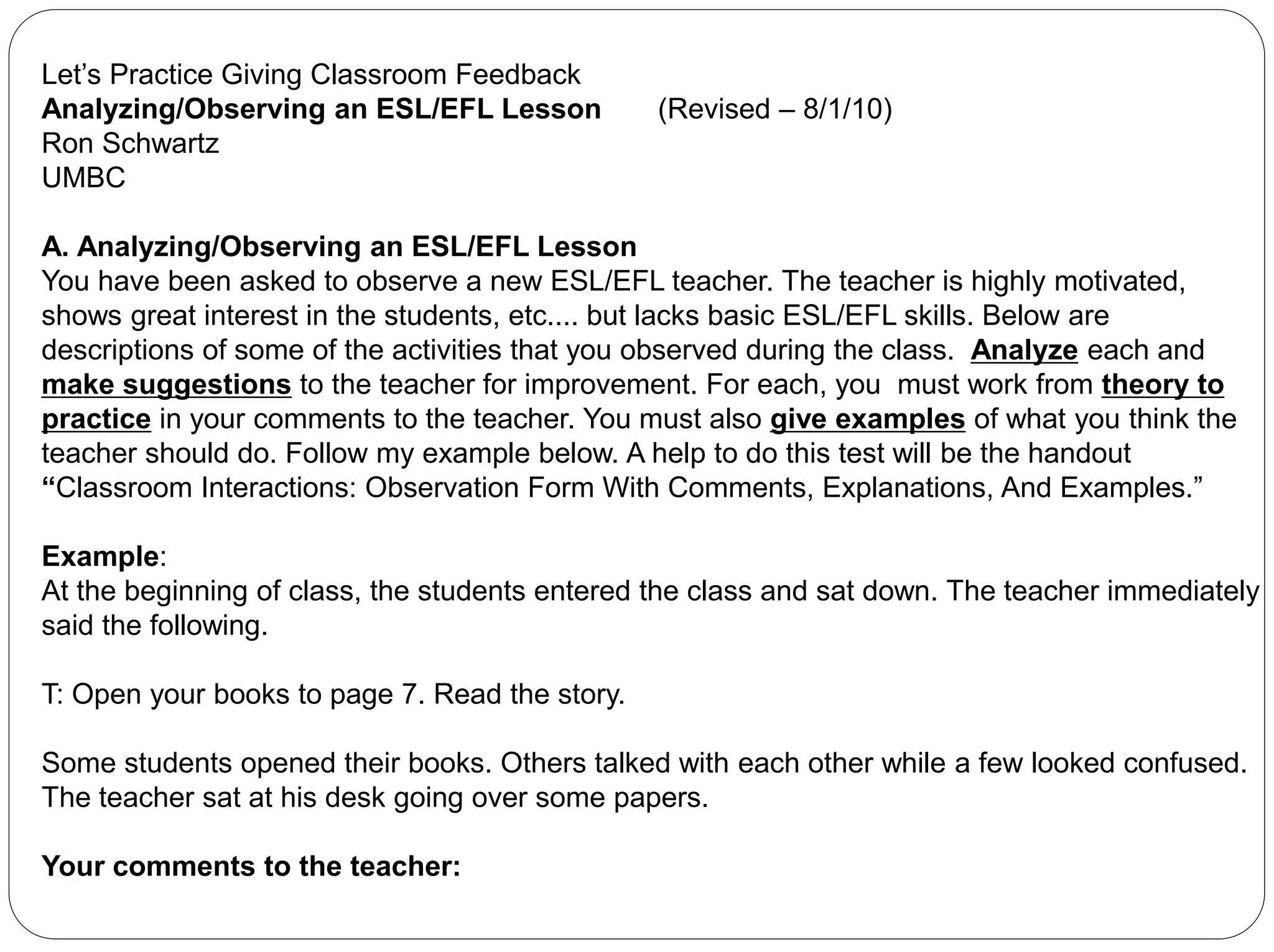
Let’s Practice Giving Classroom Feedback
Analyzing/Observing an ESL/EFL Lesson (Revised – 8/1/10)
Ron Schwartz
UMBC
A. Analyzing/Observing an ESL/EFL Lesson
You have been asked to observe a new ESL/EFL teacher. The teacher is highly motivated,
shows great interest in the students, etc.... but lacks basic ESL/EFL skills. Below are
descriptions of some of the activities that you observed during the class. Analyze each and
make suggestions to the teacher for improvement. For each, you must work from theory to
practice in your comments to the teacher. You must also give examples of what you think the
teacher should do. Follow my example below. A help to do this test will be the handout
“Classroom Interactions: Observation Form With Comments, Explanations, And Examples.”
Example:
At the beginning of class, the students entered the class and sat down. The teacher immediately
said the following.
T: Open your books to page 7. Read the story.
Some students opened their books. Others talked with each other while a few looked confused.
The teacher sat at his desk going over some papers.
Your comments to the teacher:
Error Correction
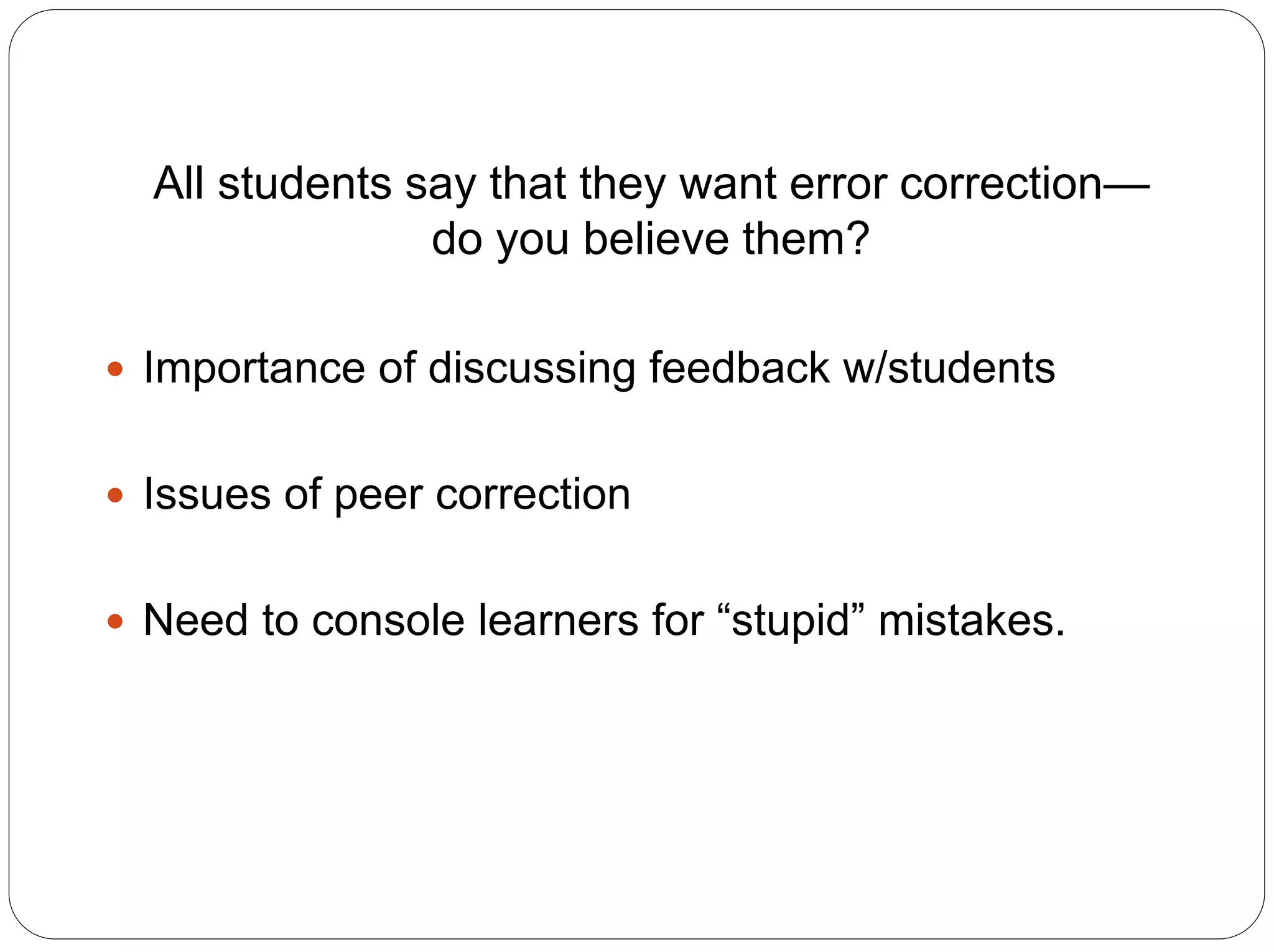
All students say that they want error correction—
do you believe them?
 Importance of discussing feedback w/students
 Issues of peer correction
 Need to console learners for “stupid” mistakes.
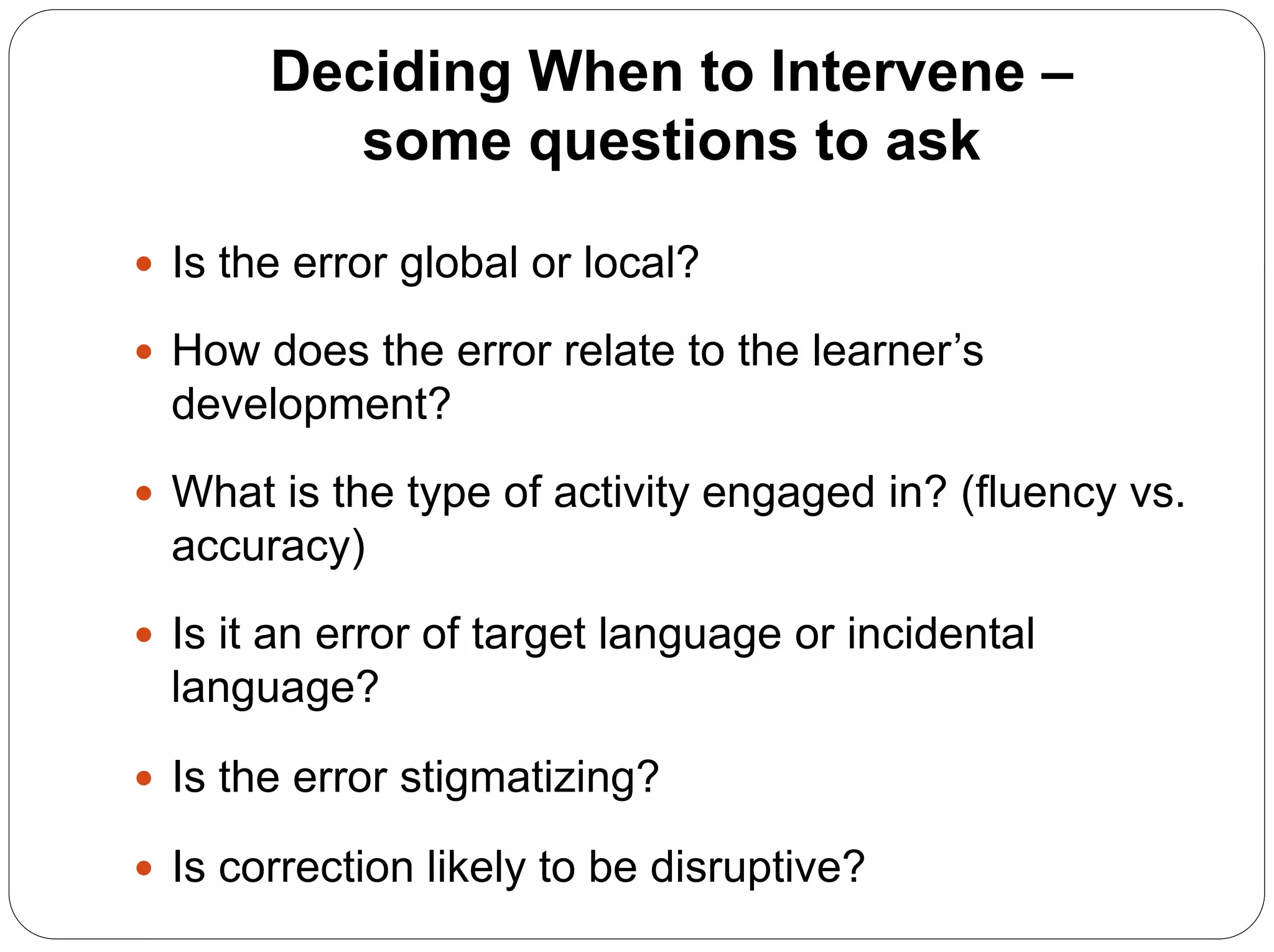
Deciding When to Intervene –
some questions to ask
 Is the error global or local?
 How does the error relate to the learner’s
development?
 What is the type of activity engaged in? (fluency vs.
accuracy)
 Is it an error of target language or incidental
language?
 Is the error stigmatizing?
 Is correction likely to be disruptive?
If you do it, when to do it?
 Immediate Correction
 Delayed Correction
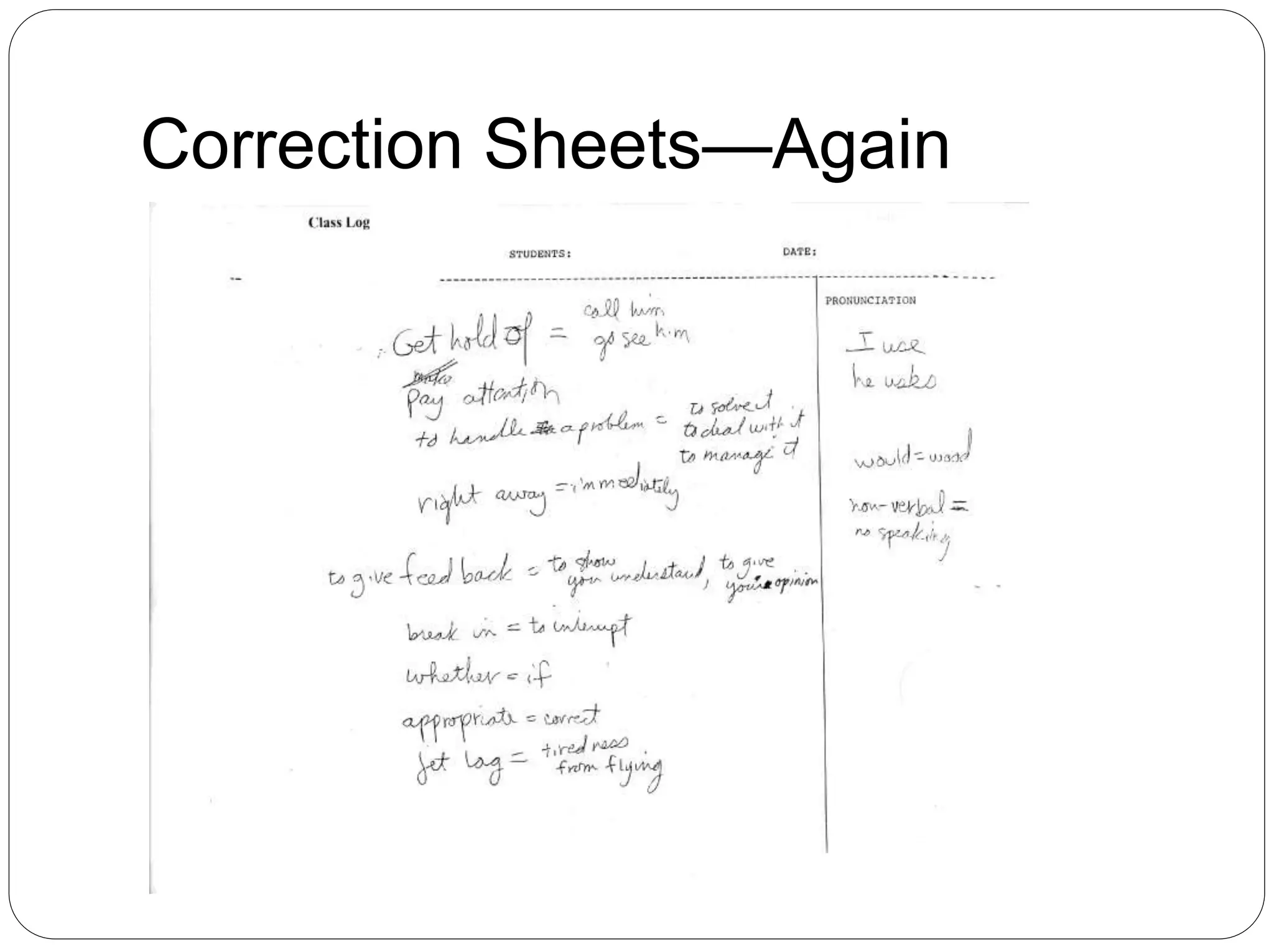
Correction Sheets—Again
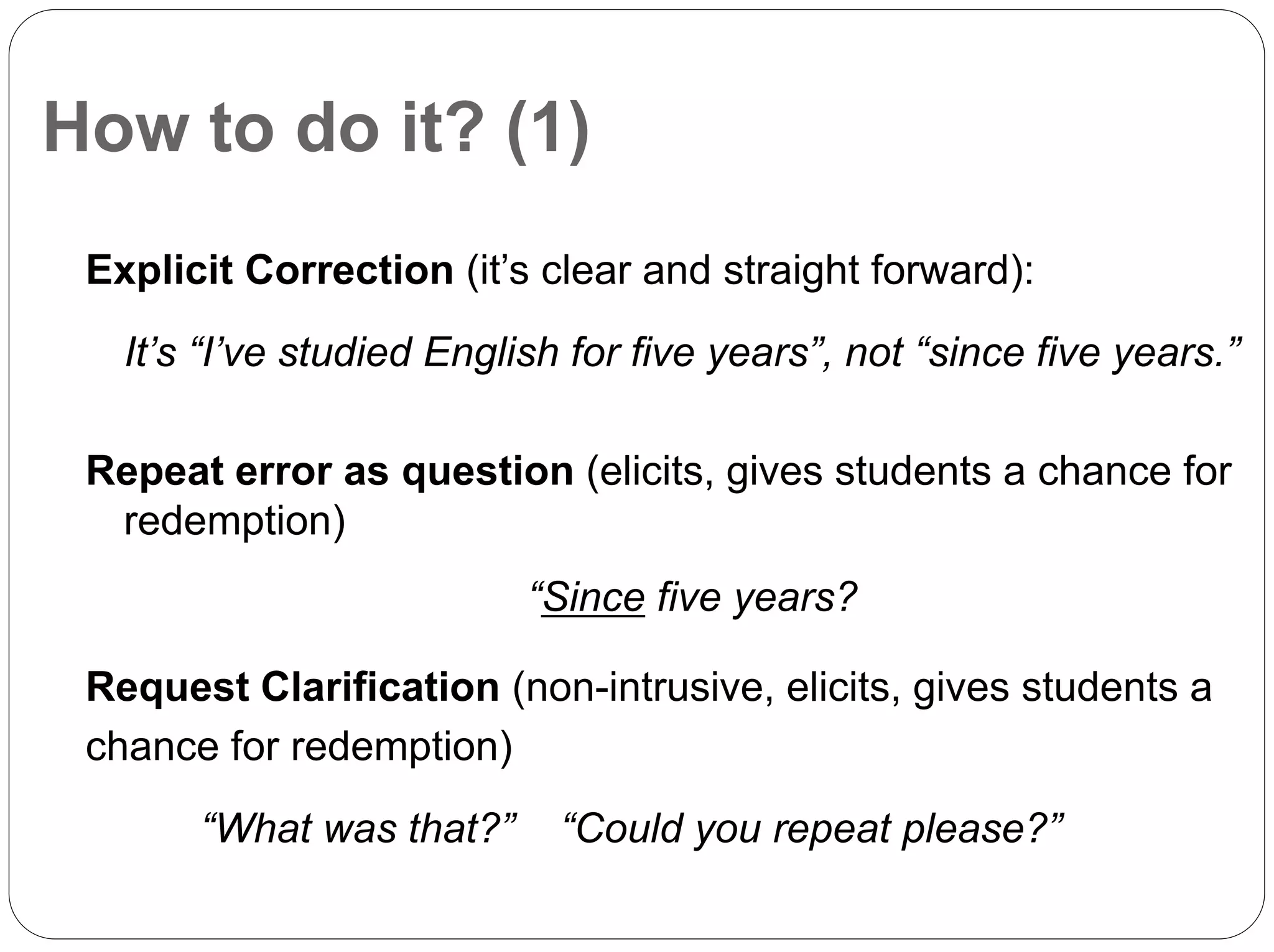
How to do it? (1)
Explicit Correction (it’s clear and straight forward):
It’s “I’ve studied English for five years”, not “since five years.”
Repeat error as question (elicits, gives students a chance for
redemption)
“Since five years?
Request Clarification (non-intrusive, elicits, gives students a
chance for redemption)
“What was that?” “Could you repeat please?”
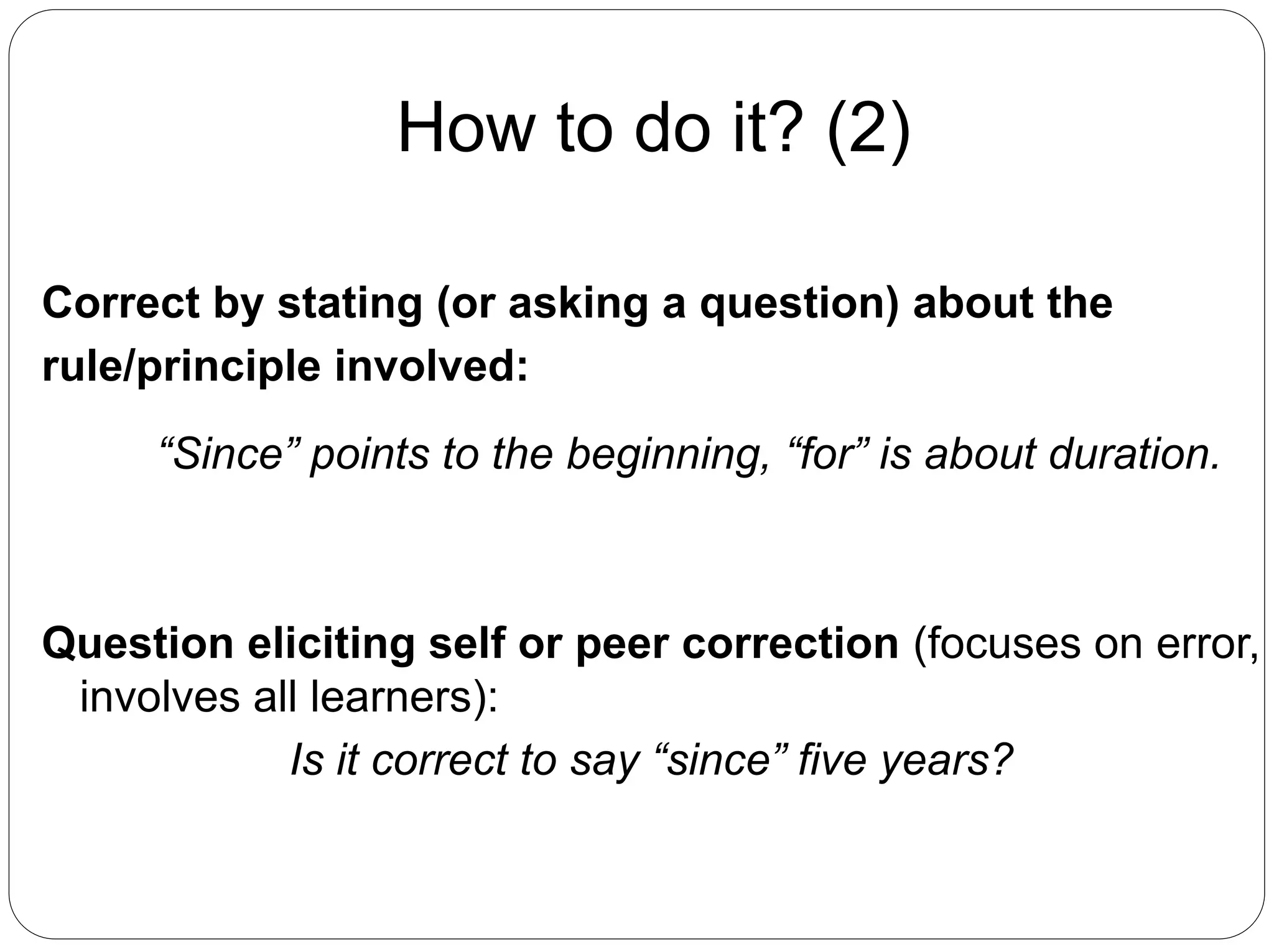
How to do it? (2)
Correct by stating (or asking a question) about the
rule/principle involved:
“Since” points to the beginning, “for” is about duration.
Question eliciting self or peer correction (focuses on error,
involves all learners):
Is it correct to say “since” five years?
How to do it? (3)
Modeling correct answer: also called “recasting.”
• less intrusive and confrontational than overt correction.
• but learners may focus on the meaning of the utterance and
not notice the correction of form:
•
Student says, “I’ve studied English *since five years.
The teacher provides a recast saying, “ I’ve studied English for five
years,”
The student replies, “Yes, that’s right,” thinking the teacher was unsure
of what the student said.
• This problem is particularly true of young learners who may
simply be developmentally incapable of noticing subtle
corrections of form.
How to do it? (4)
 In the language classroom, feedback can focus
on the language (correct vocabulary, grammar,
pronunciation or spelling, etc.)
 Or it can focus on content: was the assignment
interesting to read? Did the pair put on an
interesting skit?
So Language Feedback focuses on the quality of
language produced and Content Feedback
addresses the quality of content.
An assignment could have good content but have
some language problems or vice versa.
Try the Error Correction Activity with Your Partner
1. Sao Paulo is the large city in the world.
2. Sonia can drive very good.
3. He has already starting
4. Mr. Wu cam to Singapore last year.
5. …
You have an exit ticket to
complete
However the Exit Ticket consists of --
• Matching activity
• A fill in the blank activity
• A true/false activity
• Some “to correct or not to correct” activities,
and you can do it in pairs!
Thanks!

Global_Ed_TP_Trainer_Material1_Feedback-and-Error-Correction-Mar2019.ppt

  • 1.
    Office of OverseasProgramming & Training Support (OPATS) Feedback and Error Correction Global Standards for Education
  • 2.
    Learning Objectives  Identify:(a) what good feedback should do for students, (b) what good feedback shouldn’t do to students, (c) techniques that provide supportive feedback.  Analyze case studies of teacher-student interactions to determine when and how to give effective feedback.  Practice using error correction techniques.
  • 3.
    Let’s look atsome feedback samples: What’s your impression here? T = Teacher J = Juan T: Juan, tell us about monarch butterflies. J: Butterflies yellow. Fly Mexico. It warm Mexico. Long time T: Good J: Me is right, Teacher? T: Yes, good job, Juan.
  • 4.
    How do youreact to this feedback? T = Teacher, S1 = First Student S2 = Second Student T. Hello everyone. Did anyone do anything interesting over the weekend? S1: Teacher, I see a good movie. T: “I SAW a good movie. Often I SEE, yesterday I SAW.. I have SEEN See, Saw, Seen. Did you forget our unit on irregular verbs last week? Today I see, Yesterday I saw, I have seen...(teacher calls on a second student) Victor, did you see a movie
  • 5.
  • 6.
    Feedback vs. ErrorCorrection?  Feedback is any advice or reaction that responds to communication (a student) has produced.  Error correction is focused more on negative student production and aims to help the student repair such errors in the future.
  • 7.
    What’s so trickyabout feedback and error correction? Problem 1: Because we see giving feedback as a key teacher role, we tend to perceive our advice as affectively neutral: we aren’t criticizing—we’re just doing our job. However, learners will tend to perceive any feedback as a judgment on them. Problem 2: Even when we try to be neutral in feedback, our reactions and body language may often reveal when we feel students have “missed the mark.” Problem 3: Failure to give correction when it is needed.
  • 8.
    Group Work  Let’sdevise some principles for giving quality, meaningful feedback to students—in terms of our evaluations during whole group classroom participation. Think about  What good feedback should do for the student  What good feedback shouldn’t do TO the student  Practices/techniques we can use to provide supportive feedback. .
  • 9.
    Affective vs. CognitiveFeedback All feedback is both “affective” (about “feelings”) and cognitive (about “learning”). Some examples:  Primarily Affective: “What kind of idiot are you? “Wow, I like what you’ve done!  Primarily Cognitive: “I think you’ve made an error.” “Yes, that’s correct.” Note that both kinds of feedback can be positive, negative, or neutral.
  • 10.
    FEEDBACK VARIATIONS Positive Affective/PositiveCognitive Negative Affective/ Positive Cognitive Positive Affective/Negative Cognitive Negative Affective/Negative Cognitive Can You Think of an Example for Each Box?
  • 11.
    Softening Feedback Hedges (whichprecede a correction or modeling)—  That’s pretty good…  You’re on the right track…  Thank you (for speaking)…  That’s possible…
  • 12.
    More Softeners  Maybe… Okay… (drawn out with high-low-high intonation)  That’s an interesting idea…  I suppose that would work (you could say that)…a different way might be….  Uh-huh. Anyone else….?  (more for content that form) That’s true...
  • 13.
    Let’s Practice GivingClassroom Feedback Analyzing/Observing an ESL/EFL Lesson (Revised – 8/1/10) Ron Schwartz UMBC A. Analyzing/Observing an ESL/EFL Lesson You have been asked to observe a new ESL/EFL teacher. The teacher is highly motivated, shows great interest in the students, etc.... but lacks basic ESL/EFL skills. Below are descriptions of some of the activities that you observed during the class. Analyze each and make suggestions to the teacher for improvement. For each, you must work from theory to practice in your comments to the teacher. You must also give examples of what you think the teacher should do. Follow my example below. A help to do this test will be the handout “Classroom Interactions: Observation Form With Comments, Explanations, And Examples.” Example: At the beginning of class, the students entered the class and sat down. The teacher immediately said the following. T: Open your books to page 7. Read the story. Some students opened their books. Others talked with each other while a few looked confused. The teacher sat at his desk going over some papers. Your comments to the teacher:
  • 14.
  • 15.
    All students saythat they want error correction— do you believe them?  Importance of discussing feedback w/students  Issues of peer correction  Need to console learners for “stupid” mistakes.
  • 16.
    Deciding When toIntervene – some questions to ask  Is the error global or local?  How does the error relate to the learner’s development?  What is the type of activity engaged in? (fluency vs. accuracy)  Is it an error of target language or incidental language?  Is the error stigmatizing?  Is correction likely to be disruptive?
  • 17.
    If you doit, when to do it?  Immediate Correction  Delayed Correction
  • 18.
  • 19.
    How to doit? (1) Explicit Correction (it’s clear and straight forward): It’s “I’ve studied English for five years”, not “since five years.” Repeat error as question (elicits, gives students a chance for redemption) “Since five years? Request Clarification (non-intrusive, elicits, gives students a chance for redemption) “What was that?” “Could you repeat please?”
  • 20.
    How to doit? (2) Correct by stating (or asking a question) about the rule/principle involved: “Since” points to the beginning, “for” is about duration. Question eliciting self or peer correction (focuses on error, involves all learners): Is it correct to say “since” five years?
  • 21.
    How to doit? (3) Modeling correct answer: also called “recasting.” • less intrusive and confrontational than overt correction. • but learners may focus on the meaning of the utterance and not notice the correction of form: • Student says, “I’ve studied English *since five years. The teacher provides a recast saying, “ I’ve studied English for five years,” The student replies, “Yes, that’s right,” thinking the teacher was unsure of what the student said. • This problem is particularly true of young learners who may simply be developmentally incapable of noticing subtle corrections of form.
  • 22.
    How to doit? (4)  In the language classroom, feedback can focus on the language (correct vocabulary, grammar, pronunciation or spelling, etc.)  Or it can focus on content: was the assignment interesting to read? Did the pair put on an interesting skit? So Language Feedback focuses on the quality of language produced and Content Feedback addresses the quality of content. An assignment could have good content but have some language problems or vice versa.
  • 23.
    Try the ErrorCorrection Activity with Your Partner 1. Sao Paulo is the large city in the world. 2. Sonia can drive very good. 3. He has already starting 4. Mr. Wu cam to Singapore last year. 5. …
  • 24.
    You have anexit ticket to complete However the Exit Ticket consists of -- • Matching activity • A fill in the blank activity • A true/false activity • Some “to correct or not to correct” activities, and you can do it in pairs! Thanks!