
Laughing Matters in a Language Classroom Rajeev Ranjan English Language Teacher  B.Ed(Eng)&PGDTE  English and Foreign Languages, Hyderabad  Email id: rajeevbhuvns@gmail.com


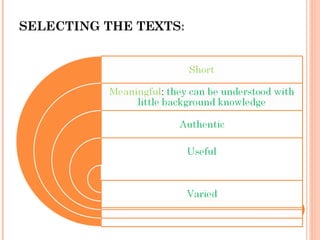
SELECTING THE TEXTS :
 
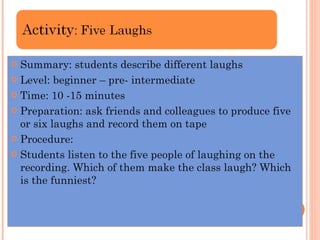
Summary: students describe different laughs  Level: beginner – pre- intermediate  Time: 10 -15 minutes  Preparation: ask friends and colleagues to produce five or six laughs and record them on tape Procedure: Students listen to the five people of laughing on the recording. Which of them make the class laugh? Which is the funniest?
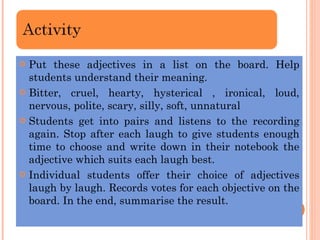
Put these adjectives in a list on the board. Help students understand their meaning. Bitter, cruel, hearty, hysterical , ironical, loud, nervous, polite, scary, silly, soft, unnatural Students get into pairs and listens to the recording again. Stop after each laugh to give students enough time to choose and write down in their notebook the adjective which suits each laugh best. Individual students offer their choice of adjectives laugh by laugh. Records votes for each objective on the board. In the end, summarise the result.
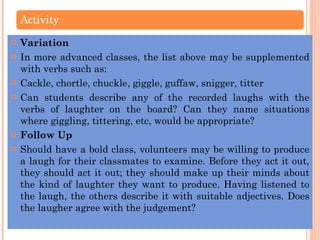
Variation  In more advanced classes, the list above may be supplemented with verbs such as: Cackle, chortle, chuckle, giggle, guffaw, snigger, titter Can students describe any of the recorded laughs with the verbs of laughter on the board? Can they name situations where giggling, tittering, etc, would be appropriate? Follow Up Should have a bold class, volunteers may be willing to produce a laugh for their classmates to examine. Before they act it out, they should act it out; they should make up their minds about the kind of laughter they want to produce. Having listened to the laugh, the others describe it with suitable adjectives. Does the laugher agree with the judgement?
 
 
LAUNCH A LAUGHING PROJECT Launch a laughing project. Everyone observes a classmate of their choice for one month. What are her/his laughing habits? In what situations, how often and how does she/he usually laugh? When the month is up. Each observer writes a short essay on their experience without supplying the name of the person under surveillance. Students then take it in turns to read out their essay, with the others trying to guess the person observed .
 
PROCEDURES: DISTRIBUTES COPIES OF BOX 3. AS STUDENTS READ THE QUOTATIONS, PROVIDE HELP WITH ANY UNFAMILIAR WORDS. A good laugh is the best pesticide.( Russian—American writer—Vladimir Nabokov) The sound of laughter is the most civilised music in the world.(British writer – Peter Ustinov) Laughter is inner jogging( American Journalist Norman Cousins) Laugh and the world laughs with you; weep and you weep alone(American poet and writer Ella Wheeler Wilcox)
 
FOLLOW UP
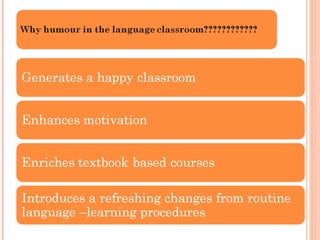
Humour can contribute a great deal to the second language classroom. It enables you not only to create an affective or positive environment, but is a source of enjoyment for you and your students. Language is seen in authentic and real life situations. Humorous situations allow your students to express themselves without fear of ridicule and criticism. Anxiety and stress is reduced and your students are encouraged to take more risks in using their second language . By:- Paul-Emile Chiasson University of New Brunswick (Saint John, NB, Canada)        http://iteslj.org/Techniques/Chiasson-Humour.html
Rajeev Ranjan English Language Teacher  B.Ed(Eng)&PGDTE  English and Foreign Languages, Hyderabad  Email id: rajeevbhuvns@gmail.com
FOR FURTHER READING AND REFERENCES  hannahtaylor.wordpress.com Laughing Matters: Humour in the language classroom—Peter Medgyes: 2002 CUP Chiaro, T.1992. The Language of Jokes: Analysing Verbal Play. London: Routledge  Ross, A.1998. The Language of Humour. London: Routledge Cranner , D.1996. Motivating High Level Learners. Harlow: Longman The Wil-Burn Type Humour Test. http://www.cheersproject.com/wil/burn.htm Guideline for Using Humor in the Classroom . http://venus.cottonwoodpress.com/extras/ideas/humor.htm

Humour in the language classroom

  • 1.
    Laughing Matters ina Language Classroom Rajeev Ranjan English Language Teacher B.Ed(Eng)&PGDTE English and Foreign Languages, Hyderabad Email id: rajeevbhuvns@gmail.com
  • 2.
  • 3.
  • 4.
  • 5.
  • 6.
  • 7.
  • 8.
  • 9.
  • 10.
  • 11.
    Summary: students describedifferent laughs Level: beginner – pre- intermediate Time: 10 -15 minutes Preparation: ask friends and colleagues to produce five or six laughs and record them on tape Procedure: Students listen to the five people of laughing on the recording. Which of them make the class laugh? Which is the funniest?
  • 12.
    Put these adjectivesin a list on the board. Help students understand their meaning. Bitter, cruel, hearty, hysterical , ironical, loud, nervous, polite, scary, silly, soft, unnatural Students get into pairs and listens to the recording again. Stop after each laugh to give students enough time to choose and write down in their notebook the adjective which suits each laugh best. Individual students offer their choice of adjectives laugh by laugh. Records votes for each objective on the board. In the end, summarise the result.
  • 13.
    Variation Inmore advanced classes, the list above may be supplemented with verbs such as: Cackle, chortle, chuckle, giggle, guffaw, snigger, titter Can students describe any of the recorded laughs with the verbs of laughter on the board? Can they name situations where giggling, tittering, etc, would be appropriate? Follow Up Should have a bold class, volunteers may be willing to produce a laugh for their classmates to examine. Before they act it out, they should act it out; they should make up their minds about the kind of laughter they want to produce. Having listened to the laugh, the others describe it with suitable adjectives. Does the laugher agree with the judgement?
  • 14.
  • 15.
  • 16.
    LAUNCH A LAUGHINGPROJECT Launch a laughing project. Everyone observes a classmate of their choice for one month. What are her/his laughing habits? In what situations, how often and how does she/he usually laugh? When the month is up. Each observer writes a short essay on their experience without supplying the name of the person under surveillance. Students then take it in turns to read out their essay, with the others trying to guess the person observed .
  • 17.
  • 18.
    PROCEDURES: DISTRIBUTES COPIESOF BOX 3. AS STUDENTS READ THE QUOTATIONS, PROVIDE HELP WITH ANY UNFAMILIAR WORDS. A good laugh is the best pesticide.( Russian—American writer—Vladimir Nabokov) The sound of laughter is the most civilised music in the world.(British writer – Peter Ustinov) Laughter is inner jogging( American Journalist Norman Cousins) Laugh and the world laughs with you; weep and you weep alone(American poet and writer Ella Wheeler Wilcox)
  • 19.
  • 20.
  • 21.
    Humour can contributea great deal to the second language classroom. It enables you not only to create an affective or positive environment, but is a source of enjoyment for you and your students. Language is seen in authentic and real life situations. Humorous situations allow your students to express themselves without fear of ridicule and criticism. Anxiety and stress is reduced and your students are encouraged to take more risks in using their second language . By:- Paul-Emile Chiasson University of New Brunswick (Saint John, NB, Canada) http://iteslj.org/Techniques/Chiasson-Humour.html
  • 22.
    Rajeev Ranjan EnglishLanguage Teacher B.Ed(Eng)&PGDTE English and Foreign Languages, Hyderabad Email id: rajeevbhuvns@gmail.com
  • 23.
    FOR FURTHER READINGAND REFERENCES hannahtaylor.wordpress.com Laughing Matters: Humour in the language classroom—Peter Medgyes: 2002 CUP Chiaro, T.1992. The Language of Jokes: Analysing Verbal Play. London: Routledge Ross, A.1998. The Language of Humour. London: Routledge Cranner , D.1996. Motivating High Level Learners. Harlow: Longman The Wil-Burn Type Humour Test. http://www.cheersproject.com/wil/burn.htm Guideline for Using Humor in the Classroom . http://venus.cottonwoodpress.com/extras/ideas/humor.htm