NOTE TAKING
AND
OUTLINING
NOTE TAKING SYSTEM
• Note taking is the practice of writing down or
otherwise recording key points of
imformation.
• It is the important part of research
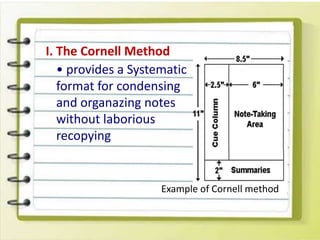
I. The Cornell Method
• provides a Systematic
format for condensing
and organazing notes
without laborious
recopying
Example of Cornell method
A. Method - during class, take down notes in 6 inch area in
the right . when the instructor moves to other point skip few
lines, After class complete phrases and sentences as soon as
possible.
B. Advantages - Organized and Systematic for recording
and reviewing notes. Simple and Efficient. "Do-it-right-in-the-
first-place" system
C. When to use - In any lecture situation
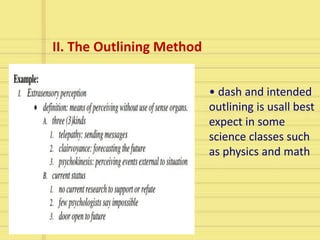
II. The Outlining Method
• dash and intended
outlining is usall best
expect in some
science classes such
as physics and math
A. Method - listening the write in points in an organized
patterns based on space indention. markings is not necessary
as space relationships will indicates major/minor points.
B. Advantages - well-organized system if done right. Its
also reducing editing and easy to review by turning main
points into questions
C. Disadvantages - requires more thought in class for
accurate organization. The system cannot be used if the
lecture is too fast
D. When to use - the outline format can be used if
the lecture present in outline organization.
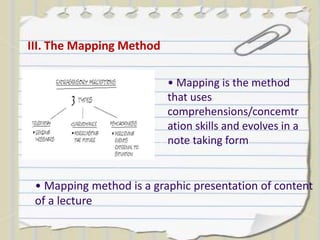
III. The Mapping Method
• Mapping is the method
that uses
comprehensions/concemtr
ation skills and evolves in a
note taking form
• Mapping method is a graphic presentation of content
of a lecture
A. Advantages - This format helps you to visually tract the
lecture regardless of conditions. Main points can be written
on flash or note cards and pieced together into a table or
larger structure at a later date.
B. Disadvantages - you may not hear changes in content
from major points to facts.
C. When to use - Use when the lecture content is heavy and
well- organized. May also be used im effectively when you
have a guest lecturer and have no idea how the ecture is going
to present
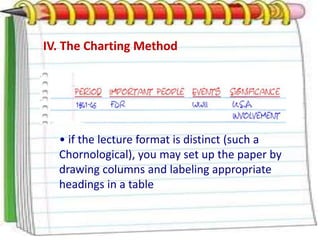
IV. The Charting Method
• if the lecture format is distinct (such a
Chornological), you may set up the paper by
drawing columns and labeling appropriate
headings in a table
A. Method - Determine the categories to be covered in
lecture. As you listen to the lecture, record informarion
(words,phrases, main idea, etc.) Into appropriate category
.
B. Advantages - Helps track conversationand dialogues
where you would normally be confused ang lose out on
relevant content
C. Disadvantages - Few disadvantages except learning
how to use the system and locatimg the appropriate
categories
D. When to use - tes will focus on both facts and
relationships. You want to get an overview of the whole course
on one big paper sequence
V. The Sentence Method
Example of Sentence Method
A. Method - Write every thought, fact or topic on a
separate line, numbering as you progress.
B. Advantages - slightly more organized than the
paragaph. Gets more or all of the information. Thinking to
tract content is still limited
C. Disadvantages - Can't determine Major/minor points
from the number sequence. Difficuilt to review unless
editing cleans up relationship
D. When to use - when the lecture is somewhat
organized, but heavy with content which comes fast.
OUTLINING
• An outline is basically a blueprint of some more help
the writer construct a more unified and a better
organized ideo of a composition or essay
• An Outline is a summary that gives the essential
features of a text.
A. TYPES
OF
OUTLINING
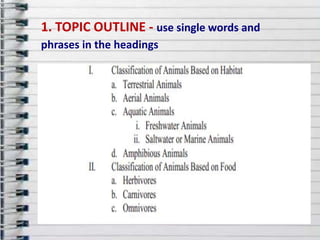
1. TOPIC OUTLINE - use single words and
phrases in the headings
2. SENTENCE OUTLINE - expand each
part into full sentence
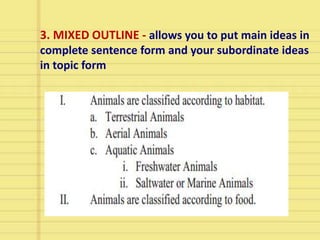
3. MIXED OUTLINE - allows you to put main ideas in
complete sentence form and your subordinate ideas
in topic form
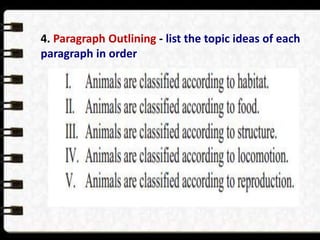
4. Paragraph Outlining - list the topic ideas of each
paragraph in order
B. SAMPLE FORMAT
FOR OUTLINING
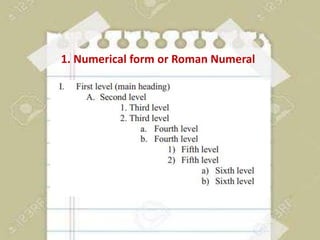
1. Numerical form or Roman Numeral
2. Arabic form or dewey decemal
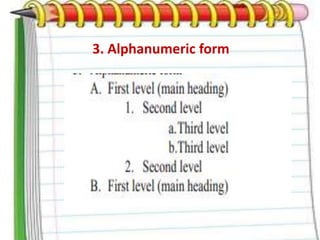
3. Alphanumeric form

Note taking and outlining

  • 1.
  • 2.
    NOTE TAKING SYSTEM •Note taking is the practice of writing down or otherwise recording key points of imformation. • It is the important part of research
  • 3.
    I. The CornellMethod • provides a Systematic format for condensing and organazing notes without laborious recopying Example of Cornell method
  • 4.
    A. Method -during class, take down notes in 6 inch area in the right . when the instructor moves to other point skip few lines, After class complete phrases and sentences as soon as possible. B. Advantages - Organized and Systematic for recording and reviewing notes. Simple and Efficient. "Do-it-right-in-the- first-place" system C. When to use - In any lecture situation
  • 5.
    II. The OutliningMethod • dash and intended outlining is usall best expect in some science classes such as physics and math
  • 6.
    A. Method -listening the write in points in an organized patterns based on space indention. markings is not necessary as space relationships will indicates major/minor points. B. Advantages - well-organized system if done right. Its also reducing editing and easy to review by turning main points into questions C. Disadvantages - requires more thought in class for accurate organization. The system cannot be used if the lecture is too fast D. When to use - the outline format can be used if the lecture present in outline organization.
  • 7.
    III. The MappingMethod • Mapping is the method that uses comprehensions/concemtr ation skills and evolves in a note taking form • Mapping method is a graphic presentation of content of a lecture
  • 8.
    A. Advantages -This format helps you to visually tract the lecture regardless of conditions. Main points can be written on flash or note cards and pieced together into a table or larger structure at a later date. B. Disadvantages - you may not hear changes in content from major points to facts. C. When to use - Use when the lecture content is heavy and well- organized. May also be used im effectively when you have a guest lecturer and have no idea how the ecture is going to present
  • 9.
    IV. The ChartingMethod • if the lecture format is distinct (such a Chornological), you may set up the paper by drawing columns and labeling appropriate headings in a table
  • 10.
    A. Method -Determine the categories to be covered in lecture. As you listen to the lecture, record informarion (words,phrases, main idea, etc.) Into appropriate category . B. Advantages - Helps track conversationand dialogues where you would normally be confused ang lose out on relevant content C. Disadvantages - Few disadvantages except learning how to use the system and locatimg the appropriate categories D. When to use - tes will focus on both facts and relationships. You want to get an overview of the whole course on one big paper sequence
  • 11.
    V. The SentenceMethod Example of Sentence Method
  • 12.
    A. Method -Write every thought, fact or topic on a separate line, numbering as you progress. B. Advantages - slightly more organized than the paragaph. Gets more or all of the information. Thinking to tract content is still limited C. Disadvantages - Can't determine Major/minor points from the number sequence. Difficuilt to review unless editing cleans up relationship D. When to use - when the lecture is somewhat organized, but heavy with content which comes fast.
  • 13.
    OUTLINING • An outlineis basically a blueprint of some more help the writer construct a more unified and a better organized ideo of a composition or essay • An Outline is a summary that gives the essential features of a text.
  • 14.
  • 15.
    1. TOPIC OUTLINE- use single words and phrases in the headings
  • 16.
    2. SENTENCE OUTLINE- expand each part into full sentence
  • 17.
    3. MIXED OUTLINE- allows you to put main ideas in complete sentence form and your subordinate ideas in topic form
  • 18.
    4. Paragraph Outlining- list the topic ideas of each paragraph in order
  • 19.
  • 20.
    1. Numerical formor Roman Numeral
  • 21.
    2. Arabic formor dewey decemal
  • 22.