SELECTING AND ORGANIZING
INFORMATION
Motivation “Write it fast”
• Class is divided into 4 groups
• Each group holds a white board and a marker
• The leader of each group goes in front, one of them picks a
category.
• The leaders go back to their teams and tell them the
category
• The teams then brainstorm words in the category and write
them down.
• The first team to finish shouts “STOP”
• The winning team calls out their answers. And the rest of the
team crashed out the answer what was mentioned.
Objectives
• define what is brainstorming
• enumerate the different techniques
of brainstorming
• appreciate the importance of the use
of different brainstorming
techniques
• practice brainstorming techniques
Activity 1 “Five Things That….”
a. Each group must have 5 members.
b. Teacher calls out one of the categories and the
students then brainstorm and write down five
answers.
c. Each team gets a corresponding point for each
answer that matches the survey’s answer.
d. The team with the most points at the end of the
game is the winner.
Analysis
1. What did you do to find out what is being ask?
2. Did your members contribute their own ideas
to the categories being required? How?
3. If you are going to choose would you like to
brainstorm ideas alone or individual? Why?
4. How were you able to organize the
information?
5. What is brainstorming?
6. How is brainstorming important to you as a
student?
Brainstorming
• an informal way of generating topics to write about, or
points to make about your topic.
• is an individual or group activity.
• Using this technique, efforts are made to make a solution
to a particular problem
• Ideas are gathered and listed from the input of every
member.
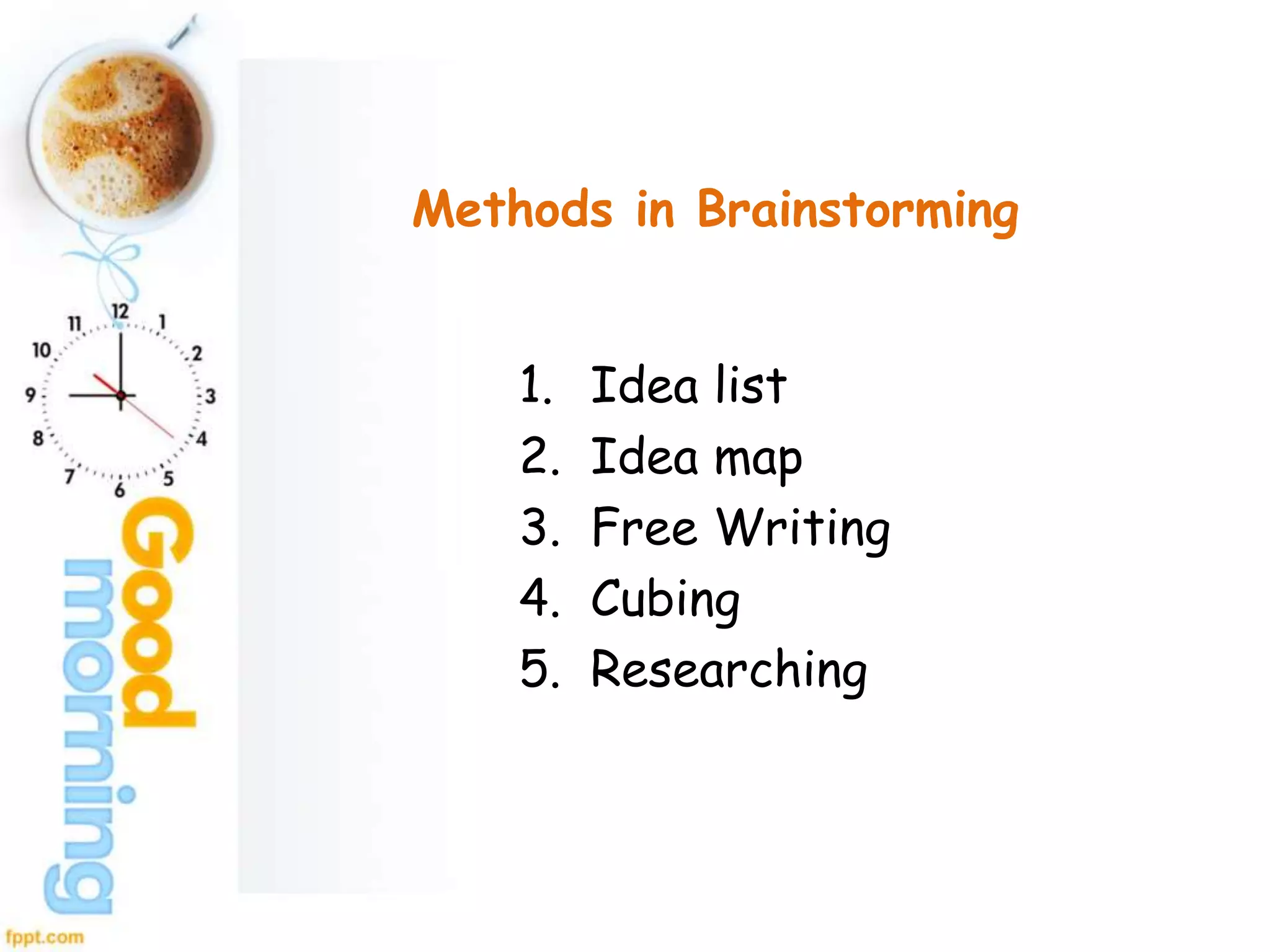
Methods in Brainstorming
1. Idea list
2. Idea map
3. Free Writing
4. Cubing
5. Researching
Methods in Brainstorming
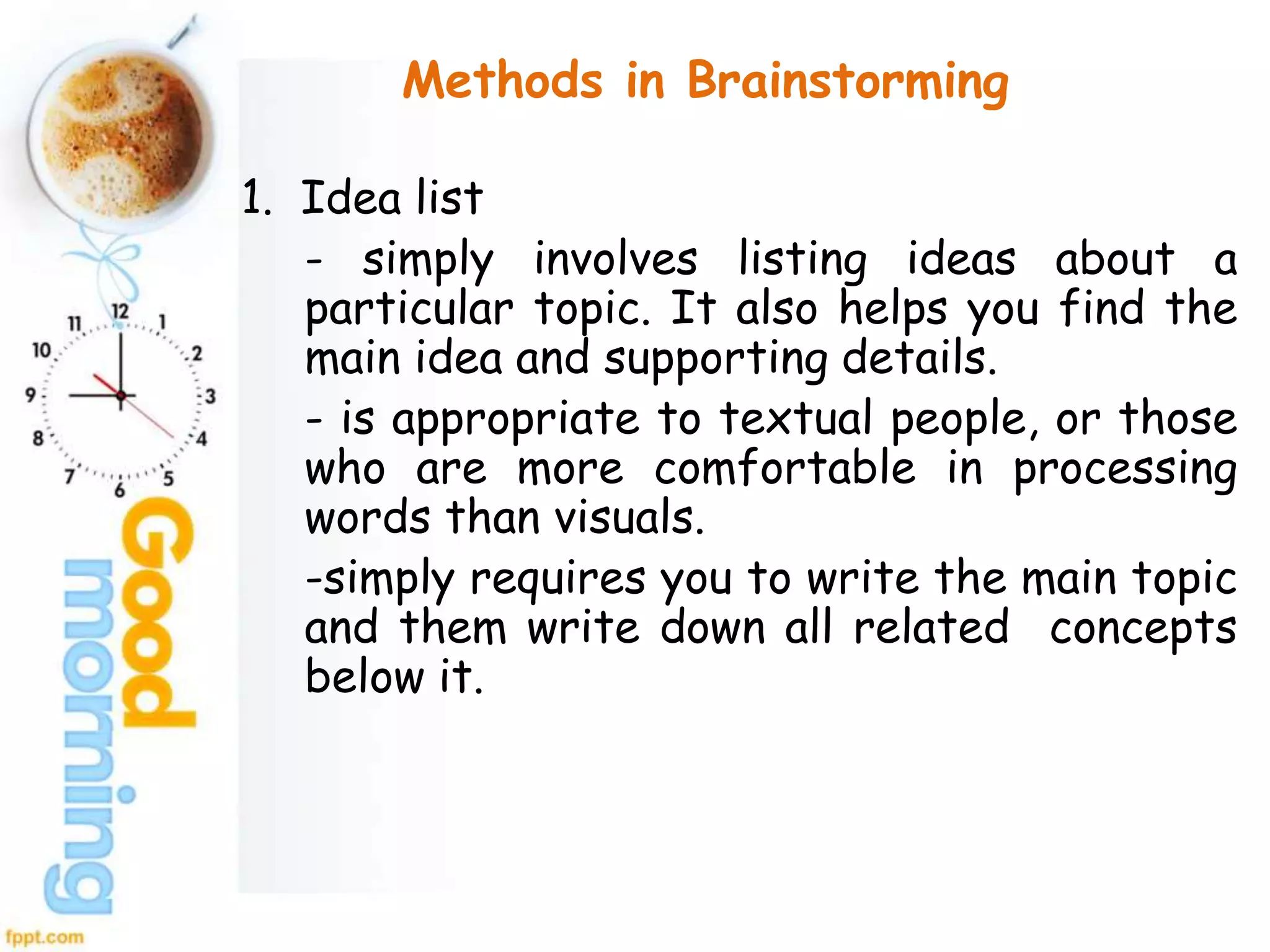
1. Idea list
- simply involves listing ideas about a
particular topic. It also helps you find the
main idea and supporting details.
- is appropriate to textual people, or those
who are more comfortable in processing
words than visuals.
-simply requires you to write the main topic
and them write down all related concepts
below it.
Methods in Brainstorming
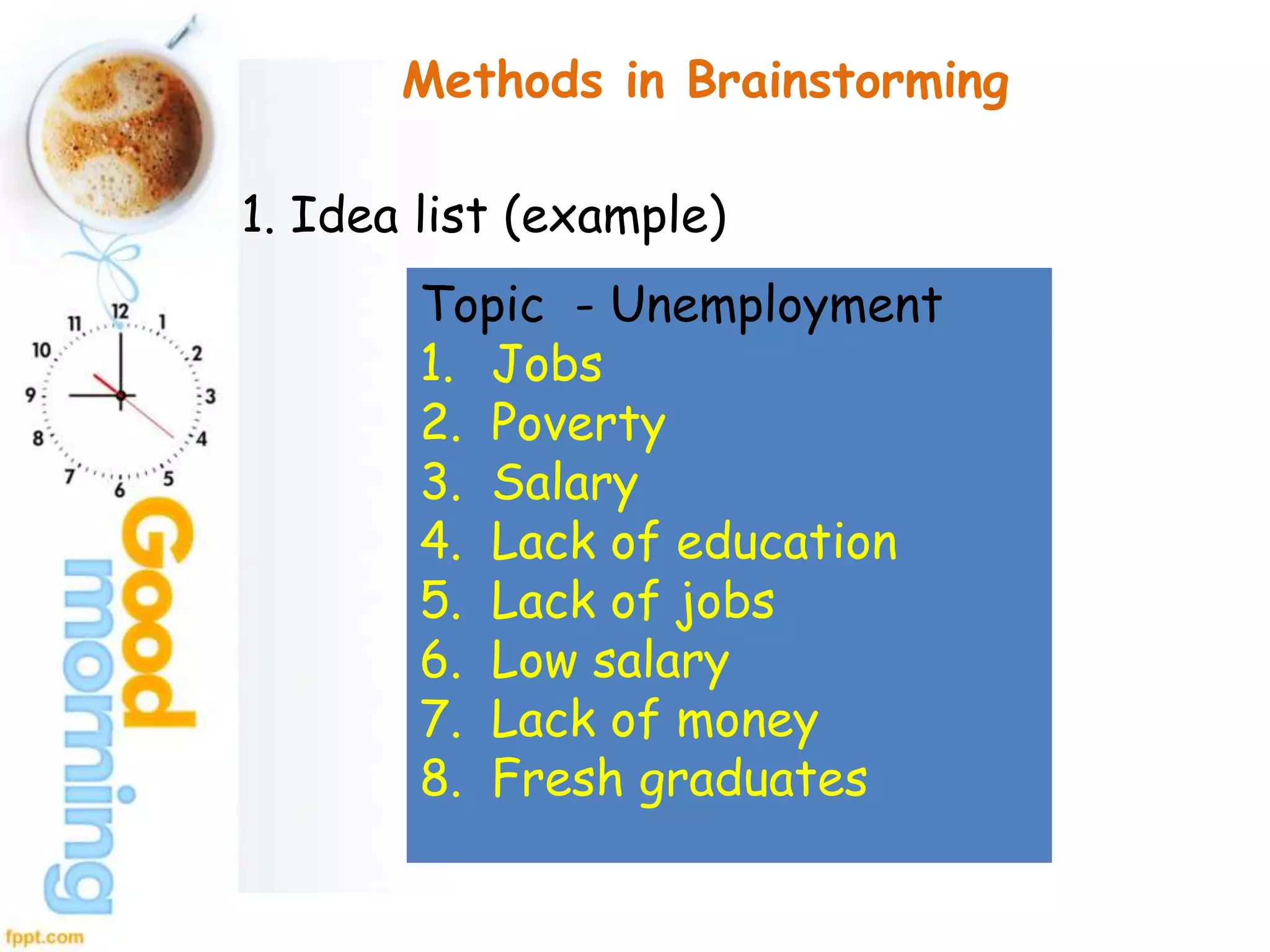
1. Idea list (example)
Topic - Unemployment
1. Jobs
2. Poverty
3. Salary
4. Lack of education
5. Lack of jobs
6. Low salary
7. Lack of money
8. Fresh graduates
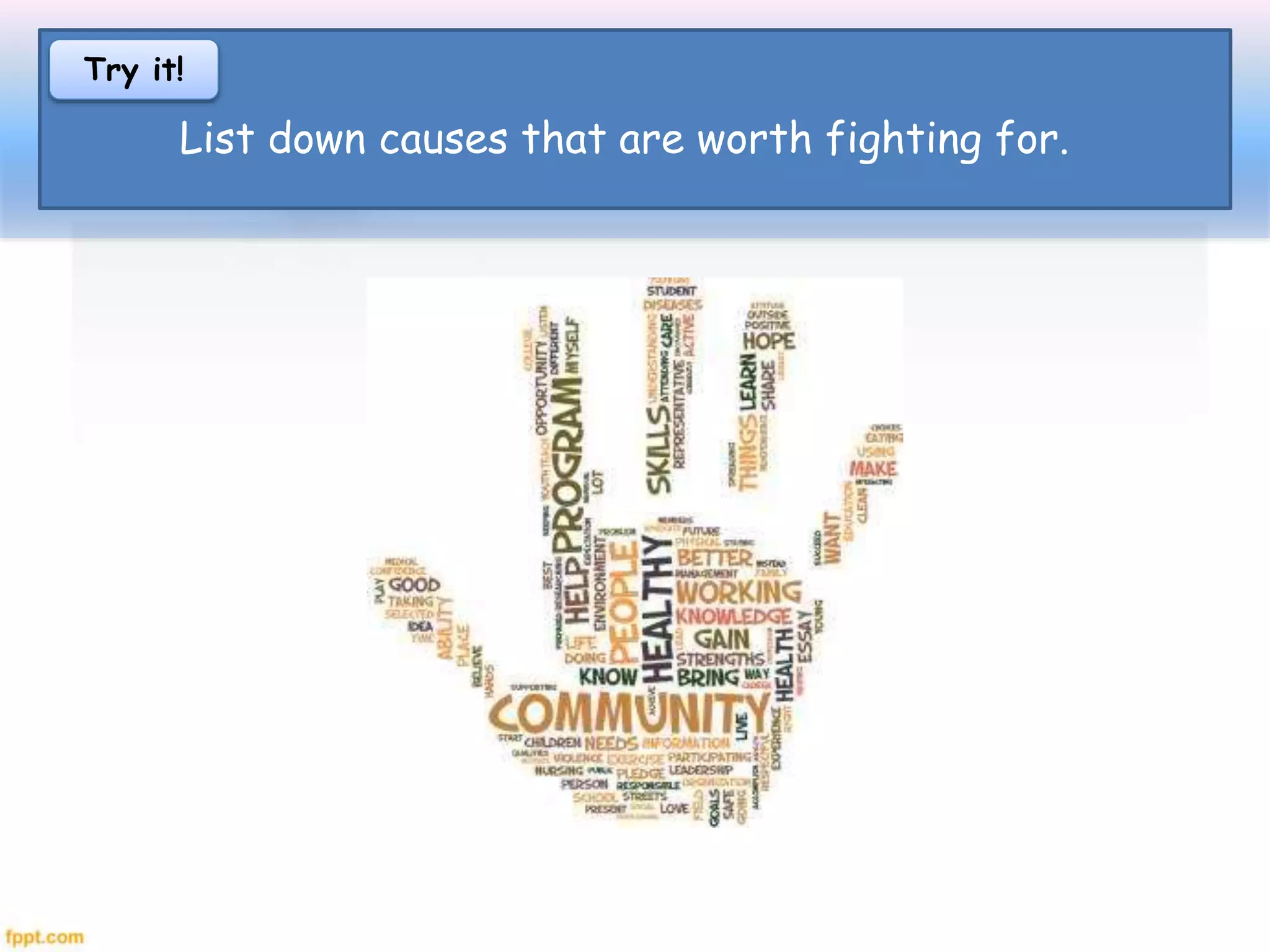
List down causes that are worth fighting for.
Try it!
Methods in Brainstorming
2. Idea map
- also called webbing or clustering
- is a visual representation of ideas and
their connections with one another.
- more structured and is able to show
how one idea subordinates another idea.
Methods in Brainstorming
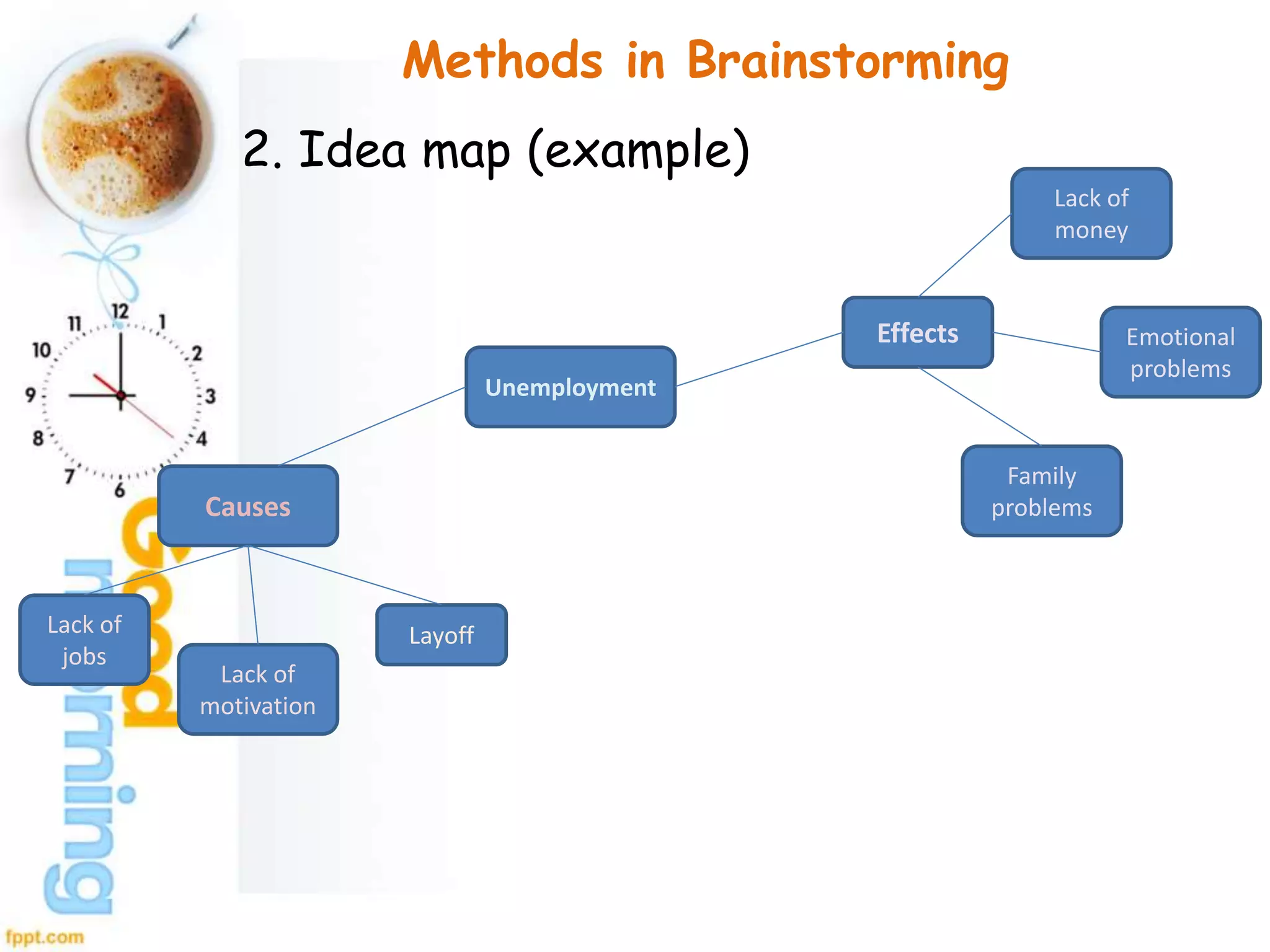
2. Idea map (example)
Unemployment
Effects
Causes
Lack of
money
Emotional
problems
Layoff
Lack of
motivation
Lack of
jobs
Family
problems
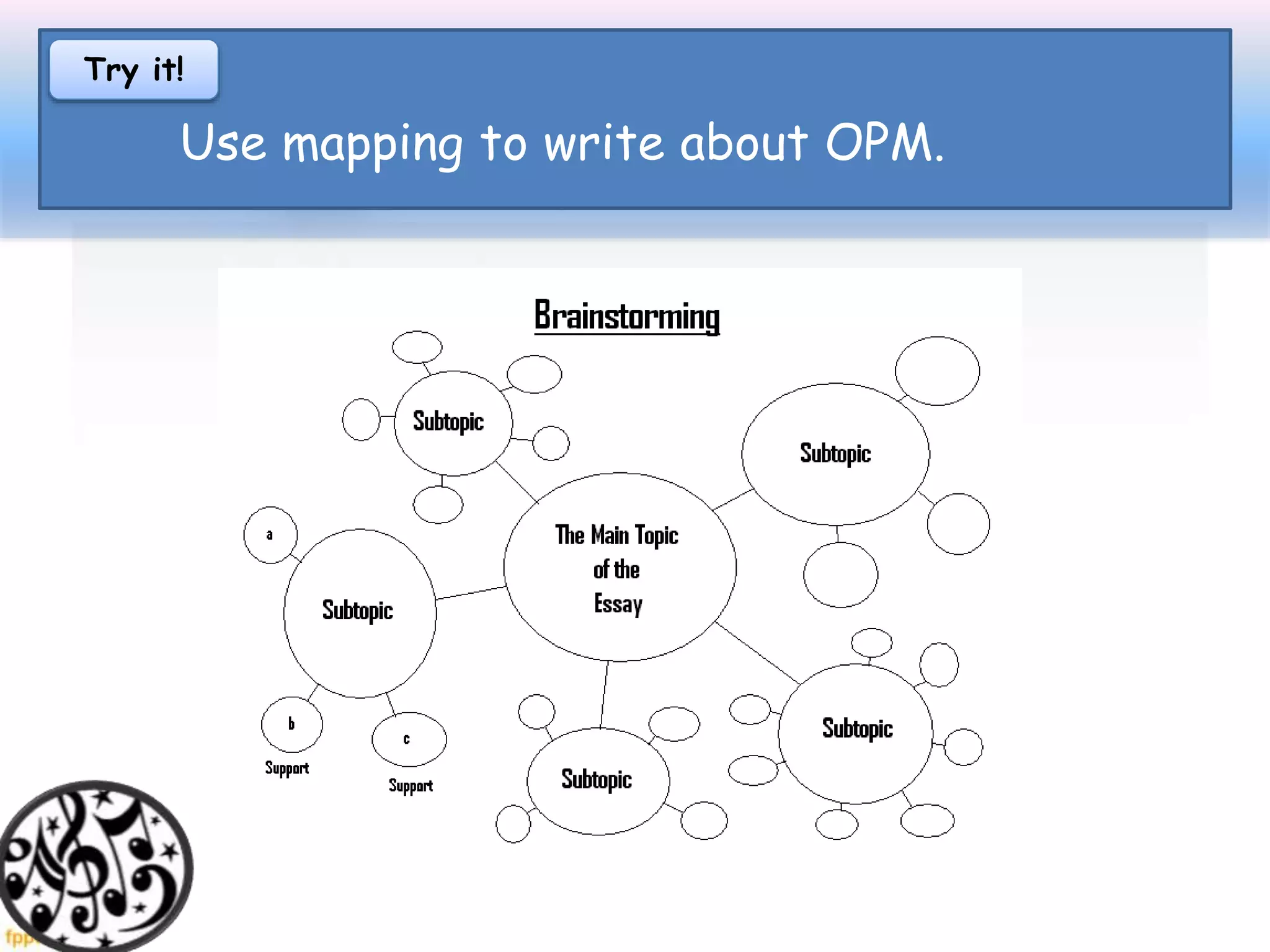
Use mapping to write about OPM.
Try it!
Methods in Brainstorming
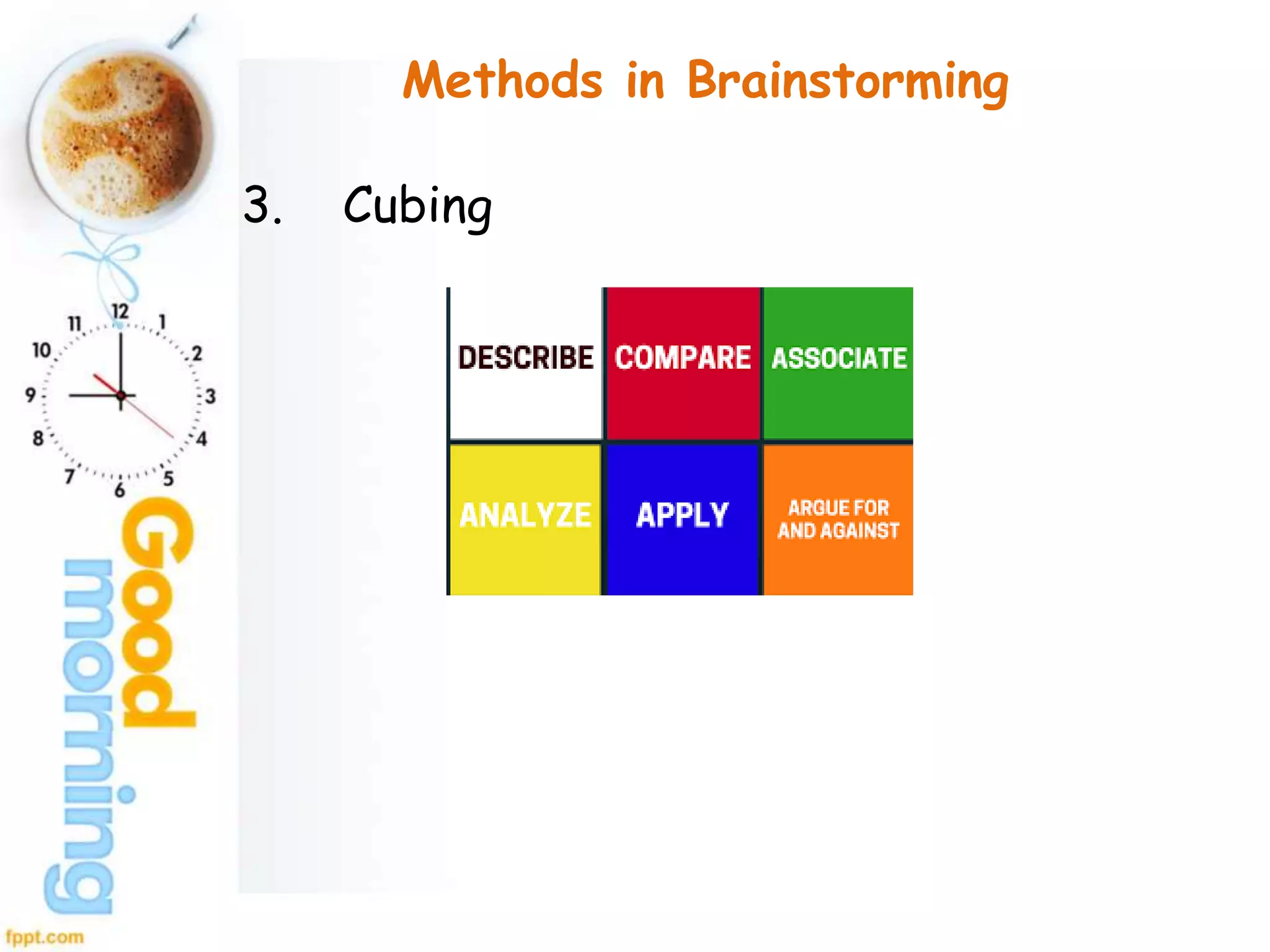
3. Cubing
- an idea is examined from six distinct
viewpoints.
 You describe the topic (what is it?)
 Compare and contrast it (what is it
like or unlike?)
 What do you associate it with(what
does it remind you of?)
 Analyze it (what are its parts?)
 Apply it (in what ways can it be
utilized)
 Argue for or against it (in what ways
can you support or oppose it)?
Methods in Brainstorming
3. Cubing
Methods in Brainstorming
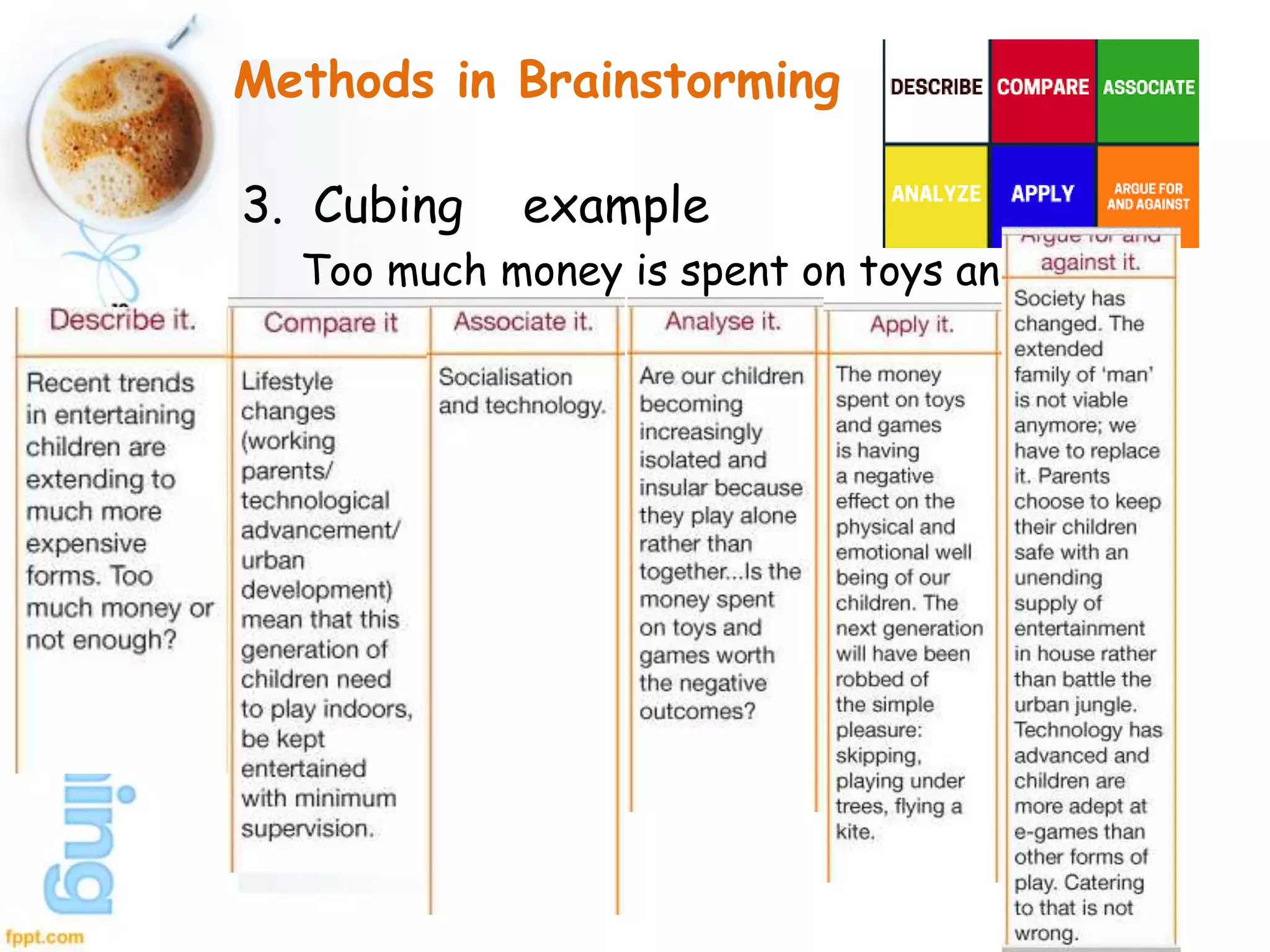
3. Cubing example
Too much money is spent on toys and games
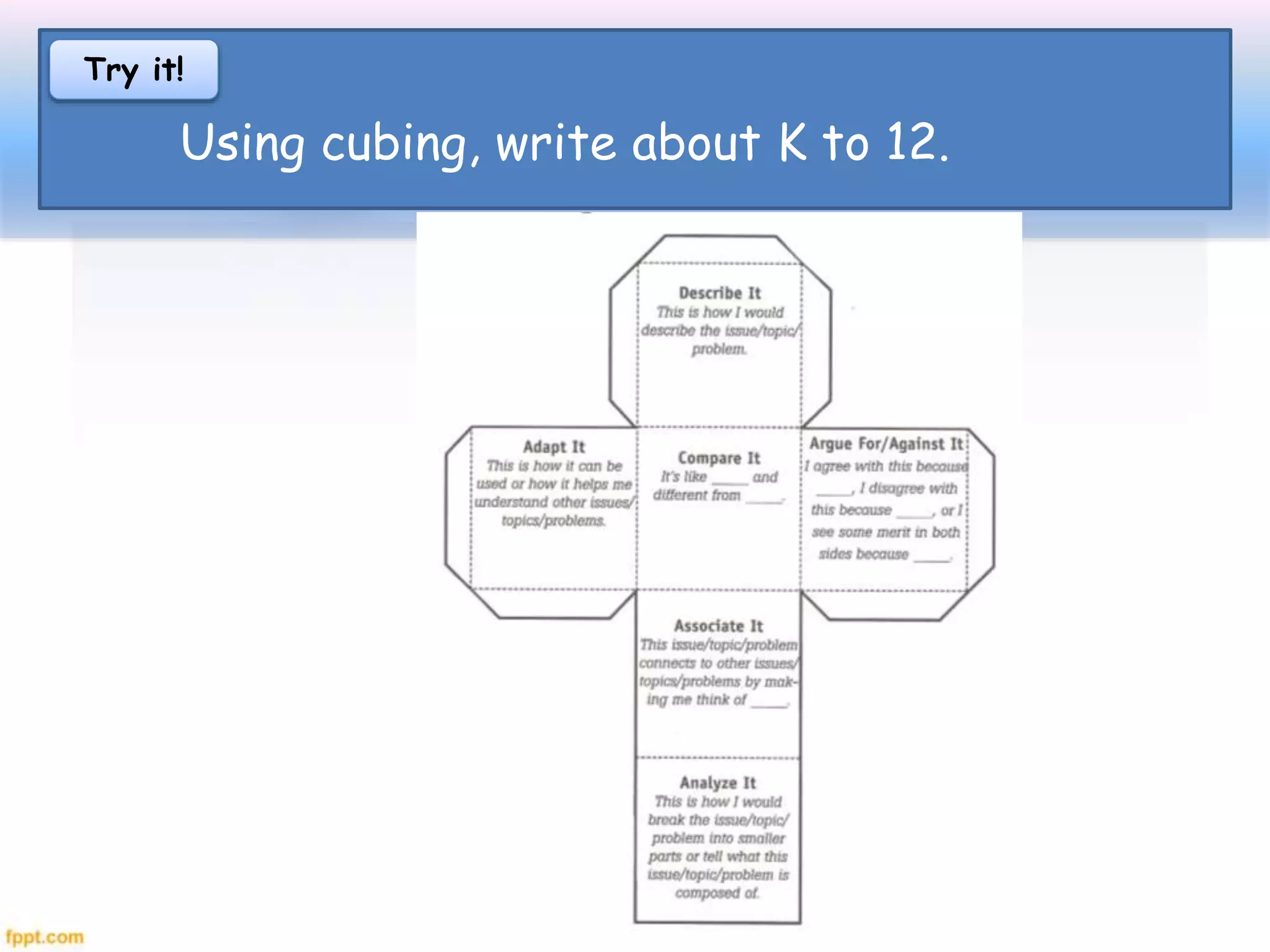
Using cubing, write about K to 12.
Try it!
Methods in Brainstorming
4. Free writing
- set a time limit and number of words
or pages. Just write. Do not edit
yourself.
- it allows someone to work without
inhibitions.
- you turn off the editor in you and
allow the writer in you free rein
4. Free writing
Sample Free Write about a name
Cassandra
She is a fashionista.
A Grade 11 student, Senior High, with moderately good grades
Moderately popular, has a good group of friends and is generally
well-liked
Comes from a nuclear family: parents still together and an older
brother
The older brother is the black sheep of the family, the rebel,
the trouble-maker
Allergic to both cats and dogs
Recently dumped by her highschool sweetheart
Light brown hair with purple highlights running through it; a chic
bob that comes to her chin, cut to that length after her break-
up
Has had the same best friend since the second grade, Erika,
whom she first met at a neighborhood-wide birthday party for
Erika and her twin brother, Steven
Unaware of Steven’s long-term crush on her
Loves the rain, especially in the summer, but hates the rainy
days; gets cold easily
Confident and likes to laugh, but is not very witty and not very
good at telling jokes
Do a five-minute example of free-writing on the subject
about your plans on 2017 in 100 words.
Try it!
Methods in Brainstorming
5. Researching
- you go to the library or check out
websites on the internet. Make a list or
map of the new ideas.
- is appropriate to textual people, or those
who are more comfortable in processing
words than visuals.
-simply requires you to write the main topic
and them write down all related concepts
below it.
ASSESSMENT
In a ½ crosswise sheet of paper
Answer the following questions.
1. What is brainstorming?
2. What are the different techniques of
brainstorming?
ASSIGNMENT
In a ½ crosswise bondpaper to be
submitted next meeting.
1. Research about K-Pop.
-end

Selecting and Organizing Information - Brainstorming

  • 1.
  • 2.
    Motivation “Write itfast” • Class is divided into 4 groups • Each group holds a white board and a marker • The leader of each group goes in front, one of them picks a category. • The leaders go back to their teams and tell them the category • The teams then brainstorm words in the category and write them down. • The first team to finish shouts “STOP” • The winning team calls out their answers. And the rest of the team crashed out the answer what was mentioned.
  • 3.
    Objectives • define whatis brainstorming • enumerate the different techniques of brainstorming • appreciate the importance of the use of different brainstorming techniques • practice brainstorming techniques
  • 4.
    Activity 1 “FiveThings That….” a. Each group must have 5 members. b. Teacher calls out one of the categories and the students then brainstorm and write down five answers. c. Each team gets a corresponding point for each answer that matches the survey’s answer. d. The team with the most points at the end of the game is the winner.
  • 5.
    Analysis 1. What didyou do to find out what is being ask? 2. Did your members contribute their own ideas to the categories being required? How? 3. If you are going to choose would you like to brainstorm ideas alone or individual? Why? 4. How were you able to organize the information? 5. What is brainstorming? 6. How is brainstorming important to you as a student?
  • 6.
    Brainstorming • an informalway of generating topics to write about, or points to make about your topic. • is an individual or group activity. • Using this technique, efforts are made to make a solution to a particular problem • Ideas are gathered and listed from the input of every member.
  • 7.
    Methods in Brainstorming 1.Idea list 2. Idea map 3. Free Writing 4. Cubing 5. Researching
  • 8.
    Methods in Brainstorming 1.Idea list - simply involves listing ideas about a particular topic. It also helps you find the main idea and supporting details. - is appropriate to textual people, or those who are more comfortable in processing words than visuals. -simply requires you to write the main topic and them write down all related concepts below it.
  • 9.
    Methods in Brainstorming 1.Idea list (example) Topic - Unemployment 1. Jobs 2. Poverty 3. Salary 4. Lack of education 5. Lack of jobs 6. Low salary 7. Lack of money 8. Fresh graduates
  • 10.
    List down causesthat are worth fighting for. Try it!
  • 11.
    Methods in Brainstorming 2.Idea map - also called webbing or clustering - is a visual representation of ideas and their connections with one another. - more structured and is able to show how one idea subordinates another idea.
  • 12.
    Methods in Brainstorming 2.Idea map (example) Unemployment Effects Causes Lack of money Emotional problems Layoff Lack of motivation Lack of jobs Family problems
  • 13.
    Use mapping towrite about OPM. Try it!
  • 14.
    Methods in Brainstorming 3.Cubing - an idea is examined from six distinct viewpoints.  You describe the topic (what is it?)  Compare and contrast it (what is it like or unlike?)  What do you associate it with(what does it remind you of?)  Analyze it (what are its parts?)  Apply it (in what ways can it be utilized)  Argue for or against it (in what ways can you support or oppose it)?
  • 15.
  • 16.
    Methods in Brainstorming 3.Cubing example Too much money is spent on toys and games
  • 17.
    Using cubing, writeabout K to 12. Try it!
  • 18.
    Methods in Brainstorming 4.Free writing - set a time limit and number of words or pages. Just write. Do not edit yourself. - it allows someone to work without inhibitions. - you turn off the editor in you and allow the writer in you free rein
  • 19.
    4. Free writing SampleFree Write about a name Cassandra She is a fashionista. A Grade 11 student, Senior High, with moderately good grades Moderately popular, has a good group of friends and is generally well-liked Comes from a nuclear family: parents still together and an older brother The older brother is the black sheep of the family, the rebel, the trouble-maker Allergic to both cats and dogs Recently dumped by her highschool sweetheart Light brown hair with purple highlights running through it; a chic bob that comes to her chin, cut to that length after her break- up Has had the same best friend since the second grade, Erika, whom she first met at a neighborhood-wide birthday party for Erika and her twin brother, Steven Unaware of Steven’s long-term crush on her Loves the rain, especially in the summer, but hates the rainy days; gets cold easily Confident and likes to laugh, but is not very witty and not very good at telling jokes
  • 20.
    Do a five-minuteexample of free-writing on the subject about your plans on 2017 in 100 words. Try it!
  • 21.
    Methods in Brainstorming 5.Researching - you go to the library or check out websites on the internet. Make a list or map of the new ideas. - is appropriate to textual people, or those who are more comfortable in processing words than visuals. -simply requires you to write the main topic and them write down all related concepts below it.
  • 22.
    ASSESSMENT In a ½crosswise sheet of paper Answer the following questions. 1. What is brainstorming? 2. What are the different techniques of brainstorming?
  • 23.
    ASSIGNMENT In a ½crosswise bondpaper to be submitted next meeting. 1. Research about K-Pop.
  • 24.