English for Study Purposes
ELAL 101 - 2
Ms. W.M.L Nayanahari
Department of English Language Teaching
Faculty of Management
Uva Wellassa University of Sri Lanka
Notes Taking Methods
When to take notes ….
Notes should be taken before , during as well as after the lecture.
Taking notes before a lecture helps in;
1. Familiarizing yourself with the lecture material in advance.
2. Committing the points to your long – term memory since the material is gone
through twice.
3. Jotting down any questions that can be raised during the lecture.
Taking notes after a lecture helps in;
1. Reviewing the notes and clarifying any points that may seem vague.
2. Organizing the points in a logical manner. (Master outline)
Note Taking Methods
1.The Cornell Method
2.The Outlining Method
3.The Mapping Method
4.The Charting Method
5.The Sentence Method
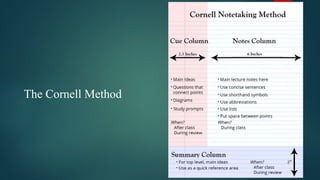
The Cornell Method
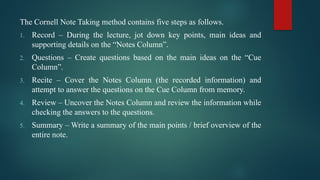
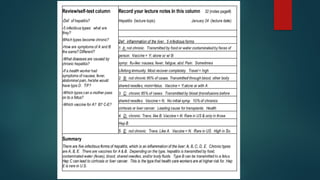
The Cornell Note Taking method contains five steps as follows.
1. Record – During the lecture, jot down key points, main ideas and
supporting details on the “Notes Column”.
2. Questions – Create questions based on the main ideas on the “Cue
Column”.
3. Recite – Cover the Notes Column (the recorded information) and
attempt to answer the questions on the Cue Column from memory.
4. Review – Uncover the Notes Column and review the information while
checking the answers to the questions.
5. Summary – Write a summary of the main points / brief overview of the
entire note.
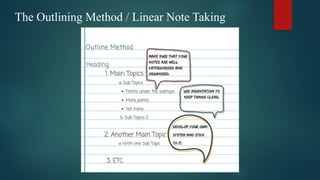
The Outlining Method / Linear Note Taking
The outlining method helps in organizing the points in an organized order.
1. Start with a major point or topic – Write it at the left hand corner of the page.
2. Beneath it, write a series of more specific points relating to that major point, and
indent it slightly.
3. Indentation can be simple with just space relationships or complex with Roman
numerals, letters and / or decimals.
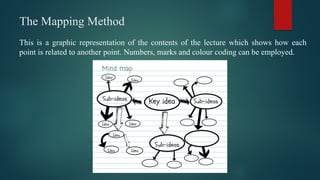
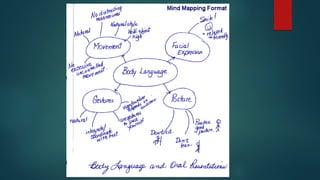
The Mapping Method
This is a graphic representation of the contents of the lecture which shows how each
point is related to another point. Numbers, marks and colour coding can be employed.
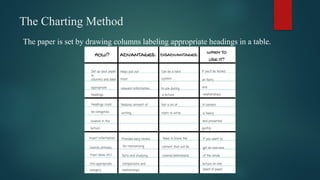
The Charting Method
The paper is set by drawing columns labeling appropriate headings in a table.
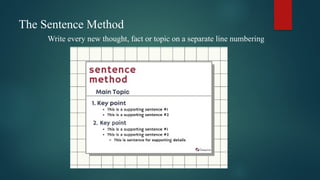
The Sentence Method
Write every new thought, fact or topic on a separate line numbering
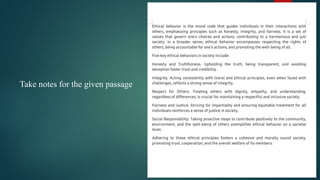
Take notes for the given passage
Thank You

English for Study Purposes - Note taking.pptx

  • 1.
    English for StudyPurposes ELAL 101 - 2 Ms. W.M.L Nayanahari Department of English Language Teaching Faculty of Management Uva Wellassa University of Sri Lanka
  • 2.
  • 3.
    When to takenotes …. Notes should be taken before , during as well as after the lecture. Taking notes before a lecture helps in; 1. Familiarizing yourself with the lecture material in advance. 2. Committing the points to your long – term memory since the material is gone through twice. 3. Jotting down any questions that can be raised during the lecture. Taking notes after a lecture helps in; 1. Reviewing the notes and clarifying any points that may seem vague. 2. Organizing the points in a logical manner. (Master outline)
  • 4.
    Note Taking Methods 1.TheCornell Method 2.The Outlining Method 3.The Mapping Method 4.The Charting Method 5.The Sentence Method
  • 5.
  • 6.
    The Cornell NoteTaking method contains five steps as follows. 1. Record – During the lecture, jot down key points, main ideas and supporting details on the “Notes Column”. 2. Questions – Create questions based on the main ideas on the “Cue Column”. 3. Recite – Cover the Notes Column (the recorded information) and attempt to answer the questions on the Cue Column from memory. 4. Review – Uncover the Notes Column and review the information while checking the answers to the questions. 5. Summary – Write a summary of the main points / brief overview of the entire note.
  • 8.
    The Outlining Method/ Linear Note Taking
  • 9.
    The outlining methodhelps in organizing the points in an organized order. 1. Start with a major point or topic – Write it at the left hand corner of the page. 2. Beneath it, write a series of more specific points relating to that major point, and indent it slightly. 3. Indentation can be simple with just space relationships or complex with Roman numerals, letters and / or decimals.
  • 10.
    The Mapping Method Thisis a graphic representation of the contents of the lecture which shows how each point is related to another point. Numbers, marks and colour coding can be employed.
  • 12.
    The Charting Method Thepaper is set by drawing columns labeling appropriate headings in a table.
  • 13.
    The Sentence Method Writeevery new thought, fact or topic on a separate line numbering
  • 14.
    Take notes forthe given passage
  • 15.