Topic Outline
An overview presentation by Jhastine Rapiz & Angela Oris
STEM 11-23, Senior High School Department,
Polytechnic University of the Philippines
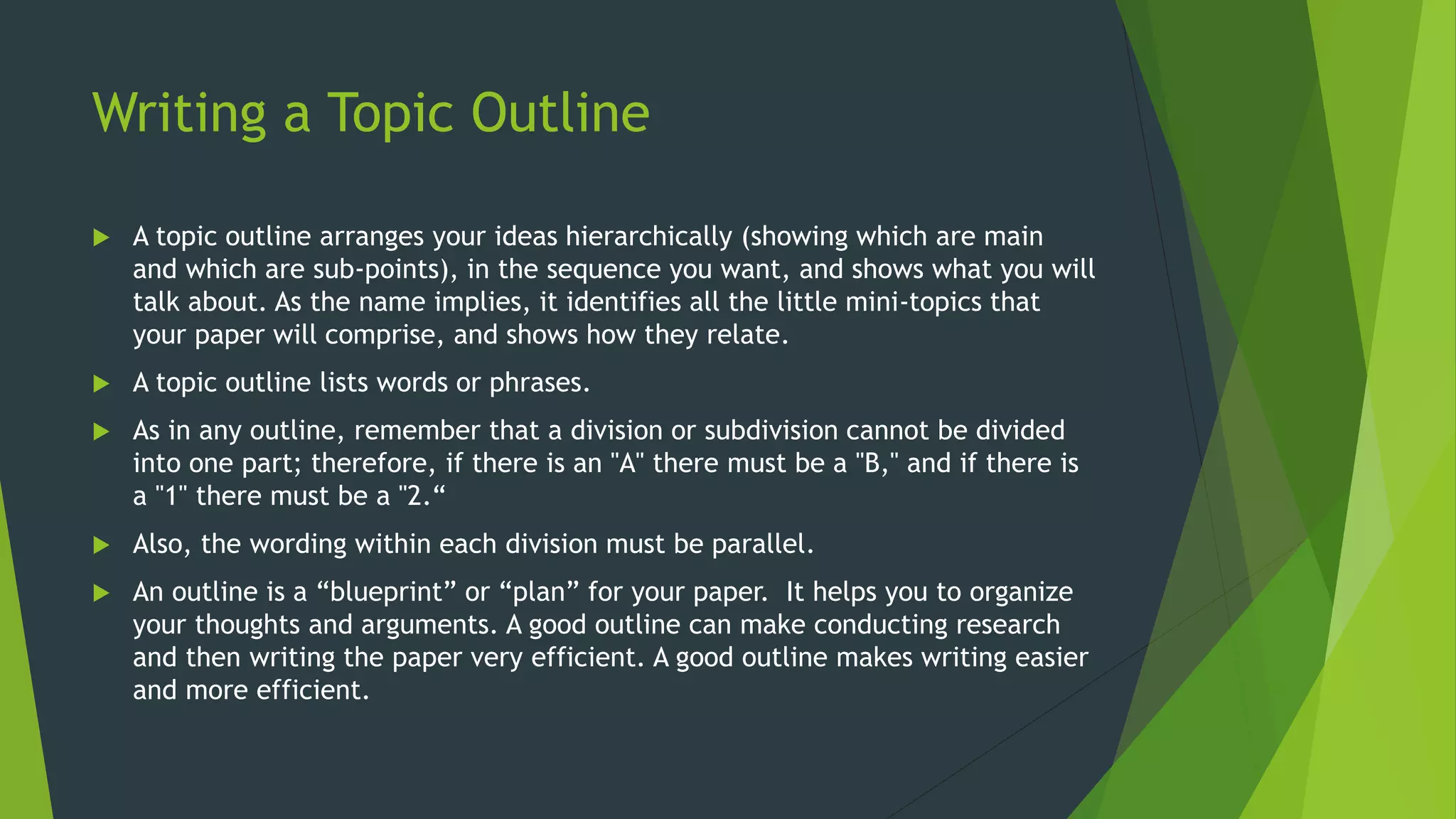
Writing a Topic Outline
 A topic outline arranges your ideas hierarchically (showing which are main
and which are sub-points), in the sequence you want, and shows what you will
talk about. As the name implies, it identifies all the little mini-topics that
your paper will comprise, and shows how they relate.
 A topic outline lists words or phrases.
 As in any outline, remember that a division or subdivision cannot be divided
into one part; therefore, if there is an "A" there must be a "B," and if there is
a "1" there must be a "2.“
 Also, the wording within each division must be parallel.
 An outline is a “blueprint” or “plan” for your paper. It helps you to organize
your thoughts and arguments. A good outline can make conducting research
and then writing the paper very efficient. A good outline makes writing easier
and more efficient.
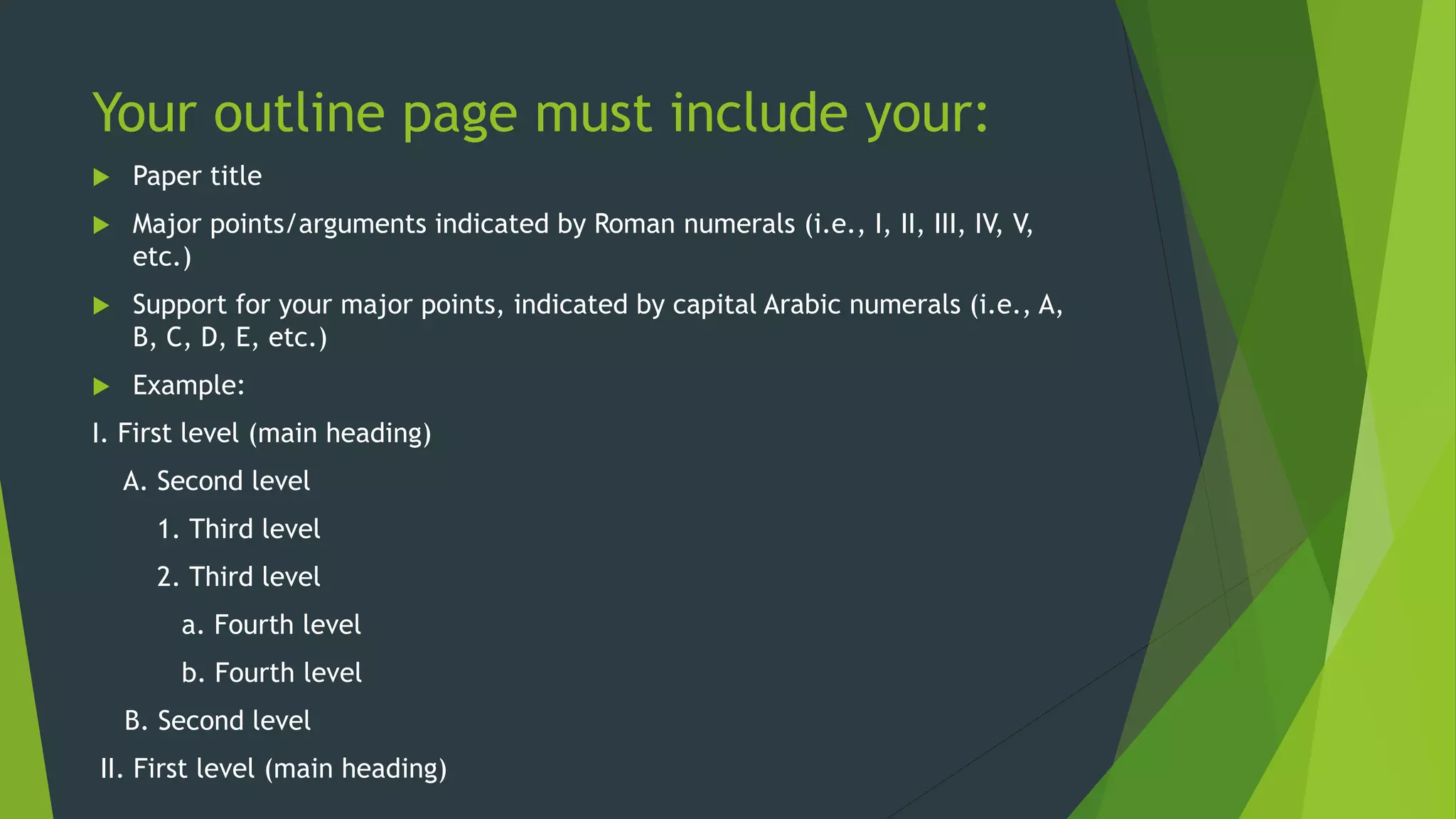
Your outline page must include your:
 Paper title
 Major points/arguments indicated by Roman numerals (i.e., I, II, III, IV, V,
etc.)
 Support for your major points, indicated by capital Arabic numerals (i.e., A,
B, C, D, E, etc.)
 Example:
I. First level (main heading)
A. Second level
1. Third level
2. Third level
a. Fourth level
b. Fourth level
B. Second level
II. First level (main heading)
Factors to Consider in Writing an Outline
 The type of outline that should be used depend on these; the length of your
paper and the complexity of your material, to name only two. When
preparing to write a long paper which presents a lot of material and complex
issues, you might like to make a complete sentence outline that maps out
every detail of your argument and its evidence. If you are going to do a short,
relatively uncomplicated paper, perhaps a brief topic outline would be
sufficient. Not the least important factor in your choice of outline is your own
preference. What type of outline do you feel most comfortable with?
An Effective Outline
 See that all the parts of the outline are there-- main headings, and
subordinate headings.
 Use the proper outline form.
 Make your outline reasonably specific, particularly in your main headings (I,
II, III, etc.).
 Check the outline for logic. Do all the parts fit together? Does every
supporting point firmly fit your thesis?
 Check the outline for the proper order-that is, for a sensible sequence or
organization of ideas.
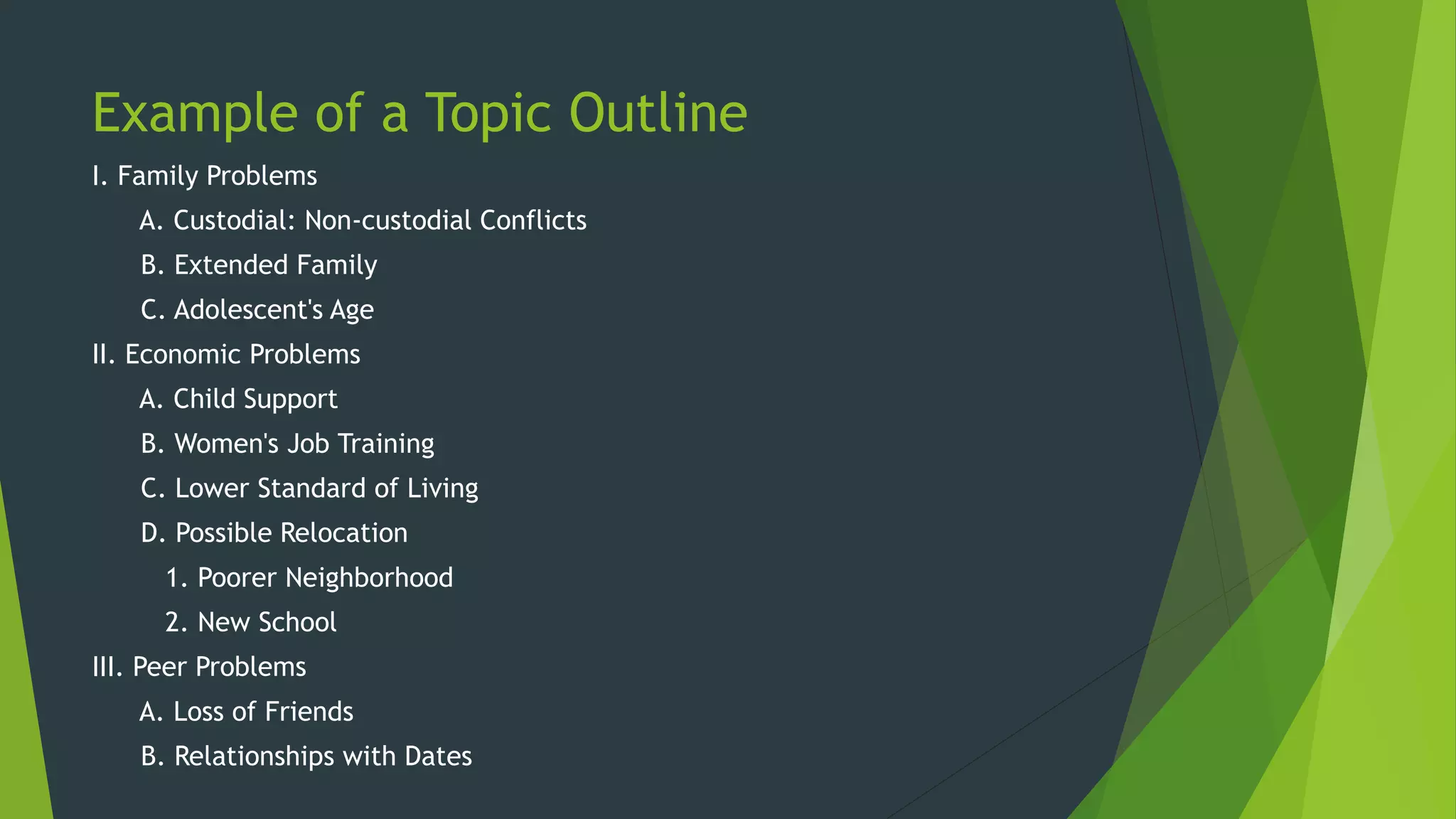
Example of a Topic Outline
I. Family Problems
A. Custodial: Non-custodial Conflicts
B. Extended Family
C. Adolescent's Age
II. Economic Problems
A. Child Support
B. Women's Job Training
C. Lower Standard of Living
D. Possible Relocation
1. Poorer Neighborhood
2. New School
III. Peer Problems
A. Loss of Friends
B. Relationships with Dates
Exercise
Make your own topic
outline about a certain
topic.
References
 https://app.shoreline.edu/doldham/102/HTML/Topic%20to%20Sentence.html
 http://www.austincc.edu/tmthomas/sample%20outline%201.htm
 http://www.eng.fju.edu.tw/con&com_databank/writing/outlines.htm
 https://www.oakton.edu/studentservices/learning_center/tutoring/research
_paper_tips/topic_outline.php

Topic outline

  • 1.
    Topic Outline An overviewpresentation by Jhastine Rapiz & Angela Oris STEM 11-23, Senior High School Department, Polytechnic University of the Philippines
  • 2.
    Writing a TopicOutline  A topic outline arranges your ideas hierarchically (showing which are main and which are sub-points), in the sequence you want, and shows what you will talk about. As the name implies, it identifies all the little mini-topics that your paper will comprise, and shows how they relate.  A topic outline lists words or phrases.  As in any outline, remember that a division or subdivision cannot be divided into one part; therefore, if there is an "A" there must be a "B," and if there is a "1" there must be a "2.“  Also, the wording within each division must be parallel.  An outline is a “blueprint” or “plan” for your paper. It helps you to organize your thoughts and arguments. A good outline can make conducting research and then writing the paper very efficient. A good outline makes writing easier and more efficient.
  • 3.
    Your outline pagemust include your:  Paper title  Major points/arguments indicated by Roman numerals (i.e., I, II, III, IV, V, etc.)  Support for your major points, indicated by capital Arabic numerals (i.e., A, B, C, D, E, etc.)  Example: I. First level (main heading) A. Second level 1. Third level 2. Third level a. Fourth level b. Fourth level B. Second level II. First level (main heading)
  • 4.
    Factors to Considerin Writing an Outline  The type of outline that should be used depend on these; the length of your paper and the complexity of your material, to name only two. When preparing to write a long paper which presents a lot of material and complex issues, you might like to make a complete sentence outline that maps out every detail of your argument and its evidence. If you are going to do a short, relatively uncomplicated paper, perhaps a brief topic outline would be sufficient. Not the least important factor in your choice of outline is your own preference. What type of outline do you feel most comfortable with?
  • 5.
    An Effective Outline See that all the parts of the outline are there-- main headings, and subordinate headings.  Use the proper outline form.  Make your outline reasonably specific, particularly in your main headings (I, II, III, etc.).  Check the outline for logic. Do all the parts fit together? Does every supporting point firmly fit your thesis?  Check the outline for the proper order-that is, for a sensible sequence or organization of ideas.
  • 6.
    Example of aTopic Outline I. Family Problems A. Custodial: Non-custodial Conflicts B. Extended Family C. Adolescent's Age II. Economic Problems A. Child Support B. Women's Job Training C. Lower Standard of Living D. Possible Relocation 1. Poorer Neighborhood 2. New School III. Peer Problems A. Loss of Friends B. Relationships with Dates
  • 7.
    Exercise Make your owntopic outline about a certain topic.
  • 8.
    References  https://app.shoreline.edu/doldham/102/HTML/Topic%20to%20Sentence.html  http://www.austincc.edu/tmthomas/sample%20outline%201.htm http://www.eng.fju.edu.tw/con&com_databank/writing/outlines.htm  https://www.oakton.edu/studentservices/learning_center/tutoring/research _paper_tips/topic_outline.php