Academic Writing Style
Medhat Mohsen
Luxor STEM School
Egypt, Qena.
2016
What is academic language?
• Academic language is the language of school and it is used in textbooks,
essays, assignments, class presentations, and assessments. Academic
language is used at all grade levels, although its frequency increases as
students get older.
• It is also the language of the workplace — for example, the language
used to write a business letter as opposed to a casual e-mail to a co-
worker.
Purpose and Product
• Students may write a lab report in science class.
• Students may orally explain their reasoning in math class.
• Students may listen to and compare two famous speeches in
history class.
• Students may compare a scene from a novel and a movie in an
English language arts class.
The difference between social and
academic language
Social English Academic English
I like this book more. This story is more exciting than the
first one we read.
It worked. Our experiment was successful.
Because they were brave. The soldiers received the medal
because of their courage.
BICS vs. CALP
You may have seen references to BICS vs. CALP when discussing
academic language. Basic Interpersonal Communication Skills
(BICS) refers to social language, and Cognitive Academic Language
Proficiency (CALP) refers to academic language.
"Bricks and mortar"
• Bricks = key vocabulary words and concepts
• Mortar = language chunks
• Example: Even though bats have wings, they are not birds.
• In this sentence, the bricks are the key vocabulary words in bold:
• Even though bats have wings, they are not birds.
• "Even though" means that two items are similar, but they are not
the same. In this case, bats and birds both share a similar feature
(having wings), but they are not the same animal.
Same Words, Different Meanings
Word Meaning
Table Lunch table (Social language)
Periodic Table of Elements (Science)
Table of Contents (ELA)
Multiplication tables (Math)
To table (delay) the discussion (Social Studies)
Plot Plot of a story (ELA)
Plot of land (Geography)
Plot ordered pairs on a graph (Math)
To plot a government coup (History)
Branch Branch of government (Social Studies)
Branch of a river (Geography)
To branch out (Idiom)
Foot Your foot (Health)
One foot in length (Math)
Foot in your mouth (Idiom)
Foot of the mountain (Geography)
To foot the bill (Idiom)
Writing Tips
• A wide range of vocabulary is of course important, but you must use the right
word, and shorter ones are often better than longer ones.
• Avoid everyday, informal language, especially colloquial expressions and slang.
- Hi folks.
- Greetings to all people.
- We wanna use it, but we messed it up.
- We were going to use it, but we couldn’t handle it well.
• Avoid spoken language that is naturally full of hesitations, repetitions,
grammatical errors and unfinished ideas.
• Sentences should be complete and ideas arranged into paragraphs or sections.
• Aim for perfection in your grammar and spelling.
AVOID SOME ASPECTS OF INFORMAL
ENGLISH
• don't (do not!) use contractions (eg it's, he'll, it'd etc): always use the full form (it
is/has, he will, it would/had).
• don't use colloquial language or slang (eg kid, a lot of/lots of, cool)
• always write as concisely as you can, with no irrelevant material or “waffle”.
• generally avoid "phrasal verbs" (e.g. get off, get away with, put in etc): instead, use
one word equivalents.
• avoid common but vague words and phrases such as get, nice, thing. Your writing needs
to be more precise.
• avoid overuse of brackets; don’t use exclamation marks or dashes; avoid direct
questions; don’t use “etc”.
• always use capital letters appropriately and never use the type of language used in
texting!
STRUCTURE YOUR WRITING CAREFULLY
• make sure you write in complete sentences.
• divide your writing up into paragraphs.
• Use connecting words and phrases to make your writing explicit
and easy to follow
• Check your grammar and spelling carefully
MAKE YOUR WRITING FORMAL AND
IMPERSONAL
• Avoid too much personal language (I, my, we etc).
• Be objective rather than subjective.
• Avoid making sweeping generalizations.
• try to write noun-based phrases rather that verb-based ones.
- For example, instead of
Crime was increasing rapidly and the police were becoming concerned.
Write: The rapid increase in crime was causing concern among the police.
HEDGING/AVOIDING COMMITMENT
• avoid overuse of first person pronouns (I, we, my, our)
• use impersonal subjects instead (It is believed that ..., it can be argued that ...)
• use passive verbs to avoid stating the ‘doer’ (Tests have been conducted)
• use verbs (often with it as subject) such as imagine, suggest, claim, suppose
• use ‘attitudinal signals’ such as apparently, arguably, ideally, strangely,
unexpectedly.
• These words allow you to hint at your attitude to something without using
personal language.
• use verbs such as would, could, may, might which ‘soften’ what you’re saying.
• use qualifying adverbs such as some, several, a minority of, a few, many to avoid
making overgeneralisations.
Exercises
• Replace the phrasal verbs in the sentences with a more
appropriate verb from the list below. Don't forget to keep the
same tense.
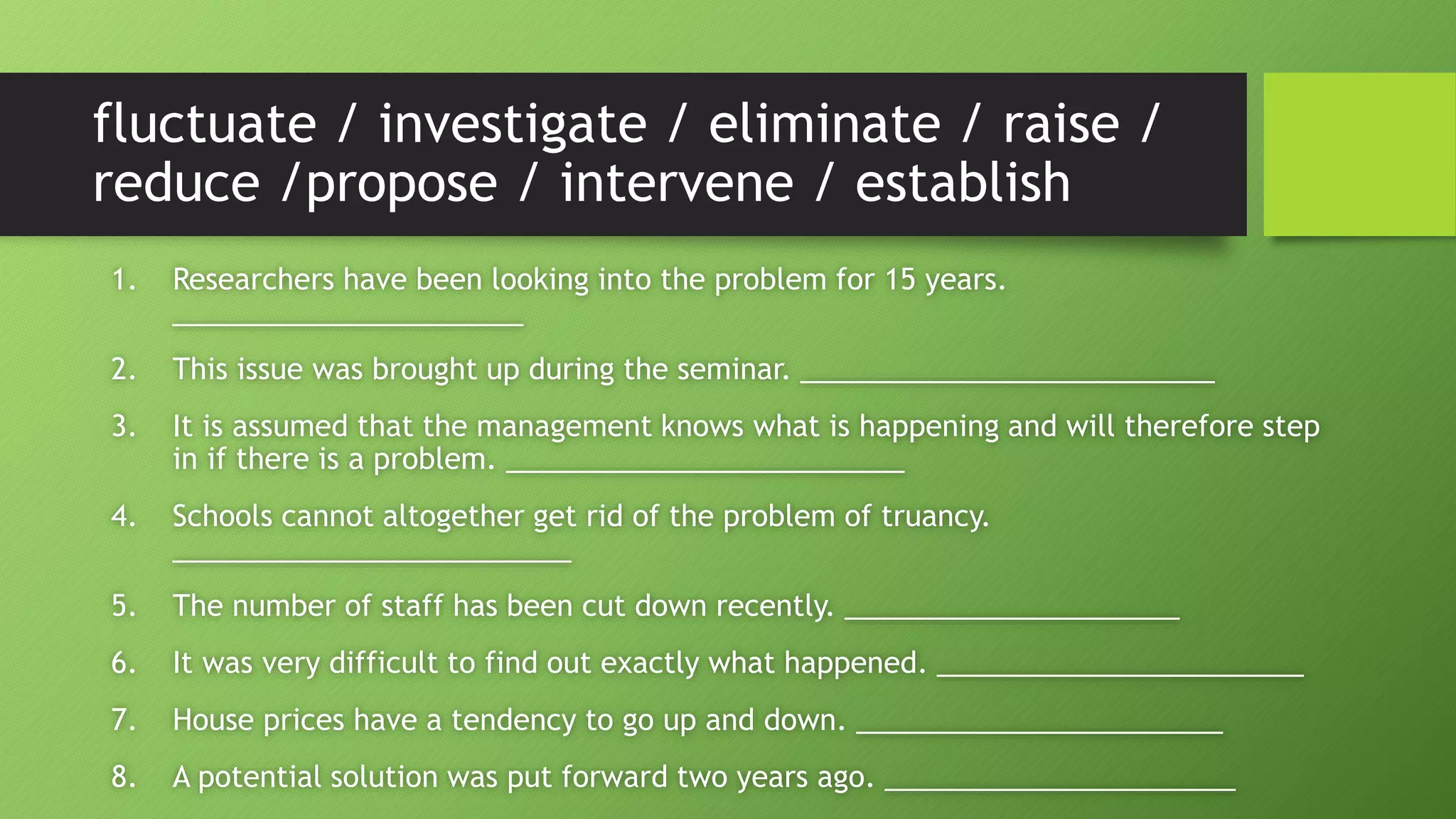
fluctuate / investigate / eliminate / raise /
reduce /propose / intervene / establish
1. Researchers have been looking into the problem for 15 years.
______________________
2. This issue was brought up during the seminar. __________________________
3. It is assumed that the management knows what is happening and will therefore step
in if there is a problem. _________________________
4. Schools cannot altogether get rid of the problem of truancy.
_________________________
5. The number of staff has been cut down recently. _____________________
6. It was very difficult to find out exactly what happened. _______________________
7. House prices have a tendency to go up and down. _______________________
8. A potential solution was put forward two years ago. ______________________
Which of the two alternatives in bold do you think
is more appropriate in academic writing?
1. The government has made considerable/great progress in solving the
problem.
2. We got/obtained excellent results in the experiment.
3. The results of lots of/numerous tests have been pretty good/encouraging.
4. A loss of jobs is one of the consequences/things that will happen if the
process is
automated.
5. The relationship between the management and workers is extremely/really
important.
6. Some suggestions springing up from/arising from the study will be presented.
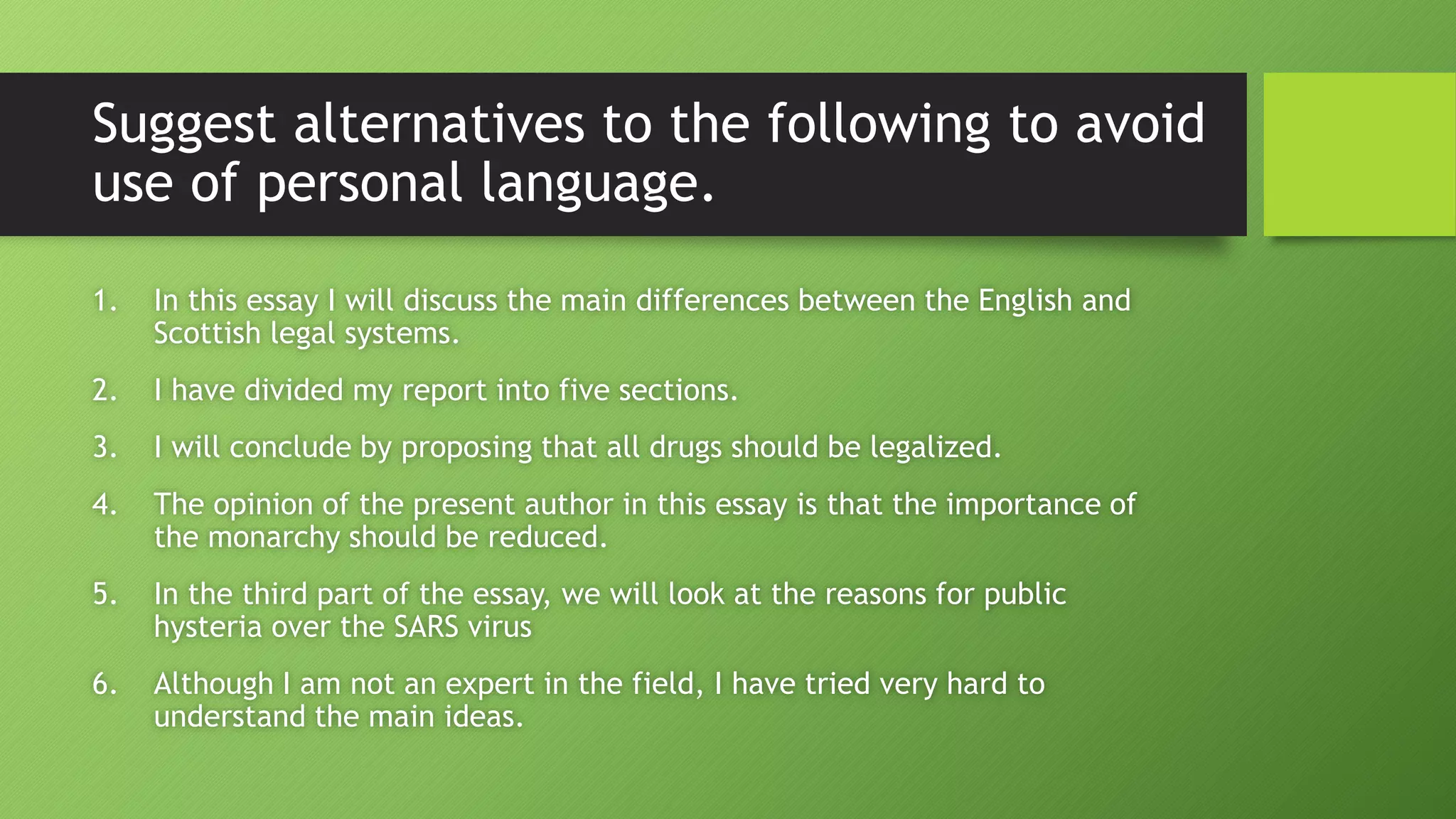
Suggest alternatives to the following to avoid
use of personal language.
1. In this essay I will discuss the main differences between the English and
Scottish legal systems.
2. I have divided my report into five sections.
3. I will conclude by proposing that all drugs should be legalized.
4. The opinion of the present author in this essay is that the importance of
the monarchy should be reduced.
5. In the third part of the essay, we will look at the reasons for public
hysteria over the SARS virus
6. Although I am not an expert in the field, I have tried very hard to
understand the main ideas.
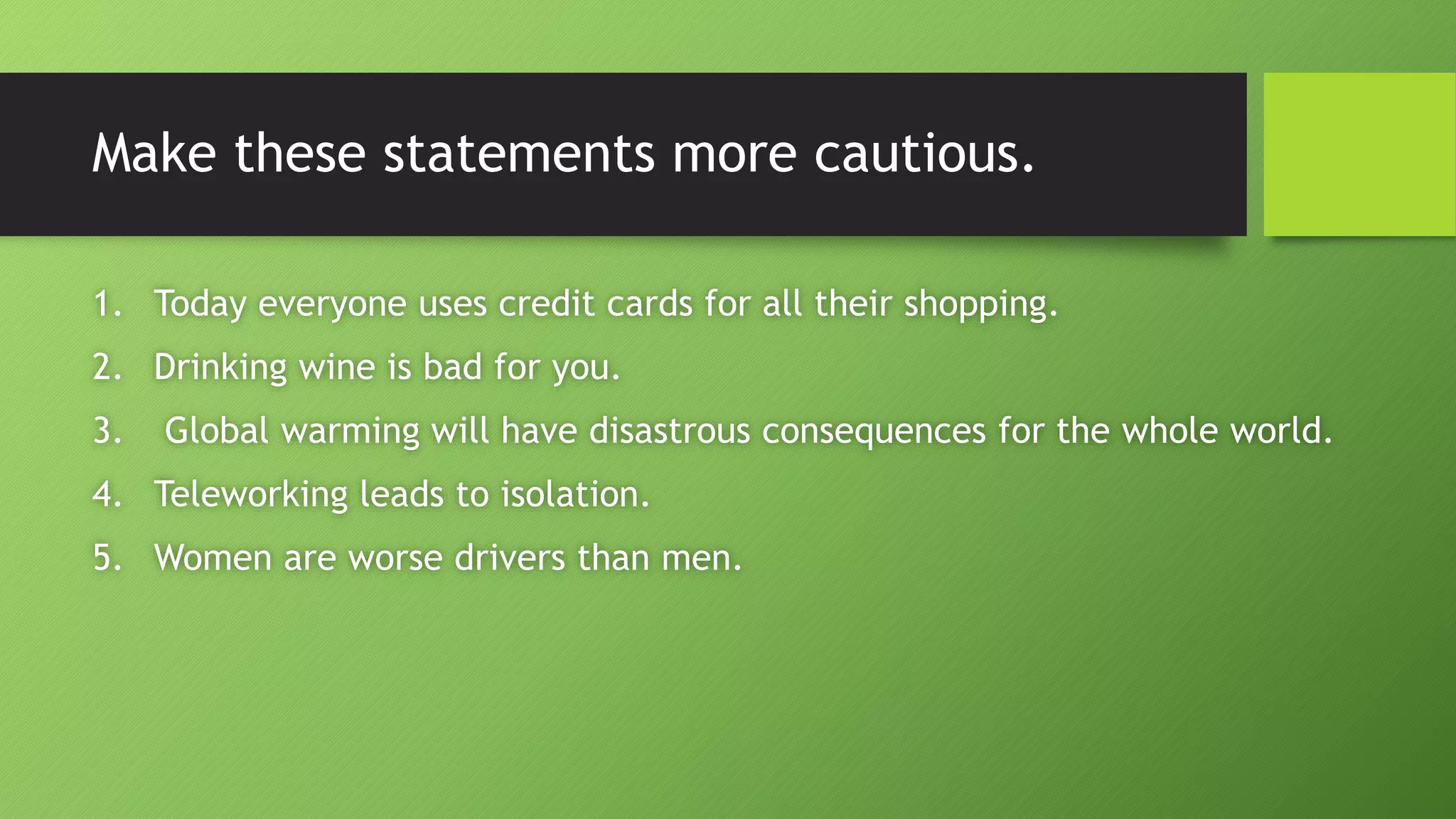
Make these statements more cautious.
1. Today everyone uses credit cards for all their shopping.
2. Drinking wine is bad for you.
3. Global warming will have disastrous consequences for the whole world.
4. Teleworking leads to isolation.
5. Women are worse drivers than men.
Handouts
• Abstract
• Academic Language and Function
• Academic Wordlist
• Spelling
• Lab Report/Capstone
• Revising
• Expressions of Quantity
• Using your computer in writing
• Download from here:
http://www.mediafire.com/download/9c3hpeq12xkowsk/Handouts.rar

Academic language

  • 1.
    Academic Writing Style MedhatMohsen Luxor STEM School Egypt, Qena. 2016
  • 2.
    What is academiclanguage? • Academic language is the language of school and it is used in textbooks, essays, assignments, class presentations, and assessments. Academic language is used at all grade levels, although its frequency increases as students get older. • It is also the language of the workplace — for example, the language used to write a business letter as opposed to a casual e-mail to a co- worker.
  • 3.
    Purpose and Product •Students may write a lab report in science class. • Students may orally explain their reasoning in math class. • Students may listen to and compare two famous speeches in history class. • Students may compare a scene from a novel and a movie in an English language arts class.
  • 4.
    The difference betweensocial and academic language Social English Academic English I like this book more. This story is more exciting than the first one we read. It worked. Our experiment was successful. Because they were brave. The soldiers received the medal because of their courage.
  • 5.
    BICS vs. CALP Youmay have seen references to BICS vs. CALP when discussing academic language. Basic Interpersonal Communication Skills (BICS) refers to social language, and Cognitive Academic Language Proficiency (CALP) refers to academic language.
  • 6.
    "Bricks and mortar" •Bricks = key vocabulary words and concepts • Mortar = language chunks • Example: Even though bats have wings, they are not birds. • In this sentence, the bricks are the key vocabulary words in bold: • Even though bats have wings, they are not birds. • "Even though" means that two items are similar, but they are not the same. In this case, bats and birds both share a similar feature (having wings), but they are not the same animal.
  • 7.
    Same Words, DifferentMeanings Word Meaning Table Lunch table (Social language) Periodic Table of Elements (Science) Table of Contents (ELA) Multiplication tables (Math) To table (delay) the discussion (Social Studies) Plot Plot of a story (ELA) Plot of land (Geography) Plot ordered pairs on a graph (Math) To plot a government coup (History) Branch Branch of government (Social Studies) Branch of a river (Geography) To branch out (Idiom) Foot Your foot (Health) One foot in length (Math) Foot in your mouth (Idiom) Foot of the mountain (Geography) To foot the bill (Idiom)
  • 8.
    Writing Tips • Awide range of vocabulary is of course important, but you must use the right word, and shorter ones are often better than longer ones. • Avoid everyday, informal language, especially colloquial expressions and slang. - Hi folks. - Greetings to all people. - We wanna use it, but we messed it up. - We were going to use it, but we couldn’t handle it well. • Avoid spoken language that is naturally full of hesitations, repetitions, grammatical errors and unfinished ideas. • Sentences should be complete and ideas arranged into paragraphs or sections. • Aim for perfection in your grammar and spelling.
  • 9.
    AVOID SOME ASPECTSOF INFORMAL ENGLISH • don't (do not!) use contractions (eg it's, he'll, it'd etc): always use the full form (it is/has, he will, it would/had). • don't use colloquial language or slang (eg kid, a lot of/lots of, cool) • always write as concisely as you can, with no irrelevant material or “waffle”. • generally avoid "phrasal verbs" (e.g. get off, get away with, put in etc): instead, use one word equivalents. • avoid common but vague words and phrases such as get, nice, thing. Your writing needs to be more precise. • avoid overuse of brackets; don’t use exclamation marks or dashes; avoid direct questions; don’t use “etc”. • always use capital letters appropriately and never use the type of language used in texting!
  • 10.
    STRUCTURE YOUR WRITINGCAREFULLY • make sure you write in complete sentences. • divide your writing up into paragraphs. • Use connecting words and phrases to make your writing explicit and easy to follow • Check your grammar and spelling carefully
  • 11.
    MAKE YOUR WRITINGFORMAL AND IMPERSONAL • Avoid too much personal language (I, my, we etc). • Be objective rather than subjective. • Avoid making sweeping generalizations. • try to write noun-based phrases rather that verb-based ones. - For example, instead of Crime was increasing rapidly and the police were becoming concerned. Write: The rapid increase in crime was causing concern among the police.
  • 12.
    HEDGING/AVOIDING COMMITMENT • avoidoveruse of first person pronouns (I, we, my, our) • use impersonal subjects instead (It is believed that ..., it can be argued that ...) • use passive verbs to avoid stating the ‘doer’ (Tests have been conducted) • use verbs (often with it as subject) such as imagine, suggest, claim, suppose • use ‘attitudinal signals’ such as apparently, arguably, ideally, strangely, unexpectedly. • These words allow you to hint at your attitude to something without using personal language. • use verbs such as would, could, may, might which ‘soften’ what you’re saying. • use qualifying adverbs such as some, several, a minority of, a few, many to avoid making overgeneralisations.
  • 13.
    Exercises • Replace thephrasal verbs in the sentences with a more appropriate verb from the list below. Don't forget to keep the same tense.
  • 14.
    fluctuate / investigate/ eliminate / raise / reduce /propose / intervene / establish 1. Researchers have been looking into the problem for 15 years. ______________________ 2. This issue was brought up during the seminar. __________________________ 3. It is assumed that the management knows what is happening and will therefore step in if there is a problem. _________________________ 4. Schools cannot altogether get rid of the problem of truancy. _________________________ 5. The number of staff has been cut down recently. _____________________ 6. It was very difficult to find out exactly what happened. _______________________ 7. House prices have a tendency to go up and down. _______________________ 8. A potential solution was put forward two years ago. ______________________
  • 15.
    Which of thetwo alternatives in bold do you think is more appropriate in academic writing? 1. The government has made considerable/great progress in solving the problem. 2. We got/obtained excellent results in the experiment. 3. The results of lots of/numerous tests have been pretty good/encouraging. 4. A loss of jobs is one of the consequences/things that will happen if the process is automated. 5. The relationship between the management and workers is extremely/really important. 6. Some suggestions springing up from/arising from the study will be presented.
  • 16.
    Suggest alternatives tothe following to avoid use of personal language. 1. In this essay I will discuss the main differences between the English and Scottish legal systems. 2. I have divided my report into five sections. 3. I will conclude by proposing that all drugs should be legalized. 4. The opinion of the present author in this essay is that the importance of the monarchy should be reduced. 5. In the third part of the essay, we will look at the reasons for public hysteria over the SARS virus 6. Although I am not an expert in the field, I have tried very hard to understand the main ideas.
  • 17.
    Make these statementsmore cautious. 1. Today everyone uses credit cards for all their shopping. 2. Drinking wine is bad for you. 3. Global warming will have disastrous consequences for the whole world. 4. Teleworking leads to isolation. 5. Women are worse drivers than men.
  • 18.
    Handouts • Abstract • AcademicLanguage and Function • Academic Wordlist • Spelling • Lab Report/Capstone • Revising • Expressions of Quantity • Using your computer in writing • Download from here: http://www.mediafire.com/download/9c3hpeq12xkowsk/Handouts.rar

Editor's Notes

  • #3 http://www.colorincolorado.org/article/academic-language-and-ells-what-teachers-need-know
  • #9 http://library.bcu.ac.uk/learner/writingguides/1.20.htm