Outlining & Summarizing
Uses of Outlining 1. Logically organizing our ideas in the preparatory stages of writing 2. Providing a map of our writing for our readers’ reference 3. Understanding the organization of other writers’ texts
Rules for Writing Outlines 1. Subdivide topics by a system of numbers and letters, followed by a period. 2. Capitalize the first letter of each heading and subheading. 3. Each heading and subheading must have at least two parts. In other words, if there is a I there must be a II; if there is an A there must be a B.
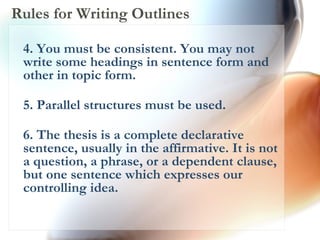
Rules for Writing Outlines   4. You must be consistent. You may not write some headings in sentence form and other in topic form. 5. Parallel structures must be used. 6. The thesis is a complete declarative sentence, usually in the affirmative. It is not a question, a phrase, or a dependent clause, but one sentence which expresses our controlling idea.
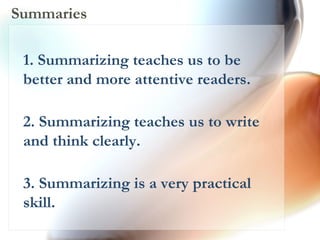
Summaries 1. Summarizing teaches us to be better and more attentive readers.  2. Summarizing teaches us to write and think clearly. 3. Summarizing is a very practical skill.
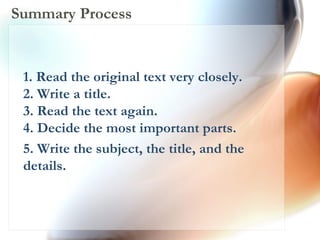
Summary Process 1. Read the original text very closely.  2. Write a title.  3. Read the text again.  4. Decide the most important parts.  5. Write the subject, the title, and the  details.
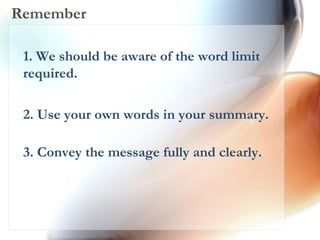
Remember 1. We should be aware of the word limit  required.  2. Use your own words in your summary.  3. Convey the message fully and clearly.
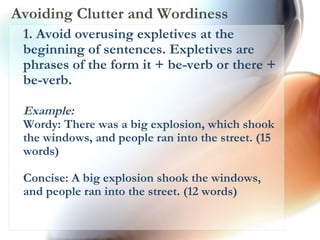
Avoiding Clutter and Wordiness 1. Avoid overusing expletives at the beginning of sentences. Expletives are phrases of the form it + be-verb or there + be-verb.  Example: Wordy: There was a big explosion, which shook the windows, and people ran into the street. (15 words) Concise: A big explosion shook the windows, and people ran into the street. (12 words)
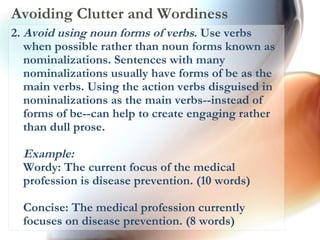
Avoiding Clutter and Wordiness 2.  Avoid using noun forms of verbs . Use verbs when possible rather than noun forms known as nominalizations. Sentences with many nominalizations usually have forms of be as the main verbs. Using the action verbs disguised in nominalizations as the main verbs--instead of forms of be--can help to create engaging rather than dull prose. Example: Wordy: The current focus of the medical profession is disease prevention. (10 words) Concise: The medical profession currently focuses on disease prevention. (8 words)
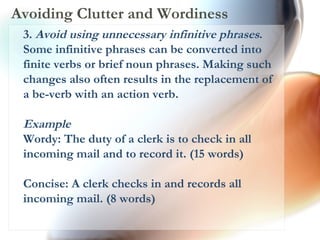
Avoiding Clutter and Wordiness 3.  Avoid using unnecessary infinitive phrases . Some infinitive phrases can be converted into finite verbs or brief noun phrases. Making such changes also often results in the replacement of a be-verb with an action verb. Example Wordy: The duty of a clerk is to check in all incoming mail and to record it. (15 words) Concise: A clerk checks in and records all incoming mail. (8 words)
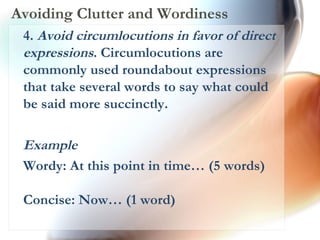
Avoiding Clutter and Wordiness 4.  Avoid circumlocutions in favor of direct expressions . Circumlocutions are commonly used roundabout expressions that take several words to say what could be said more succinctly.  Example Wordy: At this point in time… (5 words) Concise: Now… (1 word)
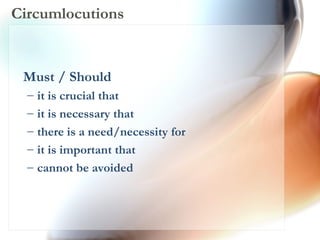
Circumlocutions Must / Should  it is crucial that  it is necessary that  there is a need/necessity for  it is important that  cannot be avoided
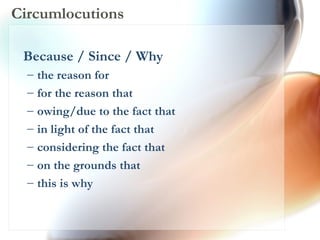
Circumlocutions Because / Since / Why  the reason for  for the reason that  owing/due to the fact that  in light of the fact that  considering the fact that  on the grounds that  this is why
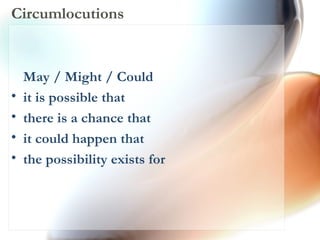
Circumlocutions May / Might / Could  it is possible that  there is a chance that  it could happen that  the possibility exists for
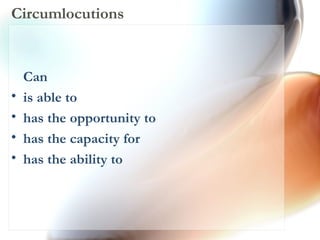
Circumlocutions Can  is able to  has the opportunity to  has the capacity for  has the ability to
Revision 1. Is the gist or main theme accurately  captured by the summary? 2. Are there any unnecessary details? 3. Is the summary as short as possible?  Can you re-write any phrases or  sentences to include less words? 4. Is the meaning of the original text  clearly stated? 5. Are all the essential points included?

Outlining & Summarizing

  • 1.
  • 2.
    Uses of Outlining1. Logically organizing our ideas in the preparatory stages of writing 2. Providing a map of our writing for our readers’ reference 3. Understanding the organization of other writers’ texts
  • 3.
    Rules for WritingOutlines 1. Subdivide topics by a system of numbers and letters, followed by a period. 2. Capitalize the first letter of each heading and subheading. 3. Each heading and subheading must have at least two parts. In other words, if there is a I there must be a II; if there is an A there must be a B.
  • 4.
    Rules for WritingOutlines 4. You must be consistent. You may not write some headings in sentence form and other in topic form. 5. Parallel structures must be used. 6. The thesis is a complete declarative sentence, usually in the affirmative. It is not a question, a phrase, or a dependent clause, but one sentence which expresses our controlling idea.
  • 5.
    Summaries 1. Summarizingteaches us to be better and more attentive readers. 2. Summarizing teaches us to write and think clearly. 3. Summarizing is a very practical skill.
  • 6.
    Summary Process 1.Read the original text very closely. 2. Write a title. 3. Read the text again. 4. Decide the most important parts. 5. Write the subject, the title, and the details.
  • 7.
    Remember 1. Weshould be aware of the word limit required. 2. Use your own words in your summary. 3. Convey the message fully and clearly.
  • 8.
    Avoiding Clutter andWordiness 1. Avoid overusing expletives at the beginning of sentences. Expletives are phrases of the form it + be-verb or there + be-verb. Example: Wordy: There was a big explosion, which shook the windows, and people ran into the street. (15 words) Concise: A big explosion shook the windows, and people ran into the street. (12 words)
  • 9.
    Avoiding Clutter andWordiness 2. Avoid using noun forms of verbs . Use verbs when possible rather than noun forms known as nominalizations. Sentences with many nominalizations usually have forms of be as the main verbs. Using the action verbs disguised in nominalizations as the main verbs--instead of forms of be--can help to create engaging rather than dull prose. Example: Wordy: The current focus of the medical profession is disease prevention. (10 words) Concise: The medical profession currently focuses on disease prevention. (8 words)
  • 10.
    Avoiding Clutter andWordiness 3. Avoid using unnecessary infinitive phrases . Some infinitive phrases can be converted into finite verbs or brief noun phrases. Making such changes also often results in the replacement of a be-verb with an action verb. Example Wordy: The duty of a clerk is to check in all incoming mail and to record it. (15 words) Concise: A clerk checks in and records all incoming mail. (8 words)
  • 11.
    Avoiding Clutter andWordiness 4. Avoid circumlocutions in favor of direct expressions . Circumlocutions are commonly used roundabout expressions that take several words to say what could be said more succinctly. Example Wordy: At this point in time… (5 words) Concise: Now… (1 word)
  • 12.
    Circumlocutions Must /Should it is crucial that it is necessary that there is a need/necessity for it is important that cannot be avoided
  • 13.
    Circumlocutions Because /Since / Why the reason for for the reason that owing/due to the fact that in light of the fact that considering the fact that on the grounds that this is why
  • 14.
    Circumlocutions May /Might / Could it is possible that there is a chance that it could happen that the possibility exists for
  • 15.
    Circumlocutions Can is able to has the opportunity to has the capacity for has the ability to
  • 16.
    Revision 1. Isthe gist or main theme accurately captured by the summary? 2. Are there any unnecessary details? 3. Is the summary as short as possible? Can you re-write any phrases or sentences to include less words? 4. Is the meaning of the original text clearly stated? 5. Are all the essential points included?