Controlling Microbial
Growth
in the Environment
Basic Principles of Microbial Control
 Sterilization- removal or destruction of all microbes
(except prions)
 ONLY the eradication of harmful microorganisms and
viruses; some innocuous microbes may still be present
and viable in an environment that is considered sterile
Commercial sterilization
 of canned food does not kill all hyperthermophilic
microbes
 because they do not cause disease and cannot grow and
spoil food at ambient temperatures, they are of no
practical concern.
Aseptic (ā-sep’tik)
 environment or procedure that is free of contamination by
pathogens
 Eg: packaged food and surgical asepsis
 When a chemical (antiseptic) is used on skin or other
tissue, the process is called antisepsis (an-tē-sep’sis)
 Sepsis-- decay
Disinfection
 refers to the use of physical or chemical
agents/disinfectants, including ultraviolet light, heat,
alcohol, and bleach, to inhibit or destroy
microorganisms, especially pathogens
 does not guarantee that all pathogens are
eliminated; indeed, disinfectants alone cannot inhibit
endospores or some viruses
 disinfectants are more concentrated or can be left on
a surface for longer periods of time
Degerming
 removal of microbes from a surface by scrubbing
 Handwashing
 Prepping an area of skin for injection
Sanitization
 disinfecting places and utensils used by the public to
reduce the number of pathogenic microbes to meet
accepted public health standards.
 steam, high-pressure hot water, and scrubbing are used
to sanitize restaurant utensils and dishes, and chemicals
are used to sanitize public toilets
 Disinfecting dishes at home and sanitizing dishes in a
restaurant is the
 Sanitas-- healthy
Pasteurization
 is the use of heat to kill pathogens and reduce the
number of spoilage microorganisms in food and
beverages.
 Milk, fruit juices, wine, and beer
Stasis vs cidium
 suffixes -stasis or -static to indicate that a chemical
or physical agent inhibits microbial metabolism and
growth but does not necessarily kill microbes
 Stasis- to stand ; remain unchanged
Stasis vs cidium
 refrigeration is bacteriostatic for most bacterial
species; it inhibits their growth, but they can resume
metabolism when the optimal temperature is
restored.
 cide or –cidal-- agents that destroy or permanently
inactivate a particular type of microbe
 Cidium– a slaying
Microbial Death Rates
 microbial death as the permanent loss of
reproductive ability under ideal environmental
conditions.
 One technique for evaluating the efficacy of an
antimicrobial agent is to calculate the microbial
death rate
 Usually Found to be constant over time for any
particular microorganism under a particular set of
conditions
Terminology of antimicrobial control
Antimicrobial action
Two basic categories:
 disrupt the integrity of cells by altering their cell
walls/cytoplasmic membranes
 Interrupt cellular metabolism and reproduction by
interfering with proteins and nucleic acids
structure
Alteration of Cell Walls and Membranes
 Cell wall: counteracting effects of osmosis when in
hypotonic solution
 Effects of physical or chemical agents
 Inability to protect cell from osmosis and or death
 Viral envelope—attachment of virus to target cell
 Damage prevents viral replication
 Lack of envelope– greated tolerance of harsh environments
and antimicrobials
Damage to Proteins and Nucleic Acids
 Proteins regulate cellular metabolism
 Like enzymes in most metabolic reactions
 form structural components in membranes and
cytoplasm
 Broken down by extreme heat (or radiation) and chemicals–
denatured proteins
 Denatured proteins– cease to function and bring about cell
death
The Selection of Microbial Control
Methods
 Ideal agents DO NOT EXIST
 Inexpensive, fast acting and stable during storage
 Factors Affecting the Efficacy of Antimicrobial
Methods
 Biosafety Levels
Factors Affecting the Efficacy of
Antimicrobial Methods
 Site to Be Treated
 Extreme heat cant be applied on humans and animals
 In medical procedures
 Instruments should be sterilized esp if will penetrate outer
defenses
 Disinfection-- surface of mucus membranes; sterilized for
immunocompromised
 Relative Susceptibility of Microorganisms
Factors Affecting the Efficacy of
Antimicrobial Methods
 Site to Be Treated
 Relative Susceptibility of Microorganisms
 Microbial death rate is usually constant for a particular agent
against a single microbe (eg: enveloped viruses: HIV)
 nonenveloped viruses e.g. polio
Microorganism Susceptibility
 Bacterial endospores-Bacillus and Clostridium- the most
resilient forms of life
 Species of mycobacteria: eg. Mycobacterium
tuberculosis– waxy lipid—strong disinfectants and
heat
 Cysts of protozoa—prevents entry of disinfectant,
drying and radiation and heat
Prions
 are infectious proteins
that cause degenerative
diseases of the brain,
are more resistant than
any cell or virus
Prion Diseases
 Several conditions fall under the term prion
diseases.
 A prion is a type of protein that can trigger normal
proteins in the brain to fold abnormally.
 affect both humans and animals and are sometimes
transmitted to humans by infected meat products
Germicidal effectiveness
 Prions
 High
 Intermediate
 Low
Germicidal effectiveness
 Prions- heating to 482°C for 4 hours to denature
 High
 Intermediate
 Low
Germicidal effectiveness
 Prions
 High- germicides that kill all pathogens, including
bacterial endospores
 sterilize invasive instruments such as catheters, implants,
and parts of heart-lung machines
 Intermediate
 Low
Germicidal effectiveness
 Prions
 High
 Intermediate- fungal spores, protozoan cysts,
 viruses, and pathogenic bacteria, but not bacterial
endospores.
 disinfect instruments that come in contact with mucous
membranes but are noninvasive, such as respiratory
equipment and endoscopes
 Low
Germicidal effectiveness
 Prions
 High
 Intermediate
 Low-eliminate vegetative bacteria, fungi, protozoa,
and some viruses
 disinfect items that contact only the skin of patients, such as
furniture and electrodes.
Environmental Conditions
Temperature and pH
 Warm disinfectants: chemicals react faster at higher
temperatures
 Acidic conditions--enhance the antimicrobial effect
of heat
 household chlorine bleach, are more effective at low pH
Organic materials
 fat, feces, vomit, blood
 intercellular matrix of biofilms
 interfere with the penetration of heat, chemicals, and
some forms of radiation
 in some cases these materials, inactivate chemical
disinfectants
Biosafety Levels
 CDC guidelines for four levels of safety in
microbiological laboratories dealing with pathogens:
 BSL 1- minimal precautions: handwashing
 BSL 2 –mod. Hazardous agents; extreme prec to
contaminated obj. or sharps
 BSL 3-hepa filter
 BSL4-most secure; sealed airlocks and mutiple
showers with uv light room
Physical Methods of Microbial Control
 Exposure of microbes to
 extremes of heat and cold
 Desiccation-- drying
 Filtration-filters
 osmotic pressure
 radiation
Heat-Related Methods
 High temperatures denature proteins, interfere with
the integrity of cytoplasmic membranes and cell
walls, and disrupt the function and structure of
nucleic acids
 Moist Heat-kills cells by denaturing proteins and
 destroying cytoplasmic membranes.
 Dry Heat
Heat-Related Methods
 Moist Heat
 Boiling- kills the vegetative cells of bacteria and fungi, the trophozoites of
protozoa, and most viruses within 10 minutes at sea level
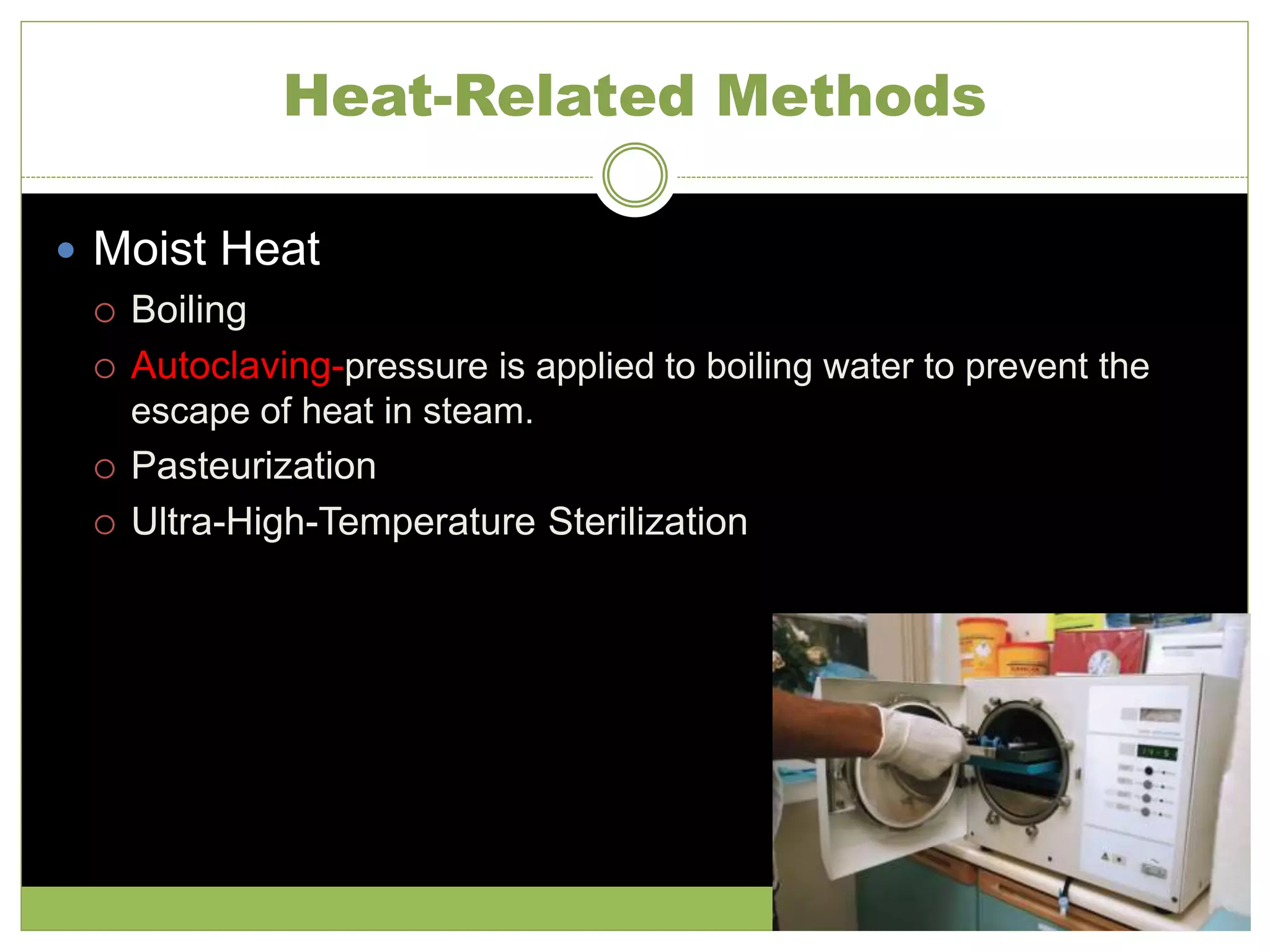
 Autoclaving
 Pasteurization
 Ultra-High-Temperature Sterilization
 Dry Heat
Heat-Related Methods
 Moist Heat
 Boiling
 Autoclaving-pressure is applied to boiling water to prevent the
escape of heat in steam.
 Pasteurization
 Ultra-High-Temperature Sterilization
Heat-Related Methods
 Moist Heat
 Boiling
 Autoclaving
 Pasteurization- heating beer and wine to destroy the
microorganisms that cause spoilage (not sterilization)
 Brucella melitensis – undulant fever/brucellosis
 Mycobacterium bovis - bovine tuberculosis
 Escherichia coli-diarrhea
 Ultra-High-Temperature Sterilization
Heat-Related Methods
 Moist Heat
 Boiling
 Autoclaving
 Pasteurization
 Ultra-High-Temperature Sterilization-flash heating
milk or other liquids to rid them of all living
microbes
 Heating beverages at higher temperatures than
pasteurization
Heat-Related Methods
 Moist Heat
 Dry Heat-powders and oils, cannot be sterilized by
boiling or with steam; some metal objects, can be
damaged by repeated exposure to steam
 dry heat requires higher temperatures for longer
times
 Complete incineration is the ultimate means of
sterilization: contaminated
Refrigeration and Freezing
 food preparation and storage, the most convenient
method of microbial control is either:
 refrigeration (temperatures between 0°C and 7°C)
 freezing(temperatures below 0°C)
 PROCESS: decrease microbial metabolism, growth,
and reproduction because chemical reactions occur
more slowly at low temperatures and because liquid
water is not available at subzero temperatures
(ususally mesophiles; except psychrophilic)
NOTE!!!
 Listeria(+) can reproduce to dangerous levels in
refrigerated food
 cause of food poisoning: flu-like symptoms
 Yersinia (-) can multiply in refrigerated blood
products and be passed on to blood recipients
 diarrhea and low-grade fever; plague: bubonic
Desiccation and Lyophilization
 Desiccation, or drying preserve such foods as fruits,
peas, beans, grain, nuts, and yeast
 inhibits the spread of most pathogens, including the
bacteria that cause syphilis, gonorrhea, and the
more common forms of bacterial pneumonia and
diarrhea
Desiccation and Lyophilization
 Lyophilization- freezing and drying, to preserve
microbes and other cells for many years
Filtration
 passage of a fluid (either a liquid or a gas) through a
sieve designed to trap particles—in this case, cells or
viruses—and separate them from the fluid
 Filtration traps microbes larger than the
 pore size, allowing smaller microbes to pass through
 HEPA filters are mounted in the air ducts of some
operating rooms, rooms occupied by patients with
airborne diseases such as tuberculosis, and rooms of
immunocompromised patients, such as burn victims and
AIDS patients.
Osmotic Pressure
 use of high concentrations of salt or sugar in foods to
inhibit microbial growth
 The removal of water inhibits cellular metabolism
because enzymes are fully functional only in
aqueous environments
 Fungi have a greater ability than bacteria to tolerate
hypertonic environments with little moisture, which
explains why jelly in your refrigerator may grow a
colony of Penicillium mold but is not likely to grow
the bacterium Salmonella
Radiation
 physical method of microbial control
 Ionizing Radiation-Electron beams, gamma rays,
and some X-rays, all of which
 have wavelengths shorter than 1 nm
 Nonionizing Radiation-Ultraviolet (UV) light, visible
light, infrared radiation, and radio waves
 UV light has sufficient energy to be a practical antimicrobial
agent
Chemical Methods of Microbial Control
 Phenol and Phenolics
 Alcohols
 Halogens
 Oxidizing Agents
 Surfactants
 Heavy Metals
 Aldehydes
 Gaseous Agents
 Enzymes
 Antimicrobial Drugs
Chemical Methods of Microbial Control
 Phenol and Phenolics
 Alcohols
 Halogens
 Oxidizing Agents
 Surfactants
 Heavy Metals
 Aldehydes
 Gaseous Agents
 Enzymes
 Antimicrobial Drugs
Chemical Methods of Microbial Control
 Phenol and Phenolics
 Alcohols--bactericidal, fungicidal, and virucidal
against enveloped viruses; however, they are not
effective against fungal spores or bacterial
endospores; intermediate- level disinfectants
 Alcohols denature proteins and disrupt cytoplasmic
membranes
 pure alcohol is not an effective antimicrobial -
denaturation of proteins requires water
Chemical Methods of Microbial Control
 70% to 90% alcohol : control microbes
 evaporate rapidly: leave no residue but disadvantage
may not contact microbes long enough to be
effective
 Alcohol-based antiseptics: more effective than soap
for bacteria on hands but not effective on some
viruses: eg. diarrhea-causing noroviruses
 Swabbing the skin with alcohol prior to an injection
removes more microbes
 by physical action (degerming) than by chemical
action.
Chemical Methods of Microbial Control
 Phenol and Phenolics
 Alcohols
 Halogens– iodine; betadine; chlorine, NaOCl;
chlorine dioxide- gas; bromine (pools/hot tubs);
flourine
Chemical Methods of Microbial Control
 Phenol and Phenolics
 Alcohols
 Halogens
 Oxidizing Agents- H202- catalase neutralizes it on open
wound; ozone; peracetic acid- sterilize medical equipemnt
 Surfactants- soaps and detergents
 Heavy Metals- silver- wounds; copper-pools
 Aldehydes-formalin-embalming, hospital
 Gaseous Agents-ethelene oxide-hospitals; explosive and
poisonous
 Enzymes- prionzyme
 Antimicrobial Drugs
Development of Resistant Microbes
 There is little evidence that the extensive use of such
products adds to human or animal health, but it does
promote the development of strains of microbes
resistant to antimicrobial chemicals:
 While susceptible cells die, resistant cells remain to
proliferate.
 Scientists have already isolated strains of
pathogenic bacteria, including M. tuberculosis, P.
aeruginosa, E. coli, and S. aureus, that are less
susceptible to common disinfectants and antiseptics.
Thanks!
 Please get ¼ and answer the quiz on the piece of
paper and send your pictures of that paper via
messenger as a personal message.
 Good luck! 
QUIZ:
1. What is the significance of performing sanitation
first before sterilization? (in your own words)
2. As a nurse how will you use the temperature to
prevent the growth of microorganisms?
3. What is the most important concept to remember
when handwashing?
4. If you have used forceps to cleanse the wound of
your patient, specifically to grasp on cotton balls for
povidone iodine, what form of disinfection will you
use?
5. Why?

Controlling Microbial Growth in the Environment

  • 1.
  • 2.
    Basic Principles ofMicrobial Control  Sterilization- removal or destruction of all microbes (except prions)  ONLY the eradication of harmful microorganisms and viruses; some innocuous microbes may still be present and viable in an environment that is considered sterile
  • 3.
    Commercial sterilization  ofcanned food does not kill all hyperthermophilic microbes  because they do not cause disease and cannot grow and spoil food at ambient temperatures, they are of no practical concern.
  • 4.
    Aseptic (ā-sep’tik)  environmentor procedure that is free of contamination by pathogens  Eg: packaged food and surgical asepsis  When a chemical (antiseptic) is used on skin or other tissue, the process is called antisepsis (an-tē-sep’sis)  Sepsis-- decay
  • 5.
    Disinfection  refers tothe use of physical or chemical agents/disinfectants, including ultraviolet light, heat, alcohol, and bleach, to inhibit or destroy microorganisms, especially pathogens  does not guarantee that all pathogens are eliminated; indeed, disinfectants alone cannot inhibit endospores or some viruses  disinfectants are more concentrated or can be left on a surface for longer periods of time
  • 6.
    Degerming  removal ofmicrobes from a surface by scrubbing  Handwashing  Prepping an area of skin for injection
  • 7.
    Sanitization  disinfecting placesand utensils used by the public to reduce the number of pathogenic microbes to meet accepted public health standards.  steam, high-pressure hot water, and scrubbing are used to sanitize restaurant utensils and dishes, and chemicals are used to sanitize public toilets  Disinfecting dishes at home and sanitizing dishes in a restaurant is the  Sanitas-- healthy
  • 10.
    Pasteurization  is theuse of heat to kill pathogens and reduce the number of spoilage microorganisms in food and beverages.  Milk, fruit juices, wine, and beer
  • 11.
    Stasis vs cidium suffixes -stasis or -static to indicate that a chemical or physical agent inhibits microbial metabolism and growth but does not necessarily kill microbes  Stasis- to stand ; remain unchanged
  • 12.
    Stasis vs cidium refrigeration is bacteriostatic for most bacterial species; it inhibits their growth, but they can resume metabolism when the optimal temperature is restored.  cide or –cidal-- agents that destroy or permanently inactivate a particular type of microbe  Cidium– a slaying
  • 13.
    Microbial Death Rates microbial death as the permanent loss of reproductive ability under ideal environmental conditions.  One technique for evaluating the efficacy of an antimicrobial agent is to calculate the microbial death rate  Usually Found to be constant over time for any particular microorganism under a particular set of conditions
  • 14.
  • 15.
    Antimicrobial action Two basiccategories:  disrupt the integrity of cells by altering their cell walls/cytoplasmic membranes  Interrupt cellular metabolism and reproduction by interfering with proteins and nucleic acids structure
  • 16.
    Alteration of CellWalls and Membranes  Cell wall: counteracting effects of osmosis when in hypotonic solution  Effects of physical or chemical agents  Inability to protect cell from osmosis and or death  Viral envelope—attachment of virus to target cell  Damage prevents viral replication  Lack of envelope– greated tolerance of harsh environments and antimicrobials
  • 17.
    Damage to Proteinsand Nucleic Acids  Proteins regulate cellular metabolism  Like enzymes in most metabolic reactions  form structural components in membranes and cytoplasm  Broken down by extreme heat (or radiation) and chemicals– denatured proteins  Denatured proteins– cease to function and bring about cell death
  • 18.
    The Selection ofMicrobial Control Methods  Ideal agents DO NOT EXIST  Inexpensive, fast acting and stable during storage  Factors Affecting the Efficacy of Antimicrobial Methods  Biosafety Levels
  • 19.
    Factors Affecting theEfficacy of Antimicrobial Methods  Site to Be Treated  Extreme heat cant be applied on humans and animals  In medical procedures  Instruments should be sterilized esp if will penetrate outer defenses  Disinfection-- surface of mucus membranes; sterilized for immunocompromised  Relative Susceptibility of Microorganisms
  • 20.
    Factors Affecting theEfficacy of Antimicrobial Methods  Site to Be Treated  Relative Susceptibility of Microorganisms  Microbial death rate is usually constant for a particular agent against a single microbe (eg: enveloped viruses: HIV)  nonenveloped viruses e.g. polio
  • 22.
    Microorganism Susceptibility  Bacterialendospores-Bacillus and Clostridium- the most resilient forms of life  Species of mycobacteria: eg. Mycobacterium tuberculosis– waxy lipid—strong disinfectants and heat  Cysts of protozoa—prevents entry of disinfectant, drying and radiation and heat
  • 23.
    Prions  are infectiousproteins that cause degenerative diseases of the brain, are more resistant than any cell or virus
  • 24.
    Prion Diseases  Severalconditions fall under the term prion diseases.  A prion is a type of protein that can trigger normal proteins in the brain to fold abnormally.  affect both humans and animals and are sometimes transmitted to humans by infected meat products
  • 25.
    Germicidal effectiveness  Prions High  Intermediate  Low
  • 26.
    Germicidal effectiveness  Prions-heating to 482°C for 4 hours to denature  High  Intermediate  Low
  • 27.
    Germicidal effectiveness  Prions High- germicides that kill all pathogens, including bacterial endospores  sterilize invasive instruments such as catheters, implants, and parts of heart-lung machines  Intermediate  Low
  • 28.
    Germicidal effectiveness  Prions High  Intermediate- fungal spores, protozoan cysts,  viruses, and pathogenic bacteria, but not bacterial endospores.  disinfect instruments that come in contact with mucous membranes but are noninvasive, such as respiratory equipment and endoscopes  Low
  • 29.
    Germicidal effectiveness  Prions High  Intermediate  Low-eliminate vegetative bacteria, fungi, protozoa, and some viruses  disinfect items that contact only the skin of patients, such as furniture and electrodes.
  • 30.
    Environmental Conditions Temperature andpH  Warm disinfectants: chemicals react faster at higher temperatures  Acidic conditions--enhance the antimicrobial effect of heat  household chlorine bleach, are more effective at low pH
  • 31.
    Organic materials  fat,feces, vomit, blood  intercellular matrix of biofilms  interfere with the penetration of heat, chemicals, and some forms of radiation  in some cases these materials, inactivate chemical disinfectants
  • 32.
    Biosafety Levels  CDCguidelines for four levels of safety in microbiological laboratories dealing with pathogens:  BSL 1- minimal precautions: handwashing  BSL 2 –mod. Hazardous agents; extreme prec to contaminated obj. or sharps  BSL 3-hepa filter  BSL4-most secure; sealed airlocks and mutiple showers with uv light room
  • 33.
    Physical Methods ofMicrobial Control  Exposure of microbes to  extremes of heat and cold  Desiccation-- drying  Filtration-filters  osmotic pressure  radiation
  • 35.
    Heat-Related Methods  Hightemperatures denature proteins, interfere with the integrity of cytoplasmic membranes and cell walls, and disrupt the function and structure of nucleic acids  Moist Heat-kills cells by denaturing proteins and  destroying cytoplasmic membranes.  Dry Heat
  • 36.
    Heat-Related Methods  MoistHeat  Boiling- kills the vegetative cells of bacteria and fungi, the trophozoites of protozoa, and most viruses within 10 minutes at sea level  Autoclaving  Pasteurization  Ultra-High-Temperature Sterilization  Dry Heat
  • 37.
    Heat-Related Methods  MoistHeat  Boiling  Autoclaving-pressure is applied to boiling water to prevent the escape of heat in steam.  Pasteurization  Ultra-High-Temperature Sterilization
  • 39.
    Heat-Related Methods  MoistHeat  Boiling  Autoclaving  Pasteurization- heating beer and wine to destroy the microorganisms that cause spoilage (not sterilization)  Brucella melitensis – undulant fever/brucellosis  Mycobacterium bovis - bovine tuberculosis  Escherichia coli-diarrhea  Ultra-High-Temperature Sterilization
  • 40.
    Heat-Related Methods  MoistHeat  Boiling  Autoclaving  Pasteurization  Ultra-High-Temperature Sterilization-flash heating milk or other liquids to rid them of all living microbes  Heating beverages at higher temperatures than pasteurization
  • 41.
    Heat-Related Methods  MoistHeat  Dry Heat-powders and oils, cannot be sterilized by boiling or with steam; some metal objects, can be damaged by repeated exposure to steam  dry heat requires higher temperatures for longer times  Complete incineration is the ultimate means of sterilization: contaminated
  • 42.
    Refrigeration and Freezing food preparation and storage, the most convenient method of microbial control is either:  refrigeration (temperatures between 0°C and 7°C)  freezing(temperatures below 0°C)  PROCESS: decrease microbial metabolism, growth, and reproduction because chemical reactions occur more slowly at low temperatures and because liquid water is not available at subzero temperatures (ususally mesophiles; except psychrophilic)
  • 43.
    NOTE!!!  Listeria(+) canreproduce to dangerous levels in refrigerated food  cause of food poisoning: flu-like symptoms  Yersinia (-) can multiply in refrigerated blood products and be passed on to blood recipients  diarrhea and low-grade fever; plague: bubonic
  • 44.
    Desiccation and Lyophilization Desiccation, or drying preserve such foods as fruits, peas, beans, grain, nuts, and yeast  inhibits the spread of most pathogens, including the bacteria that cause syphilis, gonorrhea, and the more common forms of bacterial pneumonia and diarrhea
  • 45.
    Desiccation and Lyophilization Lyophilization- freezing and drying, to preserve microbes and other cells for many years
  • 46.
    Filtration  passage ofa fluid (either a liquid or a gas) through a sieve designed to trap particles—in this case, cells or viruses—and separate them from the fluid  Filtration traps microbes larger than the  pore size, allowing smaller microbes to pass through  HEPA filters are mounted in the air ducts of some operating rooms, rooms occupied by patients with airborne diseases such as tuberculosis, and rooms of immunocompromised patients, such as burn victims and AIDS patients.
  • 48.
    Osmotic Pressure  useof high concentrations of salt or sugar in foods to inhibit microbial growth  The removal of water inhibits cellular metabolism because enzymes are fully functional only in aqueous environments  Fungi have a greater ability than bacteria to tolerate hypertonic environments with little moisture, which explains why jelly in your refrigerator may grow a colony of Penicillium mold but is not likely to grow the bacterium Salmonella
  • 49.
    Radiation  physical methodof microbial control  Ionizing Radiation-Electron beams, gamma rays, and some X-rays, all of which  have wavelengths shorter than 1 nm  Nonionizing Radiation-Ultraviolet (UV) light, visible light, infrared radiation, and radio waves  UV light has sufficient energy to be a practical antimicrobial agent
  • 50.
    Chemical Methods ofMicrobial Control  Phenol and Phenolics  Alcohols  Halogens  Oxidizing Agents  Surfactants  Heavy Metals  Aldehydes  Gaseous Agents  Enzymes  Antimicrobial Drugs
  • 51.
    Chemical Methods ofMicrobial Control  Phenol and Phenolics  Alcohols  Halogens  Oxidizing Agents  Surfactants  Heavy Metals  Aldehydes  Gaseous Agents  Enzymes  Antimicrobial Drugs
  • 52.
    Chemical Methods ofMicrobial Control  Phenol and Phenolics  Alcohols--bactericidal, fungicidal, and virucidal against enveloped viruses; however, they are not effective against fungal spores or bacterial endospores; intermediate- level disinfectants  Alcohols denature proteins and disrupt cytoplasmic membranes  pure alcohol is not an effective antimicrobial - denaturation of proteins requires water
  • 53.
    Chemical Methods ofMicrobial Control  70% to 90% alcohol : control microbes  evaporate rapidly: leave no residue but disadvantage may not contact microbes long enough to be effective  Alcohol-based antiseptics: more effective than soap for bacteria on hands but not effective on some viruses: eg. diarrhea-causing noroviruses  Swabbing the skin with alcohol prior to an injection removes more microbes  by physical action (degerming) than by chemical action.
  • 54.
    Chemical Methods ofMicrobial Control  Phenol and Phenolics  Alcohols  Halogens– iodine; betadine; chlorine, NaOCl; chlorine dioxide- gas; bromine (pools/hot tubs); flourine
  • 55.
    Chemical Methods ofMicrobial Control  Phenol and Phenolics  Alcohols  Halogens  Oxidizing Agents- H202- catalase neutralizes it on open wound; ozone; peracetic acid- sterilize medical equipemnt  Surfactants- soaps and detergents  Heavy Metals- silver- wounds; copper-pools  Aldehydes-formalin-embalming, hospital  Gaseous Agents-ethelene oxide-hospitals; explosive and poisonous  Enzymes- prionzyme  Antimicrobial Drugs
  • 56.
    Development of ResistantMicrobes  There is little evidence that the extensive use of such products adds to human or animal health, but it does promote the development of strains of microbes resistant to antimicrobial chemicals:  While susceptible cells die, resistant cells remain to proliferate.  Scientists have already isolated strains of pathogenic bacteria, including M. tuberculosis, P. aeruginosa, E. coli, and S. aureus, that are less susceptible to common disinfectants and antiseptics.
  • 57.
    Thanks!  Please get¼ and answer the quiz on the piece of paper and send your pictures of that paper via messenger as a personal message.  Good luck! 
  • 58.
    QUIZ: 1. What isthe significance of performing sanitation first before sterilization? (in your own words) 2. As a nurse how will you use the temperature to prevent the growth of microorganisms? 3. What is the most important concept to remember when handwashing? 4. If you have used forceps to cleanse the wound of your patient, specifically to grasp on cotton balls for povidone iodine, what form of disinfection will you use? 5. Why?

Editor's Notes

  • #3 Innocuous -- harmless
  • #4 hyperthermophiles may survive sterilization by laboratory methods, but they are of no practical concern to technicians because they cannot grow or reproduce under normal laboratory conditions
  • #10 Page 263
  • #21 A protein coat is less fragile than a phospholipid membrane (envelope).
  • #24 Creutzfeldt–Jakob disease (CJD), also known as classic Creutzfeldt–Jakob disease, is a fatal degenerative brain disorder.[4][1] Early symptoms include memory problems, behavioral changes, poor coordination, and visual disturbances.[4] Later symptoms include dementia, involuntary movements, blindness, weakness, and coma.[4] About 70% of people die within a year of diagnosis.
  • #47 High efficiency particulate air Membrane filters composed of various substances and with pores of various sizes can be used to trap diverse microbes. Here, a bacterium known as vancomycin-resistant Enterococcus (VRE) is trapped.
  • #48 VRE
  • #56 Tegaderm Silver sulfadiazine -cream