CONTROL
Business Administration -Prof. Hitesh Sharma
What is Control?
 “Managerial control implies the „measurement of
accomplishment‟ against the standard and the
correction of deviations to assure attainment of
objectives according to plans”. Koontz And O‟Donnell
 “Controlling is checking performance against
predetermined standards contained in the plans with
a view to ensuring adequate progress and
satisfactory performance.” E.F.L. Breach
What is Control?
 George R. Terry defined “controlling is determining
what is being accomplished, that is evaluating the
performance and, if necessary, applying corrected
measures so that the performance takes place
according to plans.”
 So the function of controlling helps to achieve the
desired goals by planning. Management must,
therefore, compare actual results with pre-determined
standards and take corrective action if necessary.
Characteristics of Control
 End function of management (Means to achieve „end‟)
 Continuous activity
 Exercised at all levels
 Dynamic process
 Constructive activity
 Forward looking process
 People oriented process
 Related to planning
 Can be informal
 Internal activity
Need/Importance of Control:
 Helps in achievement of goals
 Base of planning
 Useful for organizing
 Makes directing effective
 Helps in co-ordination
 Necessary for delegation of authority
 Helps in removing deviations
Control Techniques
 Traditional Methods
1. Budgetary Control
2. Break-even Analysis
 Modern Methods
1. PERT
2. CPM
3. Zero based budgeting
Budgetary Control
 Budget
An estimate of costs, revenues, and resources over a
specified period, reflecting a reading of future
financial conditions and goals.
A budget also serves as a
 Plan of action for achieving quantified objectives
 Standard for measuring performance
 Device for coping with future adverse situations
Budgetary Control
 Budgetary Control
According to Brown and Howard, “Budgetary
control is a system of controlling costs which includes
the preparation of budgets, coordinating the
departments and establishing responsibilities,
comparing actual performance with the budgeted
and acting upon results to achieve maximum
profitability.”
Weldon characterizes budgetary control as
planning in advance of the various functions of a
business so that the business as a whole is
controlled.
Advantages of Budgetary Control
 Maximization of Profits
 Co-ordination
 Specific Aims
 Tool for Measuring Performance
 Economy
 Determining Weaknesses
 Corrective Action
 Consciousness
 Reduces Costs
 Introduction of Incentive Schemes
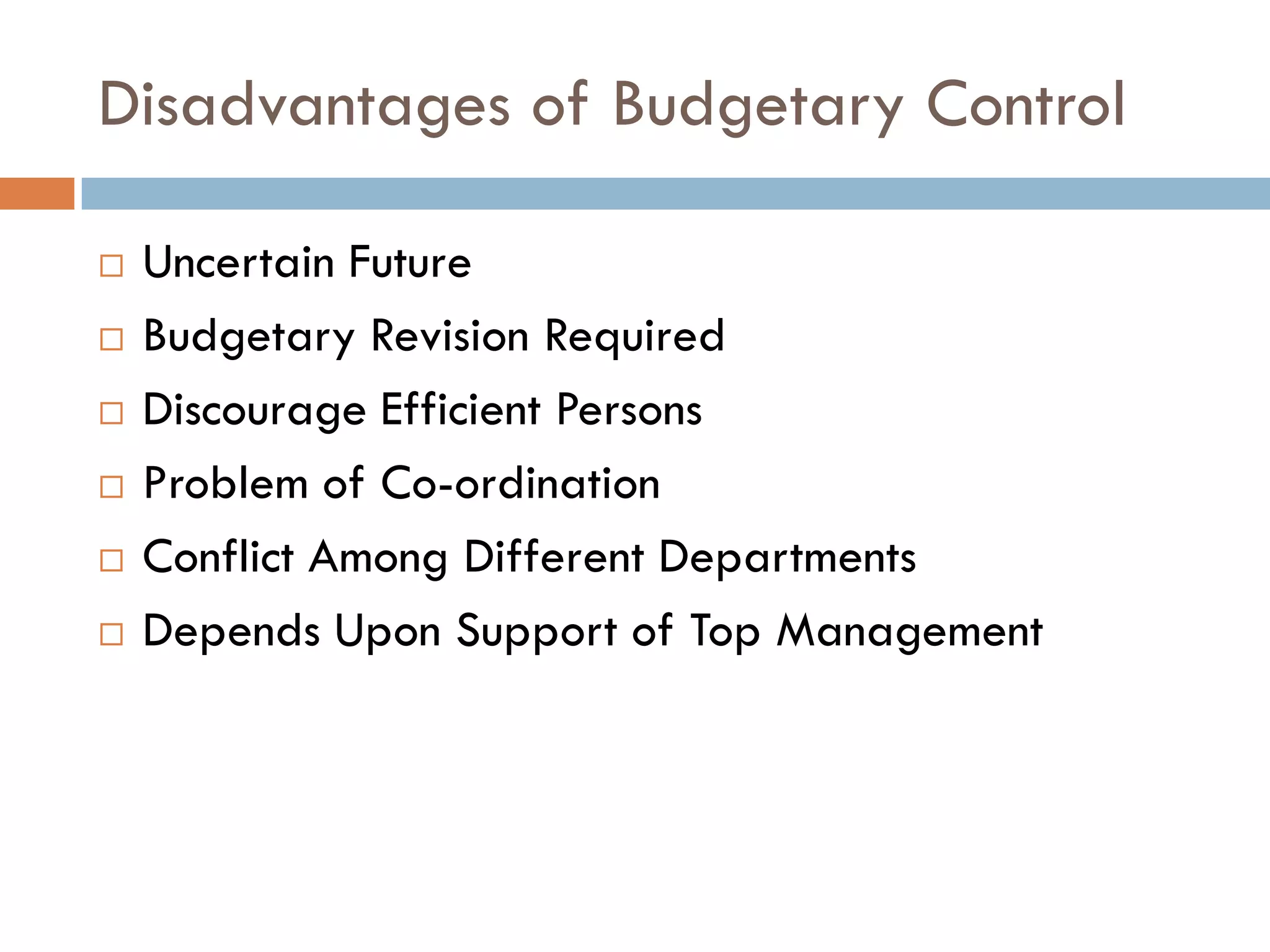
Disadvantages of Budgetary Control
 Uncertain Future
 Budgetary Revision Required
 Discourage Efficient Persons
 Problem of Co-ordination
 Conflict Among Different Departments
 Depends Upon Support of Top Management
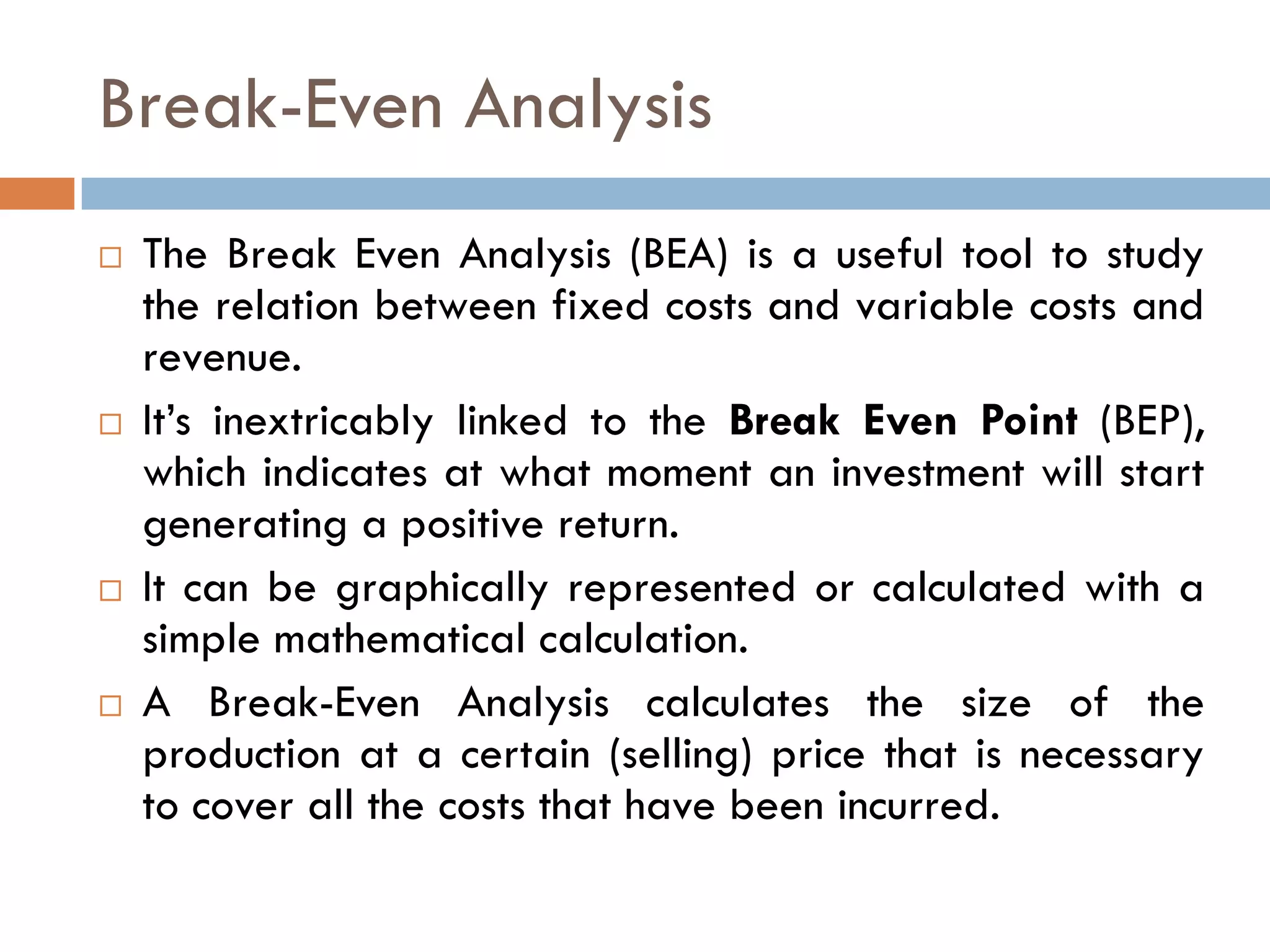
Break-Even Analysis
 The Break Even Analysis (BEA) is a useful tool to study
the relation between fixed costs and variable costs and
revenue.
 It‟s inextricably linked to the Break Even Point (BEP),
which indicates at what moment an investment will start
generating a positive return.
 It can be graphically represented or calculated with a
simple mathematical calculation.
 A Break-Even Analysis calculates the size of the
production at a certain (selling) price that is necessary
to cover all the costs that have been incurred.
Break Even Analysis Components & Formula
 Fixed costs are costs that do not change with varying
output (i.e. salary, rent, building machinery).
 Sales price per unit is the selling price (unit selling
price) per unit.
 Variable cost per unit is the variable costs incurred to
create a unit.
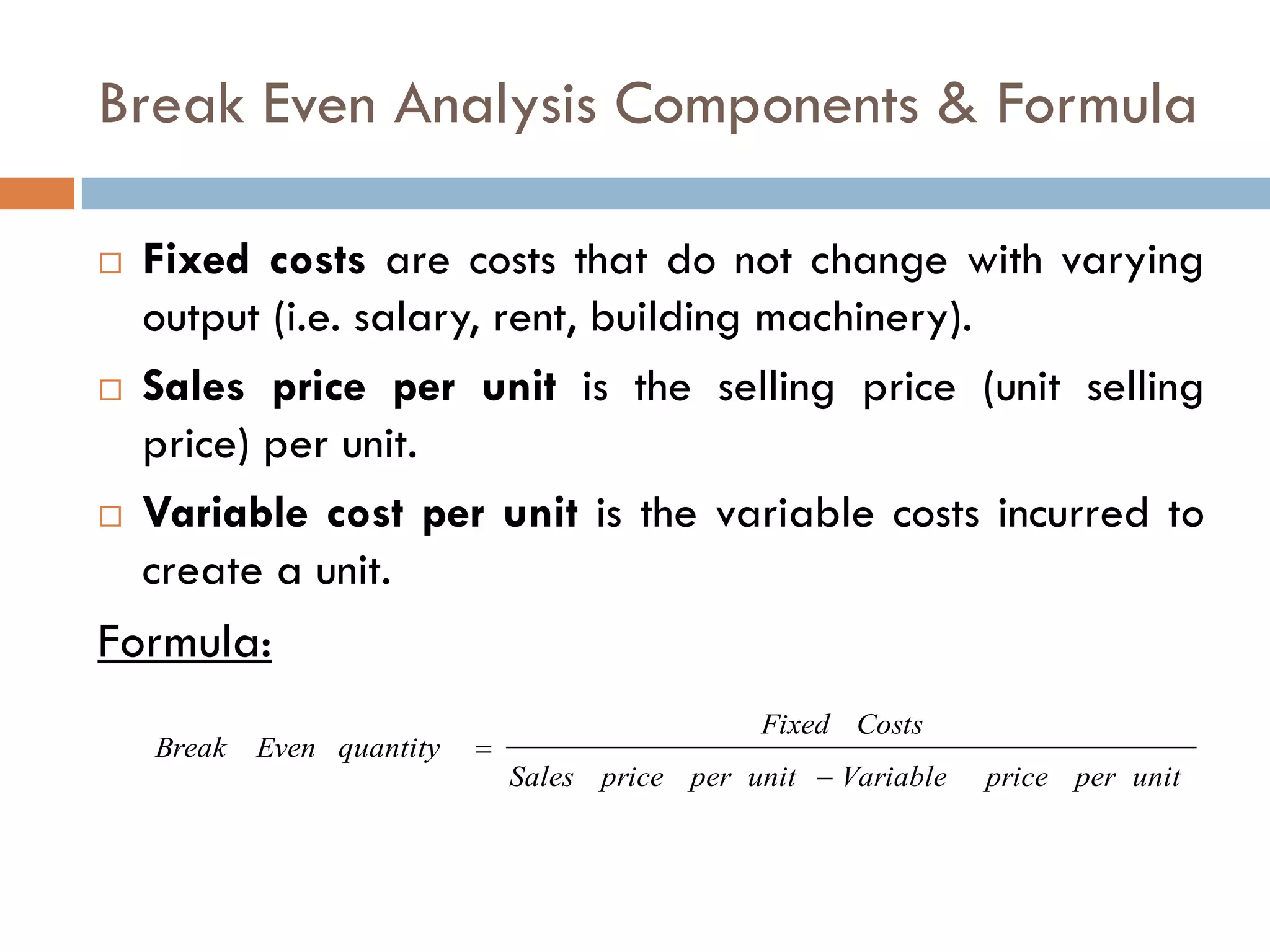
Formula:
unitperpriceVariableunitperpriceSales
CostsFixed
quantityEvenBreak


Example of Break Even Analysis
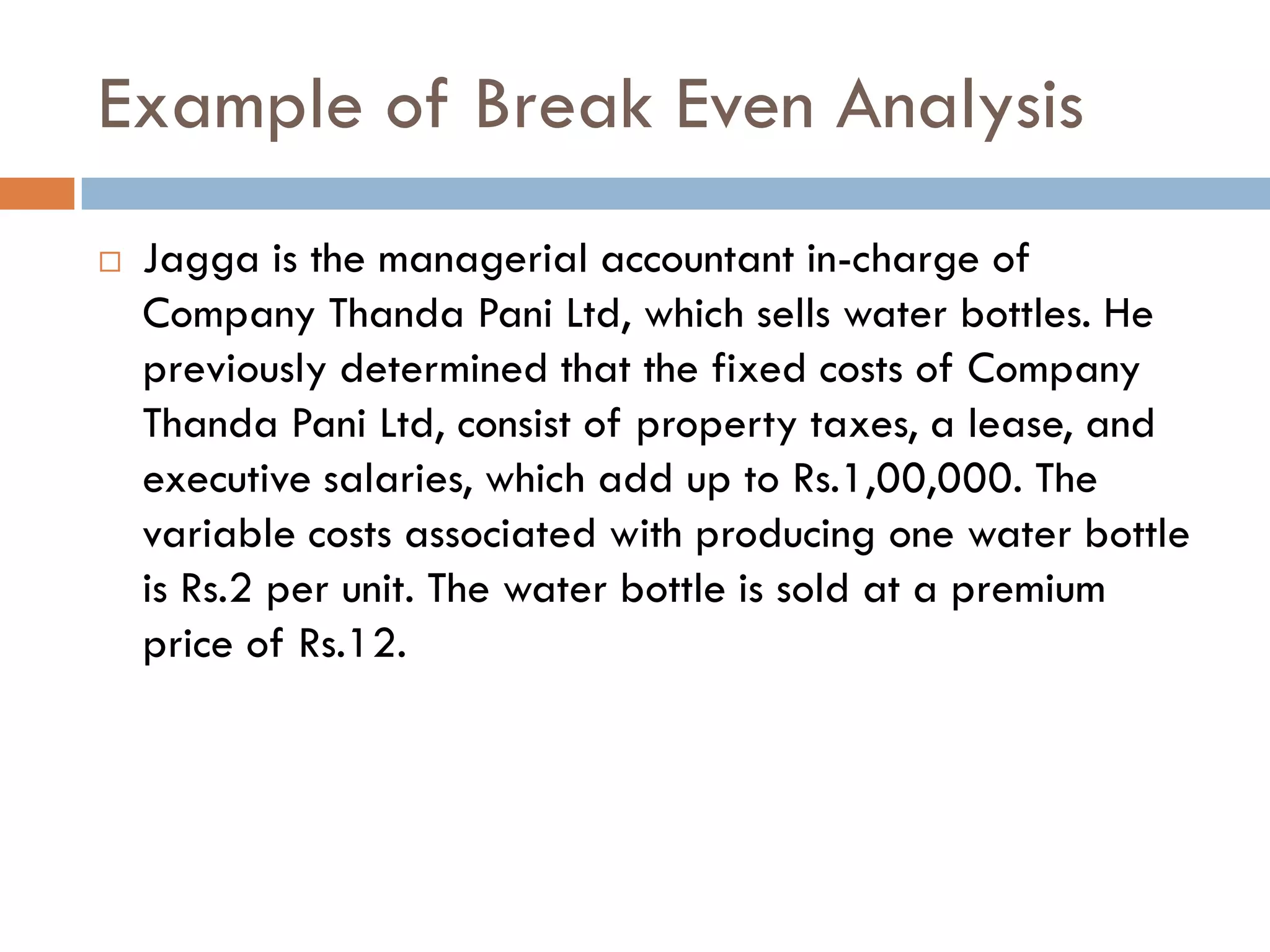
 Jagga is the managerial accountant in-charge of
Company Thanda Pani Ltd, which sells water bottles. He
previously determined that the fixed costs of Company
Thanda Pani Ltd, consist of property taxes, a lease, and
executive salaries, which add up to Rs.1,00,000. The
variable costs associated with producing one water bottle
is Rs.2 per unit. The water bottle is sold at a premium
price of Rs.12.
Example of Break Even Analysis
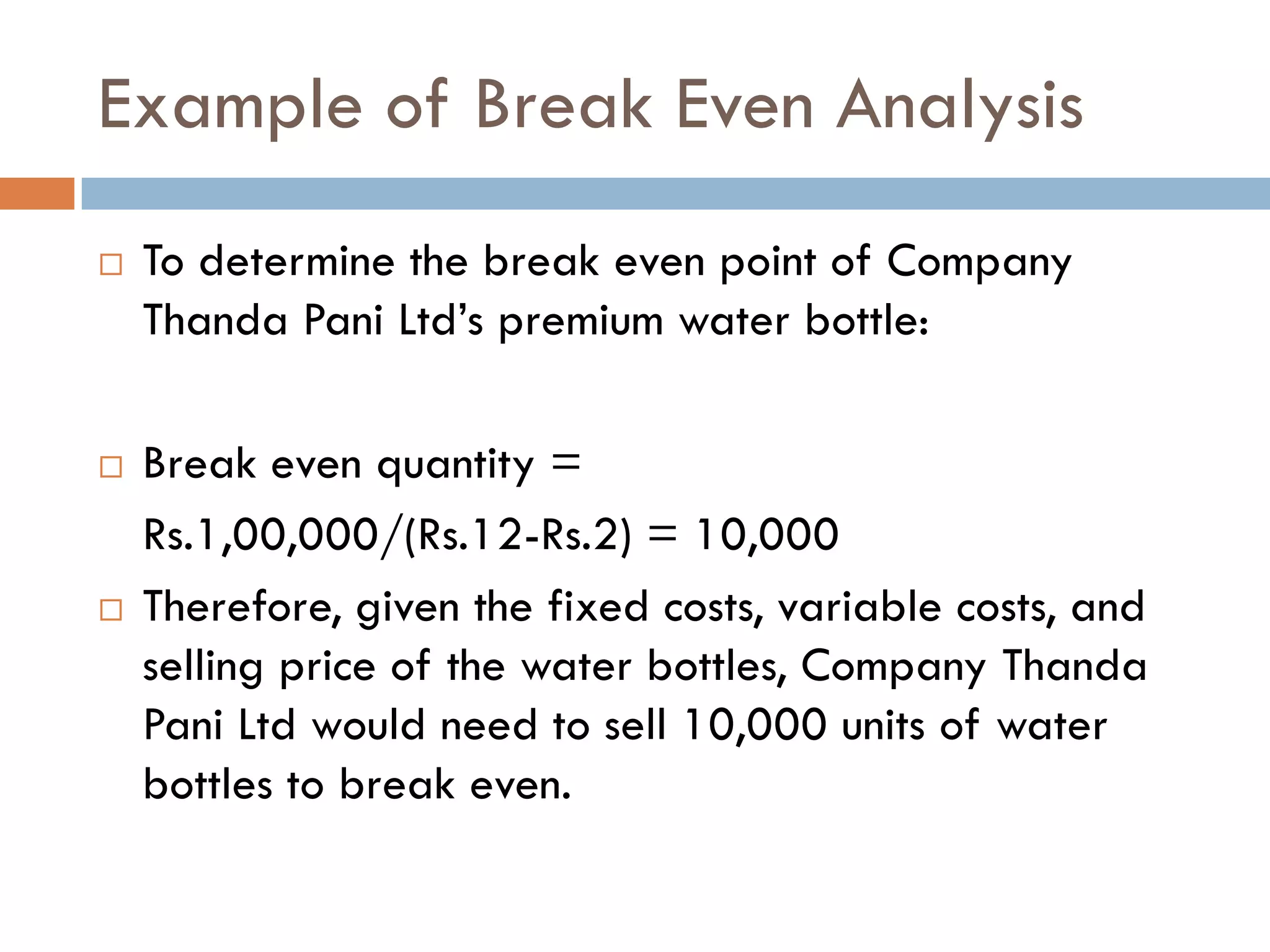
 To determine the break even point of Company
Thanda Pani Ltd‟s premium water bottle:
 Break even quantity =
Rs.1,00,000/(Rs.12-Rs.2) = 10,000
 Therefore, given the fixed costs, variable costs, and
selling price of the water bottles, Company Thanda
Pani Ltd would need to sell 10,000 units of water
bottles to break even.
Graphically Representing the Break Even Point
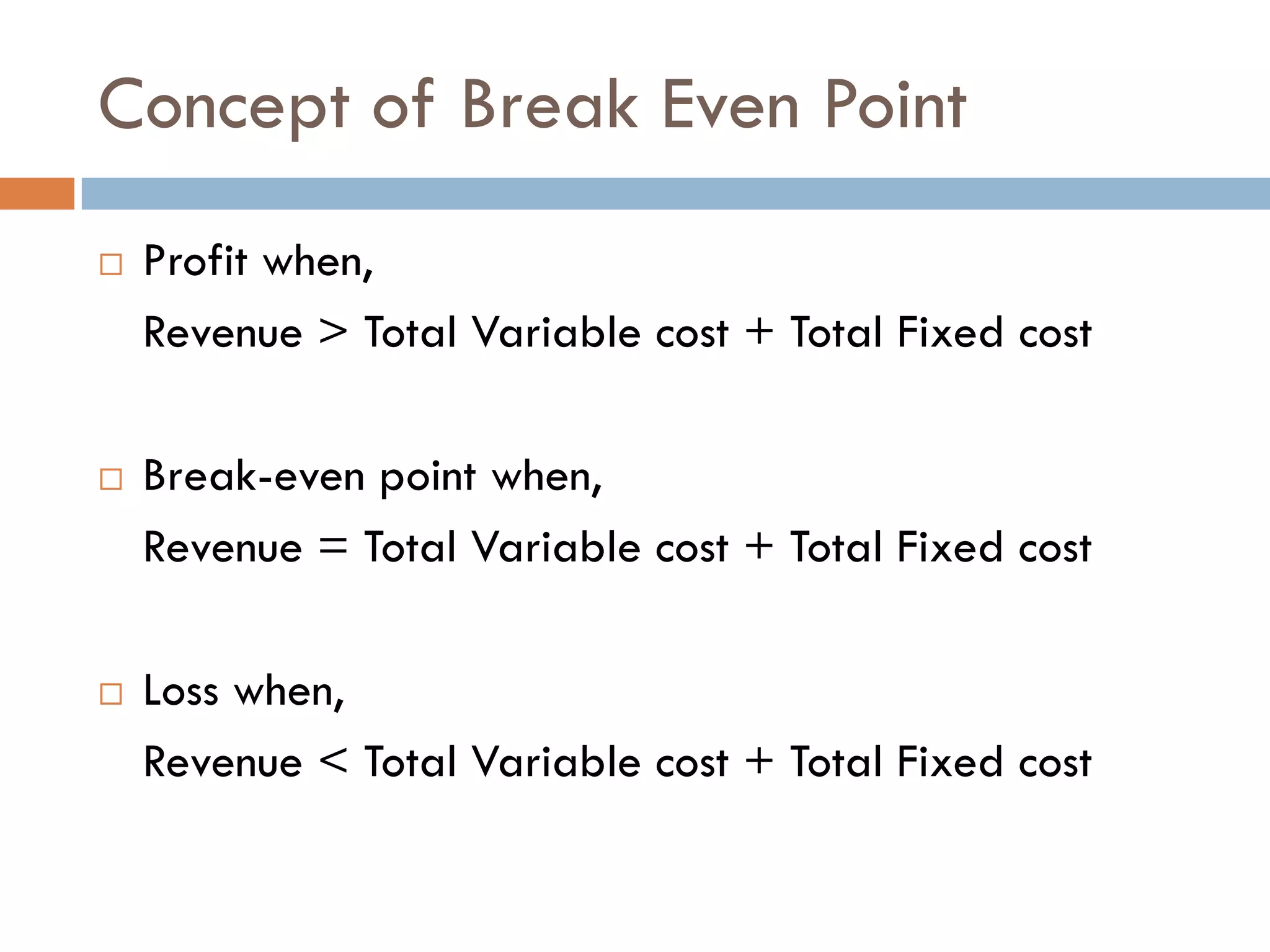
Concept of Break Even Point
 Profit when,
Revenue > Total Variable cost + Total Fixed cost
 Break-even point when,
Revenue = Total Variable cost + Total Fixed cost
 Loss when,
Revenue < Total Variable cost + Total Fixed cost
Program Evaluation Review Technique (PERT)
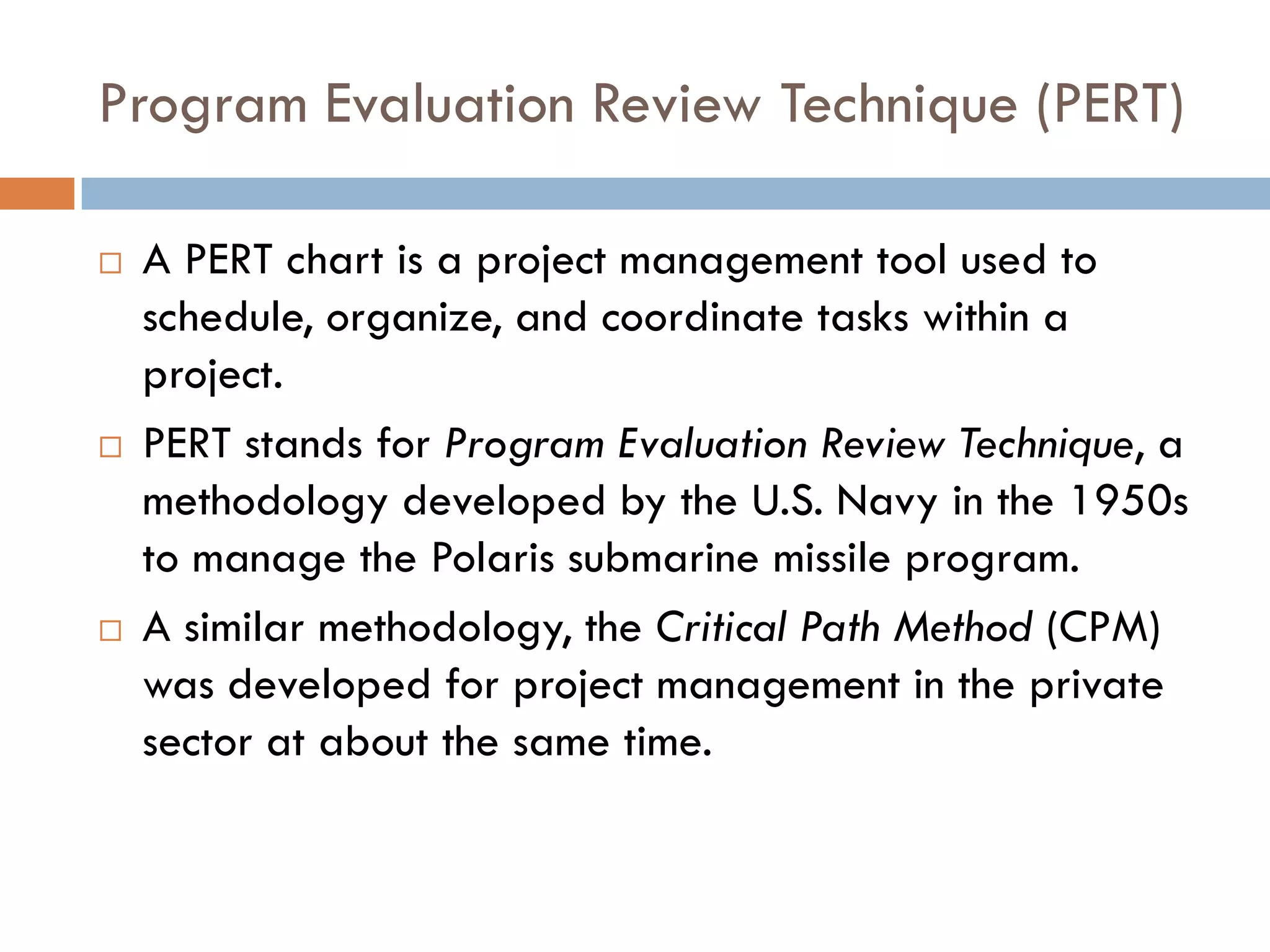
 A PERT chart is a project management tool used to
schedule, organize, and coordinate tasks within a
project.
 PERT stands for Program Evaluation Review Technique, a
methodology developed by the U.S. Navy in the 1950s
to manage the Polaris submarine missile program.
 A similar methodology, the Critical Path Method (CPM)
was developed for project management in the private
sector at about the same time.
Program Evaluation Review Technique (PERT)
 The Program Evaluation and Review Technique (PERT) is a
project scheduling technique to analyze and represent the
tasks involved in completing a given project.
Program Evaluation Review Technique (PERT)
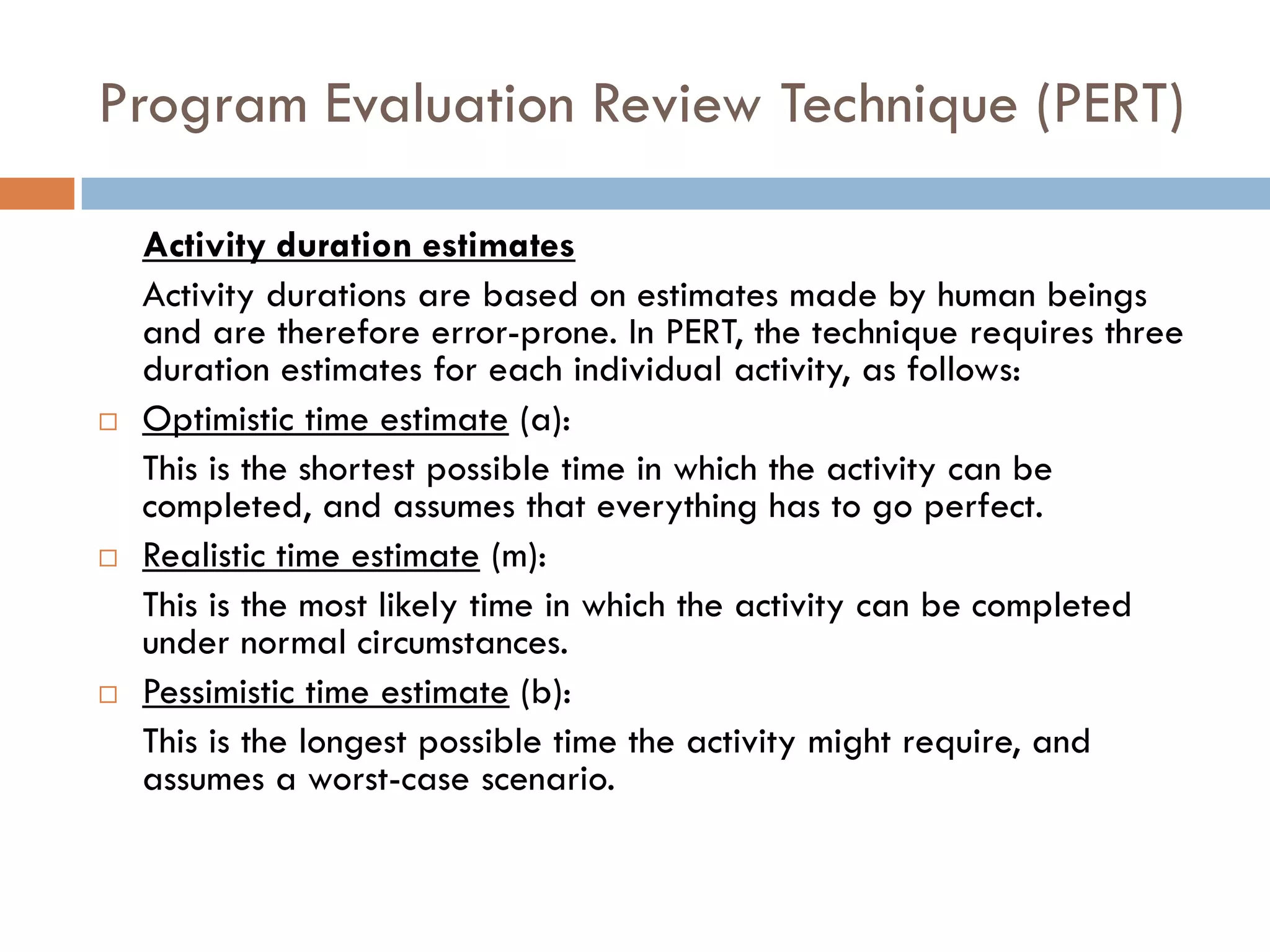
Activity duration estimates
Activity durations are based on estimates made by human beings
and are therefore error-prone. In PERT, the technique requires three
duration estimates for each individual activity, as follows:
 Optimistic time estimate (a):
This is the shortest possible time in which the activity can be
completed, and assumes that everything has to go perfect.
 Realistic time estimate (m):
This is the most likely time in which the activity can be completed
under normal circumstances.
 Pessimistic time estimate (b):
This is the longest possible time the activity might require, and
assumes a worst-case scenario.
Characteristics of PERT
 Planning & Control
 Division into activities
 Event
 Mutually related
 Expected time
 Related to time
 Presentation by chart
 Critical path
Critical Path Method
 In 1957, DuPont developed a project management method
to address the challenge of shutting down the plant for
maintenance & then restarting after the maintenance has
been completed.
 Given the complexity of the process they developed the
CRITICAL PATH METHOD for managing such projects.
 CPM provides following benefits:
1. Graphical view of the project.
2. Predicts the time required to complete the project.
3. Shows which activities are critical to maintain the schedule.
Critical Path Method Analysis
 The Critical Path Method (CPM) can help you keep
your projects on track.
 The critical path is the sequence of activities with the
longest duration. A delay in any of these activities will
result in a delay for the whole project.
 The duration of each activity is listed below each
node in the diagram. For each path, add the duration
of each node to determine it's total duration. The
critical path is the one with the longest duration.
Critical Path Method Analysis
Float Determination
 Once you've identified the critical path for the project, you
can determine the float for each activity. Float is the amount
of time an activity can slip before it causes your project to
be delayed. Float is sometimes referred to as slack.
 You will start with the activities on the critical path. Each of
those activities has a float of zero. If any of those activities
slips, the project will be delayed.
 Then you take the next longest path. Subtract it's duration
from the duration of the critical path. That's the float for
each of the activities on that path.
Critical Path Method Analysis
Using the critical path diagram from the previous section,
Activities 2, 3, and 4 are on the critical path so they have a
float of zero.
Critical Path Method Analysis
 The next longest path is Activities 1, 3, and 4. Since
Activities 3 and 4 are also on the critical path, their float
will remain as zero. For any remaining activities, in this
case Activity 1, the float will be the duration of the critical
path minus the duration of this path. 14 - 12 = 2. So
Activity 1 has a float of 2.
 The next longest path is Activities 2 and 5. Activity 2 is on
the critical path so it will have a float of zero. Activity 5
has a float of 14 - 9, which is 5. So as long as Activity 5
doesn't slip more than 5 days, it won't cause a delay to
the project.
Zero Based Budgeting
 Zero-based budgeting (ZBB) is an approach to making a
budget from scratch. The budget is not based on previous
budgets. Instead, the budget starts at zero.
 With zero-based budgeting, you need to justify every
expense before adding it to the official budget. The goal of
zero-based budgeting is to reduce spending by looking at
where costs can be cut.
 It involves re-evaluating every line item of cash flow
statement and justifying all the expenditure that is to be
incurred by the department.
Zero Based Budgeting Process
1. Identify business goals
2. Develop and analyze new ways to achieve goals
3. Discover new ways to fund business processes
4. Prioritize funds
 By following these zero-based budgeting steps, you will
determine what expenses go toward achieving business
goals that directly benefit your company. Then, you can
find new ways to spend.
 With ZBB, you might find that your budget fluctuates
significantly between periods. You might have a budget
of Rs.50,000 one year and Rs.35,000 the next, since
budgets aren‟t based on previous ones.
Zero Based Budgeting Advantages
1. Accuracy
2. Efficiency
3. Reduction in redundant activities
4. Budget inflation
5. Coordination and Communication
Zero Based Budgeting Disadvantages
1. Time-Consuming
2. High Manpower Requirement
3. Lack of Expertise
Conclusion: Zero-based budgeting aims at reflecting true
expenses to be incurred by a department or a state.
Although time-consuming, this is a more appropriate way
of budgeting. At the end of the day, it is a company‟s call
as whether it wants to invest time and manpower in the
budgeting exercise to provide more accurate numbers or
go for an easier method of incremental budgeting.

Control

  • 1.
  • 2.
    What is Control? “Managerial control implies the „measurement of accomplishment‟ against the standard and the correction of deviations to assure attainment of objectives according to plans”. Koontz And O‟Donnell  “Controlling is checking performance against predetermined standards contained in the plans with a view to ensuring adequate progress and satisfactory performance.” E.F.L. Breach
  • 3.
    What is Control? George R. Terry defined “controlling is determining what is being accomplished, that is evaluating the performance and, if necessary, applying corrected measures so that the performance takes place according to plans.”  So the function of controlling helps to achieve the desired goals by planning. Management must, therefore, compare actual results with pre-determined standards and take corrective action if necessary.
  • 4.
    Characteristics of Control End function of management (Means to achieve „end‟)  Continuous activity  Exercised at all levels  Dynamic process  Constructive activity  Forward looking process  People oriented process  Related to planning  Can be informal  Internal activity
  • 5.
    Need/Importance of Control: Helps in achievement of goals  Base of planning  Useful for organizing  Makes directing effective  Helps in co-ordination  Necessary for delegation of authority  Helps in removing deviations
  • 6.
    Control Techniques  TraditionalMethods 1. Budgetary Control 2. Break-even Analysis  Modern Methods 1. PERT 2. CPM 3. Zero based budgeting
  • 7.
    Budgetary Control  Budget Anestimate of costs, revenues, and resources over a specified period, reflecting a reading of future financial conditions and goals. A budget also serves as a  Plan of action for achieving quantified objectives  Standard for measuring performance  Device for coping with future adverse situations
  • 8.
    Budgetary Control  BudgetaryControl According to Brown and Howard, “Budgetary control is a system of controlling costs which includes the preparation of budgets, coordinating the departments and establishing responsibilities, comparing actual performance with the budgeted and acting upon results to achieve maximum profitability.” Weldon characterizes budgetary control as planning in advance of the various functions of a business so that the business as a whole is controlled.
  • 9.
    Advantages of BudgetaryControl  Maximization of Profits  Co-ordination  Specific Aims  Tool for Measuring Performance  Economy  Determining Weaknesses  Corrective Action  Consciousness  Reduces Costs  Introduction of Incentive Schemes
  • 10.
    Disadvantages of BudgetaryControl  Uncertain Future  Budgetary Revision Required  Discourage Efficient Persons  Problem of Co-ordination  Conflict Among Different Departments  Depends Upon Support of Top Management
  • 11.
    Break-Even Analysis  TheBreak Even Analysis (BEA) is a useful tool to study the relation between fixed costs and variable costs and revenue.  It‟s inextricably linked to the Break Even Point (BEP), which indicates at what moment an investment will start generating a positive return.  It can be graphically represented or calculated with a simple mathematical calculation.  A Break-Even Analysis calculates the size of the production at a certain (selling) price that is necessary to cover all the costs that have been incurred.
  • 12.
    Break Even AnalysisComponents & Formula  Fixed costs are costs that do not change with varying output (i.e. salary, rent, building machinery).  Sales price per unit is the selling price (unit selling price) per unit.  Variable cost per unit is the variable costs incurred to create a unit. Formula: unitperpriceVariableunitperpriceSales CostsFixed quantityEvenBreak  
  • 13.
    Example of BreakEven Analysis  Jagga is the managerial accountant in-charge of Company Thanda Pani Ltd, which sells water bottles. He previously determined that the fixed costs of Company Thanda Pani Ltd, consist of property taxes, a lease, and executive salaries, which add up to Rs.1,00,000. The variable costs associated with producing one water bottle is Rs.2 per unit. The water bottle is sold at a premium price of Rs.12.
  • 14.
    Example of BreakEven Analysis  To determine the break even point of Company Thanda Pani Ltd‟s premium water bottle:  Break even quantity = Rs.1,00,000/(Rs.12-Rs.2) = 10,000  Therefore, given the fixed costs, variable costs, and selling price of the water bottles, Company Thanda Pani Ltd would need to sell 10,000 units of water bottles to break even.
  • 15.
  • 16.
    Concept of BreakEven Point  Profit when, Revenue > Total Variable cost + Total Fixed cost  Break-even point when, Revenue = Total Variable cost + Total Fixed cost  Loss when, Revenue < Total Variable cost + Total Fixed cost
  • 17.
    Program Evaluation ReviewTechnique (PERT)  A PERT chart is a project management tool used to schedule, organize, and coordinate tasks within a project.  PERT stands for Program Evaluation Review Technique, a methodology developed by the U.S. Navy in the 1950s to manage the Polaris submarine missile program.  A similar methodology, the Critical Path Method (CPM) was developed for project management in the private sector at about the same time.
  • 18.
    Program Evaluation ReviewTechnique (PERT)  The Program Evaluation and Review Technique (PERT) is a project scheduling technique to analyze and represent the tasks involved in completing a given project.
  • 19.
    Program Evaluation ReviewTechnique (PERT) Activity duration estimates Activity durations are based on estimates made by human beings and are therefore error-prone. In PERT, the technique requires three duration estimates for each individual activity, as follows:  Optimistic time estimate (a): This is the shortest possible time in which the activity can be completed, and assumes that everything has to go perfect.  Realistic time estimate (m): This is the most likely time in which the activity can be completed under normal circumstances.  Pessimistic time estimate (b): This is the longest possible time the activity might require, and assumes a worst-case scenario.
  • 20.
    Characteristics of PERT Planning & Control  Division into activities  Event  Mutually related  Expected time  Related to time  Presentation by chart  Critical path
  • 21.
    Critical Path Method In 1957, DuPont developed a project management method to address the challenge of shutting down the plant for maintenance & then restarting after the maintenance has been completed.  Given the complexity of the process they developed the CRITICAL PATH METHOD for managing such projects.  CPM provides following benefits: 1. Graphical view of the project. 2. Predicts the time required to complete the project. 3. Shows which activities are critical to maintain the schedule.
  • 22.
    Critical Path MethodAnalysis  The Critical Path Method (CPM) can help you keep your projects on track.  The critical path is the sequence of activities with the longest duration. A delay in any of these activities will result in a delay for the whole project.  The duration of each activity is listed below each node in the diagram. For each path, add the duration of each node to determine it's total duration. The critical path is the one with the longest duration.
  • 23.
  • 24.
    Critical Path MethodAnalysis Float Determination  Once you've identified the critical path for the project, you can determine the float for each activity. Float is the amount of time an activity can slip before it causes your project to be delayed. Float is sometimes referred to as slack.  You will start with the activities on the critical path. Each of those activities has a float of zero. If any of those activities slips, the project will be delayed.  Then you take the next longest path. Subtract it's duration from the duration of the critical path. That's the float for each of the activities on that path.
  • 25.
    Critical Path MethodAnalysis Using the critical path diagram from the previous section, Activities 2, 3, and 4 are on the critical path so they have a float of zero.
  • 26.
    Critical Path MethodAnalysis  The next longest path is Activities 1, 3, and 4. Since Activities 3 and 4 are also on the critical path, their float will remain as zero. For any remaining activities, in this case Activity 1, the float will be the duration of the critical path minus the duration of this path. 14 - 12 = 2. So Activity 1 has a float of 2.  The next longest path is Activities 2 and 5. Activity 2 is on the critical path so it will have a float of zero. Activity 5 has a float of 14 - 9, which is 5. So as long as Activity 5 doesn't slip more than 5 days, it won't cause a delay to the project.
  • 27.
    Zero Based Budgeting Zero-based budgeting (ZBB) is an approach to making a budget from scratch. The budget is not based on previous budgets. Instead, the budget starts at zero.  With zero-based budgeting, you need to justify every expense before adding it to the official budget. The goal of zero-based budgeting is to reduce spending by looking at where costs can be cut.  It involves re-evaluating every line item of cash flow statement and justifying all the expenditure that is to be incurred by the department.
  • 28.
    Zero Based BudgetingProcess 1. Identify business goals 2. Develop and analyze new ways to achieve goals 3. Discover new ways to fund business processes 4. Prioritize funds  By following these zero-based budgeting steps, you will determine what expenses go toward achieving business goals that directly benefit your company. Then, you can find new ways to spend.  With ZBB, you might find that your budget fluctuates significantly between periods. You might have a budget of Rs.50,000 one year and Rs.35,000 the next, since budgets aren‟t based on previous ones.
  • 29.
    Zero Based BudgetingAdvantages 1. Accuracy 2. Efficiency 3. Reduction in redundant activities 4. Budget inflation 5. Coordination and Communication
  • 30.
    Zero Based BudgetingDisadvantages 1. Time-Consuming 2. High Manpower Requirement 3. Lack of Expertise Conclusion: Zero-based budgeting aims at reflecting true expenses to be incurred by a department or a state. Although time-consuming, this is a more appropriate way of budgeting. At the end of the day, it is a company‟s call as whether it wants to invest time and manpower in the budgeting exercise to provide more accurate numbers or go for an easier method of incremental budgeting.