Network Theory(19EC33)
2020-21
Class-3: Source Transformation - Examples
MOHANKUMAR V.
ASSISTANT PROFESSOR
D E P A R TM E N T O F E L E C TR O N I C S A N D C O M M U N I C A TI O N E N G I N E E R I N G
D R . A M B E D K A R I N S TI TU TE O F TE C H N O L O G Y , B E N G A L U R U - 5 6
E - M A I L : MO H A N K U MA R . V @ D R - A I T . O R G
Dept. of ECE, Dr. Ambedkar Institute of Technology, Bengaluru
Network Theory (19EC33)
Source Transformation
Key Points
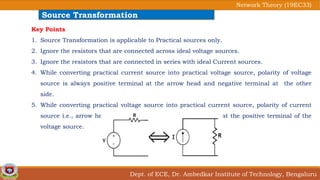
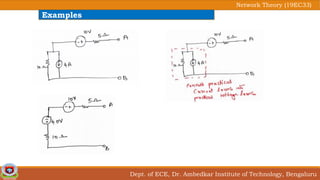
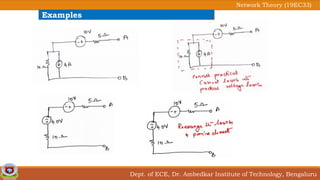
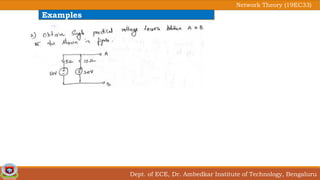
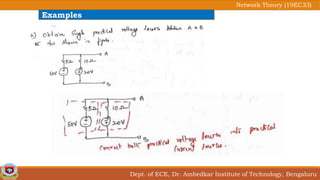
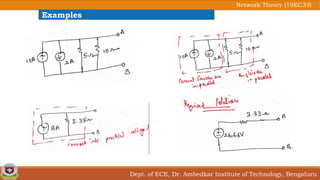
1. Source Transformation is applicable to Practical sources only.
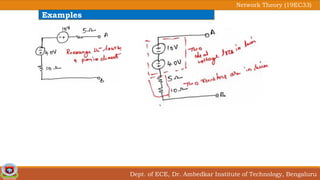
2. Ignore the resistors that are connected across ideal voltage sources.
3. Ignore the resistors that are connected in series with ideal Current sources.
4. While converting practical current source into practical voltage source, polarity of voltage
source is always positive terminal at the arrow head and negative terminal at the other
side.
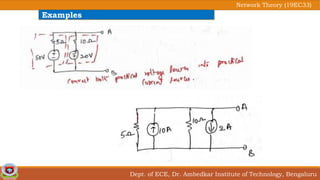
5. While converting practical voltage source into practical current source, polarity of current
source i.e., arrow head of current source must be indicated at the positive terminal of the
voltage source.
Dept. of ECE, Dr. Ambedkar Institute of Technology, Bengaluru
Network Theory (19EC33)
Source Transformation
Procedure to simplify the electrical networks/Circuits
1. Identify the load element, remove the load element and name the load terminals as A and B
or X and Y etc.
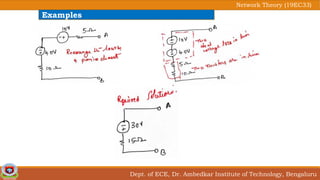
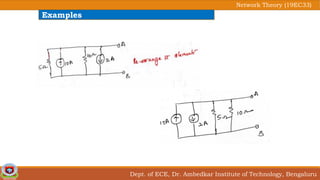
2. Reduce the ideal voltage sources, that are connected in series.
3. Reduce the ideal current sources, that are connected in parallel.
4. Apply Source transformation.
5. Apply Source shifting.
6. Repeat the steps 2 to 5 until simplified form is obtained between the load terminals.
7. Connect the load element and find the load current or load voltage or power delivered or
absorbed by the load element.
Dept. of ECE, Dr. Ambedkar Institute of Technology, Bengaluru
Network Theory (19EC33)
Examples
Dept. of ECE, Dr. Ambedkar Institute of Technology, Bengaluru
Network Theory (19EC33)
Examples
Dept. of ECE, Dr. Ambedkar Institute of Technology, Bengaluru
Network Theory (19EC33)
Examples
Dept. of ECE, Dr. Ambedkar Institute of Technology, Bengaluru
Network Theory (19EC33)
Examples
Dept. of ECE, Dr. Ambedkar Institute of Technology, Bengaluru
Network Theory (19EC33)
Examples
Dept. of ECE, Dr. Ambedkar Institute of Technology, Bengaluru
Network Theory (19EC33)
Examples
Dept. of ECE, Dr. Ambedkar Institute of Technology, Bengaluru
Network Theory (19EC33)
Examples
Dept. of ECE, Dr. Ambedkar Institute of Technology, Bengaluru
Network Theory (19EC33)
Examples
Dept. of ECE, Dr. Ambedkar Institute of Technology, Bengaluru
Network Theory (19EC33)
Examples
Dept. of ECE, Dr. Ambedkar Institute of Technology, Bengaluru
Network Theory (19EC33)
Examples
Dept. of ECE, Dr. Ambedkar Institute of Technology, Bengaluru
Network Theory (19EC33)
Examples
Dept. of ECE, Dr. Ambedkar Institute of Technology, Bengaluru
Network Theory (19EC33)
Examples
Dept. of ECE, Dr. Ambedkar Institute of Technology, Bengaluru
Network Theory (19EC33)
Examples
Dept. of ECE, Dr. Ambedkar Institute of Technology, Bengaluru
Network Theory (19EC33)
Examples
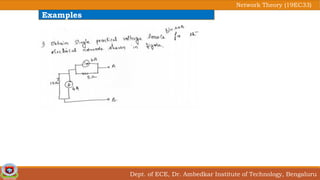
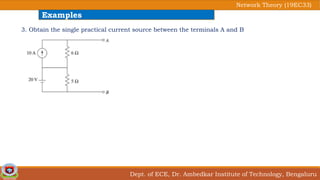
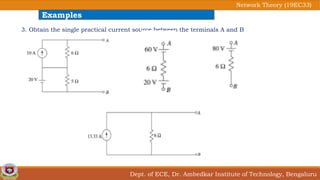
3. Obtain the single practical current source between the terminals A and B
Dept. of ECE, Dr. Ambedkar Institute of Technology, Bengaluru
Network Theory (19EC33)
Examples
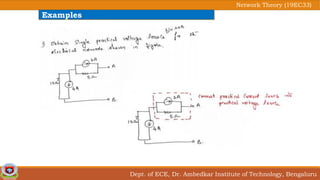
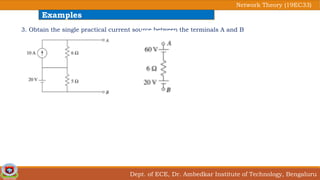
3. Obtain the single practical current source between the terminals A and B
Dept. of ECE, Dr. Ambedkar Institute of Technology, Bengaluru
Network Theory (19EC33)
Examples
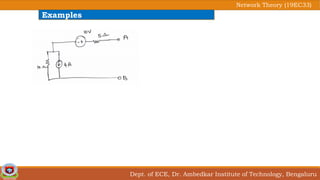
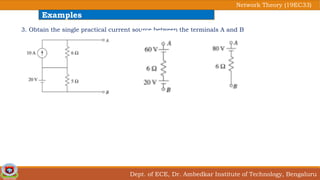
3. Obtain the single practical current source between the terminals A and B
Dept. of ECE, Dr. Ambedkar Institute of Technology, Bengaluru
Network Theory (19EC33)
Examples
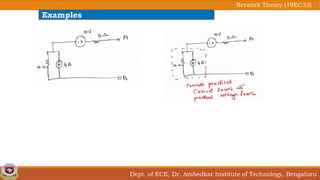
3. Obtain the single practical current source between the terminals A and B
Dept. of ECE, Dr. Ambedkar Institute of Technology, Bengaluru
Network Theory (19EC33)
Examples
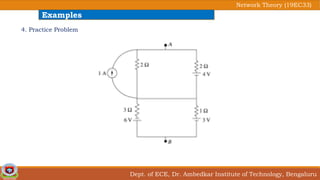
4. Practice Problem
Dept. of ECE, Dr. Ambedkar Institute of Technology, Bengaluru
Network Theory (19EC33)
Disclaimer
Some Contents and Images showed in this PPT
have been taken from the various internet
sources for educational purpose only.
Thank You
?

Source transformation

  • 1.
    Network Theory(19EC33) 2020-21 Class-3: SourceTransformation - Examples MOHANKUMAR V. ASSISTANT PROFESSOR D E P A R TM E N T O F E L E C TR O N I C S A N D C O M M U N I C A TI O N E N G I N E E R I N G D R . A M B E D K A R I N S TI TU TE O F TE C H N O L O G Y , B E N G A L U R U - 5 6 E - M A I L : MO H A N K U MA R . V @ D R - A I T . O R G
  • 2.
    Dept. of ECE,Dr. Ambedkar Institute of Technology, Bengaluru Network Theory (19EC33) Source Transformation Key Points 1. Source Transformation is applicable to Practical sources only. 2. Ignore the resistors that are connected across ideal voltage sources. 3. Ignore the resistors that are connected in series with ideal Current sources. 4. While converting practical current source into practical voltage source, polarity of voltage source is always positive terminal at the arrow head and negative terminal at the other side. 5. While converting practical voltage source into practical current source, polarity of current source i.e., arrow head of current source must be indicated at the positive terminal of the voltage source.
  • 3.
    Dept. of ECE,Dr. Ambedkar Institute of Technology, Bengaluru Network Theory (19EC33) Source Transformation Procedure to simplify the electrical networks/Circuits 1. Identify the load element, remove the load element and name the load terminals as A and B or X and Y etc. 2. Reduce the ideal voltage sources, that are connected in series. 3. Reduce the ideal current sources, that are connected in parallel. 4. Apply Source transformation. 5. Apply Source shifting. 6. Repeat the steps 2 to 5 until simplified form is obtained between the load terminals. 7. Connect the load element and find the load current or load voltage or power delivered or absorbed by the load element.
  • 4.
    Dept. of ECE,Dr. Ambedkar Institute of Technology, Bengaluru Network Theory (19EC33) Examples
  • 5.
    Dept. of ECE,Dr. Ambedkar Institute of Technology, Bengaluru Network Theory (19EC33) Examples
  • 6.
    Dept. of ECE,Dr. Ambedkar Institute of Technology, Bengaluru Network Theory (19EC33) Examples
  • 7.
    Dept. of ECE,Dr. Ambedkar Institute of Technology, Bengaluru Network Theory (19EC33) Examples
  • 8.
    Dept. of ECE,Dr. Ambedkar Institute of Technology, Bengaluru Network Theory (19EC33) Examples
  • 9.
    Dept. of ECE,Dr. Ambedkar Institute of Technology, Bengaluru Network Theory (19EC33) Examples
  • 10.
    Dept. of ECE,Dr. Ambedkar Institute of Technology, Bengaluru Network Theory (19EC33) Examples
  • 11.
    Dept. of ECE,Dr. Ambedkar Institute of Technology, Bengaluru Network Theory (19EC33) Examples
  • 12.
    Dept. of ECE,Dr. Ambedkar Institute of Technology, Bengaluru Network Theory (19EC33) Examples
  • 13.
    Dept. of ECE,Dr. Ambedkar Institute of Technology, Bengaluru Network Theory (19EC33) Examples
  • 14.
    Dept. of ECE,Dr. Ambedkar Institute of Technology, Bengaluru Network Theory (19EC33) Examples
  • 15.
    Dept. of ECE,Dr. Ambedkar Institute of Technology, Bengaluru Network Theory (19EC33) Examples
  • 16.
    Dept. of ECE,Dr. Ambedkar Institute of Technology, Bengaluru Network Theory (19EC33) Examples
  • 17.
    Dept. of ECE,Dr. Ambedkar Institute of Technology, Bengaluru Network Theory (19EC33) Examples 3. Obtain the single practical current source between the terminals A and B
  • 18.
    Dept. of ECE,Dr. Ambedkar Institute of Technology, Bengaluru Network Theory (19EC33) Examples 3. Obtain the single practical current source between the terminals A and B
  • 19.
    Dept. of ECE,Dr. Ambedkar Institute of Technology, Bengaluru Network Theory (19EC33) Examples 3. Obtain the single practical current source between the terminals A and B
  • 20.
    Dept. of ECE,Dr. Ambedkar Institute of Technology, Bengaluru Network Theory (19EC33) Examples 3. Obtain the single practical current source between the terminals A and B
  • 21.
    Dept. of ECE,Dr. Ambedkar Institute of Technology, Bengaluru Network Theory (19EC33) Examples 4. Practice Problem
  • 23.
    Dept. of ECE,Dr. Ambedkar Institute of Technology, Bengaluru Network Theory (19EC33) Disclaimer Some Contents and Images showed in this PPT have been taken from the various internet sources for educational purpose only. Thank You ?