PRESENTATION
ON
“Night Vision Technology”
Submitted To -
Ms. Swati Sharma
(Assistant Professor)
Submitted By -
Arun
Roll No. – 1720064
BCA I (SEM 2)
CONTENTS
• Introduction
• Types of Night Vision
• Working of Technical Night Vision
• Night Vision Devices
• Applications
• Conclusion
INTRODUCTION
• Night vision technology, literally allows one to see in the dark.
• It is originally developed for military use .
• Humans have poor night vision compared to many other
animals.
• With the proper night-vision equipment, we can see a person
standing over 200 yards (183 m) away on a moonless, cloudy
night.
TYPES OF NIGHT VISION
It is broadly classified into two types :-
 Biological Night Vision
• Molecules in the rods of the eye undergo a change in shape as light.
• Molecules in the human rods is insensitive to the light.
 Technical Night Vision
• Image intensifier
• Thermal imaging
WORKING OF TECHNICAL
NIGHT VISION
Technical Night vision can work in two very different ways:-
 Image Intensifier
 Thermal Imaging
Image Intensifier
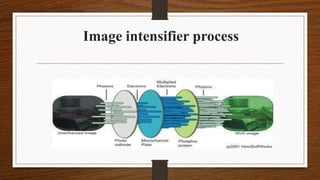
• Night vision amplifies light to achieve better vision .
• A conventional lens, captures ambient light.
• The gathered light is sent to the image-intensifier tube.
• The light energy released electron from the cathode and accelerated.
• These electrons enter micro channel plate and bounce off and generate more electron.
• Thousands of other electrons to be released in channel.
• Original electrons collide with the channel,exciting atoms and
causing other electrons.
• New electrons collide with other atoms, creating a chain.
• In image-intensifier tube, the electrons hit a screen.
• The energy of the electrons release photons and create green image
on the screen.
• The green phosphor image is viewed through another lens.
Image intensifier process
Thermal Imaging
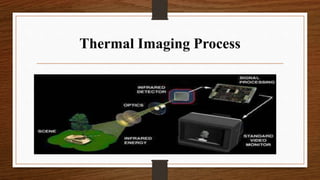
All objects emit infrared energy as a function of their temperature.
• A lens focuses the infrared light.
• The focused light is scanned and create temperature pattern.
• The pattern created is translated into electric impulses.
• The impulses are sent to a circuit board that translates the
information into data for the display.
• The signal-processing unit sends the information to the is
play, and appears as various colors.
• Thermal images are black and white in nature.
Thermal Imaging Process
.
NIGHT VISION DEVICES
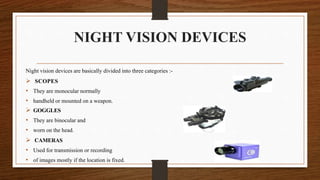
Night vision devices are basically divided into three categories :-
 SCOPES
• They are monocular normally
• handheld or mounted on a weapon.
 GOGGLES
• They are binocular and
• worn on the head.
 CAMERAS
• Used for transmission or recording
• of images mostly if the location is fixed.
APPLICATIONS
• Military
• Hunting
• Wildlife observation
• Security
• Hidden-object detection
CONCLUSIONS
• Today in the 21st century we have come a long way in the development
of night vision technology, from the early 1940’s.
• Night vision devices are basically designed for utmost defensive
purposes but the application within the scientific or the civilian range is
often prohibited by law.
• In present scenario the applications of night vision technology is
very essential to combat terrorism which is a major problem being faced by
mankind.
Thank you

Night Vision Technology

  • 1.
    PRESENTATION ON “Night Vision Technology” SubmittedTo - Ms. Swati Sharma (Assistant Professor) Submitted By - Arun Roll No. – 1720064 BCA I (SEM 2)
  • 2.
    CONTENTS • Introduction • Typesof Night Vision • Working of Technical Night Vision • Night Vision Devices • Applications • Conclusion
  • 3.
    INTRODUCTION • Night visiontechnology, literally allows one to see in the dark. • It is originally developed for military use . • Humans have poor night vision compared to many other animals. • With the proper night-vision equipment, we can see a person standing over 200 yards (183 m) away on a moonless, cloudy night.
  • 4.
    TYPES OF NIGHTVISION It is broadly classified into two types :-  Biological Night Vision • Molecules in the rods of the eye undergo a change in shape as light. • Molecules in the human rods is insensitive to the light.  Technical Night Vision • Image intensifier • Thermal imaging
  • 5.
    WORKING OF TECHNICAL NIGHTVISION Technical Night vision can work in two very different ways:-  Image Intensifier  Thermal Imaging
  • 6.
    Image Intensifier • Nightvision amplifies light to achieve better vision . • A conventional lens, captures ambient light. • The gathered light is sent to the image-intensifier tube. • The light energy released electron from the cathode and accelerated. • These electrons enter micro channel plate and bounce off and generate more electron. • Thousands of other electrons to be released in channel.
  • 7.
    • Original electronscollide with the channel,exciting atoms and causing other electrons. • New electrons collide with other atoms, creating a chain. • In image-intensifier tube, the electrons hit a screen. • The energy of the electrons release photons and create green image on the screen. • The green phosphor image is viewed through another lens.
  • 8.
  • 10.
    Thermal Imaging All objectsemit infrared energy as a function of their temperature. • A lens focuses the infrared light. • The focused light is scanned and create temperature pattern. • The pattern created is translated into electric impulses.
  • 11.
    • The impulsesare sent to a circuit board that translates the information into data for the display. • The signal-processing unit sends the information to the is play, and appears as various colors. • Thermal images are black and white in nature.
  • 12.
  • 13.
    NIGHT VISION DEVICES Nightvision devices are basically divided into three categories :-  SCOPES • They are monocular normally • handheld or mounted on a weapon.  GOGGLES • They are binocular and • worn on the head.  CAMERAS • Used for transmission or recording • of images mostly if the location is fixed.
  • 14.
    APPLICATIONS • Military • Hunting •Wildlife observation • Security • Hidden-object detection
  • 15.
    CONCLUSIONS • Today inthe 21st century we have come a long way in the development of night vision technology, from the early 1940’s. • Night vision devices are basically designed for utmost defensive purposes but the application within the scientific or the civilian range is often prohibited by law. • In present scenario the applications of night vision technology is very essential to combat terrorism which is a major problem being faced by mankind.
  • 16.