Seminar On
Night Vision Technology
Presented By :-
Siddhesh. A. Jadhav
CONTENTS
Introduction
Types Of Night Vision
Working Of Technical Night Vision
Night Vision Devices
Generations
Applications
Conclusion
INTRODUCTION
• Night Vision Technology, Literally Allows One To See In The
Dark.
• It Is Originally Developed For Military Use .
• Humans Have Poor Night Vision Compared To Many Other
Animals.
• With The Proper Night-vision Equipment, We Can See A Person
Standing Over 200 Yards (183 M) Away On A Moonless, Cloudy
Night.
TYPES OF NIGHT VISION
It is broadly classified into two types
 Biological Night Vision
• Molecules in the rods of the eye undergo a change in shape as light.
• Molecules in the human rods is insensitive to the light.
 Technical Night Vision
• Image intensifier
• Thermal imaging
WORKING OF TECHNICAL
NIGHT VISION
Technical Night vision can work in two very different ways
 Image Intensifier
• Night vision amplifies light to achieve better vision .
• A conventional lens, captures ambient light.
• The gathered light is sent to the image-intensifier tube.
• The light energy released electron from the cathode and accelerated.
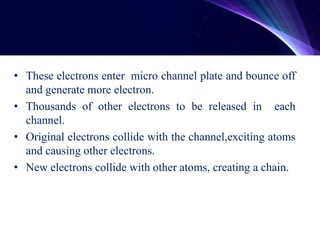
• These electrons enter micro channel plate and bounce off
and generate more electron.
• Thousands of other electrons to be released in each
channel.
• Original electrons collide with the channel,exciting atoms
and causing other electrons.
• New electrons collide with other atoms, creating a chain.
• In Image-intensifier Tube, The Electrons Hit A Screen.
• The Energy Of The Electrons Release Photons And Create
Green Image On The Screen.
• The Green Phosphor Image Is Viewed Through Another Lens.
Fig1:- Image intensifier process
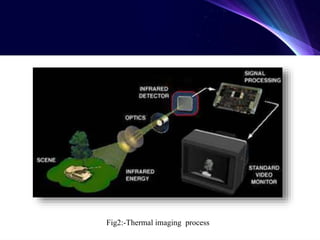
 Thermal Imaging
All Objects Emit Infrared Energy As A Function
Of Their Temperature.
• A Lens Focuses The Infrared Light.
• The Focused Light Is Scanned And Create
Temperature Pattern.
• The Pattern Created Is Translated Into Electric
Impulses.
• The Impulses Are Sent To A Circuit Board That
Translates The Information Into Data For The Display.
• The Signal-processing Unit Sends The Information To
The Is Play, And Appears As Various Colors.
• Thermal Images Are Black And White In Nature.
Fig2:-Thermal imaging process
NIGHT VISION DEVICES
Night Vision Devices Are Basically Divided Into Three Categories
 Scopes
• They Are Monocular Normally
Handheld Or Mounted On A Weapon.
 Goggles
• They Are Binocular And
Worn On The Head.
 Cameras
• Used For Transmission Or Recording
Of Images Mostly If The Location Is Fixed.
Fig3:- Night vision
devices
GENERATIONS
 Generation 0
The earliest (1950's) night vision products were based
on image conversion, rather
than intensification.
 Generation 1
• Vacuum Tube Technology
• Full Moon Operation
• Amplification: 1,000
• Operating Life: 2,000 Hours
Fig4:- Generations1 Night vision
 Generation 2
• First Micro channel Plate Application
• One-Quarter Moon Operation
• Amplification: 20,000
• Operating Life: 2,500 Hours
 Generation3
• Improved Micro channel Plate & Photocathode
• Starlight Operation
• Amplification: 40,000
• Operating Life: 10,000 Hour
Fig5:- Generations2 Night vision device
APPLICATIONS
• Military
• Hunting
• Wildlife observation
• Security
• Hidden-object detection
ADVANTAGES
• No particular skill required
• Accidents cases reduction
• Compact system
• 3x range visual
DISADVANTAGES
• The only disadvantage is that the Initial cost too high.
CONCLUSIONS
• Today in the 21st century we have come a long way in the
development of night vision technology, from the early 1940’s.
• Night vision devices are basically designed for utmost defensive
purposes but the application within the scientific or the civilian
range is often prohibited by law.
• In present scenario the applications of night vision technology is
very essential to combat terrorism which is a major problem being
faced by mankind.
B027SiddheshJadhav.pptx

B027SiddheshJadhav.pptx

  • 1.
    Seminar On Night VisionTechnology Presented By :- Siddhesh. A. Jadhav
  • 2.
    CONTENTS Introduction Types Of NightVision Working Of Technical Night Vision Night Vision Devices Generations Applications Conclusion
  • 3.
    INTRODUCTION • Night VisionTechnology, Literally Allows One To See In The Dark. • It Is Originally Developed For Military Use . • Humans Have Poor Night Vision Compared To Many Other Animals. • With The Proper Night-vision Equipment, We Can See A Person Standing Over 200 Yards (183 M) Away On A Moonless, Cloudy Night.
  • 4.
    TYPES OF NIGHTVISION It is broadly classified into two types  Biological Night Vision • Molecules in the rods of the eye undergo a change in shape as light. • Molecules in the human rods is insensitive to the light.  Technical Night Vision • Image intensifier • Thermal imaging
  • 5.
    WORKING OF TECHNICAL NIGHTVISION Technical Night vision can work in two very different ways  Image Intensifier • Night vision amplifies light to achieve better vision . • A conventional lens, captures ambient light. • The gathered light is sent to the image-intensifier tube. • The light energy released electron from the cathode and accelerated.
  • 6.
    • These electronsenter micro channel plate and bounce off and generate more electron. • Thousands of other electrons to be released in each channel. • Original electrons collide with the channel,exciting atoms and causing other electrons. • New electrons collide with other atoms, creating a chain.
  • 7.
    • In Image-intensifierTube, The Electrons Hit A Screen. • The Energy Of The Electrons Release Photons And Create Green Image On The Screen. • The Green Phosphor Image Is Viewed Through Another Lens. Fig1:- Image intensifier process
  • 8.
     Thermal Imaging AllObjects Emit Infrared Energy As A Function Of Their Temperature. • A Lens Focuses The Infrared Light. • The Focused Light Is Scanned And Create Temperature Pattern. • The Pattern Created Is Translated Into Electric Impulses.
  • 9.
    • The ImpulsesAre Sent To A Circuit Board That Translates The Information Into Data For The Display. • The Signal-processing Unit Sends The Information To The Is Play, And Appears As Various Colors. • Thermal Images Are Black And White In Nature.
  • 10.
  • 11.
    NIGHT VISION DEVICES NightVision Devices Are Basically Divided Into Three Categories  Scopes • They Are Monocular Normally Handheld Or Mounted On A Weapon.  Goggles • They Are Binocular And Worn On The Head.  Cameras • Used For Transmission Or Recording Of Images Mostly If The Location Is Fixed. Fig3:- Night vision devices
  • 12.
    GENERATIONS  Generation 0 Theearliest (1950's) night vision products were based on image conversion, rather than intensification.  Generation 1 • Vacuum Tube Technology • Full Moon Operation • Amplification: 1,000 • Operating Life: 2,000 Hours
  • 13.
  • 14.
     Generation 2 •First Micro channel Plate Application • One-Quarter Moon Operation • Amplification: 20,000 • Operating Life: 2,500 Hours  Generation3 • Improved Micro channel Plate & Photocathode • Starlight Operation • Amplification: 40,000 • Operating Life: 10,000 Hour
  • 15.
  • 16.
    APPLICATIONS • Military • Hunting •Wildlife observation • Security • Hidden-object detection
  • 17.
    ADVANTAGES • No particularskill required • Accidents cases reduction • Compact system • 3x range visual
  • 18.
    DISADVANTAGES • The onlydisadvantage is that the Initial cost too high.
  • 19.
    CONCLUSIONS • Today inthe 21st century we have come a long way in the development of night vision technology, from the early 1940’s. • Night vision devices are basically designed for utmost defensive purposes but the application within the scientific or the civilian range is often prohibited by law. • In present scenario the applications of night vision technology is very essential to combat terrorism which is a major problem being faced by mankind.