Non-Ferrous Metals
and Their alloys
Copper and its alloys
Copper
• Copper (Cu) atomic weight 63.546 is a soft, malleable and ductile metal
with very high thermal and electrical conductivity from the group of
Coinage metals in the modern periodic table.
• There are 29 isotopes of copper. Cu and Cu are stable, with Cu comprising
approximately 69% of naturally occurring copper. The other isotopes are
radioactive.
• Copper is present in the Earth's crust at a concentration of about 50 parts
per million (ppm)
• Copper occurs as native copper or in mineral such as the copper sulfides
chalcopyrite and chalcocite, copper carbonates azurite and malachite and
the copper(I) oxide mineral cuprite.
Extraction Techniques
• Copper ore is mined both underground and on the surface. Large excavations
formed by surface mining are called open-pit mines.
• Most of the copper ores mined today are oxide or sulfide ores.
• HYDROMETALLURGICAL operations are required for treating very poor
grade oxide ores (LEACHING)
• PYROMETALLURGICAL treatments are given to the sulphide ores for their
smelting and roasting.
• ELECTROMETALLURGICAL techniques are employed for the electro refining
of blister copper or copper scrap.
Extraction of Cu from sulphide ores
• Copper is extracted usually from the sulphide ore chalcopyrite (CuFeS2)
by smelting process.
• Ores containing 4% or more copper are treated by smelting process.
• There are following steps for the Pyrometallurgical extraction of copper
from Chalcopyrite.
1. CONCENTRATION - By froath floatation Method
2. ROASTING
3. SMELTING
4. BESSEMERIZATION - Blister copper is obtained
Refining of Blister Copper
• Blister copper is refined by electrolysis. The blister copper then undergoes "fire
refining.“
• Air and natural gas are blown through the copper to remove any remaining sulfur
and oxygen.
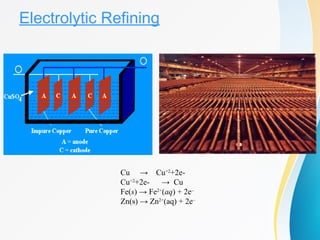
• The copper is cast into copper anodes and placed in an electrolytic cell. Once
charged, the pure copper collects on the cathode and is removed as 99% pure.
• Blocks of blister copper are used as anodes and thin sheets of pure copper act as
cathodes. The cathode plates are coated with graphite in order to remove
depositing copper.
• The electrolyte is copper sulphate (CuSO4) mixed with a little amount of H2SO4 to
increase the electrical conductivity.
• Optimum potential difference is 1.3 volt for this electrolytic process.
Electrolytic Refining
Cu → Cu+2
+2e-
Cu+2
+2e- → Cu
Fe(s) → Fe2+
(aq) + 2e–
Zn(s) → Zn2+
(aq) + 2e–
Copper Alloys
Deformable and heat treatable
1) Al-Cu-Mg-alloys (duraluminium)
2) Al-Cu-Mg-Si-alloys (forgable)
3) Al-Mg-Si-alloys (corrosion resistance)
4) Al-Zn-Mg-Cu-alloys (high strength)
5) Al-Cu-Mg-Ni-Fe-alloys (heat resistance)
Rm → 500 N/mm2
; Rp0,2 → 390 N/mm2
; A → 25%
Deformable and non heat treatable
1) Al-Mn-alloys
2) Al-Mg-alloys (magnalium)
Rm → 300 N/mm2; Rp0,2 → 150 N/mm2; A → 25%
Plane bearing alloys (for mono- and bimetallic bearing shells)
Al-Sn; Al-Ni; Al-Cu-Sb Typical structure of bearing material
Copper alloy designations
Generic name UNS numbers Composition
Wrought alloys
Coppers C10100-C15760 >99%Cu
High-copper alloys C16200-C19600 >96%Cu
Brasses C20500-C28580 Cu-Zn
Leaded brasses C31200-C38590 Cu-Zn-Pb
Tin brasses C40400-C49080 Cu-Zn-Sn-Pb
Phosphor bronzes C50100-C52400 Cu-Sn-P
Leaded phosphor bronzes C53200-C54800 Cu-Sn-Pb-P
Copper-phosphorus and copper-silver
phosphorus alloys
C55180-C55284 Cu-P-Ag
Aluminum bronzes C60600-C64400 Cu-Al-Ni-Fe-Si-Sn
Silicon bronzes C64700-C66100 Cu-Si-Sn
Other copper-zinc alloys C66400-C69900  
Copper-nickels C70000-C79900 Cu-Ni-Fe
Nickel silvers C73200-C79900 Cu-Ni-Zn
wrought alloys
designated C16000 - C79999 
forged,rolled,hot and cold work can be 
done
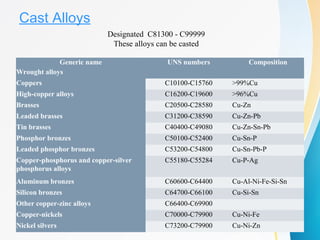
Cast Alloys
Generic name UNS numbers Composition
Wrought alloys
Coppers C10100-C15760 >99%Cu
High-copper alloys C16200-C19600 >96%Cu
Brasses C20500-C28580 Cu-Zn
Leaded brasses C31200-C38590 Cu-Zn-Pb
Tin brasses C40400-C49080 Cu-Zn-Sn-Pb
Phosphor bronzes C50100-C52400 Cu-Sn-P
Leaded phosphor bronzes C53200-C54800 Cu-Sn-Pb-P
Copper-phosphorus and copper-silver
phosphorus alloys
C55180-C55284 Cu-P-Ag
Aluminum bronzes C60600-C64400 Cu-Al-Ni-Fe-Si-Sn
Silicon bronzes C64700-C66100 Cu-Si-Sn
Other copper-zinc alloys C66400-C69900  
Copper-nickels C70000-C79900 Cu-Ni-Fe
Nickel silvers C73200-C79900 Cu-Ni-Zn
Designated  C81300 - C99999
These alloys can be casted
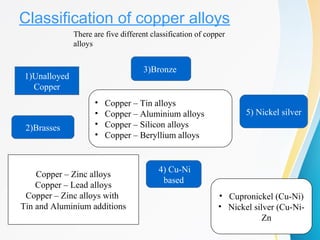
Classification of copper alloys
There are five different classification of copper 
alloys
1)Unalloyed 
Copper
2)Brasses
Copper – Zinc alloys
Copper – Lead alloys
Copper – Zinc alloys with 
Tin and Aluminium additions
3)Bronze
• Copper – Tin alloys
• Copper – Aluminium alloys
• Copper – Silicon alloys
• Copper – Beryllium alloys
4) Cu-Ni 
based
• Cupronickel (Cu-Ni)
• Nickel silver (Cu-Ni-
Zn
5) Nickel silver
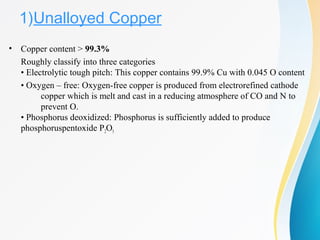
1)Unalloyed Copper
• Copper content > 99.3%
Roughly classify into three categories
• Electrolytic tough pitch: This copper contains 99.9% Cu with 0.045 O content
• Oxygen – free: Oxygen-free copper is produced from electrorefined cathode 
copper which is melt and cast in a reducing atmosphere of CO and N to 
prevent O.
• Phosphorus deoxidized: Phosphorus is sufficiently added to produce 
phosphoruspentoxide P2O5
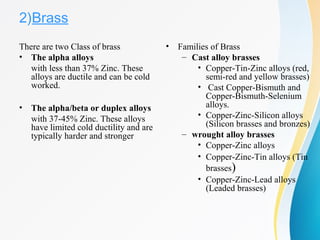
2)Brass
There are two Class of brass
• The alpha alloys
with less than 37% Zinc. These 
alloys are ductile and can be cold 
worked.
• The alpha/beta or duplex alloys
with 37-45% Zinc. These alloys 
have limited cold ductility and are 
typically harder and stronger
• Families of Brass
– Cast alloy brasses
• Copper-Tin-Zinc alloys (red, 
semi-red and yellow brasses)
•  Cast Copper-Bismuth and 
Copper-Bismuth-Selenium 
alloys.
• Copper-Zinc-Silicon alloys 
(Silicon brasses and bronzes)
– wrought alloy brasses
• Copper-Zinc alloys
• Copper-Zinc-Tin alloys (Tin 
brasses)
• Copper-Zinc-Lead alloys 
(Leaded brasses)
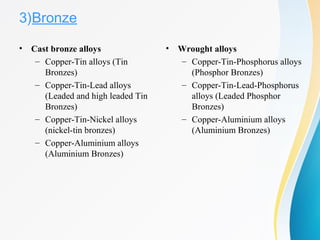
3)Bronze
• Cast bronze alloys
– Copper-Tin alloys (Tin 
Bronzes)
– Copper-Tin-Lead alloys 
(Leaded and high leaded Tin 
Bronzes)
– Copper-Tin-Nickel alloys 
(nickel-tin bronzes)
– Copper-Aluminium alloys 
(Aluminium Bronzes)
• Wrought alloys
– Copper-Tin-Phosphorus alloys 
(Phosphor Bronzes)
– Copper-Tin-Lead-Phosphorus 
alloys (Leaded Phosphor 
Bronzes)
– Copper-Aluminium alloys 
(Aluminium Bronzes)
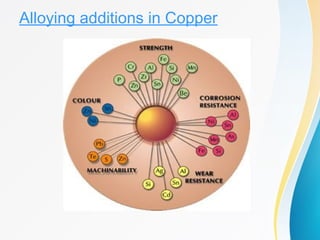
Alloying additions in Copper
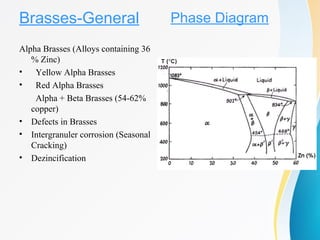
Brasses-General
Alpha Brasses (Alloys containing 36
% Zinc)
• Yellow Alpha Brasses
• Red Alpha Brasses
Alpha + Beta Brasses (54-62%
copper)
• Defects in Brasses
• Intergranuler corrosion (Seasonal
Cracking)
• Dezincification
Phase Diagram
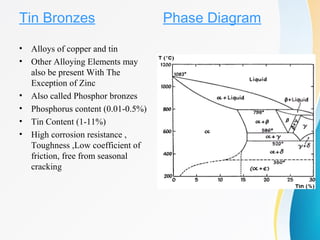
Tin Bronzes
• Alloys of copper and tin
• Other Alloying Elements may
also be present With The
Exception of Zinc
• Also called Phosphor bronzes
• Phosphorus content (0.01-0.5%)
• Tin Content (1-11%)
• High corrosion resistance ,
Toughness ,Low coefficient of
friction, free from seasonal
cracking
Phase Diagram
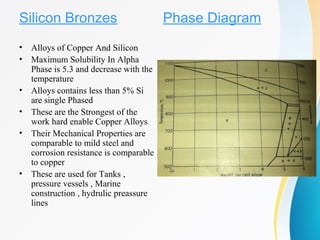
Silicon Bronzes
• Alloys of Copper And Silicon
• Maximum Solubility In Alpha
Phase is 5.3 and decrease with the
temperature
• Alloys contains less than 5% Si
are single Phased
• These are the Strongest of the
work hard enable Copper Alloys
• Their Mechanical Properties are
comparable to mild steel and
corrosion resistance is comparable
to copper
• These are used for Tanks ,
pressure vessels , Marine
construction , hydrulic preassure
lines
Phase Diagram
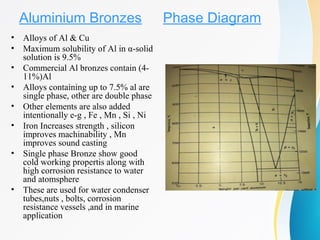
Aluminium Bronzes
• Alloys of Al & Cu
• Maximum solubility of Al in α-solid
solution is 9.5%
• Commercial Al bronzes contain (4-
11%)Al
• Alloys containing up to 7.5% al are
single phase, other are double phase
• Other elements are also added
intentionally e-g , Fe , Mn , Si , Ni
• Iron Increases strength , silicon
improves machinability , Mn
improves sound casting
• Single phase Bronze show good
cold working propertis along with
high corrosion resistance to water
and atomsphere
• These are used for water condenser
tubes,nuts , bolts, corrosion
resistance vessels ,and in marine
application
Phase Diagram
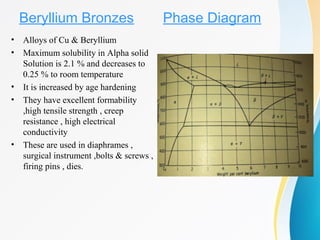
Beryllium Bronzes
• Alloys of Cu & Beryllium
• Maximum solubility in Alpha solid
Solution is 2.1 % and decreases to
0.25 % to room temperature
• It is increased by age hardening
• They have excellent formability
,high tensile strength , creep
resistance , high electrical
conductivity
• These are used in diaphrames ,
surgical instrument ,bolts & screws ,
firing pins , dies.
Phase Diagram
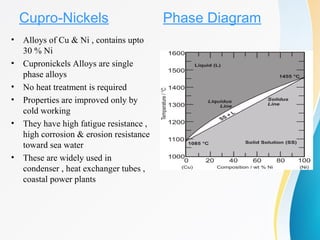
Cupro-Nickels
• Alloys of Cu & Ni , contains upto
30 % Ni
• Cupronickels Alloys are single
phase alloys
• No heat treatment is required
• Properties are improved only by
cold working
• They have high fatigue resistance ,
high corrosion & erosion resistance
toward sea water
• These are widely used in
condenser , heat exchanger tubes ,
coastal power plants
Phase Diagram
Nickel Silver
• Alloys of Cu-Ni-Zn
• Commercial Alloys are contain Cu (50-70%) , Ni (5-10%) , Zn (5-40%)
• If copper is more than 60 % these are single phased ,ductile & easily
workable at room temp.
• Addition of Zinc imparts silver-blue-white colour ,good corrosion
resistance.
• These are Excellent base metals for plating with Cr ,Ni ,Ag
• These are used For Rivets, screws, Costume jewelry , name plates & radio
dials
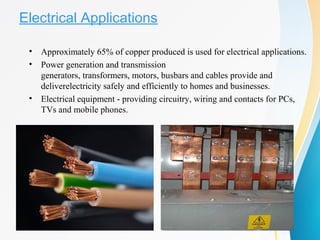
Electrical Applications
• Approximately 65% of copper produced is used for electrical applications.
• Power generation and transmission
generators, transformers, motors, busbars and cables provide and
deliverelectricity safely and efficiently to homes and businesses.
• Electrical equipment - providing circuitry, wiring and contacts for PCs,
TVs and mobile phones.
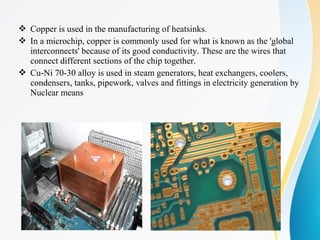
 Copper is used in the manufacturing of heatsinks.
 In a microchip, copper is commonly used for what is known as the 'global
interconnects' because of its good conductivity. These are the wires that
connect different sections of the chip together.
 Cu-Ni 70-30 alloy is used in steam generators, heat exchangers, coolers,
condensers, tanks, pipework, valves and fittings in electricity generation by
Nuclear means
Automotive Applications
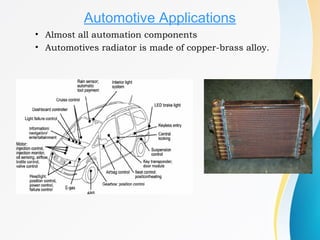
• Almost all automation components
• Automotives radiator is made of copper-brass alloy.
Other Applications
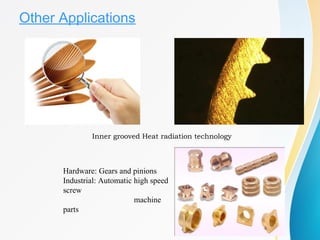
Inner grooved Heat radiation technology
Hardware: Gears and pinions
Industrial: Automatic high speed
screw
machine
parts
Copper and its alloys

Copper and its alloys

  • 1.
  • 2.
  • 3.
    Copper • Copper (Cu)atomic weight 63.546 is a soft, malleable and ductile metal with very high thermal and electrical conductivity from the group of Coinage metals in the modern periodic table. • There are 29 isotopes of copper. Cu and Cu are stable, with Cu comprising approximately 69% of naturally occurring copper. The other isotopes are radioactive. • Copper is present in the Earth's crust at a concentration of about 50 parts per million (ppm) • Copper occurs as native copper or in mineral such as the copper sulfides chalcopyrite and chalcocite, copper carbonates azurite and malachite and the copper(I) oxide mineral cuprite.
  • 4.
    Extraction Techniques • Copperore is mined both underground and on the surface. Large excavations formed by surface mining are called open-pit mines. • Most of the copper ores mined today are oxide or sulfide ores. • HYDROMETALLURGICAL operations are required for treating very poor grade oxide ores (LEACHING) • PYROMETALLURGICAL treatments are given to the sulphide ores for their smelting and roasting. • ELECTROMETALLURGICAL techniques are employed for the electro refining of blister copper or copper scrap.
  • 5.
    Extraction of Cufrom sulphide ores • Copper is extracted usually from the sulphide ore chalcopyrite (CuFeS2) by smelting process. • Ores containing 4% or more copper are treated by smelting process. • There are following steps for the Pyrometallurgical extraction of copper from Chalcopyrite. 1. CONCENTRATION - By froath floatation Method 2. ROASTING 3. SMELTING 4. BESSEMERIZATION - Blister copper is obtained
  • 6.
    Refining of BlisterCopper • Blister copper is refined by electrolysis. The blister copper then undergoes "fire refining.“ • Air and natural gas are blown through the copper to remove any remaining sulfur and oxygen. • The copper is cast into copper anodes and placed in an electrolytic cell. Once charged, the pure copper collects on the cathode and is removed as 99% pure. • Blocks of blister copper are used as anodes and thin sheets of pure copper act as cathodes. The cathode plates are coated with graphite in order to remove depositing copper. • The electrolyte is copper sulphate (CuSO4) mixed with a little amount of H2SO4 to increase the electrical conductivity. • Optimum potential difference is 1.3 volt for this electrolytic process.
  • 7.
    Electrolytic Refining Cu →Cu+2 +2e- Cu+2 +2e- → Cu Fe(s) → Fe2+ (aq) + 2e– Zn(s) → Zn2+ (aq) + 2e–
  • 8.
    Copper Alloys Deformable andheat treatable 1) Al-Cu-Mg-alloys (duraluminium) 2) Al-Cu-Mg-Si-alloys (forgable) 3) Al-Mg-Si-alloys (corrosion resistance) 4) Al-Zn-Mg-Cu-alloys (high strength) 5) Al-Cu-Mg-Ni-Fe-alloys (heat resistance) Rm → 500 N/mm2 ; Rp0,2 → 390 N/mm2 ; A → 25% Deformable and non heat treatable 1) Al-Mn-alloys 2) Al-Mg-alloys (magnalium) Rm → 300 N/mm2; Rp0,2 → 150 N/mm2; A → 25% Plane bearing alloys (for mono- and bimetallic bearing shells) Al-Sn; Al-Ni; Al-Cu-Sb Typical structure of bearing material
  • 9.
    Copper alloy designations Genericname UNS numbers Composition Wrought alloys Coppers C10100-C15760 >99%Cu High-copper alloys C16200-C19600 >96%Cu Brasses C20500-C28580 Cu-Zn Leaded brasses C31200-C38590 Cu-Zn-Pb Tin brasses C40400-C49080 Cu-Zn-Sn-Pb Phosphor bronzes C50100-C52400 Cu-Sn-P Leaded phosphor bronzes C53200-C54800 Cu-Sn-Pb-P Copper-phosphorus and copper-silver phosphorus alloys C55180-C55284 Cu-P-Ag Aluminum bronzes C60600-C64400 Cu-Al-Ni-Fe-Si-Sn Silicon bronzes C64700-C66100 Cu-Si-Sn Other copper-zinc alloys C66400-C69900   Copper-nickels C70000-C79900 Cu-Ni-Fe Nickel silvers C73200-C79900 Cu-Ni-Zn wrought alloys designated C16000 - C79999  forged,rolled,hot and cold work can be  done
  • 10.
    Cast Alloys Generic nameUNS numbers Composition Wrought alloys Coppers C10100-C15760 >99%Cu High-copper alloys C16200-C19600 >96%Cu Brasses C20500-C28580 Cu-Zn Leaded brasses C31200-C38590 Cu-Zn-Pb Tin brasses C40400-C49080 Cu-Zn-Sn-Pb Phosphor bronzes C50100-C52400 Cu-Sn-P Leaded phosphor bronzes C53200-C54800 Cu-Sn-Pb-P Copper-phosphorus and copper-silver phosphorus alloys C55180-C55284 Cu-P-Ag Aluminum bronzes C60600-C64400 Cu-Al-Ni-Fe-Si-Sn Silicon bronzes C64700-C66100 Cu-Si-Sn Other copper-zinc alloys C66400-C69900   Copper-nickels C70000-C79900 Cu-Ni-Fe Nickel silvers C73200-C79900 Cu-Ni-Zn Designated  C81300 - C99999 These alloys can be casted
  • 11.
    Classification of copperalloys There are five different classification of copper  alloys 1)Unalloyed  Copper 2)Brasses Copper – Zinc alloys Copper – Lead alloys Copper – Zinc alloys with  Tin and Aluminium additions 3)Bronze • Copper – Tin alloys • Copper – Aluminium alloys • Copper – Silicon alloys • Copper – Beryllium alloys 4) Cu-Ni  based • Cupronickel (Cu-Ni) • Nickel silver (Cu-Ni- Zn 5) Nickel silver
  • 12.
  • 13.
    2)Brass There are two Class of brass • The alphaalloys with less than 37% Zinc. These  alloys are ductile and can be cold  worked. • The alpha/beta or duplex alloys with 37-45% Zinc. These alloys  have limited cold ductility and are  typically harder and stronger • Families of Brass – Cast alloy brasses • Copper-Tin-Zinc alloys (red,  semi-red and yellow brasses) •  Cast Copper-Bismuth and  Copper-Bismuth-Selenium  alloys. • Copper-Zinc-Silicon alloys  (Silicon brasses and bronzes) – wrought alloy brasses • Copper-Zinc alloys • Copper-Zinc-Tin alloys (Tin  brasses) • Copper-Zinc-Lead alloys  (Leaded brasses)
  • 14.
    3)Bronze • Cast bronzealloys – Copper-Tin alloys (Tin  Bronzes) – Copper-Tin-Lead alloys  (Leaded and high leaded Tin  Bronzes) – Copper-Tin-Nickel alloys  (nickel-tin bronzes) – Copper-Aluminium alloys  (Aluminium Bronzes) • Wrought alloys – Copper-Tin-Phosphorus alloys  (Phosphor Bronzes) – Copper-Tin-Lead-Phosphorus  alloys (Leaded Phosphor  Bronzes) – Copper-Aluminium alloys  (Aluminium Bronzes)
  • 15.
  • 16.
    Brasses-General Alpha Brasses (Alloyscontaining 36 % Zinc) • Yellow Alpha Brasses • Red Alpha Brasses Alpha + Beta Brasses (54-62% copper) • Defects in Brasses • Intergranuler corrosion (Seasonal Cracking) • Dezincification Phase Diagram
  • 17.
    Tin Bronzes • Alloysof copper and tin • Other Alloying Elements may also be present With The Exception of Zinc • Also called Phosphor bronzes • Phosphorus content (0.01-0.5%) • Tin Content (1-11%) • High corrosion resistance , Toughness ,Low coefficient of friction, free from seasonal cracking Phase Diagram
  • 18.
    Silicon Bronzes • Alloysof Copper And Silicon • Maximum Solubility In Alpha Phase is 5.3 and decrease with the temperature • Alloys contains less than 5% Si are single Phased • These are the Strongest of the work hard enable Copper Alloys • Their Mechanical Properties are comparable to mild steel and corrosion resistance is comparable to copper • These are used for Tanks , pressure vessels , Marine construction , hydrulic preassure lines Phase Diagram
  • 19.
    Aluminium Bronzes • Alloysof Al & Cu • Maximum solubility of Al in α-solid solution is 9.5% • Commercial Al bronzes contain (4- 11%)Al • Alloys containing up to 7.5% al are single phase, other are double phase • Other elements are also added intentionally e-g , Fe , Mn , Si , Ni • Iron Increases strength , silicon improves machinability , Mn improves sound casting • Single phase Bronze show good cold working propertis along with high corrosion resistance to water and atomsphere • These are used for water condenser tubes,nuts , bolts, corrosion resistance vessels ,and in marine application Phase Diagram
  • 20.
    Beryllium Bronzes • Alloysof Cu & Beryllium • Maximum solubility in Alpha solid Solution is 2.1 % and decreases to 0.25 % to room temperature • It is increased by age hardening • They have excellent formability ,high tensile strength , creep resistance , high electrical conductivity • These are used in diaphrames , surgical instrument ,bolts & screws , firing pins , dies. Phase Diagram
  • 21.
    Cupro-Nickels • Alloys ofCu & Ni , contains upto 30 % Ni • Cupronickels Alloys are single phase alloys • No heat treatment is required • Properties are improved only by cold working • They have high fatigue resistance , high corrosion & erosion resistance toward sea water • These are widely used in condenser , heat exchanger tubes , coastal power plants Phase Diagram
  • 22.
    Nickel Silver • Alloysof Cu-Ni-Zn • Commercial Alloys are contain Cu (50-70%) , Ni (5-10%) , Zn (5-40%) • If copper is more than 60 % these are single phased ,ductile & easily workable at room temp. • Addition of Zinc imparts silver-blue-white colour ,good corrosion resistance. • These are Excellent base metals for plating with Cr ,Ni ,Ag • These are used For Rivets, screws, Costume jewelry , name plates & radio dials
  • 23.
    Electrical Applications • Approximately65% of copper produced is used for electrical applications. • Power generation and transmission generators, transformers, motors, busbars and cables provide and deliverelectricity safely and efficiently to homes and businesses. • Electrical equipment - providing circuitry, wiring and contacts for PCs, TVs and mobile phones.
  • 24.
     Copper isused in the manufacturing of heatsinks.  In a microchip, copper is commonly used for what is known as the 'global interconnects' because of its good conductivity. These are the wires that connect different sections of the chip together.  Cu-Ni 70-30 alloy is used in steam generators, heat exchangers, coolers, condensers, tanks, pipework, valves and fittings in electricity generation by Nuclear means
  • 25.
    Automotive Applications • Almostall automation components • Automotives radiator is made of copper-brass alloy.
  • 26.
    Other Applications Inner groovedHeat radiation technology Hardware: Gears and pinions Industrial: Automatic high speed screw machine parts