Chapter 5 Matter in Motion
Motion When an object changes distance over time.  How do you know if an object is in motion?
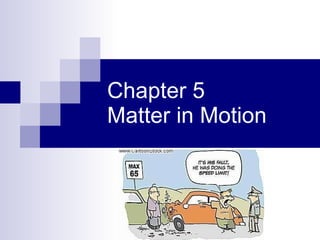
Reference point Is an object that motion is measured against What is the reference point in this picture.
Frame of Reference Video 1960
Speed Formula  ex. 66m/s AS=Average Speed TD=Total Distance TT=Total  Time
Average Speed Actual Speed
 
Solve for AS, TT, or TD If you walk for 1.5 hours and travel 7.5 km what is your average speed? AS =  TD    TT AS =  7.5 km  1.5 hr AS = 5 km/hr
Solve for AS, TT, or TD If you ride a bike .5 hours and cover 4,000 m what is your average speed?  AS =  TD    TT AS =  4,000 m   .5 hr AS = 8,000 m/hr
Solve for AS, TT, or TD If the average speed of a car is 110 km/hr how long will it take that car to travel 715 km? TT = T D   AS TT =  715 km  110 km/hr TT = 6.5 hr
Solve for AS, TT, or TD If the average speed of a tricycle is 5 km/hr what distance will it cover in 10 hours? TD = AS * TT TD = 5 km/hour * 10 hours TD = 50 km
Velocity Formula  ex. 66m/s West V= Velocity TD=Total Distance TT=Total  Time + direction
Velocity- Speed in a given direction  west (m)
Combining Velocity When you combine two velocities that are  in the same direction,  add them together to find the resultant velocity.
Combining Velocity When you combine two  velocities that are  in opposite directions,  subtract the smaller velocity from the larger velocity to find the resultant velocity. The resultant velocity is in the direction of the larger velocity.
Combining Velocity What happens when the person and the bus go in the same direction? ___________________________________ ___________________________________ What happens when the person and the bus are going in different directions? ___________________________________ ___________________________________
Look at p. 110 and complete the self check.  ___________________________________ ___________________________________ ___________________________________ ___________________________________ ___________________________________ ___________________________________ ___________________________________ ___________________________________
How do we measure a change in velocity?  What is a change in velocity called?  Acceleration-  The rate at which velocity is changing.  Term  “Acceleration”  is used when velocity increases. Term  “Deceleration”  is used when velocity decreases. A  “change in direction”  but not speed is also acceleration.
 
Acceleration Formula ∆  = change Acceleration =  ∆ V ∆ V= Final V- Starting V   t Acc.=  Final V - Starting V   t
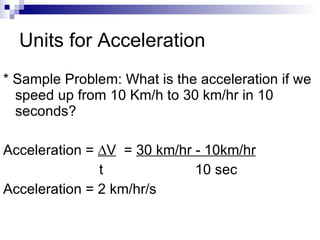
Units for Acceleration * Sample Problem: What is the acceleration if we speed up from 10 Km/h to 30 km/hr in 10 seconds? Acceleration =  ∆ V   =  30 km/hr - 10km/hr   t 10 sec Acceleration = 2 km/hr/s
1. A plane passes over point A with a velocity of 8000 m/s north. Forty seconds later it passes over point B with a velocity of 10,000 m/s north.  What is the planes acceleration from A to B? Acceleration =  ∆ V 10,000 m/s – 8,000 m/s   t 40 s Acc=  50 m/s/s or m/s 2
2. A coconut falls from the top of a tree and reaches a velocity of 19.6 m/s when it hits the ground.  It takes two seconds for the coconut to hit the ground.  What is its acceleration? Acceleration =  ∆ V 19.6 m/s – 0 m/s   t 2 s Acc=  9.8 m/s/s or m/s 2


1 2 3
1 2 3 4 5
1 2 3 4 5
1 2 3 4 5
Time (s) Time (s) Velocity (m/s) Position (m)
C
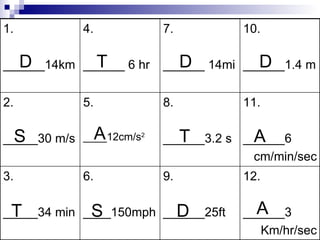
D T D D S A T A T S D A 12.  ______3 Km/hr/sec 9.  ______25ft 6.  ____150mph 3. _____34 min 11. ______6 cm/min/sec 8.  ______3.2 s 5.  ____12cm/s 2 2. _____30 m/s 10. ______1.4 m 7.  ______ 14mi 4.  ______ 6 hr 1.  ______14km
13. Goldie Goldfish, a speed swimmer, loves to race around the park’s pond, which is 0.5 miles around. If she can swim 20 laps around the track in 2 hours, what is her average speed? What is missing?  20 * 0.5 = 10 mi AS= TD/TT 10mi / 2 hr AS= 5 mph
14. It takes Stu, a slimy slug, 20 minutes to travel from his favorite bush to the local trash can (a trip of 30m), how far can he travel in 1 hour (60 min)? What is the first step.  AS= TD/TT 30 m  /  20 min AS= 1.5 m / min Now what? S * T = D 1.5 m / min * 60 min =  90m
15. At exactly 2:00 pm, Speedy the Snail crawls onto a meter stick at the 10 cm mark. If he reaches the 65 cm mark at exactly 2:10 pm, what is his speed? What is the first step.  65cm -10cm= 55cm (which is the total distance)  Now what? AS= TD/TT AS= 55cm /10 min AS= 5.5 cm / min
16. If it takes Leaping Louie 5 minutes to jump 3 blocks, how long will it take for him to jump 15 blocks? What is the first step.  3 blocks / 5 min = .6 blocks / min  Now what? 15 / .6 block / min = 25 min
16. If Bert the Bat travels eastward at 40 mph with a tail wind of 6 mph, what is his actual speed? Don’t use a formula just think about it!  Add the bat’s velocity to the wind’s 46 mph 6mph east 40 mph east
18. Toon Train is traveling at the speed of 10 m/s at the top of a hill. Five seconds later it reaches the bottom if the hill and is moving at 30 m/s. What is the rate of acceleration of Toon Train? Acceleration =  ∆ V t 30m/s – 10 m/s  =  5 s  Acc= 4 m/s/s down
19. Pete the Penguin loves to sled down his favorite hill. If he hits a speed of 50 m/s after 5 seconds, what is his rate of acceleration?  Hint: He starts at 0 m/s at the top of the hill. Acceleration =  ∆ V t 50m/s – 0 m/s  =  5 s  Acc= 10 m/s/s down
20. Monster Mike’s truck decelerates from 72 m/s to 0 m/s in 6 seconds. What is his rate of deceleration? Acceleration =  ∆ V t 0m/s – 72 m/s  =  6 s  Acc= -12 m/s/s forward
Quick Review  What does A show for distance/time? What does B show for distance/time?  What does C show for distance/time?  Time (min) Distance (km)
Quick Review  What does A show for velocity /time? What does B show for velocity /time? What does C show for velocity /time? Time (min) Velocity (km/ min east)
Speed and Acceleration Part 1: Does the speedometer of a car read average speed or instantaneous speed?  ______________________________ How do you know? Instantaneous It shows the speed you are going right now, not the speed you were going or are going to go. It also changes as you push the gas.
Speed and Acceleration Part 1: If the speedometer of your car reads a constant speed of 40km/hr, can you say the car has a constant velocity?  ______  Explain your answer. No You can’t say this because the car could be changing direction.  Ex. Nascar
a)  Which two controls on a car cause a change in speed?  _________________________ _________________________ b)  Which additional control causes a change in velocity? _________________________ Gas Pedal  Brake Steering Wheel
What is the acceleration of a car that travels in a straight line at a constant speed?  _________________________________ Describe a situation in which you can accelerate even though your speed doesn’t change.  ___________________________________ The acceleration of the car would be 0 m/s/s Pac-man.
Part 2: Calculations 6. It takes Serina 0.25 hours to drive to school. Her route is 16 km long. What is Serina’s average speed on her drive to school?   S= D/T S=  16 km .25 hr S= 64 km/hr Answer: Work: Formula:
Part 2: Calculations 7. In a competition, an athlete threw a flying disk 139 meters through the air. While in flight, the disk traveled at an average speed of 13.0 m/s. How long did the disk remain in the air?  T=D/V T=  139m 13 m/s T= 10.69 s Answer: Work: Formula:
Part 2: Calculations 8. A runner covers the last straight stretch of a race in 4 s.  During that time, he speeds up from 5 m/s to 9 m/s.  What is the runner’s acceleration in this part of the race? Acc=  V f  –V s   TT Acc=  9m/s – 5 m/s 4 s Acc.= 1 m / s / s Answer: Work: Formula:
Part 2: Calculations 9.  If you shout into the Grand Canyon, your voice travels at the speed of sound (340 m/s) to the bottom of the canyon and back, and you hear an echo.  How deep is the Grand Canyon at a spot where you can hear your echo 5.2 seconds after you shout? D=T * V D= 5.2 * 340 D= 1768 m Answer: Work: Formula:
Part 2: Calculations 10. Falling objects drop with an average acceleration of 9.8 m/s2.  If an object falls from a tall building, how long will it take before it reaches a speed of 49 m/s? T =  V f - V s Acc T=  49 – 0 9.8 T= 5 s Answer: Work: Formula:
Part 2: Calculations 11.  Josh rolled a bowling ball down a lane in 2.5 s.  The ball traveled at a constant acceleration of 1.8 m/s2 down the lane and was traveling at a speed of 7.6 m/s by the time it reached the pins at the end of the lane.  How fast was the ball going when it left Tim’s hand? V s  = V f  –(A * T) V s  =  7.6 m/s – (1.8 * 2.5)  V s  = 3.1 m/s  Answer: Work: Formula:
Acceleration Practice: Part 1: True or False 1. _______ If you slow down on your bike you accelerate? Why?___________________________________ 2. _______ If you ride your bike at a constant speed, you cannot accelerate? Why?__________________________________ 3. _______Changing the speed and changing the direction of your bike are both examples of acceleration?  Why?___________________________________ True False True
Acceleration Practice: Part 2: Acceleration? 4. You are riding your bike at
 
Force 5-2 p. 115 - 118 Force is a push or a pull Forces have the ability to change an objects motion Starting Stopping Speeding up Slowing down Changing direction
Forces may change an objects shape Forces give  energy  to an object All of the forces acting on an object together are known as  net forces Balanced Forces:  are equal net forces No movement or change in movement occurs
 
Unbalances Forces: are unequal forces  Some change in movement occurs Where are the unbalanced forces?
Left
What is the motion of this object? Are the forces balanced?
Forces can be represented with arrows called  vectors .  Vectors show the direction and magnitude of a force.  Forces are measured in Newtons (N). Larger Force Smaller Force  MAGNITUDE
Chapter 5 Section 3  Friction  is a force that opposes motion between surfaces that are touching.  Even surfaces that appear smooth have rough edges.
On p. 119
Two ways to  Increase  friction. 1. Make the surface rougher. 2. Greater force.
Two ways to  Decrease  friction. 1. Make the surface smoother. 2. Less force.
 
Be Careful!  Friction is not increased by increasing surface area if the mass stays constant.
Types of friction Sliding Rolling Fluid Static
Examples of types of Friction Sliding _____________________ _____________________ _____________________
Examples of types of Friction Rolling _____________________ _____________________ _____________________
Examples of types of Friction Fluid- Remember this is a liquid or a gas! _____________________ _____________________ _____________________
Examples of types of Friction Static- friction with no movement but a force is applied. _____________________ _____________________ _____________________
Explain this diagram.
5-4 Gravity Section 5-4
5-4 Gravity Gravity: force of attraction between objects due to their masses.  Why are astronauts so “bouncy on the moon?
Gravity acts “down”.  Earth gravity pulls objects towards the center of the Earth. So no matter where you are on Earth all objects fall “down” to the ground.
What do the apple and the moon have in common? The law of universal gravitation.  Describes the relationship between force, mass and distance. States that all objects in the universe attract each other through gravitational force.  The size of that force depends on the mass of the objects and the distance between the objects.
Small mass, Small distance= Medium Gravity Large mass, Small distance= Large Gravity Large mass, Large distance= Small Gravity
If all objects have gravity why don’t you feel it?  Earth is so big and close that all other things are very small or very far making there gravity VERY small.  The two factors that effect gravity are: 1. Distance 2. Mass
Weight V.S. Mass  What does this diagram show?
Weight V.S. Mass Our mass is in Kilograms but our weight is in Newtons…. Why? Weight is the force of gravity.  Forces are measured in Newtons (N) so Weight is measured in Newtons (N).
Weight V.S. Mass on Earth Using the data below, explain the relationship between  weight and mass on earth? What is the gravity on Earth?  What is gravity on the Moon? 166 N 100kg 980 N 100kg 133 N 80 kg 784 N 80 kg 100 N 60 Kg 588 N 60 Kg Weight Mass Weight Mass Moon Earth
What is the formula for weight? WEIGHT  (N) MASS (Kg) Acceleration DUE TO GRAVITY (on earth  9.8 m/s/s)
Weight Mass Balance Measure of gravity Constant on earth Measured in (N) Changes with gravity 6 X less on the moon Spring Scale Amount of matter Constant on earth Measured in (g) Never changes Remains the same when gravity changes
Directed Reading 5-2 1. All forces have size and direction True / False 2. A force is a push or a pull. True / False 3. Forces are expressed in liters. True / False 4.  You can exert a push without there being an object to receive the push. True / False 5. Name three things that you exert a force on while doing your home work?  Newtons (N)
6. In which of the following situations is a force being exerted?  A. A woman pushes the elevator button. B. a pile of soil sits on the ground C. Socks cling together when they come out of the dryer.  D. Magnets stick to the refrigerator. 7. In figure 8 on p. 116 how does the net force help the students move the piano? ______________________________ Since the forces are in the same direction you add the forces together.
Directed Reading 5-2 8. Suppose the dog on the left in figure 9, on page 117, increased its force to 13 N. Which dog would win the tug-of-war? Explain?  ___________________________________ ___________________________________ 9. Why is it useful to know the net force?  ___________________________________ 10. Forces are unbalances when the net forces are not = to ______________ The dog on the left will win by 1 N because  forces are not negative but positive in a direction.  It can tell you about the motion of an object.  Zero
Directed Reading 5-2 11. To start or change the motion of an object you need a (n) __________ force. 12. Forces are balanced when the net force applied to an object is ___________ zero.  13. Are the forces in Figure 10 balanced? ____ How do you know? _____________________________________ unbalanced equal to  yes  The cards are not moving or falling.
Directed Reading 5-3 1. What force is responsible for the painful difference between sliding on grass and sliding on pavement?  ______________________ 2. Friction occurs when the hills and valleys of two surfaces stick together.  True  /  False 3. Why does pavement create more friction than grass?  ___________________________________ Sliding Friction The pavement is rougher than the grass.
Directed Reading 5-3 4. Why is more force needed to slide the larger book in Figure 12 on p. 120?  ___________________________________ ___________________________________ 5. Friction is affected by the amount of the surface that is touching.  True  /  False The mass is larger so the downward force  That is created is larger.
Directed Reading 5-3 6. Hockey puck on ice 7. Crate on loading ramp 8. Wheeled cart pushed 9. air passing a car A. Sliding Friction B. Rolling Friction C. Fluid Friction D. Static Friction
Directed Reading 5-3 10. Static friction is at work if you try to drag a heavy suitcase along the floor and the suitcase  (moves  or  does not move) 11. As soon as an object starts moving, static friction (increases  or  disappears).  If the suitcase had moved, what type of  friction would have been at work?
12. How does friction harm the engine of a car?  ___________________________________ ___________________________________ 13. Why do you need friction to walk?  ___________________________________ ___________________________________ 14. Which of the following will reduce friction?  A. Use a lubricant.  B. Make surface smoother. C. Push surfaces  D. Change sliding friction together.   to rolling friction.  It wears down the parts inside the car  because of sliding friction.  If there was no friction you would not be able  to grip the floor with your shoes.
Section Review p. 124 1. Explain why friction occurs? 2. Name two ways friction can be increased? 3. Give an example of Sliding Friction, Rolling Friction, Fluid Friction, Static Friction.  4. How is friction harmful and helpful when you ride a bike?
Directed Reading 5-4 1. Why did the astronaut in Figure 18 bounce on the moon?  2. The force of attraction between two objects due to their masses is the force of ______________. 3. Does all matter experience gravity? Explain. ______________________________________ ______________________________________ 4. The force that pulls you towards your pencil is called ________________ force.  Gravity  Yes because all matter has mass and gravity  is a force that an object has b/c it has mass  Gravitational
Directed Reading 5-4 5. Do scientists think that seeds can sense gravity? True  /  False 6. Since all objects are attracted to each other because of gravity, why can’t you see objects moving towards each other?  ____________ _____________________________________ _____________________________________ 7. How are objects effected by the mass of the earth?  ____________________________ b/c the gravity  Of earth is to large for the force of gravity to  overcome the force of friction.
Directed Reading 5-4 8. What did Newton find out about the moon and the falling apple?  ________________ ___________________________________ 9. Newton’s law of universal gravitation describes the relationship between all the following except _____.  10. Which of the following are subject to the law of universal gravitation? __________ Both the apple and  The moon are being acted upon by gravity.  heat  A, B, C, D
Directed Reading 5-4 11. If the distance between objects are the same the gravitational force between two feathers is greater than the gravitational force between two boiling balls. ________  12. If two objects are moved_____________ each other, the gravitational force between them increases.  13. Why is the cat easier to pick up than the elephant?  ___________________________________ False  toward  Cat has less mass and thus less gravitational force
Directed Reading 5-4 14. In a _____________ gravity is so great that even light can’t escape.  15. Why doesn’t the sun’s gravity pull you off earth? ____________________________ 16. The gravitational force exerted by an object depends on the _________ of the object.  The measure of Earths gravitational force on an object is the objects ________________.  Black Hole It is very far away.  mass weight
___ ___ ___ ___ ___ ___ 18. different on the moon 19. Expresses in (N) 20. Expressed in (G) 21. Measure of the gravitational force 22. Value does not change 23. amount of matter in an object W W M W M M 24. On Earth mass & weight are constant, which means that they are the same thing.  True  /  False
Section Review p. 129 1. How does the mass of an object relate to the gravitational force the object exerts on other objects? 2. How does the distance between objects affect the gravity between them? 3. Explain why your weight would change as you orbit in a space shuttle but your mass would not.

Chapter 5

  • 1.
  • 2.
    Motion When anobject changes distance over time. How do you know if an object is in motion?
  • 3.
    Reference point Isan object that motion is measured against What is the reference point in this picture.
  • 4.
  • 5.
    Speed Formula ex. 66m/s AS=Average Speed TD=Total Distance TT=Total Time
  • 6.
  • 7.
  • 8.
    Solve for AS,TT, or TD If you walk for 1.5 hours and travel 7.5 km what is your average speed? AS = TD TT AS = 7.5 km 1.5 hr AS = 5 km/hr
  • 9.
    Solve for AS,TT, or TD If you ride a bike .5 hours and cover 4,000 m what is your average speed? AS = TD TT AS = 4,000 m .5 hr AS = 8,000 m/hr
  • 10.
    Solve for AS,TT, or TD If the average speed of a car is 110 km/hr how long will it take that car to travel 715 km? TT = T D AS TT = 715 km 110 km/hr TT = 6.5 hr
  • 11.
    Solve for AS,TT, or TD If the average speed of a tricycle is 5 km/hr what distance will it cover in 10 hours? TD = AS * TT TD = 5 km/hour * 10 hours TD = 50 km
  • 12.
    Velocity Formula ex. 66m/s West V= Velocity TD=Total Distance TT=Total Time + direction
  • 13.
    Velocity- Speed ina given direction west (m)
  • 14.
    Combining Velocity Whenyou combine two velocities that are in the same direction, add them together to find the resultant velocity.
  • 15.
    Combining Velocity Whenyou combine two velocities that are in opposite directions, subtract the smaller velocity from the larger velocity to find the resultant velocity. The resultant velocity is in the direction of the larger velocity.
  • 16.
    Combining Velocity Whathappens when the person and the bus go in the same direction? ___________________________________ ___________________________________ What happens when the person and the bus are going in different directions? ___________________________________ ___________________________________
  • 17.
    Look at p.110 and complete the self check. ___________________________________ ___________________________________ ___________________________________ ___________________________________ ___________________________________ ___________________________________ ___________________________________ ___________________________________
  • 18.
    How do wemeasure a change in velocity? What is a change in velocity called? Acceleration- The rate at which velocity is changing. Term “Acceleration” is used when velocity increases. Term “Deceleration” is used when velocity decreases. A “change in direction” but not speed is also acceleration.
  • 19.
  • 20.
    Acceleration Formula ∆ = change Acceleration = ∆ V ∆ V= Final V- Starting V t Acc.= Final V - Starting V t
  • 21.
    Units for Acceleration* Sample Problem: What is the acceleration if we speed up from 10 Km/h to 30 km/hr in 10 seconds? Acceleration = ∆ V = 30 km/hr - 10km/hr t 10 sec Acceleration = 2 km/hr/s
  • 22.
    1. A planepasses over point A with a velocity of 8000 m/s north. Forty seconds later it passes over point B with a velocity of 10,000 m/s north. What is the planes acceleration from A to B? Acceleration = ∆ V 10,000 m/s – 8,000 m/s t 40 s Acc= 50 m/s/s or m/s 2
  • 23.
    2. A coconutfalls from the top of a tree and reaches a velocity of 19.6 m/s when it hits the ground. It takes two seconds for the coconut to hit the ground. What is its acceleration? Acceleration = ∆ V 19.6 m/s – 0 m/s t 2 s Acc= 9.8 m/s/s or m/s 2
  • 24.
  • 25.
  • 26.
  • 27.
  • 28.
  • 29.
    1 2 34 5
  • 30.
    1 2 34 5
  • 31.
    1 2 34 5
  • 32.
    Time (s) Time(s) Velocity (m/s) Position (m)
  • 33.
    Time (s) Time(s) Velocity (m/s) Position (m)
  • 34.
  • 35.
    D T DD S A T A T S D A 12. ______3 Km/hr/sec 9. ______25ft 6. ____150mph 3. _____34 min 11. ______6 cm/min/sec 8. ______3.2 s 5. ____12cm/s 2 2. _____30 m/s 10. ______1.4 m 7. ______ 14mi 4. ______ 6 hr 1. ______14km
  • 36.
    13. Goldie Goldfish,a speed swimmer, loves to race around the park’s pond, which is 0.5 miles around. If she can swim 20 laps around the track in 2 hours, what is her average speed? What is missing? 20 * 0.5 = 10 mi AS= TD/TT 10mi / 2 hr AS= 5 mph
  • 37.
    14. It takesStu, a slimy slug, 20 minutes to travel from his favorite bush to the local trash can (a trip of 30m), how far can he travel in 1 hour (60 min)? What is the first step. AS= TD/TT 30 m / 20 min AS= 1.5 m / min Now what? S * T = D 1.5 m / min * 60 min = 90m
  • 38.
    15. At exactly2:00 pm, Speedy the Snail crawls onto a meter stick at the 10 cm mark. If he reaches the 65 cm mark at exactly 2:10 pm, what is his speed? What is the first step. 65cm -10cm= 55cm (which is the total distance) Now what? AS= TD/TT AS= 55cm /10 min AS= 5.5 cm / min
  • 39.
    16. If ittakes Leaping Louie 5 minutes to jump 3 blocks, how long will it take for him to jump 15 blocks? What is the first step. 3 blocks / 5 min = .6 blocks / min Now what? 15 / .6 block / min = 25 min
  • 40.
    16. If Bertthe Bat travels eastward at 40 mph with a tail wind of 6 mph, what is his actual speed? Don’t use a formula just think about it! Add the bat’s velocity to the wind’s 46 mph 6mph east 40 mph east
  • 41.
    18. Toon Trainis traveling at the speed of 10 m/s at the top of a hill. Five seconds later it reaches the bottom if the hill and is moving at 30 m/s. What is the rate of acceleration of Toon Train? Acceleration = ∆ V t 30m/s – 10 m/s = 5 s Acc= 4 m/s/s down
  • 42.
    19. Pete thePenguin loves to sled down his favorite hill. If he hits a speed of 50 m/s after 5 seconds, what is his rate of acceleration? Hint: He starts at 0 m/s at the top of the hill. Acceleration = ∆ V t 50m/s – 0 m/s = 5 s Acc= 10 m/s/s down
  • 43.
    20. Monster Mike’struck decelerates from 72 m/s to 0 m/s in 6 seconds. What is his rate of deceleration? Acceleration = ∆ V t 0m/s – 72 m/s = 6 s Acc= -12 m/s/s forward
  • 44.
    Quick Review What does A show for distance/time? What does B show for distance/time? What does C show for distance/time? Time (min) Distance (km)
  • 45.
    Quick Review What does A show for velocity /time? What does B show for velocity /time? What does C show for velocity /time? Time (min) Velocity (km/ min east)
  • 46.
    Speed and AccelerationPart 1: Does the speedometer of a car read average speed or instantaneous speed? ______________________________ How do you know? Instantaneous It shows the speed you are going right now, not the speed you were going or are going to go. It also changes as you push the gas.
  • 47.
    Speed and AccelerationPart 1: If the speedometer of your car reads a constant speed of 40km/hr, can you say the car has a constant velocity? ______ Explain your answer. No You can’t say this because the car could be changing direction. Ex. Nascar
  • 48.
    a) Whichtwo controls on a car cause a change in speed? _________________________ _________________________ b) Which additional control causes a change in velocity? _________________________ Gas Pedal Brake Steering Wheel
  • 49.
    What is theacceleration of a car that travels in a straight line at a constant speed? _________________________________ Describe a situation in which you can accelerate even though your speed doesn’t change. ___________________________________ The acceleration of the car would be 0 m/s/s Pac-man.
  • 50.
    Part 2: Calculations6. It takes Serina 0.25 hours to drive to school. Her route is 16 km long. What is Serina’s average speed on her drive to school? S= D/T S= 16 km .25 hr S= 64 km/hr Answer: Work: Formula:
  • 51.
    Part 2: Calculations7. In a competition, an athlete threw a flying disk 139 meters through the air. While in flight, the disk traveled at an average speed of 13.0 m/s. How long did the disk remain in the air? T=D/V T= 139m 13 m/s T= 10.69 s Answer: Work: Formula:
  • 52.
    Part 2: Calculations8. A runner covers the last straight stretch of a race in 4 s. During that time, he speeds up from 5 m/s to 9 m/s. What is the runner’s acceleration in this part of the race? Acc= V f –V s TT Acc= 9m/s – 5 m/s 4 s Acc.= 1 m / s / s Answer: Work: Formula:
  • 53.
    Part 2: Calculations9. If you shout into the Grand Canyon, your voice travels at the speed of sound (340 m/s) to the bottom of the canyon and back, and you hear an echo. How deep is the Grand Canyon at a spot where you can hear your echo 5.2 seconds after you shout? D=T * V D= 5.2 * 340 D= 1768 m Answer: Work: Formula:
  • 54.
    Part 2: Calculations10. Falling objects drop with an average acceleration of 9.8 m/s2. If an object falls from a tall building, how long will it take before it reaches a speed of 49 m/s? T = V f - V s Acc T= 49 – 0 9.8 T= 5 s Answer: Work: Formula:
  • 55.
    Part 2: Calculations11. Josh rolled a bowling ball down a lane in 2.5 s. The ball traveled at a constant acceleration of 1.8 m/s2 down the lane and was traveling at a speed of 7.6 m/s by the time it reached the pins at the end of the lane. How fast was the ball going when it left Tim’s hand? V s = V f –(A * T) V s = 7.6 m/s – (1.8 * 2.5) V s = 3.1 m/s Answer: Work: Formula:
  • 56.
    Acceleration Practice: Part1: True or False 1. _______ If you slow down on your bike you accelerate? Why?___________________________________ 2. _______ If you ride your bike at a constant speed, you cannot accelerate? Why?__________________________________ 3. _______Changing the speed and changing the direction of your bike are both examples of acceleration? Why?___________________________________ True False True
  • 57.
    Acceleration Practice: Part2: Acceleration? 4. You are riding your bike at
  • 58.
  • 59.
    Force 5-2 p.115 - 118 Force is a push or a pull Forces have the ability to change an objects motion Starting Stopping Speeding up Slowing down Changing direction
  • 60.
    Forces may changean objects shape Forces give energy to an object All of the forces acting on an object together are known as net forces Balanced Forces: are equal net forces No movement or change in movement occurs
  • 61.
  • 62.
    Unbalances Forces: areunequal forces Some change in movement occurs Where are the unbalanced forces?
  • 63.
  • 64.
    What is themotion of this object? Are the forces balanced?
  • 65.
    Forces can berepresented with arrows called vectors . Vectors show the direction and magnitude of a force. Forces are measured in Newtons (N). Larger Force Smaller Force MAGNITUDE
  • 66.
    Chapter 5 Section3 Friction is a force that opposes motion between surfaces that are touching. Even surfaces that appear smooth have rough edges.
  • 67.
  • 68.
    Two ways to Increase friction. 1. Make the surface rougher. 2. Greater force.
  • 69.
    Two ways to Decrease friction. 1. Make the surface smoother. 2. Less force.
  • 70.
  • 71.
    Be Careful! Friction is not increased by increasing surface area if the mass stays constant.
  • 72.
    Types of frictionSliding Rolling Fluid Static
  • 73.
    Examples of typesof Friction Sliding _____________________ _____________________ _____________________
  • 74.
    Examples of typesof Friction Rolling _____________________ _____________________ _____________________
  • 75.
    Examples of typesof Friction Fluid- Remember this is a liquid or a gas! _____________________ _____________________ _____________________
  • 76.
    Examples of typesof Friction Static- friction with no movement but a force is applied. _____________________ _____________________ _____________________
  • 77.
  • 78.
  • 79.
    5-4 Gravity Gravity:force of attraction between objects due to their masses. Why are astronauts so “bouncy on the moon?
  • 80.
    Gravity acts “down”. Earth gravity pulls objects towards the center of the Earth. So no matter where you are on Earth all objects fall “down” to the ground.
  • 81.
    What do theapple and the moon have in common? The law of universal gravitation. Describes the relationship between force, mass and distance. States that all objects in the universe attract each other through gravitational force. The size of that force depends on the mass of the objects and the distance between the objects.
  • 82.
    Small mass, Smalldistance= Medium Gravity Large mass, Small distance= Large Gravity Large mass, Large distance= Small Gravity
  • 83.
    If all objectshave gravity why don’t you feel it? Earth is so big and close that all other things are very small or very far making there gravity VERY small. The two factors that effect gravity are: 1. Distance 2. Mass
  • 84.
    Weight V.S. Mass What does this diagram show?
  • 85.
    Weight V.S. MassOur mass is in Kilograms but our weight is in Newtons…. Why? Weight is the force of gravity. Forces are measured in Newtons (N) so Weight is measured in Newtons (N).
  • 86.
    Weight V.S. Masson Earth Using the data below, explain the relationship between weight and mass on earth? What is the gravity on Earth? What is gravity on the Moon? 166 N 100kg 980 N 100kg 133 N 80 kg 784 N 80 kg 100 N 60 Kg 588 N 60 Kg Weight Mass Weight Mass Moon Earth
  • 87.
    What is theformula for weight? WEIGHT (N) MASS (Kg) Acceleration DUE TO GRAVITY (on earth 9.8 m/s/s)
  • 88.
    Weight Mass BalanceMeasure of gravity Constant on earth Measured in (N) Changes with gravity 6 X less on the moon Spring Scale Amount of matter Constant on earth Measured in (g) Never changes Remains the same when gravity changes
  • 89.
    Directed Reading 5-21. All forces have size and direction True / False 2. A force is a push or a pull. True / False 3. Forces are expressed in liters. True / False 4. You can exert a push without there being an object to receive the push. True / False 5. Name three things that you exert a force on while doing your home work? Newtons (N)
  • 90.
    6. In whichof the following situations is a force being exerted? A. A woman pushes the elevator button. B. a pile of soil sits on the ground C. Socks cling together when they come out of the dryer. D. Magnets stick to the refrigerator. 7. In figure 8 on p. 116 how does the net force help the students move the piano? ______________________________ Since the forces are in the same direction you add the forces together.
  • 91.
    Directed Reading 5-28. Suppose the dog on the left in figure 9, on page 117, increased its force to 13 N. Which dog would win the tug-of-war? Explain? ___________________________________ ___________________________________ 9. Why is it useful to know the net force? ___________________________________ 10. Forces are unbalances when the net forces are not = to ______________ The dog on the left will win by 1 N because forces are not negative but positive in a direction. It can tell you about the motion of an object. Zero
  • 92.
    Directed Reading 5-211. To start or change the motion of an object you need a (n) __________ force. 12. Forces are balanced when the net force applied to an object is ___________ zero. 13. Are the forces in Figure 10 balanced? ____ How do you know? _____________________________________ unbalanced equal to yes The cards are not moving or falling.
  • 93.
    Directed Reading 5-31. What force is responsible for the painful difference between sliding on grass and sliding on pavement? ______________________ 2. Friction occurs when the hills and valleys of two surfaces stick together. True / False 3. Why does pavement create more friction than grass? ___________________________________ Sliding Friction The pavement is rougher than the grass.
  • 94.
    Directed Reading 5-34. Why is more force needed to slide the larger book in Figure 12 on p. 120? ___________________________________ ___________________________________ 5. Friction is affected by the amount of the surface that is touching. True / False The mass is larger so the downward force That is created is larger.
  • 95.
    Directed Reading 5-36. Hockey puck on ice 7. Crate on loading ramp 8. Wheeled cart pushed 9. air passing a car A. Sliding Friction B. Rolling Friction C. Fluid Friction D. Static Friction
  • 96.
    Directed Reading 5-310. Static friction is at work if you try to drag a heavy suitcase along the floor and the suitcase (moves or does not move) 11. As soon as an object starts moving, static friction (increases or disappears). If the suitcase had moved, what type of friction would have been at work?
  • 97.
    12. How doesfriction harm the engine of a car? ___________________________________ ___________________________________ 13. Why do you need friction to walk? ___________________________________ ___________________________________ 14. Which of the following will reduce friction? A. Use a lubricant. B. Make surface smoother. C. Push surfaces D. Change sliding friction together. to rolling friction. It wears down the parts inside the car because of sliding friction. If there was no friction you would not be able to grip the floor with your shoes.
  • 98.
    Section Review p.124 1. Explain why friction occurs? 2. Name two ways friction can be increased? 3. Give an example of Sliding Friction, Rolling Friction, Fluid Friction, Static Friction. 4. How is friction harmful and helpful when you ride a bike?
  • 99.
    Directed Reading 5-41. Why did the astronaut in Figure 18 bounce on the moon? 2. The force of attraction between two objects due to their masses is the force of ______________. 3. Does all matter experience gravity? Explain. ______________________________________ ______________________________________ 4. The force that pulls you towards your pencil is called ________________ force. Gravity Yes because all matter has mass and gravity is a force that an object has b/c it has mass Gravitational
  • 100.
    Directed Reading 5-45. Do scientists think that seeds can sense gravity? True / False 6. Since all objects are attracted to each other because of gravity, why can’t you see objects moving towards each other? ____________ _____________________________________ _____________________________________ 7. How are objects effected by the mass of the earth? ____________________________ b/c the gravity Of earth is to large for the force of gravity to overcome the force of friction.
  • 101.
    Directed Reading 5-48. What did Newton find out about the moon and the falling apple? ________________ ___________________________________ 9. Newton’s law of universal gravitation describes the relationship between all the following except _____. 10. Which of the following are subject to the law of universal gravitation? __________ Both the apple and The moon are being acted upon by gravity. heat A, B, C, D
  • 102.
    Directed Reading 5-411. If the distance between objects are the same the gravitational force between two feathers is greater than the gravitational force between two boiling balls. ________ 12. If two objects are moved_____________ each other, the gravitational force between them increases. 13. Why is the cat easier to pick up than the elephant? ___________________________________ False toward Cat has less mass and thus less gravitational force
  • 103.
    Directed Reading 5-414. In a _____________ gravity is so great that even light can’t escape. 15. Why doesn’t the sun’s gravity pull you off earth? ____________________________ 16. The gravitational force exerted by an object depends on the _________ of the object. The measure of Earths gravitational force on an object is the objects ________________. Black Hole It is very far away. mass weight
  • 104.
    ___ ___ ______ ___ ___ 18. different on the moon 19. Expresses in (N) 20. Expressed in (G) 21. Measure of the gravitational force 22. Value does not change 23. amount of matter in an object W W M W M M 24. On Earth mass & weight are constant, which means that they are the same thing. True / False
  • 105.
    Section Review p.129 1. How does the mass of an object relate to the gravitational force the object exerts on other objects? 2. How does the distance between objects affect the gravity between them? 3. Explain why your weight would change as you orbit in a space shuttle but your mass would not.