Newer TETRACYCLINES
Dr. SHAKEEB
DHORAJIWALA(JR II)
• Dr. KANCHAN RAO
SINGH
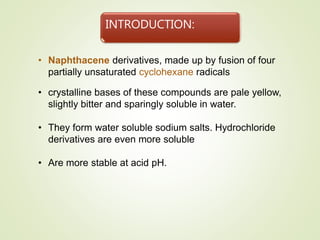
INTRODUCTION:
• Naphthacene derivatives, made up by fusion of four
partially unsaturated cyclohexane radicals
• crystalline bases of these compounds are pale yellow,
slightly bitter and sparingly soluble in water.
• They form water soluble sodium salts. Hydrochloride
derivatives are even more soluble
• Are more stable at acid pH.
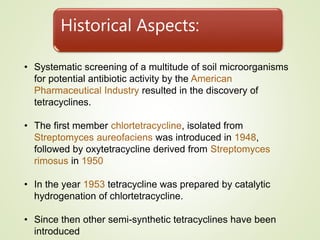
Historical Aspects:
• Systematic screening of a multitude of soil microorganisms
for potential antibiotic activity by the American
Pharmaceutical Industry resulted in the discovery of
tetracyclines.
• The first member chlortetracycline, isolated from
Streptomyces aureofaciens was introduced in 1948,
followed by oxytetracycline derived from Streptomyces
rimosus in 1950
• In the year 1953 tetracycline was prepared by catalytic
hydrogenation of chlortetracycline.
• Since then other semi-synthetic tetracyclines have been
introduced
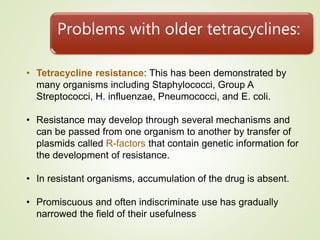
Problems with older tetracyclines:
• Tetracycline resistance: This has been demonstrated by
many organisms including Staphylococci, Group A
Streptococci, H. influenzae, Pneumococci, and E. coli.
• Resistance may develop through several mechanisms and
can be passed from one organism to another by transfer of
plasmids called R-factors that contain genetic information for
the development of resistance.
• In resistant organisms, accumulation of the drug is absent.
• Promiscuous and often indiscriminate use has gradually
narrowed the field of their usefulness
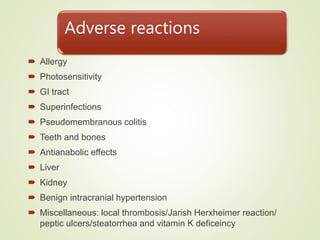
Adverse reactions
 Allergy
 Photosensitivity
 GI tract
 Superinfections
 Pseudomembranous colitis
 Teeth and bones
 Antianabolic effects
 Liver
 Kidney
 Benign intracranial hypertension
 Miscellaneous: local thrombosis/Jarish Herxheimer reaction/
peptic ulcers/steatorrhea and vitamin K deficeincy
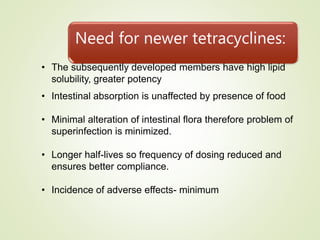
Need for newer tetracyclines:
• The subsequently developed members have high lipid
solubility, greater potency
• Intestinal absorption is unaffected by presence of food
• Minimal alteration of intestinal flora therefore problem of
superinfection is minimized.
• Longer half-lives so frequency of dosing reduced and
ensures better compliance.
• Incidence of adverse effects- minimum
Newer tetracycline in a nutshell:
Variant of
Tetracycline
Doxyxcycline Minocycline Demeclocycli
e
Tigecycline
Source: Semisynthetic Semisynthetic Streptomyces
Aurofeofacien
s
Synthetic
derivative of
Minocycline
Potency: High High(<minocy
cline)
Intermediate High
Intestinal
absorption(%):
95-100 95-100 60-80 Poor
Plasma protein
binding:
High High High Low
Elimination: Primarily
excreted fecally
as conjugates
Primarily
metabolized
with excretion
in urine and
bile
Partial
metabolisms
low renal
exctretion
Bile-80%
Urine-20%
Plasma T1/2(in
hrs):
18-24 18-24 16-18 37-67
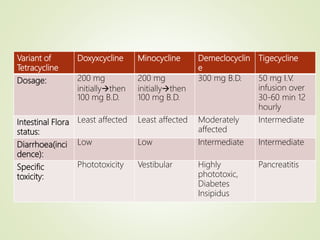
Variant of
Tetracycline
Doxyxcycline Minocycline Demeclocyclin
e
Tigecycline
Dosage: 200 mg
initiallythen
100 mg B.D.
200 mg
initiallythen
100 mg B.D.
300 mg B.D. 50 mg I.V.
infusion over
30-60 min 12
hourly
Intestinal Flora
status:
Least affected Least affected Moderately
affected
Intermediate
Diarrhoea(inci
dence):
Low Low Intermediate Intermediate
Specific
toxicity:
Phototoxicity Vestibular Highly
phototoxic,
Diabetes
Insipidus
Pancreatitis
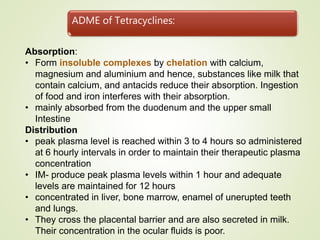
ADME of Tetracyclines:
Absorption:
• Form insoluble complexes by chelation with calcium,
magnesium and aluminium and hence, substances like milk that
contain calcium, and antacids reduce their absorption. Ingestion
of food and iron interferes with their absorption.
• mainly absorbed from the duodenum and the upper small
Intestine
Distribution
• peak plasma level is reached within 3 to 4 hours so administered
at 6 hourly intervals in order to maintain their therapeutic plasma
concentration
• IM- produce peak plasma levels within 1 hour and adequate
levels are maintained for 12 hours
• concentrated in liver, bone marrow, enamel of unerupted teeth
and lungs.
• They cross the placental barrier and are also secreted in milk.
Their concentration in the ocular fluids is poor.
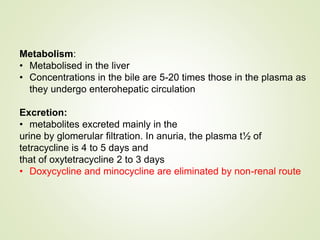
Metabolism:
• Metabolised in the liver
• Concentrations in the bile are 5-20 times those in the plasma as
they undergo enterohepatic circulation
Excretion:
• metabolites excreted mainly in the
urine by glomerular filtration. In anuria, the plasma t½ of
tetracycline is 4 to 5 days and
that of oxytetracycline 2 to 3 days
• Doxycycline and minocycline are eliminated by non-renal route
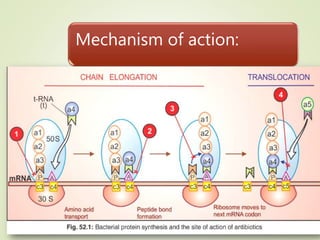
Mechanism of action:
Properties:
 Physical properties:
• The crystalline bases of these compounds are pale
yellow, slightly bitter and sparingly soluble in water.
• However, they form water soluble sodium salts.
• Tetracyclines are more stable at acid pH
Chemical properties and interactions:
•They are tetracene derivative and interacts with the other
compounds in the following ways:
oChelates bi/tri-valent ions like Ca2+,Mg2+,Fe3+,Zn2+,Al3+ and
and forms insoluble complexes milk and products, antacids
and cathartics containing ions with subsequent reduction in
bioavailability
oInterferes with bactericidal action of Penicillin
o Enzyme inducers like Phenytoin, carbamazepine,
barbiturates decreases the half life of tetracyclines.
oPotentiates anti-coagulant action of coumarin derivatives
like warfarin.
Uses:
I)Empirical:
• When nature and sensitivity of infecting organism is not known, in
cases of mixed infection. However in serious infections they are
avoided.
II) Drug of first choice in:
1.Venereal diseases:
a)Chlamydial nonspecific urethritis/endocervicitis
b)Lymphogranuloma venereum c) Granuloma inguinale
2.Atypical Pneumonia due to M.Pneumonia and psittacosis
3) Cholera
4)Brucellosis
Uses:
5) Plague
6) Relapsing fever
7)Rickettsia infections
III) Drug of second choice in place of:
1)penicillin/ampicillin for tetanus/anthrax/actinomycosis and
listeria infection
2) ceftriaxone, amoxicillin or azithromycin for gonorrhoea,
especially for penicillin resistant non-PPNG; also in patients allergic
to penicillin.
3)Ceftriaxone for syphilis in patients allergic to penicillin
4) Penicillin for leptospirosis; doxycycline 100 mg BD for 7 days is
curative. Weekly doxycycline (200 mg) as prophylaxis.
Uses:
5) Azithromycin for pneumonia due to Chlamydia pneumoniae
6) Ceftriaxone/azithromycin for chancroid
7) Streptomycin for tularemia
IV) Other infective conditions:
1) Urinary tract infections
2) Community-acquired pneumonia,
3) Amoebiasis
4) adjuvant to quinine or artesunate for chloroquine-resistant P.
falciparum malaria
5) Acne vulgaris
6) Propionibacterium acnes
7) Chronic obstructive lung disease
Conclusion:
 Tetracyclines are broad spectrum bacteriostatic antibiotics.
However in order to tackle the problems of drug resistance and
superinfection, highly judicious use is advocated limiting its use
to treat infections where highly selective and less toxic anti-
microbial agents are not available.
 Although with the availability of semi-synthetic and synthetic
derivatives the utility of tetracyclines has increased, however the
limitations still exists for e.g. when used in treatment of hospital
acquired/ventilator-associated chest infections, mortality was
found to be higher in a comparative trial,in tigecycline group than
in the comparator group.

Newer tetracyclines(12 7-18)

  • 1.
  • 2.
    INTRODUCTION: • Naphthacene derivatives,made up by fusion of four partially unsaturated cyclohexane radicals • crystalline bases of these compounds are pale yellow, slightly bitter and sparingly soluble in water. • They form water soluble sodium salts. Hydrochloride derivatives are even more soluble • Are more stable at acid pH.
  • 3.
    Historical Aspects: • Systematicscreening of a multitude of soil microorganisms for potential antibiotic activity by the American Pharmaceutical Industry resulted in the discovery of tetracyclines. • The first member chlortetracycline, isolated from Streptomyces aureofaciens was introduced in 1948, followed by oxytetracycline derived from Streptomyces rimosus in 1950 • In the year 1953 tetracycline was prepared by catalytic hydrogenation of chlortetracycline. • Since then other semi-synthetic tetracyclines have been introduced
  • 4.
    Problems with oldertetracyclines: • Tetracycline resistance: This has been demonstrated by many organisms including Staphylococci, Group A Streptococci, H. influenzae, Pneumococci, and E. coli. • Resistance may develop through several mechanisms and can be passed from one organism to another by transfer of plasmids called R-factors that contain genetic information for the development of resistance. • In resistant organisms, accumulation of the drug is absent. • Promiscuous and often indiscriminate use has gradually narrowed the field of their usefulness
  • 5.
    Adverse reactions  Allergy Photosensitivity  GI tract  Superinfections  Pseudomembranous colitis  Teeth and bones  Antianabolic effects  Liver  Kidney  Benign intracranial hypertension  Miscellaneous: local thrombosis/Jarish Herxheimer reaction/ peptic ulcers/steatorrhea and vitamin K deficeincy
  • 6.
    Need for newertetracyclines: • The subsequently developed members have high lipid solubility, greater potency • Intestinal absorption is unaffected by presence of food • Minimal alteration of intestinal flora therefore problem of superinfection is minimized. • Longer half-lives so frequency of dosing reduced and ensures better compliance. • Incidence of adverse effects- minimum
  • 7.
    Newer tetracycline ina nutshell: Variant of Tetracycline Doxyxcycline Minocycline Demeclocycli e Tigecycline Source: Semisynthetic Semisynthetic Streptomyces Aurofeofacien s Synthetic derivative of Minocycline Potency: High High(<minocy cline) Intermediate High Intestinal absorption(%): 95-100 95-100 60-80 Poor Plasma protein binding: High High High Low Elimination: Primarily excreted fecally as conjugates Primarily metabolized with excretion in urine and bile Partial metabolisms low renal exctretion Bile-80% Urine-20% Plasma T1/2(in hrs): 18-24 18-24 16-18 37-67
  • 8.
    Variant of Tetracycline Doxyxcycline MinocyclineDemeclocyclin e Tigecycline Dosage: 200 mg initiallythen 100 mg B.D. 200 mg initiallythen 100 mg B.D. 300 mg B.D. 50 mg I.V. infusion over 30-60 min 12 hourly Intestinal Flora status: Least affected Least affected Moderately affected Intermediate Diarrhoea(inci dence): Low Low Intermediate Intermediate Specific toxicity: Phototoxicity Vestibular Highly phototoxic, Diabetes Insipidus Pancreatitis
  • 9.
    ADME of Tetracyclines: Absorption: •Form insoluble complexes by chelation with calcium, magnesium and aluminium and hence, substances like milk that contain calcium, and antacids reduce their absorption. Ingestion of food and iron interferes with their absorption. • mainly absorbed from the duodenum and the upper small Intestine Distribution • peak plasma level is reached within 3 to 4 hours so administered at 6 hourly intervals in order to maintain their therapeutic plasma concentration • IM- produce peak plasma levels within 1 hour and adequate levels are maintained for 12 hours • concentrated in liver, bone marrow, enamel of unerupted teeth and lungs. • They cross the placental barrier and are also secreted in milk. Their concentration in the ocular fluids is poor.
  • 10.
    Metabolism: • Metabolised inthe liver • Concentrations in the bile are 5-20 times those in the plasma as they undergo enterohepatic circulation Excretion: • metabolites excreted mainly in the urine by glomerular filtration. In anuria, the plasma t½ of tetracycline is 4 to 5 days and that of oxytetracycline 2 to 3 days • Doxycycline and minocycline are eliminated by non-renal route
  • 11.
  • 12.
    Properties:  Physical properties: •The crystalline bases of these compounds are pale yellow, slightly bitter and sparingly soluble in water. • However, they form water soluble sodium salts. • Tetracyclines are more stable at acid pH
  • 13.
    Chemical properties andinteractions: •They are tetracene derivative and interacts with the other compounds in the following ways: oChelates bi/tri-valent ions like Ca2+,Mg2+,Fe3+,Zn2+,Al3+ and and forms insoluble complexes milk and products, antacids and cathartics containing ions with subsequent reduction in bioavailability oInterferes with bactericidal action of Penicillin o Enzyme inducers like Phenytoin, carbamazepine, barbiturates decreases the half life of tetracyclines. oPotentiates anti-coagulant action of coumarin derivatives like warfarin.
  • 14.
    Uses: I)Empirical: • When natureand sensitivity of infecting organism is not known, in cases of mixed infection. However in serious infections they are avoided. II) Drug of first choice in: 1.Venereal diseases: a)Chlamydial nonspecific urethritis/endocervicitis b)Lymphogranuloma venereum c) Granuloma inguinale 2.Atypical Pneumonia due to M.Pneumonia and psittacosis 3) Cholera 4)Brucellosis
  • 15.
    Uses: 5) Plague 6) Relapsingfever 7)Rickettsia infections III) Drug of second choice in place of: 1)penicillin/ampicillin for tetanus/anthrax/actinomycosis and listeria infection 2) ceftriaxone, amoxicillin or azithromycin for gonorrhoea, especially for penicillin resistant non-PPNG; also in patients allergic to penicillin. 3)Ceftriaxone for syphilis in patients allergic to penicillin 4) Penicillin for leptospirosis; doxycycline 100 mg BD for 7 days is curative. Weekly doxycycline (200 mg) as prophylaxis.
  • 16.
    Uses: 5) Azithromycin forpneumonia due to Chlamydia pneumoniae 6) Ceftriaxone/azithromycin for chancroid 7) Streptomycin for tularemia IV) Other infective conditions: 1) Urinary tract infections 2) Community-acquired pneumonia, 3) Amoebiasis 4) adjuvant to quinine or artesunate for chloroquine-resistant P. falciparum malaria 5) Acne vulgaris 6) Propionibacterium acnes 7) Chronic obstructive lung disease
  • 17.
    Conclusion:  Tetracyclines arebroad spectrum bacteriostatic antibiotics. However in order to tackle the problems of drug resistance and superinfection, highly judicious use is advocated limiting its use to treat infections where highly selective and less toxic anti- microbial agents are not available.  Although with the availability of semi-synthetic and synthetic derivatives the utility of tetracyclines has increased, however the limitations still exists for e.g. when used in treatment of hospital acquired/ventilator-associated chest infections, mortality was found to be higher in a comparative trial,in tigecycline group than in the comparator group.

Editor's Notes

  • #6 • Allergy: Skin rashestopical application -Photosensitivity marked erythema ,vesicular exanthema. A brown-black discolouration of nails /marked loosening • GI tract: Nausea, vomiting, epigastric distress and loose stools.Nausea and vomiting may be prevented by taking these drugs after meals. Mild diarrhoea appears to be dose-dependent and is more common following daily doses over 2 g. Diarrhoea secondary to irritation is not accompanied by RBCs or pus cells in feces, and can thus be differentiated from serious diarrhoea secondary to GI superinfection. • Superinfection: Suppression of the normal intestinal flora with resultant superinfection is liable to occur after prolonged tetracycline therapy, particularly in patients with diabetes mellitus, leukemia or leucopenia and in those on steroid therapy. -Infection with Candida albicans is especially common and may cause diarrhoea or soft, bulky, odourless stools, soreness and redness of the mouth (thrush), glossitis, black hairy tongue and inflammatory lesions of the vulva, vagina and perianal region causing pruritus. Nystatin is effective locally in oropharyngeal, vaginal and perineal lesions. -Superinfection with resistant S. aureus occurs more frequently in hospitalised patients. Serious staphylococcal enteritis is heralded by sudden loss of appetite, abdominal discomfort, distension and a profuse watery diarrhoea; the stools show the presence of blood. It carries a mortality rate of 40%. Immediate stoppage of tetracyclines, institution of appropriate antibiotic therapy and correction of dehydration and electrolyte imbalance are recommended. -Pseudomembranous colitis characterised by profuse diarrhoea and fever may occur due to superinfection with Clostridium difficile. The stools contain shreds of mucous membrane and blood. • Teeth and bones: Tetracyclines chelate calcium, forming a tetracycline-orthophosphate complex and are deposited in areas of calcification in bones and teeth. Administration of these antibiotics to pregnant women may lead to yellow staining of the teeth of the infant; defective formation of enamel and hypoplasia of the teeth may also occur. -Pigmentation of permanent teeth and increased risk of caries may occur in children. -Even a short course given after the 14th week of pregnancy can be damaging. Tetracyclines administered during pregnancy are deposited in foetal bones and may reduce their linear growth. They should also be avoided in infants and in children upto the age of 12 years. They are also deposited in nails, which may cause nails to fluoresce. • Antianabolic effect: • Liver: Fatal hepatic dysfunction with pancreatitis may occur in patients receiving large doses of tetracyclines over short periods, particularly by IV route. Such patients develop jaundice, azotemia and coma. Pregnancy, hepatic damage, renal impairment and concurrent use of other hepatotoxic drugs may enhance the hepatotoxic action. • Kidney: In patients with significant renal impairment, tetracyclines may cause an aggravation of azotemia and exaggerated antianabolic effect. A reversible ‘Fanconi-like’ syndrome, characterised by nausea, vomiting, proteinuria, glycosuria, acidosis and aminoaciduria may develop after ingestion of outdated tetracycline capsules. It is attributed to a degradation product, epianhydrotetracyclinechange of colour from yellow to brown. • Benign intracranial hypertension: Some patients may develop increased intracranial pressure. This causes bulging of the anterior fontanelle in infants and headache, photophobia and papilloedema in adults. • Miscellaneous: IV tetracyclines may cause local thrombosis. -Jarish-Herxheimer reaction has been reported very rarely following IV tetracycline. It is characterised by sudden rise of temperature, rigors, hypertension, hyperventilation and tachycardia, followed by hypotension. -Uremic patients may develop peptic ulcers. Tetracyclines have been observed to inhibit urease of gastric mucosa which breaks down urea into ammonia. Ammonia serves to reduce gastric acidity and hence, lowering of ammonia concentration by tetracyclines may lead to hyperacidity with ulceration. Steatorrhea and deficiency of vitamin K may occur after prolonged tetracycline therapy
  • #7 Chlortetracycline, Methacycline, Rolitetracycline, Lymecycline are no longer commercially available
  • #8 -Doxycycline: children more than 8 years of age, the dose is 4.4 mg/kg/d in two divided doses the first day, then 2.2 mg/kg given once or twice daily. -Demeclocycline aka Demethylchlorotetracycline: Diabetes insipidus through ADH antagonism -Tigecycline: intestinal absorption is poor so given only IV as infusionlow plasma protein binding with high volume of distribution(7 l/kg) Bile eliminated so dose need not be adjusted in renal failure
  • #9 The glycyclamide moiety confers ability to overcome resistance Tigecycline: no activity against pseudomonas/ providencia/ proteus $:Stenotrophomonas and Ureaplasma: where other tetracycline are more effective than tigecycline Doxycycline: least hepatotoxic
  • #11 Special uses: 1) irritative effect of tetracyclines has been used therapeutically in patients with malignant pleural effusions
  • #12 The messenger RNA (mRNA) attaches to the 30S ribosome. The initiation complex of mRNA starts protein synthesis and polysome formation. The nascent peptide chain is attached to the peptidyl (P) site of the 50S ribosome. The next amino acid (a) is transported to the acceptor (A) site of the ribosome by its specific tRNA which is complementary to the base sequence of the next mRNA codon (C). The nascent peptide chain is transferred to the newly attached amino acid by peptide bond formation. The elongated peptide chain is shifted back from the ‘A’ to the ‘P’ site and the ribosome moves along the mRNA to expose the next codon for amino acid attachment. Finally the process is terminated by the termination complex and the protein is released. (1) Aminoglycosides bind to several sites at 30S and 50S subunits as well as to their interface—freeze initiation, interfere with polysome formation and cause misreading of mRNA code. (2) Tetracyclines bind to 30S ribosome and inhibit aminoacyl tRNA attachment to the ‘A’ site. (3) Chloramphenicol binds to 50S subunit—interferes with peptide bond formation and transfer of peptide chain from ‘P’site. (4) Erythromycin and clindamycin also bind to 50S ribosome and hinder translocation of the elongated peptide chain back from ‘A’ site to ‘P’ site and the ribosome does not move along the mRNA to expose the next codon. Peptide synthesis may be prematurely terminated
  • #13 Fanconi syndrome: (characterized by nausea, vomiting, polyuria, polydipsia, proteinuria, acidosis, glycosuria, and aminoaciduria. Fanconis anemia: genetic disorder/BM failure/birth defects(arms and thumbs/ears/eyes)+CHD/kidney/skin discoloration