Critical Appraisal of A Journal
Article
Dr. Shakeeb Dhorajiwala,
MBBS, MD. Pharmacology, DM 1st year resident- Department Of Clinical Pharmacology
Former Scientist B in project “Covishield”,
Presentation for: Dept. of Clinical Pharmacology, Seth GSMC & KEM hospital, Parel, Mumbai.
Link to the article
https://s.docworkspace.com/d/AAHGiCOfprJbqaG2_OedFA
• Disclaimer: For Educational Purpose only (non-commercial use)
11-02-2021 2
Introduction(1/5)
Major depressive disorder widespread debilitating illness.
Prevalence: 300 million1
High rate of :
• medical,
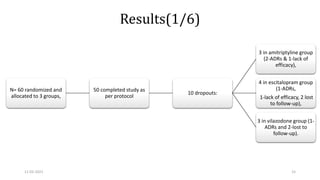
• psychiatric co-morbidity,
• functional impairment
• Personal and societal cost
F:M= 1.5:1
Leading cause of disability in both
11-02-2021
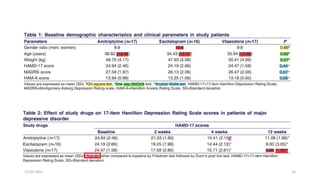
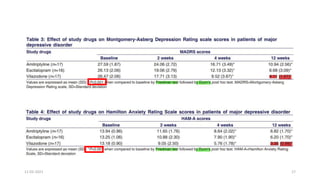
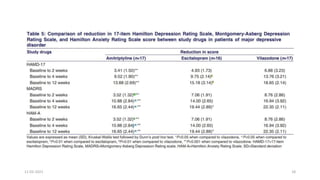
1. Murray CJ, Vos T, Lozano R, Naghavi M, Flaxman AD, Michaud C,et al. Disability-adjusted life years (DALYs) for 291 diseases
andinjuries in 21 regions, 1990-2010: A systematic analysis for the global burden of disease study 2010. Lancet
2012;380:2197-223
3
Cont’d(2/5)
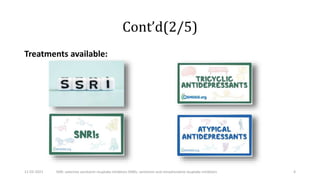
Treatments available:
11-02-2021 SSRI: selective serotonin reuptake inhibitors SNRIs: serotonin and noradrenaline reuptake inhibitors 4
Limitations of existing treatment(3/5)
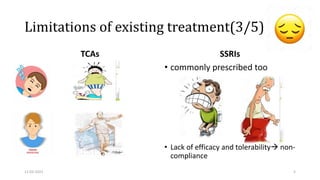
TCAs SSRIs
• commonly prescribed too
• Lack of efficacy and tolerability non-
compliance
11-02-2021 5
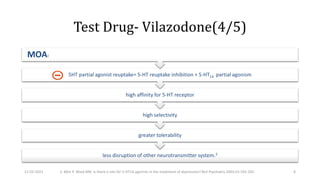
Test Drug- Vilazodone(4/5)
less disruption of other neurotransmitter system.2
greater tolerability
high selectivity
high affinity for 5-HT receptor
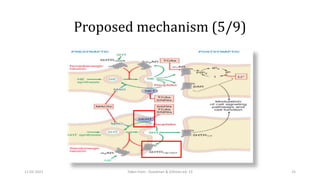
5HT partial agonist reuptake= 5-HT reuptake inhibition + 5-HT1A partial agonism
MOA:
11-02-2021 2. Blier P, Ward NM. Is there a role for 5-HT1A agonists in the treatment of depression? Biol Psychiatry 2003;53:193-203. 6
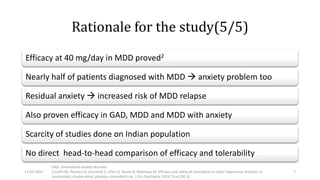
Rationale for the study(5/5)
Efficacy at 40 mg/day in MDD proved2
Nearly half of patients diagnosed with MDD  anxiety problem too
Residual anxiety  increased risk of MDD relapse
Also proven efficacy in GAD, MDD and MDD with anxiety
Scarcity of studies done on Indian population
No direct head-to-head comparison of efficacy and tolerability
11-02-2021
GAD: Generalized anxiety disorder
2.Croft HA, Pomara N, Gommoll C, Chen D, Nunez R, Mathews M. Efficacy and safety of vilazodone in major depressive disorder: A
randomized, double-blind, placebo-controlled trial. J Clin Psychiatry 2014;75:e1291-8.
7
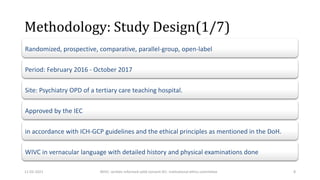
Methodology: Study Design(1/7)
Randomized, prospective, comparative, parallel-group, open-label
Period: February 2016 - October 2017
Site: Psychiatry OPD of a tertiary care teaching hospital.
Approved by the IEC
in accordance with ICH-GCP guidelines and the ethical principles as mentioned in the DoH.
WIVC in vernacular language with detailed history and physical examinations done
11-02-2021 WIVC: written informed valid consent IEC: institutional ethics committee 8
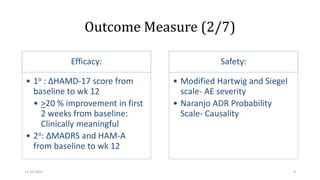
Outcome Measure (2/7)
Efficacy:
• 1o : ΔHAMD-17 score from
baseline to wk 12
• >20 % improvement in first
2 weeks from baseline:
Clinically meaningful
• 2o: ΔMADRS and HAM-A
from baseline to wk 12
Safety:
• Modified Hartwig and Siegel
scale- AE severity
• Naranjo ADR Probability
Scale- Causality
11-02-2021 9
Cont’d(3/7)
f/u visits: 2, 4 and 12 weeks
Compliance was assessed by empty blister packets
Rescue management:
• i/c/o no response or worsening: withdrawal from study with
subsequent psychiatric care
No post-trial access
11-02-2021 10
Selection Criteria (4/7)
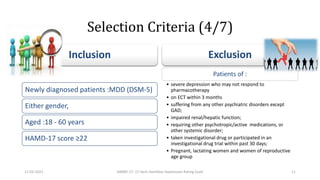
Inclusion
Newly diagnosed patients :MDD (DSM-5)
Either gender,
Aged :18 - 60 years
HAMD-17 score ≥22
Exclusion
Patients of :
• severe depression who may not respond to
pharmacotherapy
• on ECT within 3 months
• suffering from any other psychiatric disorders except
GAD;
• impaired renal/hepatic function;
• requiring other psychotropic/active medications, or
other systemic disorder;
• taken investigational drug or participated in an
investigational drug trial within past 30 days;
• Pregnant, lactating women and women of reproductive
age group
11-02-2021 HAMD-17: 17-item Hamilton Depression Rating Scale 11
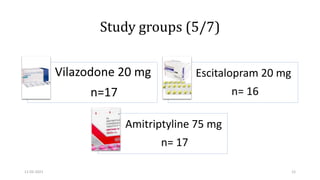
Study groups (5/7)
Vilazodone 20 mg
n=17
Escitalopram 20 mg
n= 16
Amitriptyline 75 mg
n= 17
11-02-2021 12
Statistical Analysis (6/7)
sample size calculated based on change in HAMD score from baseline to week 12 and standard
deviation (SD) = 10.38 from previous studies,
α = 5% and 1-β= 80%.
required sample size : 20/ group with dropout rate of 20%,
Power and Sample Size Calculation software version 3.0.43
Categorical data: Chi-square test
11-02-2021 13
Statistics cont’d (7/7)
continuous variables: one-way ANOVA
1o and 2o efficacy parameters analyzed by Friedman test  Dunn’s test: within-group comparison at
different follow-up visits
Kruskal–Wallis test  Dunn’s test : between groups comparison.
P < 0.05 :statistically significant.
GraphPad Prism version 5.01 (GraphPad software Inc., California, USA) for analysis.
11-02-2021 14
Results(1/6)
N= 60 randomized and
allocated to 3 groups,
50 completed study as
per protocol
10 dropouts:
3 in amitriptyline group
(2-ADRs & 1-lack of
efficacy),
4 in escitalopram group
(1-ADRs,
1-lack of efficacy, 2 lost
to follow-up),
3 in vilazodone group (1-
ADRs and 2-lost to
follow-up).
11-02-2021 15
11-02-2021 16
11-02-2021 17
11-02-2021 18
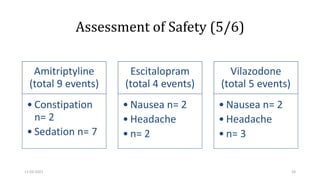
Assessment of Safety (5/6)
Amitriptyline
(total 9 events)
• Constipation
n= 2
• Sedation n= 7
Escitalopram
(total 4 events)
• Nausea n= 2
• Headache
• n= 2
Vilazodone
(total 5 events)
• Nausea n= 2
• Headache
• n= 3
11-02-2021 19
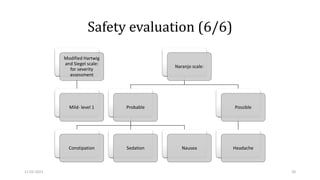
Safety evaluation (6/6)
Modified Hartwig
and Siegel scale:
for severity
assessment
Mild- level 1
Naranjo scale:
Probable
Constipation Sedation Nausea
Possible
Headache
11-02-2021 20
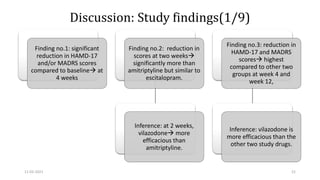
Discussion: Study findings(1/9)
11-02-2021 21
Finding no.1: significant
reduction in HAMD-17
and/or MADRS scores
compared to baseline at
4 weeks
Finding no.2: reduction in
scores at two weeks
significantly more than
amitriptyline but similar to
escitalopram.
Inference: at 2 weeks,
vilazodone more
efficacious than
amitriptyline.
Finding no.3: reduction in
HAMD-17 and MADRS
scores highest
compared to other two
groups at week 4 and
week 12,
Inference: vilazodone is
more efficacious than the
other two study drugs.
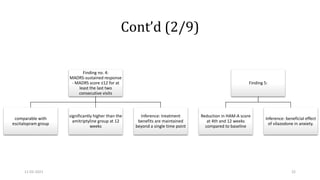
Cont’d (2/9)
Finding no. 4:
MADRS-sustained response
- MADRS score ≤12 for at
least the last two
consecutive visits
comparable with
escitalopram group
significantly higher than the
amitriptyline group at 12
weeks
Inference: treatment
benefits are maintained
beyond a single time point
Finding 5:
Reduction in HAM-A score
at 4th and 12 weeks
compared to baseline
Inference: beneficial effect
of vilazodone in anxiety.
11-02-2021 22
What other studies showed(3/9)
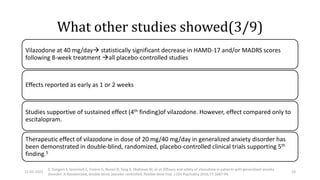
Vilazodone at 40 mg/day statistically significant decrease in HAMD-17 and/or MADRS scores
following 8-week treatment all placebo-controlled studies
Effects reported as early as 1 or 2 weeks
Studies supportive of sustained effect (4th finding)of vilazodone. However, effect compared only to
escitalopram.
Therapeutic effect of vilazodone in dose of 20 mg/40 mg/day in generalized anxiety disorder has
been demonstrated in double-blind, randomized, placebo-controlled clinical trials supporting 5th
finding.5
11-02-2021
5. Durgam S, Gommoll C, Forero G, Nunez R, Tang X, Mathews M, et al. Efficacy and safety of vilazodone in patients with generalized anxiety
disorder: A Randomized, double-blind, placebo-controlled, flexible-dose trial. J Clin Psychiatry 2016;77:1687-94.
23
Justification for Dose Selection(4/9)
studies comparing
doses of 20 mg and
40 mg/day reported-
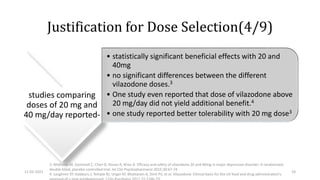
• statistically significant beneficial effects with 20 and
40mg
• no significant differences between the different
vilazodone doses.3
• One study even reported that dose of vilazodone above
20 mg/day did not yield additional benefit.4
• one study reported better tolerability with 20 mg dose3
11-02-2021
3. Mathews M, Gommoll C, Chen D, Nunez R, Khan A. Efficacy and safety of vilazodone 20 and 40mg in major depressive disorder: A randomized,
double-blind, placebo-controlled trial. Int Clin Psychopharmacol 2015;30:67-74
4. Laughren TP, Gobburu J, Temple RJ, Unger EF, Bhattaram A, Dinh PV, et al. Vilazodone: Clinical basis for the US food and drug administration’s
24
Proposed mechanism (5/9)
11-02-2021 Taken from : Goodman & Gillman ed. 13 25
Evaluation of Safety Profile (6/9)
Adverse effects with antidepressant drugs are common
negatively impact patient outcomes.
vilazodone (29.41%) and escitalopram (25%) groups comparable
amitriptyline group (52.94%) significantly higher
Intolerability to medication is one of the most common reasons of discontinuation of antidepressant
treatment.[29]
Constipation and sedation were major adverse events
11-02-2021 26
Cont’d (7/9)
Nausea and headache major adverse events in escitalopram and vilazodone
groups.
GI s/e of mild severity and transient.
Sexual dysfunction is a common adverse effect of SSRIs which are currently the
most commonly used antidepressants.[4]
Sexual dysfunction as a s/e reported by none.
11-02-2021 27
Limitations (8/9)
open-label study
small sample size restricts generalizability of study
results
Third, assessing adverse effects on sexual functions
difficult since they did not use any measurable criteria
11-02-2021 28
Conclusion (9/9)
Although results
of their study
show that
vilazodone is
more efficacious
antidepressant
compared to
escitalopram
and
amitriptyline:
• small sample size of this study does not allow
generalization of results
• High cost of vilazodone another hindrance
• Hence, they suggested that vilazodone be
considered as a treatment option in selected
group of MDD patients with coexisting anxiety not
responding satisfactorily to standard drugs.
• However, even this needs to be substantiated by
large-scale studies with larger sample size and
having an active comparator group.
11-02-2021 29

For slideshare How to Critically-Appraise a Journal Article

  • 1.
    Critical Appraisal ofA Journal Article Dr. Shakeeb Dhorajiwala, MBBS, MD. Pharmacology, DM 1st year resident- Department Of Clinical Pharmacology Former Scientist B in project “Covishield”, Presentation for: Dept. of Clinical Pharmacology, Seth GSMC & KEM hospital, Parel, Mumbai.
  • 2.
    Link to thearticle https://s.docworkspace.com/d/AAHGiCOfprJbqaG2_OedFA • Disclaimer: For Educational Purpose only (non-commercial use) 11-02-2021 2
  • 3.
    Introduction(1/5) Major depressive disorderwidespread debilitating illness. Prevalence: 300 million1 High rate of : • medical, • psychiatric co-morbidity, • functional impairment • Personal and societal cost F:M= 1.5:1 Leading cause of disability in both 11-02-2021 1. Murray CJ, Vos T, Lozano R, Naghavi M, Flaxman AD, Michaud C,et al. Disability-adjusted life years (DALYs) for 291 diseases andinjuries in 21 regions, 1990-2010: A systematic analysis for the global burden of disease study 2010. Lancet 2012;380:2197-223 3
  • 4.
    Cont’d(2/5) Treatments available: 11-02-2021 SSRI:selective serotonin reuptake inhibitors SNRIs: serotonin and noradrenaline reuptake inhibitors 4
  • 5.
    Limitations of existingtreatment(3/5) TCAs SSRIs • commonly prescribed too • Lack of efficacy and tolerability non- compliance 11-02-2021 5
  • 6.
    Test Drug- Vilazodone(4/5) lessdisruption of other neurotransmitter system.2 greater tolerability high selectivity high affinity for 5-HT receptor 5HT partial agonist reuptake= 5-HT reuptake inhibition + 5-HT1A partial agonism MOA: 11-02-2021 2. Blier P, Ward NM. Is there a role for 5-HT1A agonists in the treatment of depression? Biol Psychiatry 2003;53:193-203. 6
  • 7.
    Rationale for thestudy(5/5) Efficacy at 40 mg/day in MDD proved2 Nearly half of patients diagnosed with MDD  anxiety problem too Residual anxiety  increased risk of MDD relapse Also proven efficacy in GAD, MDD and MDD with anxiety Scarcity of studies done on Indian population No direct head-to-head comparison of efficacy and tolerability 11-02-2021 GAD: Generalized anxiety disorder 2.Croft HA, Pomara N, Gommoll C, Chen D, Nunez R, Mathews M. Efficacy and safety of vilazodone in major depressive disorder: A randomized, double-blind, placebo-controlled trial. J Clin Psychiatry 2014;75:e1291-8. 7
  • 8.
    Methodology: Study Design(1/7) Randomized,prospective, comparative, parallel-group, open-label Period: February 2016 - October 2017 Site: Psychiatry OPD of a tertiary care teaching hospital. Approved by the IEC in accordance with ICH-GCP guidelines and the ethical principles as mentioned in the DoH. WIVC in vernacular language with detailed history and physical examinations done 11-02-2021 WIVC: written informed valid consent IEC: institutional ethics committee 8
  • 9.
    Outcome Measure (2/7) Efficacy: •1o : ΔHAMD-17 score from baseline to wk 12 • >20 % improvement in first 2 weeks from baseline: Clinically meaningful • 2o: ΔMADRS and HAM-A from baseline to wk 12 Safety: • Modified Hartwig and Siegel scale- AE severity • Naranjo ADR Probability Scale- Causality 11-02-2021 9
  • 10.
    Cont’d(3/7) f/u visits: 2,4 and 12 weeks Compliance was assessed by empty blister packets Rescue management: • i/c/o no response or worsening: withdrawal from study with subsequent psychiatric care No post-trial access 11-02-2021 10
  • 11.
    Selection Criteria (4/7) Inclusion Newlydiagnosed patients :MDD (DSM-5) Either gender, Aged :18 - 60 years HAMD-17 score ≥22 Exclusion Patients of : • severe depression who may not respond to pharmacotherapy • on ECT within 3 months • suffering from any other psychiatric disorders except GAD; • impaired renal/hepatic function; • requiring other psychotropic/active medications, or other systemic disorder; • taken investigational drug or participated in an investigational drug trial within past 30 days; • Pregnant, lactating women and women of reproductive age group 11-02-2021 HAMD-17: 17-item Hamilton Depression Rating Scale 11
  • 12.
    Study groups (5/7) Vilazodone20 mg n=17 Escitalopram 20 mg n= 16 Amitriptyline 75 mg n= 17 11-02-2021 12
  • 13.
    Statistical Analysis (6/7) samplesize calculated based on change in HAMD score from baseline to week 12 and standard deviation (SD) = 10.38 from previous studies, α = 5% and 1-β= 80%. required sample size : 20/ group with dropout rate of 20%, Power and Sample Size Calculation software version 3.0.43 Categorical data: Chi-square test 11-02-2021 13
  • 14.
    Statistics cont’d (7/7) continuousvariables: one-way ANOVA 1o and 2o efficacy parameters analyzed by Friedman test  Dunn’s test: within-group comparison at different follow-up visits Kruskal–Wallis test  Dunn’s test : between groups comparison. P < 0.05 :statistically significant. GraphPad Prism version 5.01 (GraphPad software Inc., California, USA) for analysis. 11-02-2021 14
  • 15.
    Results(1/6) N= 60 randomizedand allocated to 3 groups, 50 completed study as per protocol 10 dropouts: 3 in amitriptyline group (2-ADRs & 1-lack of efficacy), 4 in escitalopram group (1-ADRs, 1-lack of efficacy, 2 lost to follow-up), 3 in vilazodone group (1- ADRs and 2-lost to follow-up). 11-02-2021 15
  • 16.
  • 17.
  • 18.
  • 19.
    Assessment of Safety(5/6) Amitriptyline (total 9 events) • Constipation n= 2 • Sedation n= 7 Escitalopram (total 4 events) • Nausea n= 2 • Headache • n= 2 Vilazodone (total 5 events) • Nausea n= 2 • Headache • n= 3 11-02-2021 19
  • 20.
    Safety evaluation (6/6) ModifiedHartwig and Siegel scale: for severity assessment Mild- level 1 Naranjo scale: Probable Constipation Sedation Nausea Possible Headache 11-02-2021 20
  • 21.
    Discussion: Study findings(1/9) 11-02-202121 Finding no.1: significant reduction in HAMD-17 and/or MADRS scores compared to baseline at 4 weeks Finding no.2: reduction in scores at two weeks significantly more than amitriptyline but similar to escitalopram. Inference: at 2 weeks, vilazodone more efficacious than amitriptyline. Finding no.3: reduction in HAMD-17 and MADRS scores highest compared to other two groups at week 4 and week 12, Inference: vilazodone is more efficacious than the other two study drugs.
  • 22.
    Cont’d (2/9) Finding no.4: MADRS-sustained response - MADRS score ≤12 for at least the last two consecutive visits comparable with escitalopram group significantly higher than the amitriptyline group at 12 weeks Inference: treatment benefits are maintained beyond a single time point Finding 5: Reduction in HAM-A score at 4th and 12 weeks compared to baseline Inference: beneficial effect of vilazodone in anxiety. 11-02-2021 22
  • 23.
    What other studiesshowed(3/9) Vilazodone at 40 mg/day statistically significant decrease in HAMD-17 and/or MADRS scores following 8-week treatment all placebo-controlled studies Effects reported as early as 1 or 2 weeks Studies supportive of sustained effect (4th finding)of vilazodone. However, effect compared only to escitalopram. Therapeutic effect of vilazodone in dose of 20 mg/40 mg/day in generalized anxiety disorder has been demonstrated in double-blind, randomized, placebo-controlled clinical trials supporting 5th finding.5 11-02-2021 5. Durgam S, Gommoll C, Forero G, Nunez R, Tang X, Mathews M, et al. Efficacy and safety of vilazodone in patients with generalized anxiety disorder: A Randomized, double-blind, placebo-controlled, flexible-dose trial. J Clin Psychiatry 2016;77:1687-94. 23
  • 24.
    Justification for DoseSelection(4/9) studies comparing doses of 20 mg and 40 mg/day reported- • statistically significant beneficial effects with 20 and 40mg • no significant differences between the different vilazodone doses.3 • One study even reported that dose of vilazodone above 20 mg/day did not yield additional benefit.4 • one study reported better tolerability with 20 mg dose3 11-02-2021 3. Mathews M, Gommoll C, Chen D, Nunez R, Khan A. Efficacy and safety of vilazodone 20 and 40mg in major depressive disorder: A randomized, double-blind, placebo-controlled trial. Int Clin Psychopharmacol 2015;30:67-74 4. Laughren TP, Gobburu J, Temple RJ, Unger EF, Bhattaram A, Dinh PV, et al. Vilazodone: Clinical basis for the US food and drug administration’s 24
  • 25.
    Proposed mechanism (5/9) 11-02-2021Taken from : Goodman & Gillman ed. 13 25
  • 26.
    Evaluation of SafetyProfile (6/9) Adverse effects with antidepressant drugs are common negatively impact patient outcomes. vilazodone (29.41%) and escitalopram (25%) groups comparable amitriptyline group (52.94%) significantly higher Intolerability to medication is one of the most common reasons of discontinuation of antidepressant treatment.[29] Constipation and sedation were major adverse events 11-02-2021 26
  • 27.
    Cont’d (7/9) Nausea andheadache major adverse events in escitalopram and vilazodone groups. GI s/e of mild severity and transient. Sexual dysfunction is a common adverse effect of SSRIs which are currently the most commonly used antidepressants.[4] Sexual dysfunction as a s/e reported by none. 11-02-2021 27
  • 28.
    Limitations (8/9) open-label study smallsample size restricts generalizability of study results Third, assessing adverse effects on sexual functions difficult since they did not use any measurable criteria 11-02-2021 28
  • 29.
    Conclusion (9/9) Although results oftheir study show that vilazodone is more efficacious antidepressant compared to escitalopram and amitriptyline: • small sample size of this study does not allow generalization of results • High cost of vilazodone another hindrance • Hence, they suggested that vilazodone be considered as a treatment option in selected group of MDD patients with coexisting anxiety not responding satisfactorily to standard drugs. • However, even this needs to be substantiated by large-scale studies with larger sample size and having an active comparator group. 11-02-2021 29

Editor's Notes

  • #6 TCA: slow onset- upto 1 month Only 2/3 improve and 1/3 remit
  • #10 MADRS: Montgomery Asberg Depression rating scale Hamilton anxiety & depression rating scale
  • #16 Analysis: Per protocol