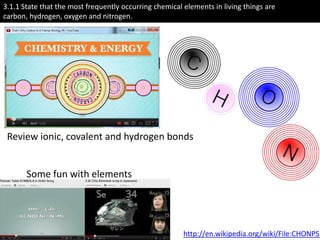
3.1.1 State that the most frequently occurring chemical elements in living things are
carbon, hydrogen, oxygen and nitrogen.


 Review ionic, covalent and hydrogen bonds


       Some fun with elements


                                                        http://en.wikipedia.org/wiki/File:CHONPS.
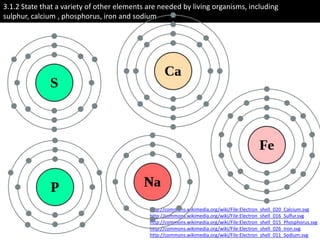
3.1.2 State that a variety of other elements are needed by living organisms, including
sulphur, calcium , phosphorus, iron and sodium


                                             http://commons.wikimedia.org/wiki/File:Electron_shell_020_Calcium.svg
                                             http://commons.wikimedia.org/wiki/File:Electron_shell_016_Sulfur.svg
                                             http://commons.wikimedia.org/wiki/File:Electron_shell_015_Phosphorus.svg
                                             http://commons.wikimedia.org/wiki/File:Electron_shell_026_Iron.svg
                                             http://commons.wikimedia.org/wiki/File:Electron_shell_011_Sodium.svg
http://www.flickr.com/photos/csb13/1873194745/
3.1.3 State one role for each of the elements


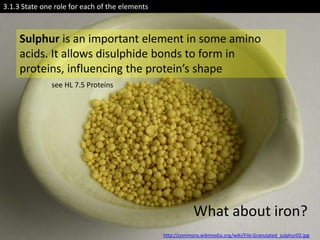
     Sulphur is an important element in some amino
     acids. It allows disulphide bonds to form in
     proteins, influencing the protein’s shape
               see HL 7.5 Proteins


                                                             What about iron?
                                                http://commons.wikimedia.org/wiki/File:Granulated_sulphur02.jpg
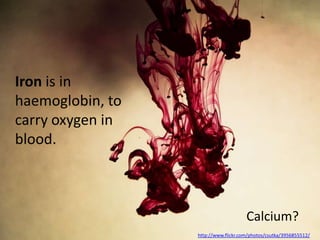
Iron is in
haemoglobin, to
carry oxygen in
blood.


                                      Calcium?
                  http://www.flickr.com/photos/csutka/3956855512/
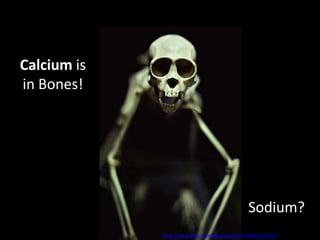
Calcium is
in Bones!


                                                Sodium?
             http://www.flickr.com/photos/mugley/3491817141/
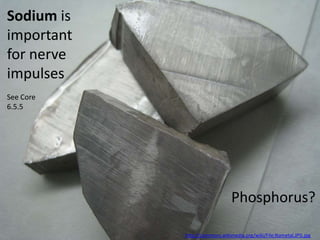
Sodium is
important
for nerve
impulses
See Core
6.5.5


                               Phosphorus?

            http://commons.wikimedia.org/wiki/File:Nametal.JPG.jpg
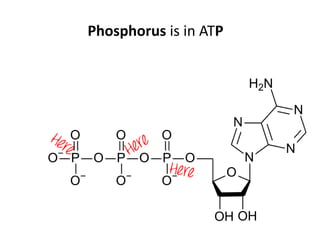
Phosphorus is in ATP
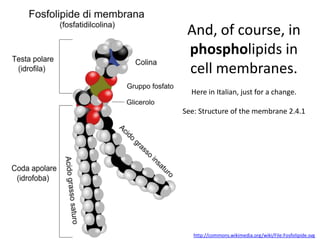
And, of course, in
 phospholipids in
 cell membranes.
  Here in Italian, just for a change.

See: Structure of the membrane 2.4.1


   http://commons.wikimedia.org/wiki/File:Fosfolipide.svg
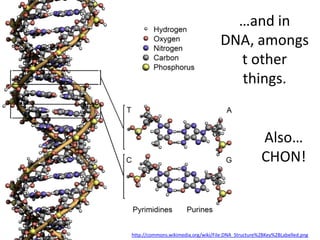
…and in
                                    DNA, amongs
                                      t other
                                      things.


                                                     Also…
                                                     CHON!


http://commons.wikimedia.org/wiki/File:DNA_Structure%2BKey%2BLabelled.png
3.1.4 Draw and label a diagram showing the structure of water molecules to show their polarity
and hydrogen bond formation.


      Water is a weird and
      freaky substance.

      It is this way because
      of its polar nature.


                                       http://commons.wikimedia.org/wiki/File:Water_drop_animation_enhanced_small.gif
No,
that kind
      http://commons.wikimedia.org/wiki/File:Eisb%C3%A4r_1996-07-23.jpg
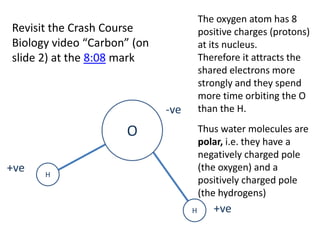
The oxygen atom has 8
Revisit the Crash Course               positive charges (protons)
Biology video “Carbon” (on             at its nucleus.
slide 2) at the 8:08 mark              Therefore it attracts the
                                       shared electrons more
                                       strongly and they spend
                                       more time orbiting the O
                             -ve       than the H.

                     O                 Thus water molecules are
                                       polar, i.e. they have a
                                       negatively charged pole
+ve   H
                                       (the oxygen) and a
                                       positively charged pole
                                       (the hydrogens)
                                   H      +ve
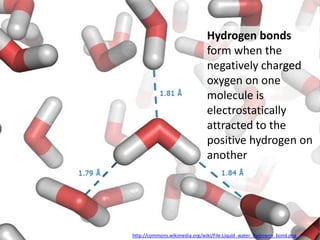
Hydrogen bonds
                               form when the
                               negatively charged
                               oxygen on one
                               molecule is
                               electrostatically
                               attracted to the
                               positive hydrogen on
                               another


http://commons.wikimedia.org/wiki/File:Liquid_water_hydrogen_bond.png
3.1.5 Outline the thermal, cohesive and solvent properties of water

 Thermal:
 You know about the phases (states)
 of water: Solid, Liquid and Gas.

 Water changes from solid to liquid and
 gas progressively as more energy (heat)
 is added.

 The weird thing about water is that it
 takes more energy than it “should” to
 change from one state to the next.

 Why do you think that might be?

                                                         http://www.flickr.com/photos/westy559/328563694/
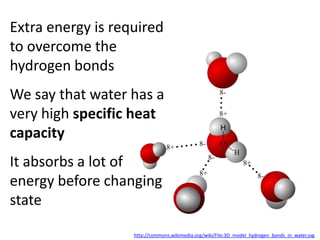
Extra energy is required
to overcome the
hydrogen bonds
We say that water has a
very high specific heat
capacity
It absorbs a lot of
energy before changing
state

                   http://commons.wikimedia.org/wiki/File:3D_model_hydrogen_bonds_in_water.svg
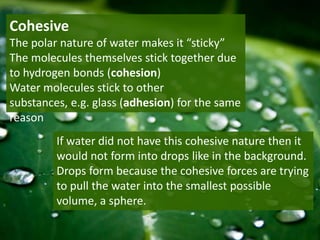
Cohesive
The polar nature of water makes it “sticky”
The molecules themselves stick together due
to hydrogen bonds (cohesion)
Water molecules stick to other
substances, e.g. glass (adhesion) for the same
reason
         If water did not have this cohesive nature then it
         would not form into drops like in the background.
         Drops form because the cohesive forces are trying
         to pull the water into the smallest possible
         volume, a sphere.
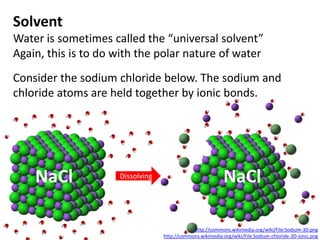
Solvent
Water is sometimes called the “universal solvent”
Again, this is to do with the polar nature of water
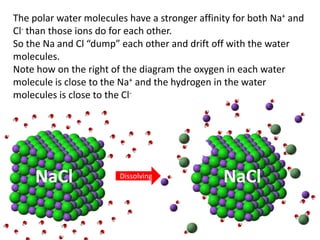
Consider the sodium chloride below. The sodium and
chloride atoms are held together by ionic bonds.


    NaCl             Dissolving                            NaCl

                                              http://commons.wikimedia.org/wiki/File:Sodium-3D.png
                                  http://commons.wikimedia.org/wiki/File:Sodium-chloride-3D-ionic.png
Chlorine     Water
Solvent                               Sodium

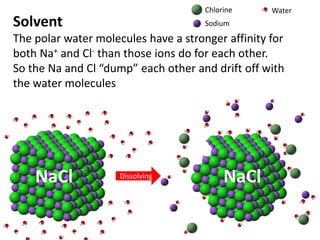
The polar water molecules have a stronger affinity for
both Na+ and Cl- than those ions do for each other.
So the Na and Cl “dump” each other and drift off with
the water molecules


    NaCl             Dissolving            NaCl
The polar water molecules have a stronger affinity for both Na+ and
Cl- than those ions do for each other.
So the Na and Cl “dump” each other and drift off with the water
molecules.
Note how on the right of the diagram the oxygen in each water
molecule is close to the Na+ and the hydrogen in the water
molecules is close to the Cl-


     NaCl               Dissolving              NaCl
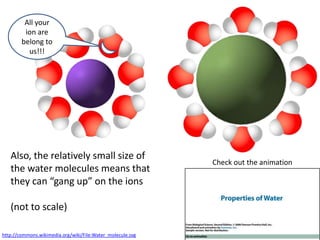
All your
         ion are
        belong to
          us!!!


   Also, the relatively small size of
                                                            Check out the animation
   the water molecules means that
   they can “gang up” on the ions

   (not to scale)

http://commons.wikimedia.org/wiki/File:Water_molecule.svg
3.1.6 Explain the relationship between the properties of water and its uses in living organisms as
a coolant, medium for metabolic reactions and transport medium


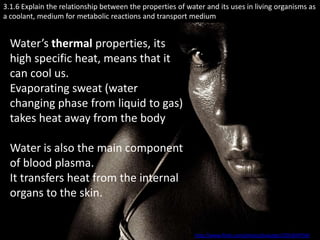
  Water’s thermal properties, its
  high specific heat, means that it
  can cool us.
  Evaporating sweat (water
  changing phase from liquid to gas)
  takes heat away from the body

  Water is also the main component
  of blood plasma.
  It transfers heat from the internal
  organs to the skin.


                                                            http://www.flickr.com/photos/bukutgirl/205304794/
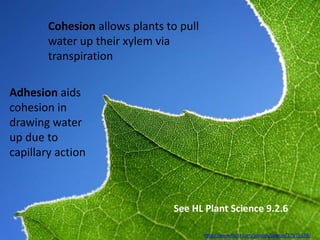
Cohesion allows plants to pull
        water up their xylem via
        transpiration

Adhesion aids
cohesion in
drawing water
up due to
capillary action


                                See HL Plant Science 9.2.6

                                         http://www.flickr.com/photos/jaxxon/37559138/
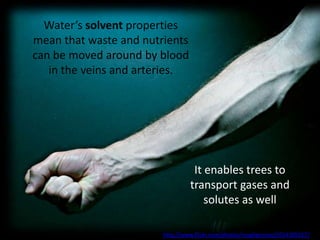
Water’s solvent properties
mean that waste and nutrients
can be moved around by blood
   in the veins and arteries.


                                  It enables trees to
                                 transport gases and
                                     solutes as well

                        http://www.flickr.com/photos/roughgroove/3554305017/
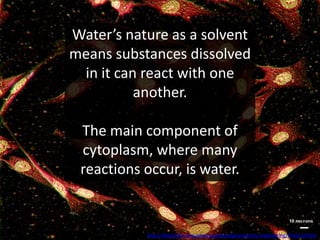
Water’s nature as a solvent
means substances dissolved
 in it can react with one
          another.

 The main component of
 cytoplasm, where many
 reactions occur, is water.


           http://www.flickr.com/photos/cambridgeuniversity-engineering/5431155934/
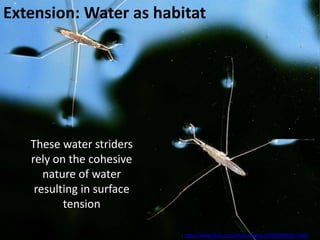
Extension: Water as habitat


   These water striders
   rely on the cohesive
      nature of water
    resulting in surface
          tension

                           http://www.flickr.com/photos/alexyo1968/4985953786/
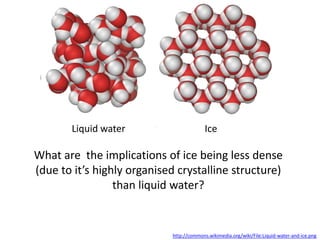
Liquid water                       Ice

What are the implications of ice being less dense
(due to it’s highly organised crystalline structure)
                 than liquid water?


                            http://commons.wikimedia.org/wiki/File:Liquid-water-and-ice.png
Back to the bear…


                     I have somewhere to
                        stand and hunt.
                      See 5.2.6 to see why you
                     hoomans are worrying me!


                    http://commons.wikimedia.org/wiki/File:Eisb%C3%A4r_1996-07-23.jpg
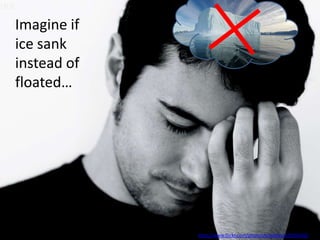
Imagine if
ice sank
instead of
floated…


             http://www.flickr.com/photos/toniblay/52925332/
Lakes at high latitudes would freeze from the bottom
up. Solid. And remain so for most if not all of the year at
                      high latitudes.


 The seas would be similarly affected. The water that is
     usually insulated by the ice, at above freezing
             temperatures, would not exist.
  There would be no habitat for the bottom dwellers.

In fact, the pressure of the overlying water would make
  the water at the bottom freeze. Even in the tropics.
Lucky for us
water is the
 way it is!
Further information:


     Properties of water

                           Three of the best sites for
                           IB-specific Biology
                           information. The top link
                           takes you to the PPT by
                           Stephen Taylor

IB Biology Core 3.1: Chemical Elements and Water

  • 2.
    3.1.1 State thatthe most frequently occurring chemical elements in living things are carbon, hydrogen, oxygen and nitrogen. Review ionic, covalent and hydrogen bonds Some fun with elements http://en.wikipedia.org/wiki/File:CHONPS.
  • 3.
    3.1.2 State thata variety of other elements are needed by living organisms, including sulphur, calcium , phosphorus, iron and sodium http://commons.wikimedia.org/wiki/File:Electron_shell_020_Calcium.svg http://commons.wikimedia.org/wiki/File:Electron_shell_016_Sulfur.svg http://commons.wikimedia.org/wiki/File:Electron_shell_015_Phosphorus.svg http://commons.wikimedia.org/wiki/File:Electron_shell_026_Iron.svg http://commons.wikimedia.org/wiki/File:Electron_shell_011_Sodium.svg
  • 4.
  • 5.
    3.1.3 State onerole for each of the elements Sulphur is an important element in some amino acids. It allows disulphide bonds to form in proteins, influencing the protein’s shape see HL 7.5 Proteins What about iron? http://commons.wikimedia.org/wiki/File:Granulated_sulphur02.jpg
  • 6.
    Iron is in haemoglobin,to carry oxygen in blood. Calcium? http://www.flickr.com/photos/csutka/3956855512/
  • 7.
    Calcium is in Bones! Sodium? http://www.flickr.com/photos/mugley/3491817141/
  • 8.
    Sodium is important for nerve impulses SeeCore 6.5.5 Phosphorus? http://commons.wikimedia.org/wiki/File:Nametal.JPG.jpg
  • 9.
  • 10.
    And, of course,in phospholipids in cell membranes. Here in Italian, just for a change. See: Structure of the membrane 2.4.1 http://commons.wikimedia.org/wiki/File:Fosfolipide.svg
  • 11.
    …and in DNA, amongs t other things. Also… CHON! http://commons.wikimedia.org/wiki/File:DNA_Structure%2BKey%2BLabelled.png
  • 12.
    3.1.4 Draw andlabel a diagram showing the structure of water molecules to show their polarity and hydrogen bond formation. Water is a weird and freaky substance. It is this way because of its polar nature. http://commons.wikimedia.org/wiki/File:Water_drop_animation_enhanced_small.gif
  • 13.
    No, that kind http://commons.wikimedia.org/wiki/File:Eisb%C3%A4r_1996-07-23.jpg
  • 14.
    The oxygen atomhas 8 Revisit the Crash Course positive charges (protons) Biology video “Carbon” (on at its nucleus. slide 2) at the 8:08 mark Therefore it attracts the shared electrons more strongly and they spend more time orbiting the O -ve than the H. O Thus water molecules are polar, i.e. they have a negatively charged pole +ve H (the oxygen) and a positively charged pole (the hydrogens) H +ve
  • 15.
    Hydrogen bonds form when the negatively charged oxygen on one molecule is electrostatically attracted to the positive hydrogen on another http://commons.wikimedia.org/wiki/File:Liquid_water_hydrogen_bond.png
  • 16.
    3.1.5 Outline thethermal, cohesive and solvent properties of water Thermal: You know about the phases (states) of water: Solid, Liquid and Gas. Water changes from solid to liquid and gas progressively as more energy (heat) is added. The weird thing about water is that it takes more energy than it “should” to change from one state to the next. Why do you think that might be? http://www.flickr.com/photos/westy559/328563694/
  • 17.
    Extra energy isrequired to overcome the hydrogen bonds We say that water has a very high specific heat capacity It absorbs a lot of energy before changing state http://commons.wikimedia.org/wiki/File:3D_model_hydrogen_bonds_in_water.svg
  • 18.
    Cohesive The polar natureof water makes it “sticky” The molecules themselves stick together due to hydrogen bonds (cohesion) Water molecules stick to other substances, e.g. glass (adhesion) for the same reason If water did not have this cohesive nature then it would not form into drops like in the background. Drops form because the cohesive forces are trying to pull the water into the smallest possible volume, a sphere.
  • 19.
    Solvent Water is sometimescalled the “universal solvent” Again, this is to do with the polar nature of water Consider the sodium chloride below. The sodium and chloride atoms are held together by ionic bonds. NaCl Dissolving NaCl http://commons.wikimedia.org/wiki/File:Sodium-3D.png http://commons.wikimedia.org/wiki/File:Sodium-chloride-3D-ionic.png
  • 20.
    Chlorine Water Solvent Sodium The polar water molecules have a stronger affinity for both Na+ and Cl- than those ions do for each other. So the Na and Cl “dump” each other and drift off with the water molecules NaCl Dissolving NaCl
  • 21.
    The polar watermolecules have a stronger affinity for both Na+ and Cl- than those ions do for each other. So the Na and Cl “dump” each other and drift off with the water molecules. Note how on the right of the diagram the oxygen in each water molecule is close to the Na+ and the hydrogen in the water molecules is close to the Cl- NaCl Dissolving NaCl
  • 22.
    All your ion are belong to us!!! Also, the relatively small size of Check out the animation the water molecules means that they can “gang up” on the ions (not to scale) http://commons.wikimedia.org/wiki/File:Water_molecule.svg
  • 23.
    3.1.6 Explain therelationship between the properties of water and its uses in living organisms as a coolant, medium for metabolic reactions and transport medium Water’s thermal properties, its high specific heat, means that it can cool us. Evaporating sweat (water changing phase from liquid to gas) takes heat away from the body Water is also the main component of blood plasma. It transfers heat from the internal organs to the skin. http://www.flickr.com/photos/bukutgirl/205304794/
  • 24.
    Cohesion allows plantsto pull water up their xylem via transpiration Adhesion aids cohesion in drawing water up due to capillary action See HL Plant Science 9.2.6 http://www.flickr.com/photos/jaxxon/37559138/
  • 25.
    Water’s solvent properties meanthat waste and nutrients can be moved around by blood in the veins and arteries. It enables trees to transport gases and solutes as well http://www.flickr.com/photos/roughgroove/3554305017/
  • 26.
    Water’s nature asa solvent means substances dissolved in it can react with one another. The main component of cytoplasm, where many reactions occur, is water. http://www.flickr.com/photos/cambridgeuniversity-engineering/5431155934/
  • 27.
    Extension: Water ashabitat These water striders rely on the cohesive nature of water resulting in surface tension http://www.flickr.com/photos/alexyo1968/4985953786/
  • 28.
    Liquid water Ice What are the implications of ice being less dense (due to it’s highly organised crystalline structure) than liquid water? http://commons.wikimedia.org/wiki/File:Liquid-water-and-ice.png
  • 29.
    Back to thebear… I have somewhere to stand and hunt. See 5.2.6 to see why you hoomans are worrying me! http://commons.wikimedia.org/wiki/File:Eisb%C3%A4r_1996-07-23.jpg
  • 30.
    Imagine if ice sank insteadof floated… http://www.flickr.com/photos/toniblay/52925332/
  • 31.
    Lakes at highlatitudes would freeze from the bottom up. Solid. And remain so for most if not all of the year at high latitudes. The seas would be similarly affected. The water that is usually insulated by the ice, at above freezing temperatures, would not exist. There would be no habitat for the bottom dwellers. In fact, the pressure of the overlying water would make the water at the bottom freeze. Even in the tropics.
  • 32.
    Lucky for us wateris the way it is!
  • 33.
    Further information: Properties of water Three of the best sites for IB-specific Biology information. The top link takes you to the PPT by Stephen Taylor