Bonding
Learning objectives
Why do atoms form bonds?
Types of bonding
Formation of ions and ionic bonds
Properties of ionic compounds
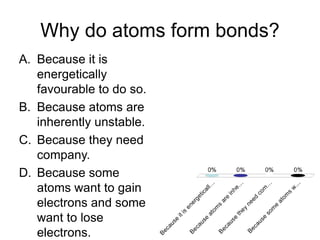
Why do atoms form bonds?
A. Because it is
energetically
favourable to do so.
B. Because atoms are
inherently unstable.
C. Because they need
company.
D. Because some
atoms want to gain
electrons and some
want to lose
electrons.
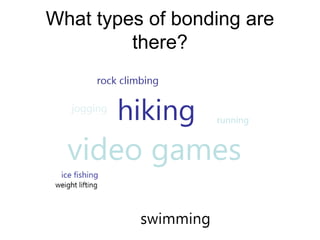
What types of bonding are
there?
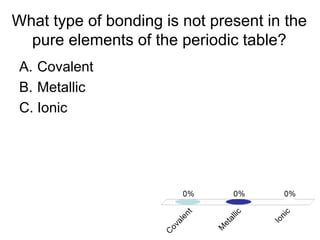
What type of bonding is not present in the
pure elements of the periodic table?
A. Covalent
B. Metallic
C. Ionic
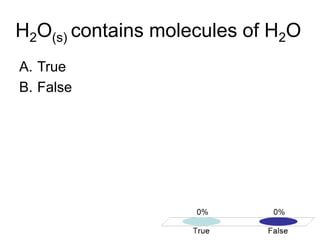
H2O(s) contains molecules of H2O
A. True
B. False
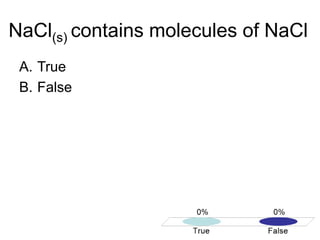
NaCl(s) contains molecules of NaCl
A. True
B. False
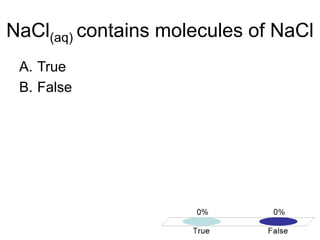
NaCl(aq) contains molecules of NaCl
A. True
B. False
Give an example of an element
that forms metallic bonds
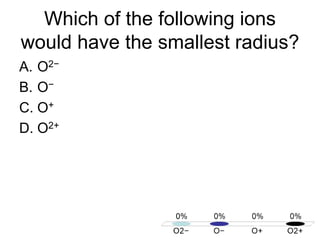
Which of the following ions
would have the smallest radius?
A. O2−
B. O−
C. O+
D. O2+
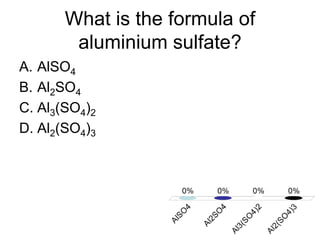
What is the formula of
aluminium sulfate?
A. AlSO4
B. Al2SO4
C. Al3(SO4)2
D. Al2(SO4)3
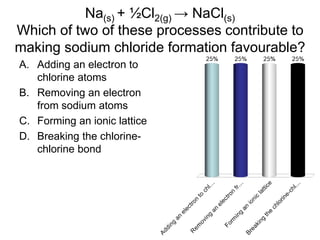
Na(s) + ½Cl2(g) → NaCl(s)
Which of two of these processes contribute to
making sodium chloride formation favourable?
A. Adding an electron to
chlorine atoms
B. Removing an electron
from sodium atoms
C. Forming an ionic lattice
D. Breaking the chlorine-
chlorine bond

Introduction to bonding

  • 1.
  • 2.
    Learning objectives Why doatoms form bonds? Types of bonding Formation of ions and ionic bonds Properties of ionic compounds
  • 3.
    Why do atomsform bonds? A. Because it is energetically favourable to do so. B. Because atoms are inherently unstable. C. Because they need company. D. Because some atoms want to gain electrons and some want to lose electrons.
  • 4.
    What types ofbonding are there?
  • 5.
    What type ofbonding is not present in the pure elements of the periodic table? A. Covalent B. Metallic C. Ionic
  • 6.
    H2O(s) contains moleculesof H2O A. True B. False
  • 7.
    NaCl(s) contains moleculesof NaCl A. True B. False
  • 8.
    NaCl(aq) contains moleculesof NaCl A. True B. False
  • 9.
    Give an exampleof an element that forms metallic bonds
  • 10.
    Which of thefollowing ions would have the smallest radius? A. O2− B. O− C. O+ D. O2+
  • 11.
    What is theformula of aluminium sulfate? A. AlSO4 B. Al2SO4 C. Al3(SO4)2 D. Al2(SO4)3
  • 12.
    Na(s) + ½Cl2(g)→ NaCl(s) Which of two of these processes contribute to making sodium chloride formation favourable? A. Adding an electron to chlorine atoms B. Removing an electron from sodium atoms C. Forming an ionic lattice D. Breaking the chlorine- chlorine bond