NEUROPATHY
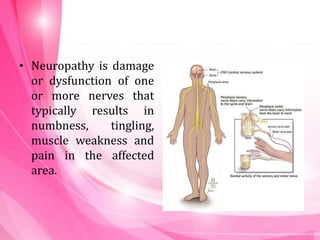
• Neuropathy is damage
or dysfunction of one
or more nerves that
typically results in
numbness, tingling,
muscle weakness and
pain in the affected
area.
Classification
• Cranial neuropathy, a result of damage to
the nerves inside the brain or brainstem.
• Peripheral neuropathy, a result of damage to
the nerves outside of the brain and spinal
cord.
Cranial neuropathy
• Cranial neuropathy, a result of damage to
the nerves inside the brain or brainstem.
Types of cranial neuropathies
• Bell palsy: the facial nerve damage (seventh cranial nerve).
• Microvascular cranial nerve palsy. The damage of one or more
nerves, typically those that go to the eye. It is most common in
people who have diabetes and high blood pressure.
• Third nerve palsy. The damage of third cranial nerve. This
nerve helps manage muscles that control eye movement, as well
as the size of the pupil.
• Fourth nerve palsy. This is also called superior oblique palsy. It
affects the superior oblique muscle, which helps to converge
eyes (to look at the tip of nose).
• Sixth nerve palsy. This is also called cranial nerve VI or
abducens palsy. It affects the sixth cranial nerve, which also
helps control eye movement.
Etiology
Infections
• Infections in the spinal fluid can irritate cranial nerves. For example,
Lyme disease often affects the seventh nerve. But it can cause problems
with any cranial nerve.
Cancer
• Cancer cells can spread to the spinal fluid and damage one or more
cranial nerves. Sometimes cancer can press on cranial nerves as they
run through the skull.
Increased intracranial pressure
• Increased intracranial pressure from a tumor, head trauma, or brain
swelling. This can injure cranial nerves. Pressure can also be raised in
certain headaches. Cranial nerves 3, 4, and 6 are most often affected.
Congenital cranial neuropathies.
• These are nerve injuries from trauma that occurs at birth. Or they can
occur before birth from developmental problems or infection.
Microvascular cranial nerve palsy.
• This can develop in people who have high blood
pressure or other vascular risks, such as diabetes or
smoking. Poor circulation to the cranial nerves injures
them. It most often affects cranial nerves 3, 4, and 6.
Autoimmune abnormalities.
• These occur when the immune system attacks one's own
cranial nerves. This can happen in Guillain-Barre
syndrome or lupus.
Aneurysm.
• This can press on nearby nerves. It most often affects
cranial nerves, 3, 4, and 6.
Clinical manifestations of CN
• Pain
• A tingling sensation
• Numbness
• Skin that feels sensitive to the touch
• Weak or paralyzed muscles. This can cause
drooling or slurred speech.
• Vision changes
• Diplopia
Diagnostic Evaluations
• Nervous system exam to test sensation, reflexes, balance and mental
status
• Electromyography (EMG), which measures the electrical activity of
muscles when working and at rest
• CT or MRI scans, which are imaging tests that allow healthcare
providers to see the brain
• Nerve conduction velocity tests to help find out how and where the
nerve is damaged
• Biopsies of the skin and nerves to find out how severely nerves are
damaged
• Hearing tests
• Spinal tap (lumbar puncture) to look for infection or inflammation in
the spinal fluid
• Angiography, a special X-ray that uses contrast dye and takes pictures
of your heart and blood vessels.
Peripheral neuropathy
• Peripheral neuropathy, a result of damage to
the nerves outside of the brain and spinal
cord.
Types of peripheral neuropathies
• Motor neuropathy – impairment of
movement
• Sensory neuropathy – impairment of
sensations
• Autonomic nerve neuropathy – diminishing
the in voluntary functions
• Combination neuropathies
• Mononeuropathy - Damage to a single
peripheral nerve
Etiology
• Autoimmune diseases. These include Sjogren's syndrome, lupus,
rheumatoid arthritis, Guillain-Barre syndrome, chronic inflammatory
demyelinating polyneuropathy and vasculitis.
• Diabetes.
• Infections. These include certain viral or bacterial infections, including
Lyme disease, shingles, Epstein-Barr virus, hepatitis B and C, leprosy,
diphtheria, and HIV.
• Inherited disorders. Disorders such as Charcot-Marie-Tooth disease
are hereditary types of neuropathy.
• Tumors.
• Bone marrow disorders. These include an abnormal protein in the
blood bone cancer, lymphoma.
• Alcoholism.
• Medications. Eg. Chemotherapy
• Vitamin deficiencies. B vitamins — including B-1, B-6 and B-12 —
vitamin E and niacin are crucial to nerve health.
Clinical manifestations PN
• Gradual onset of numbness, prickling or tingling in feet or hands, which
can spread upward into legs and arms
• Sharp, jabbing, throbbing or burning pain
• Extreme sensitivity to touch
• Pain during activities that shouldn't cause pain, such as pain in feet
when putting weight on them
• Lack of coordination and falling
• Muscle weakness
• Feeling as wearing gloves or socks when you're not
• Paralysis if motor nerves are affected
• Heat intolerance
• Excessive sweating or not being able to sweat
• Bowel, bladder or digestive problems
• Changes in blood pressure, causing dizziness or lightheadedness
Complications
• Burns and skin trauma
• Infection
• Falls
Diagnosis
• History Collection
• Neurological examination
• Blood tests. These can detect vitamin deficiencies, diabetes,
abnormal immune function and other indications of conditions
that can cause peripheral neuropathy.
• Imaging tests. CT or MRI scans can look for herniated disks,
tumors or other abnormalities.
• Nerve function tests. Electromyography (EMG) records
electrical activity in your muscles to detect nerve damage. A thin
needle (electrode) is inserted into the muscle to measure
electrical activity as you contract the muscle.
• Nerve biopsy
• Skin biopsy:- removes a small portion of skin to look for a
reduction in nerve endings.
• CT scan
• Electromyography (EMG)
MEDICAL MANAGEMENT
• Pain relievers - nonsteroidal anti-inflammatory
drugs, can relieve mild symptoms.
• Anti-seizure medications. Medications such as
gabapentin and pregabalin, developed to treat
epilepsy, may relieve nerve pain. Side effects can
include drowsiness and dizziness.
• Topical treatments. Capsaicin cream, Lidocaine
patches
• Antidepressants. Certain tricyclic antidepressants,
such as amitriptyline, doxepin and nortriptyline,
have been found to help relieve pain by interfering
with chemical processes in brain and spinal cord.
• Transcutaneous electrical nerve stimulation
(TENS). Electrodes placed on the skin deliver a gentle
electric current at varying frequencies. TENS should be
applied for 30 minutes daily for about a month.
• Plasma exchange and intravenous immune
globulin. These procedures, which help suppress
immune system activity, might benefit people with
certain inflammatory conditions.
• Physical therapy can help improve movements.
• Surgery - neuropathies caused by pressure on nerves,
such as pressure from tumors, might need surgery to
reduce the pressure.
MONONEUROPATHY
• Damage to a single peripheral nerve is
called mononeuropathy. Physical injury or
trauma such as from an accident is the most
common cause. Prolonged pressure on a
nerve, caused by extended periods of being
sedentary (such as sitting in a wheelchair or
lying in bed), or continuous, repetitive
motions, can trigger a mononeuropathy
Management
• Medicines can be used to control pain.
• Antidepressants such as duloxetine or
nortripyline.
• Antiseizure medicines such as gabapentin
and pregabalin.
• Physical therapy uses a combination of focused exercise,
massage and other treatments to help you increase your
strength, balance and range of motion.
• Occupational therapy can help you cope with the pain
and loss of function, and teach you skills to make up for
that loss.
• Proper nutrition involves eating a healthier diet and
making sure to get the right balance of vitamins and other
nutrients.
THANK YOU

Neuropathy

  • 1.
  • 2.
    • Neuropathy isdamage or dysfunction of one or more nerves that typically results in numbness, tingling, muscle weakness and pain in the affected area.
  • 3.
    Classification • Cranial neuropathy,a result of damage to the nerves inside the brain or brainstem. • Peripheral neuropathy, a result of damage to the nerves outside of the brain and spinal cord.
  • 4.
    Cranial neuropathy • Cranialneuropathy, a result of damage to the nerves inside the brain or brainstem.
  • 5.
    Types of cranialneuropathies • Bell palsy: the facial nerve damage (seventh cranial nerve). • Microvascular cranial nerve palsy. The damage of one or more nerves, typically those that go to the eye. It is most common in people who have diabetes and high blood pressure. • Third nerve palsy. The damage of third cranial nerve. This nerve helps manage muscles that control eye movement, as well as the size of the pupil. • Fourth nerve palsy. This is also called superior oblique palsy. It affects the superior oblique muscle, which helps to converge eyes (to look at the tip of nose). • Sixth nerve palsy. This is also called cranial nerve VI or abducens palsy. It affects the sixth cranial nerve, which also helps control eye movement.
  • 6.
    Etiology Infections • Infections inthe spinal fluid can irritate cranial nerves. For example, Lyme disease often affects the seventh nerve. But it can cause problems with any cranial nerve. Cancer • Cancer cells can spread to the spinal fluid and damage one or more cranial nerves. Sometimes cancer can press on cranial nerves as they run through the skull. Increased intracranial pressure • Increased intracranial pressure from a tumor, head trauma, or brain swelling. This can injure cranial nerves. Pressure can also be raised in certain headaches. Cranial nerves 3, 4, and 6 are most often affected. Congenital cranial neuropathies. • These are nerve injuries from trauma that occurs at birth. Or they can occur before birth from developmental problems or infection.
  • 7.
    Microvascular cranial nervepalsy. • This can develop in people who have high blood pressure or other vascular risks, such as diabetes or smoking. Poor circulation to the cranial nerves injures them. It most often affects cranial nerves 3, 4, and 6. Autoimmune abnormalities. • These occur when the immune system attacks one's own cranial nerves. This can happen in Guillain-Barre syndrome or lupus. Aneurysm. • This can press on nearby nerves. It most often affects cranial nerves, 3, 4, and 6.
  • 8.
    Clinical manifestations ofCN • Pain • A tingling sensation • Numbness • Skin that feels sensitive to the touch • Weak or paralyzed muscles. This can cause drooling or slurred speech. • Vision changes • Diplopia
  • 9.
    Diagnostic Evaluations • Nervoussystem exam to test sensation, reflexes, balance and mental status • Electromyography (EMG), which measures the electrical activity of muscles when working and at rest • CT or MRI scans, which are imaging tests that allow healthcare providers to see the brain • Nerve conduction velocity tests to help find out how and where the nerve is damaged • Biopsies of the skin and nerves to find out how severely nerves are damaged • Hearing tests • Spinal tap (lumbar puncture) to look for infection or inflammation in the spinal fluid • Angiography, a special X-ray that uses contrast dye and takes pictures of your heart and blood vessels.
  • 10.
    Peripheral neuropathy • Peripheralneuropathy, a result of damage to the nerves outside of the brain and spinal cord.
  • 11.
    Types of peripheralneuropathies • Motor neuropathy – impairment of movement • Sensory neuropathy – impairment of sensations • Autonomic nerve neuropathy – diminishing the in voluntary functions • Combination neuropathies • Mononeuropathy - Damage to a single peripheral nerve
  • 12.
    Etiology • Autoimmune diseases.These include Sjogren's syndrome, lupus, rheumatoid arthritis, Guillain-Barre syndrome, chronic inflammatory demyelinating polyneuropathy and vasculitis. • Diabetes. • Infections. These include certain viral or bacterial infections, including Lyme disease, shingles, Epstein-Barr virus, hepatitis B and C, leprosy, diphtheria, and HIV. • Inherited disorders. Disorders such as Charcot-Marie-Tooth disease are hereditary types of neuropathy. • Tumors. • Bone marrow disorders. These include an abnormal protein in the blood bone cancer, lymphoma. • Alcoholism. • Medications. Eg. Chemotherapy • Vitamin deficiencies. B vitamins — including B-1, B-6 and B-12 — vitamin E and niacin are crucial to nerve health.
  • 13.
    Clinical manifestations PN •Gradual onset of numbness, prickling or tingling in feet or hands, which can spread upward into legs and arms • Sharp, jabbing, throbbing or burning pain • Extreme sensitivity to touch • Pain during activities that shouldn't cause pain, such as pain in feet when putting weight on them • Lack of coordination and falling • Muscle weakness • Feeling as wearing gloves or socks when you're not • Paralysis if motor nerves are affected • Heat intolerance • Excessive sweating or not being able to sweat • Bowel, bladder or digestive problems • Changes in blood pressure, causing dizziness or lightheadedness
  • 14.
    Complications • Burns andskin trauma • Infection • Falls
  • 15.
    Diagnosis • History Collection •Neurological examination • Blood tests. These can detect vitamin deficiencies, diabetes, abnormal immune function and other indications of conditions that can cause peripheral neuropathy. • Imaging tests. CT or MRI scans can look for herniated disks, tumors or other abnormalities. • Nerve function tests. Electromyography (EMG) records electrical activity in your muscles to detect nerve damage. A thin needle (electrode) is inserted into the muscle to measure electrical activity as you contract the muscle. • Nerve biopsy • Skin biopsy:- removes a small portion of skin to look for a reduction in nerve endings. • CT scan • Electromyography (EMG)
  • 16.
    MEDICAL MANAGEMENT • Painrelievers - nonsteroidal anti-inflammatory drugs, can relieve mild symptoms. • Anti-seizure medications. Medications such as gabapentin and pregabalin, developed to treat epilepsy, may relieve nerve pain. Side effects can include drowsiness and dizziness. • Topical treatments. Capsaicin cream, Lidocaine patches • Antidepressants. Certain tricyclic antidepressants, such as amitriptyline, doxepin and nortriptyline, have been found to help relieve pain by interfering with chemical processes in brain and spinal cord.
  • 17.
    • Transcutaneous electricalnerve stimulation (TENS). Electrodes placed on the skin deliver a gentle electric current at varying frequencies. TENS should be applied for 30 minutes daily for about a month. • Plasma exchange and intravenous immune globulin. These procedures, which help suppress immune system activity, might benefit people with certain inflammatory conditions. • Physical therapy can help improve movements. • Surgery - neuropathies caused by pressure on nerves, such as pressure from tumors, might need surgery to reduce the pressure.
  • 18.
    MONONEUROPATHY • Damage toa single peripheral nerve is called mononeuropathy. Physical injury or trauma such as from an accident is the most common cause. Prolonged pressure on a nerve, caused by extended periods of being sedentary (such as sitting in a wheelchair or lying in bed), or continuous, repetitive motions, can trigger a mononeuropathy
  • 19.
    Management • Medicines canbe used to control pain. • Antidepressants such as duloxetine or nortripyline. • Antiseizure medicines such as gabapentin and pregabalin.
  • 20.
    • Physical therapyuses a combination of focused exercise, massage and other treatments to help you increase your strength, balance and range of motion. • Occupational therapy can help you cope with the pain and loss of function, and teach you skills to make up for that loss. • Proper nutrition involves eating a healthier diet and making sure to get the right balance of vitamins and other nutrients.
  • 21.