Neuronal PlasticityBySyedMujtabaHasnain Nadir Mubarak RazaWagha
What is neuronal plasticity?Plasticity is the quality of being ‘plastic’ or formative.Neuronal plasticity refers to the ability of the brain to change and adapt itself as a result of one’s experience.
Applications of Neuronal Plasticity‘Learning new things’‘Making new memories’‘Rewiring circuits’
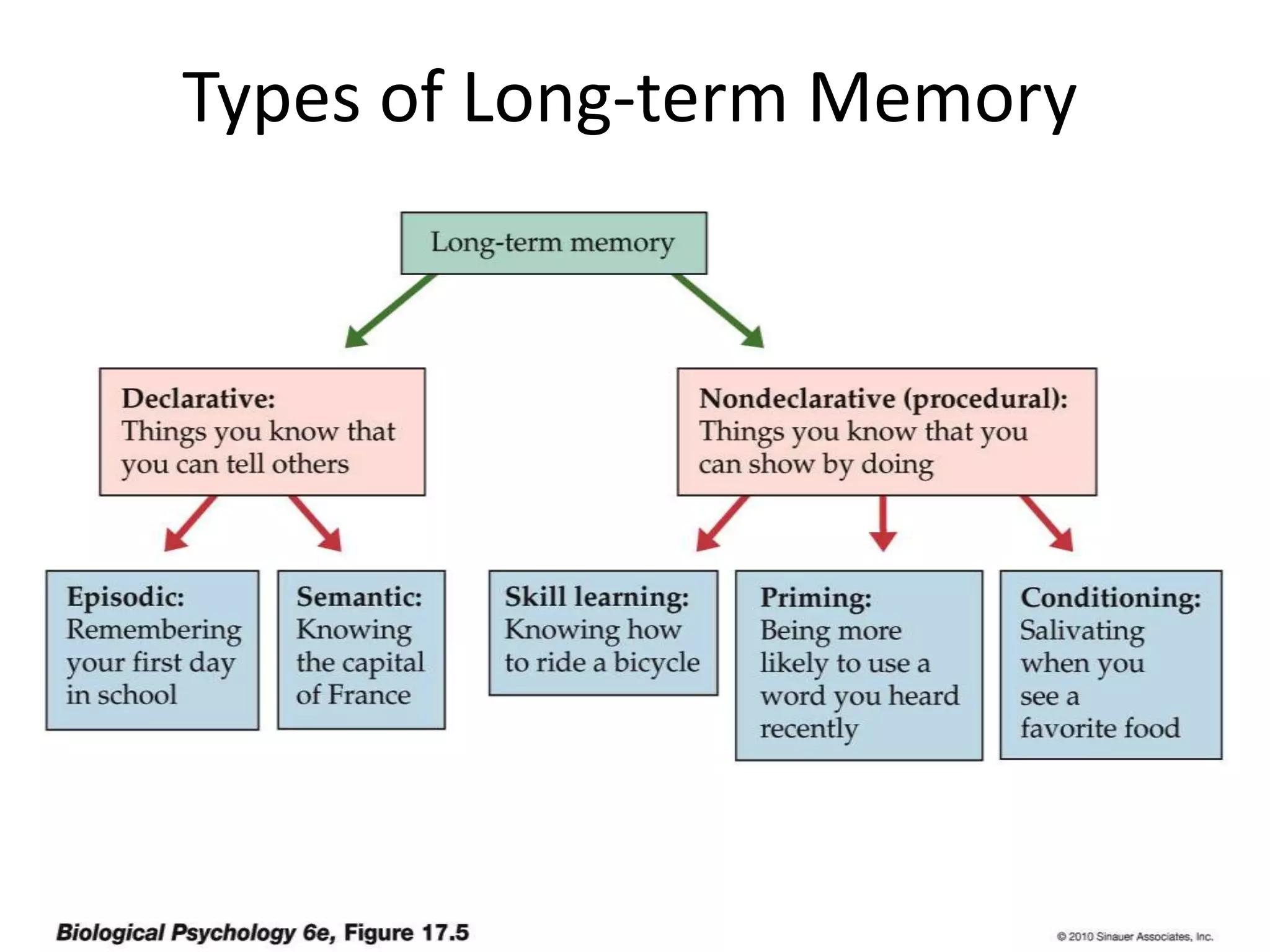
Types of Long-term Memory
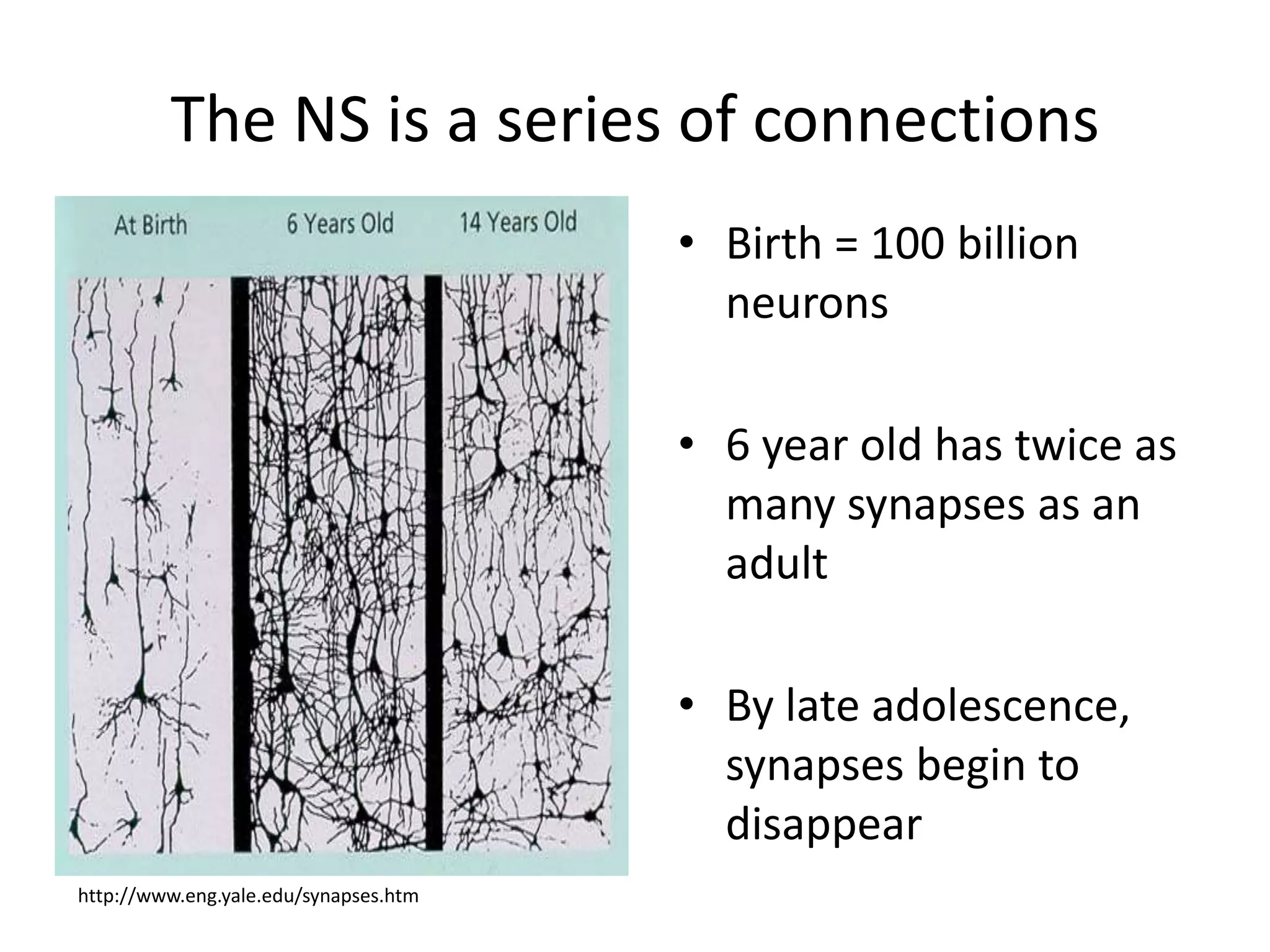
The NS is a series of connectionsBirth = 100 billion neurons6 year old has twice as many synapses as an adultBy late adolescence, synapses begin to disappearhttp://www.eng.yale.edu/synapses.htm
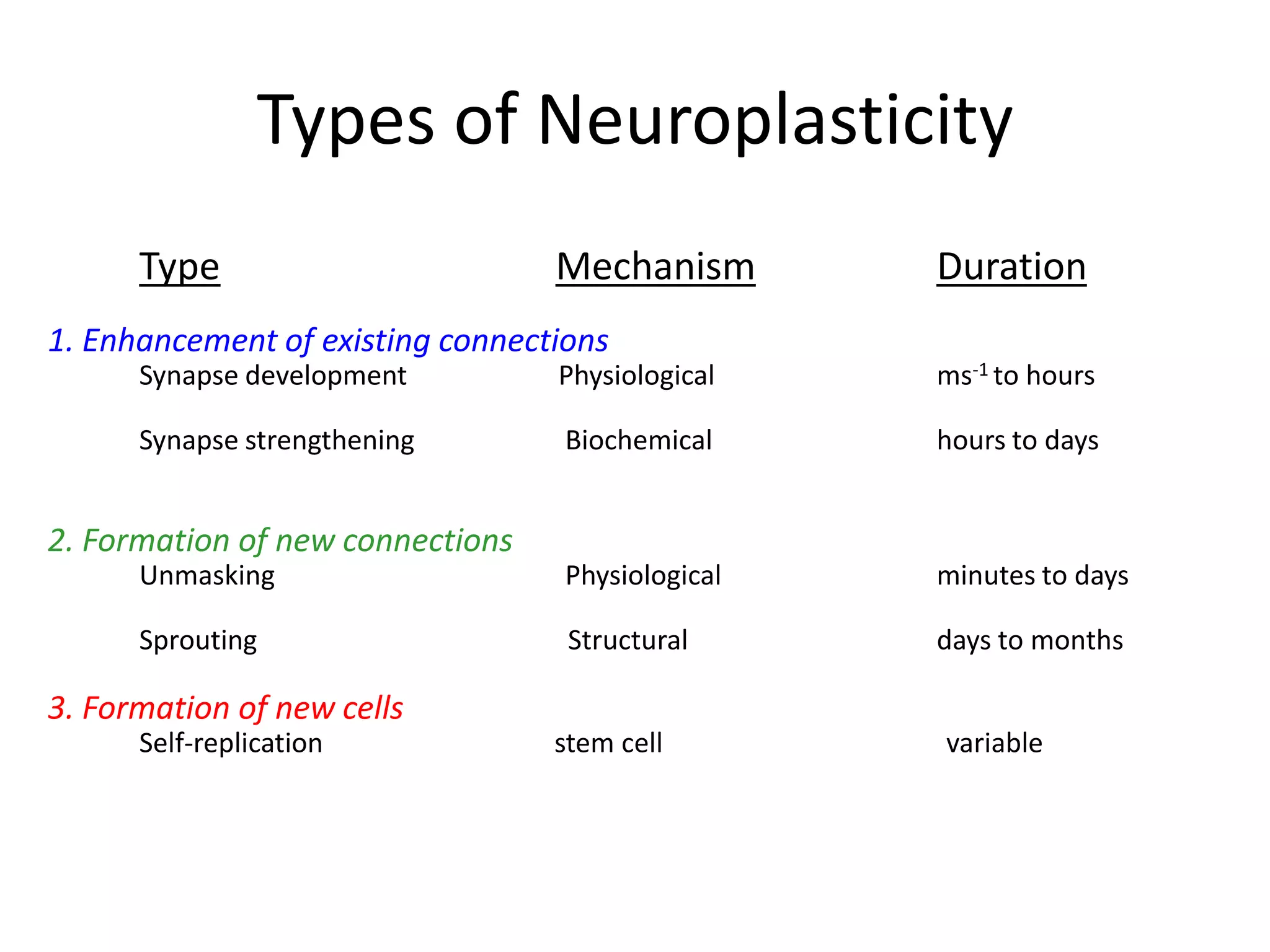
Types of NeuroplasticityTypeMechanismDuration1. Enhancement of existing connections	Synapse development 	                   Physiological 		ms-1 to hours 	Synapse strengthening 	                    Biochemical		hours to days2. Formation of new connections	Unmasking 		                    Physiological 		minutes to days	Sprouting 	                                       Structural		days to months3. Formation of new cells	Self-replication                                  stem cell  		                    variable
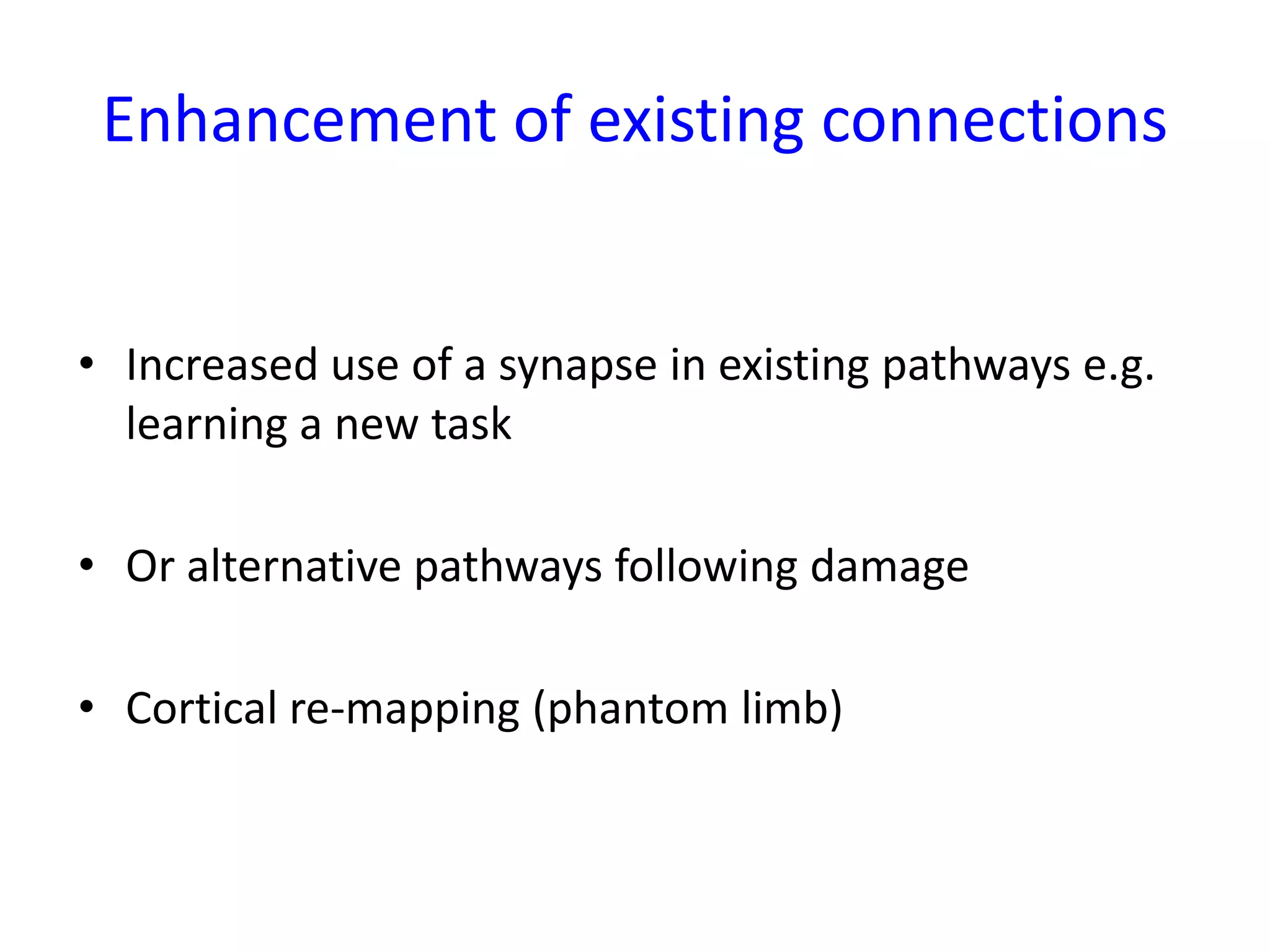
Enhancement of existing connectionsIncreased use of a synapse in existing pathways e.g. learning a new task Or alternative pathways following damageCortical re-mapping (phantom limb)
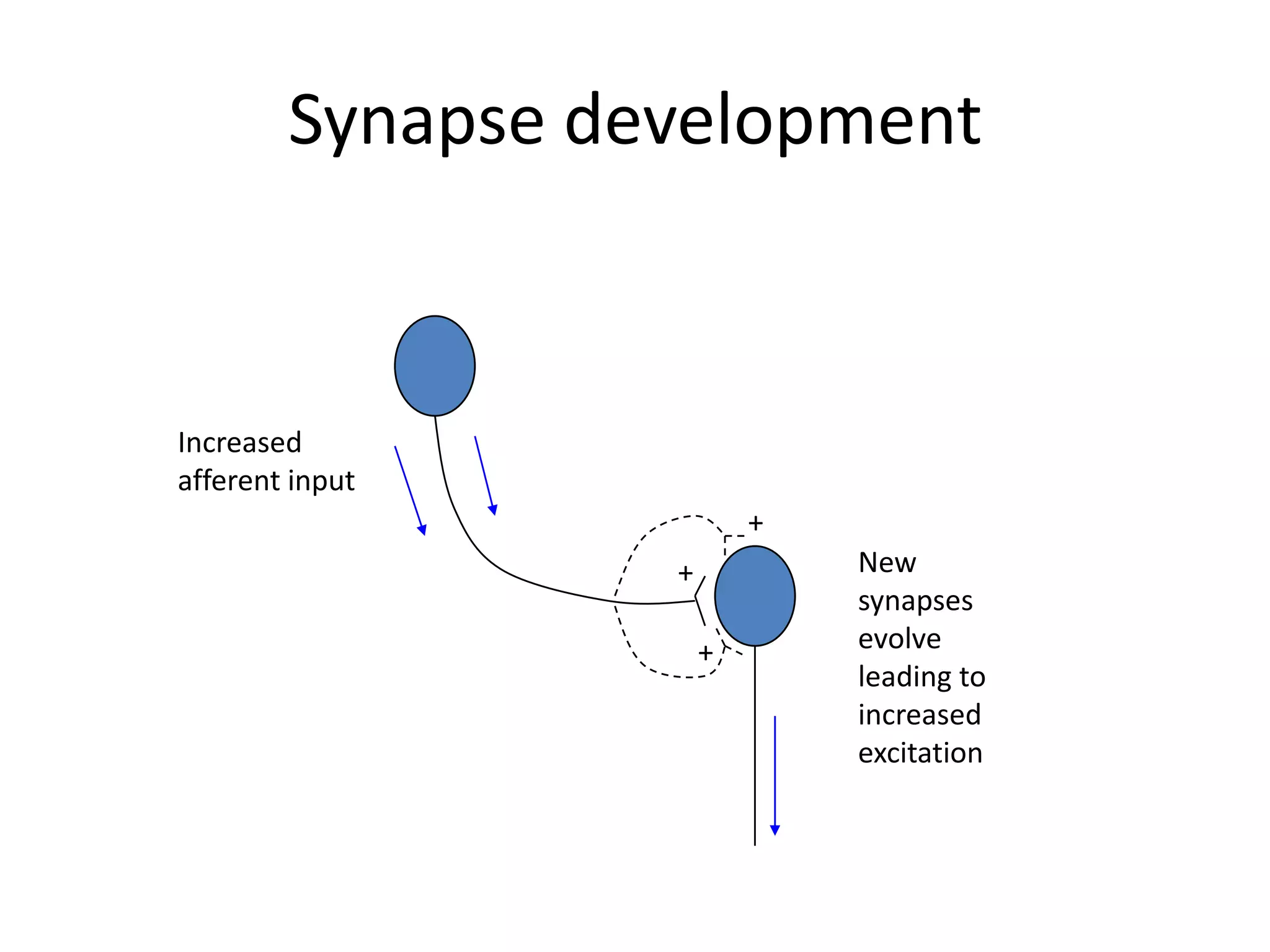
Synapse developmentIncreased afferent input+New synapses evolve leading to increased excitation++
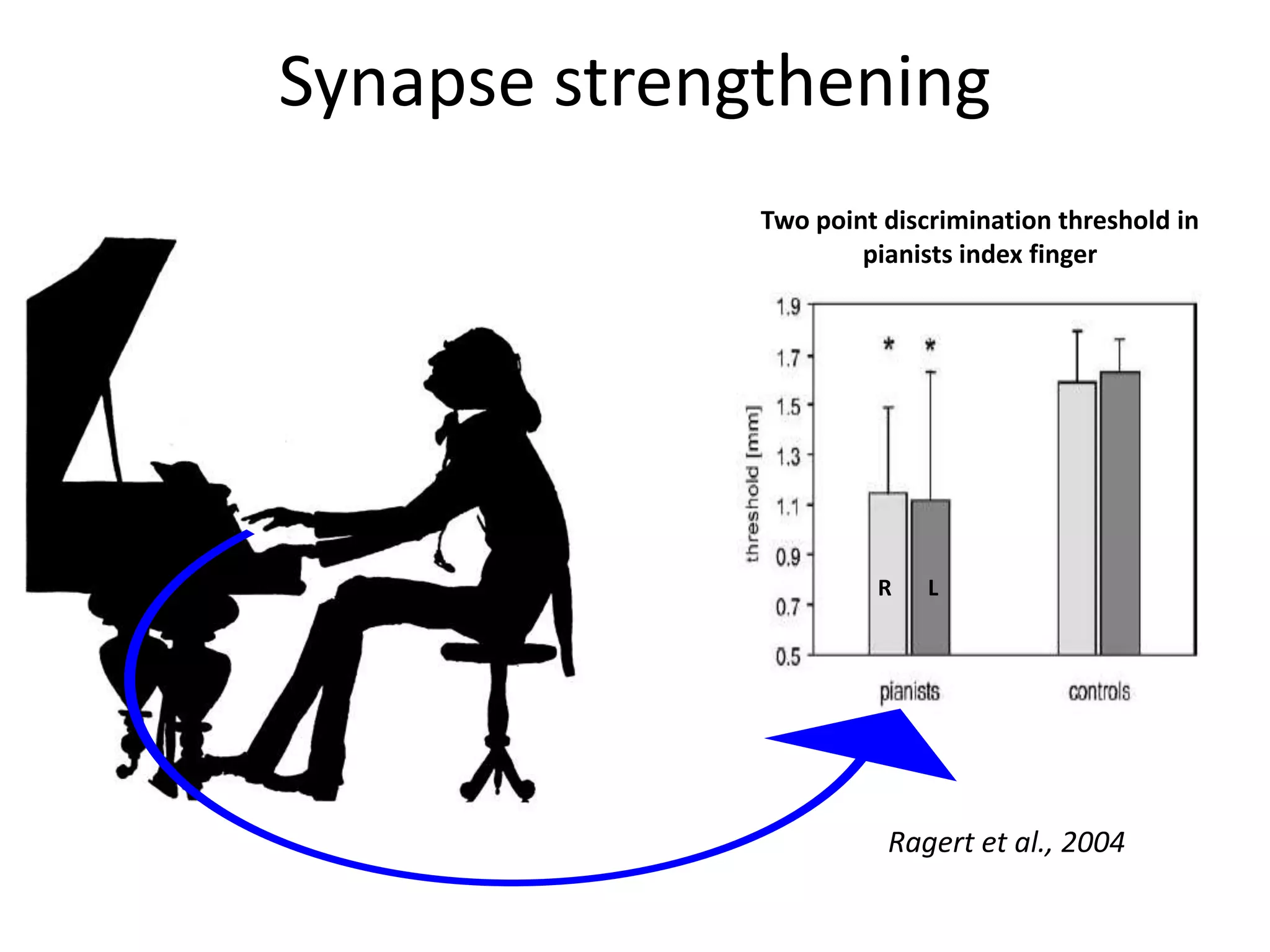
Synapse strengtheningTwo point discrimination threshold in pianists index fingerRLRagert et al., 2004
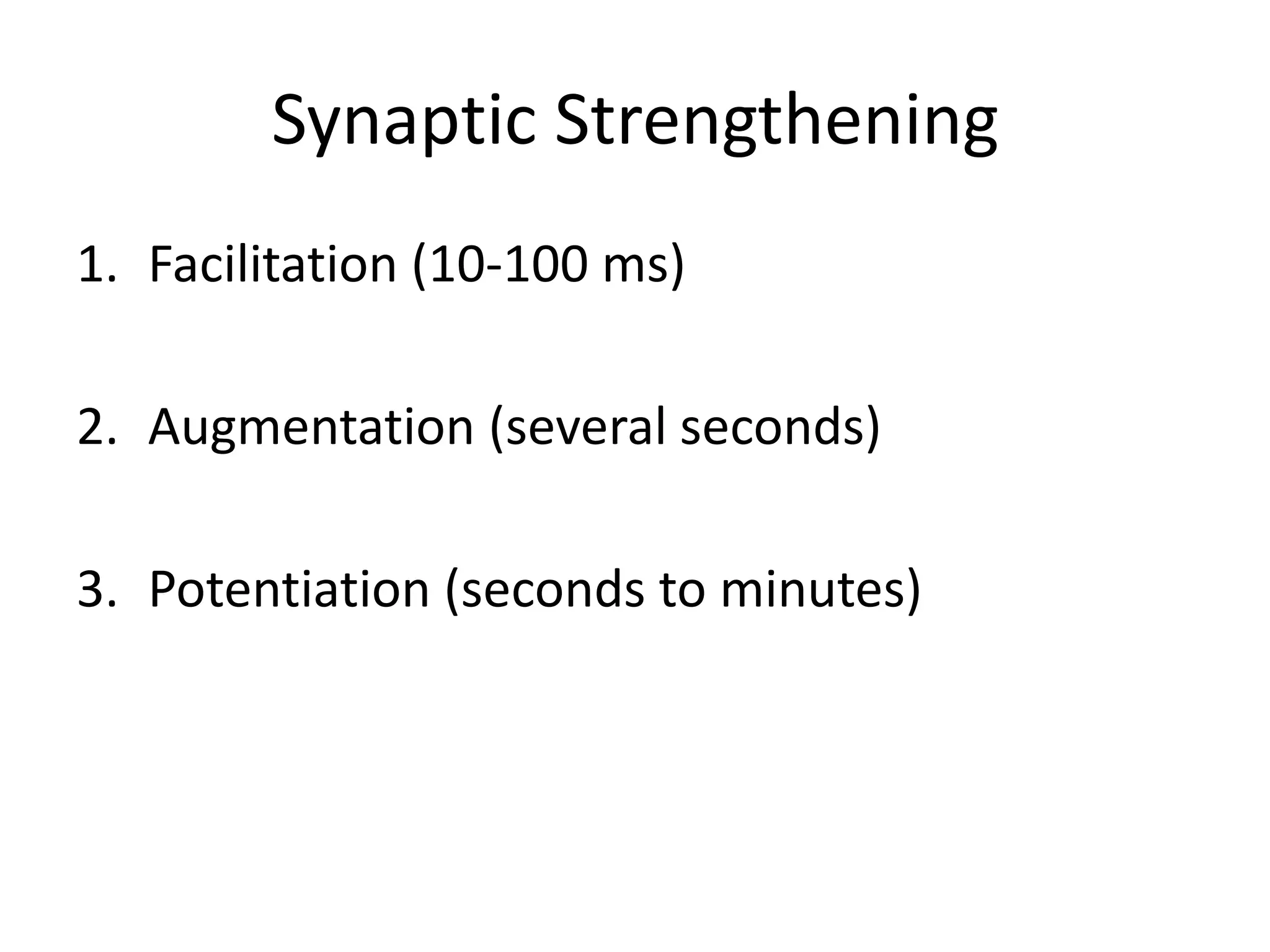
Synaptic StrengtheningFacilitation (10-100 ms)Augmentation (several seconds)Potentiation (seconds to minutes)
Formation of new connectionsUnmasking of pre-existing pathwaysSprouting of new pathways
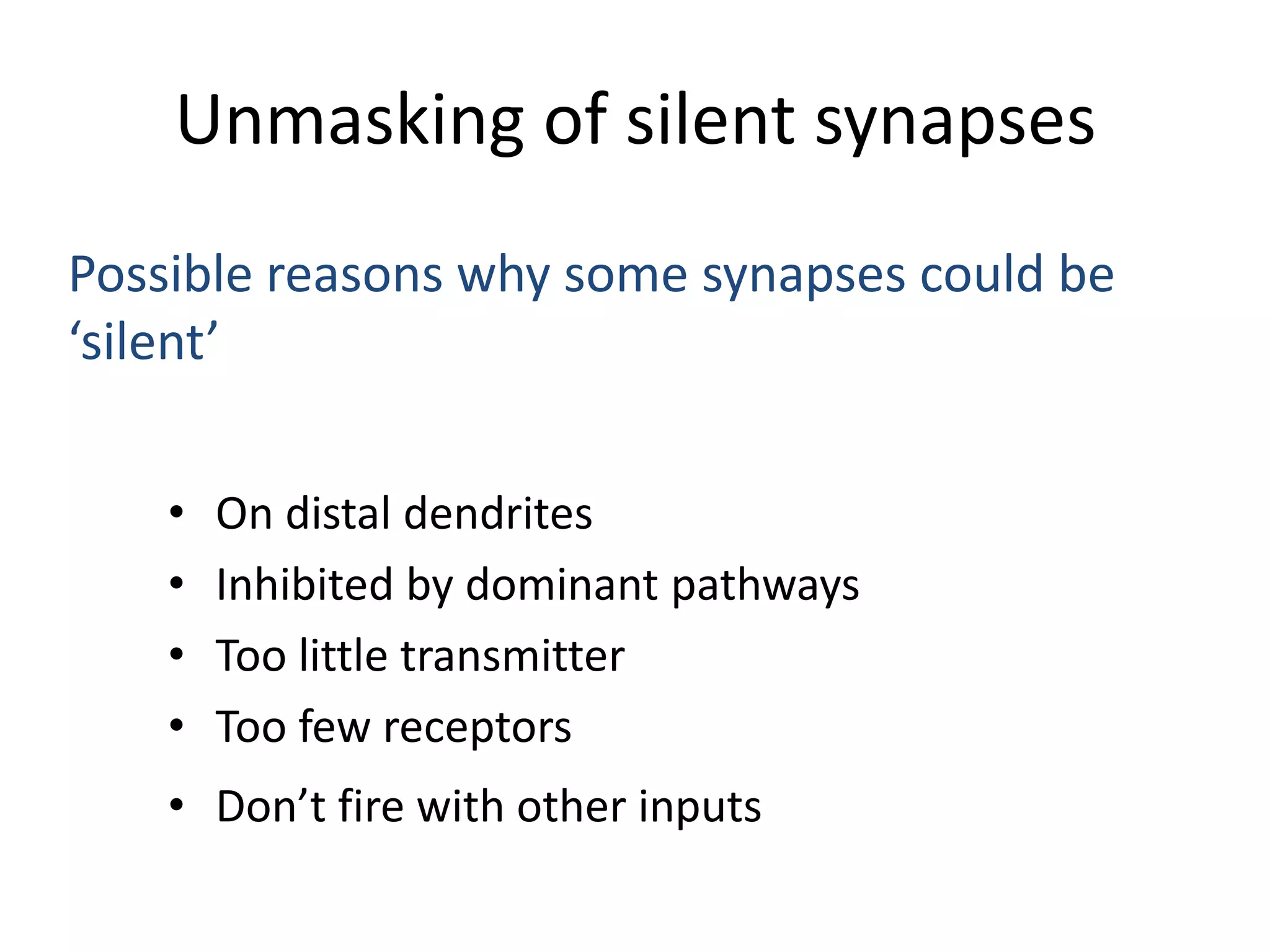
Unmasking of silent synapsesPossible reasons why some synapses could be ‘silent’On distal dendritesInhibited by dominant pathwaysToo little transmitterToo few receptorsDon’t fire with other inputs
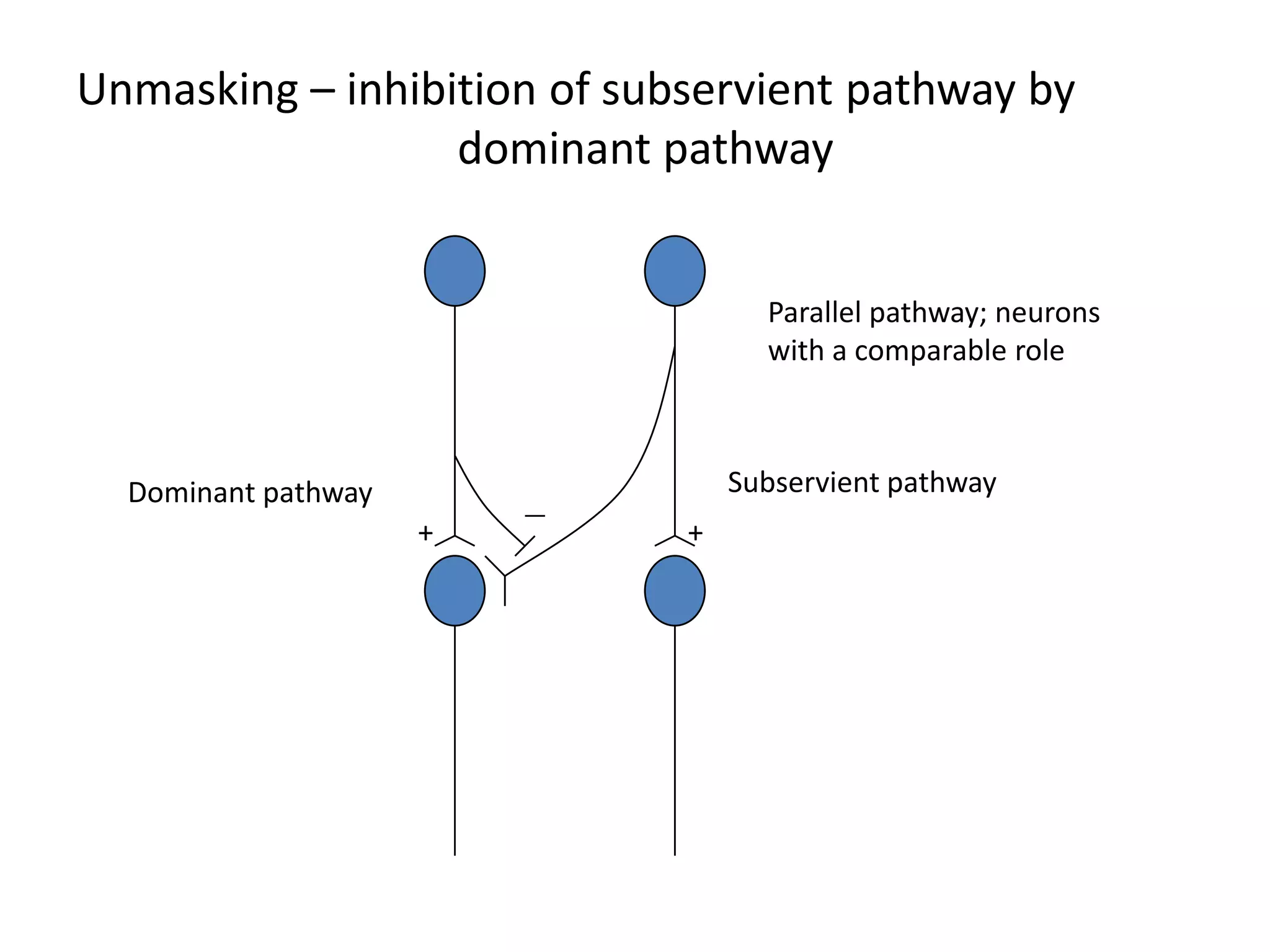
Unmasking – inhibition of subservient pathway by               			dominant pathway Parallel pathway; neurons with a comparable roleSubservient pathwayDominant pathway++
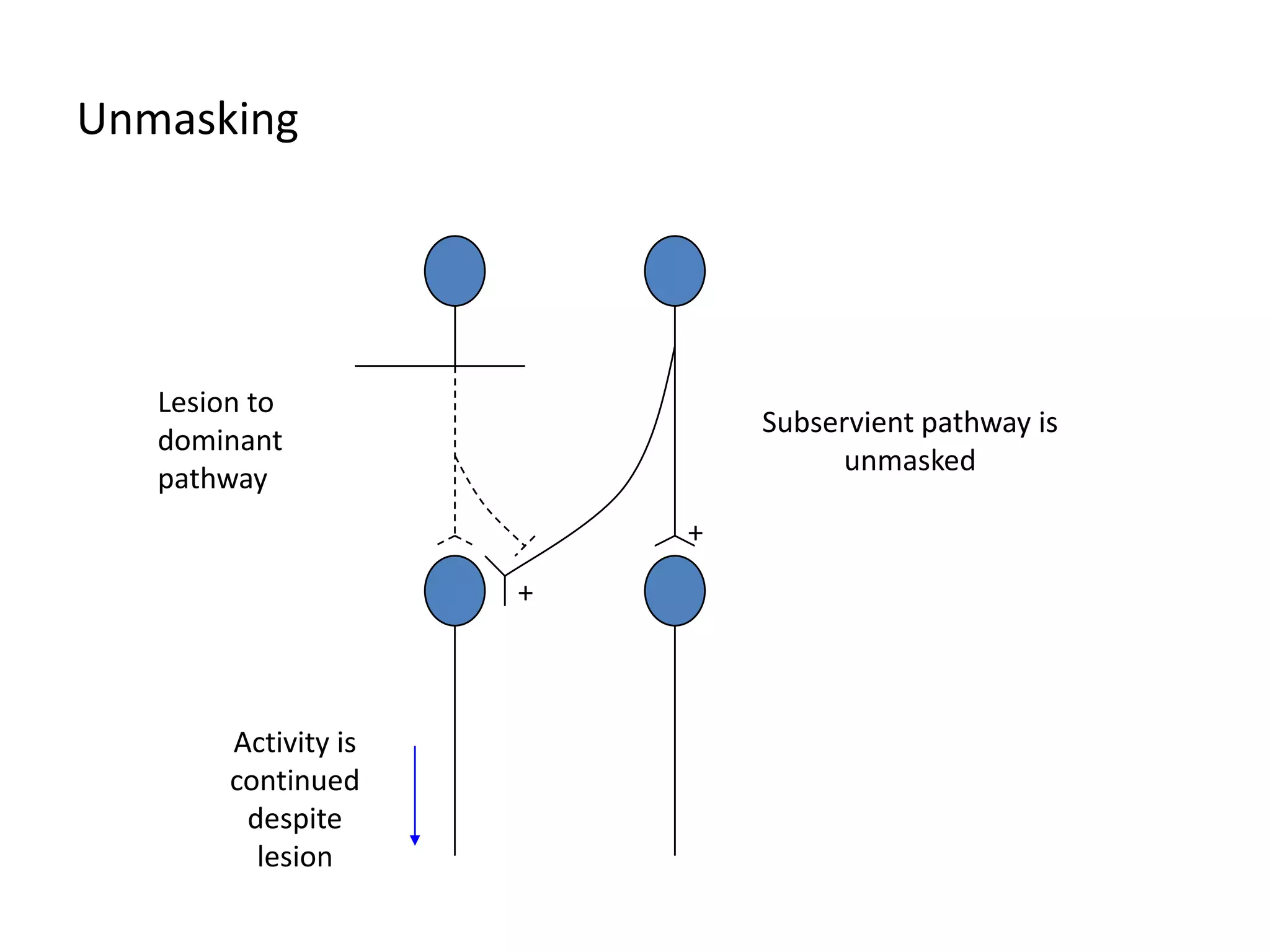
UnmaskingLesion to dominant pathwaySubservient pathway is unmasked++Activity is continued despite lesion
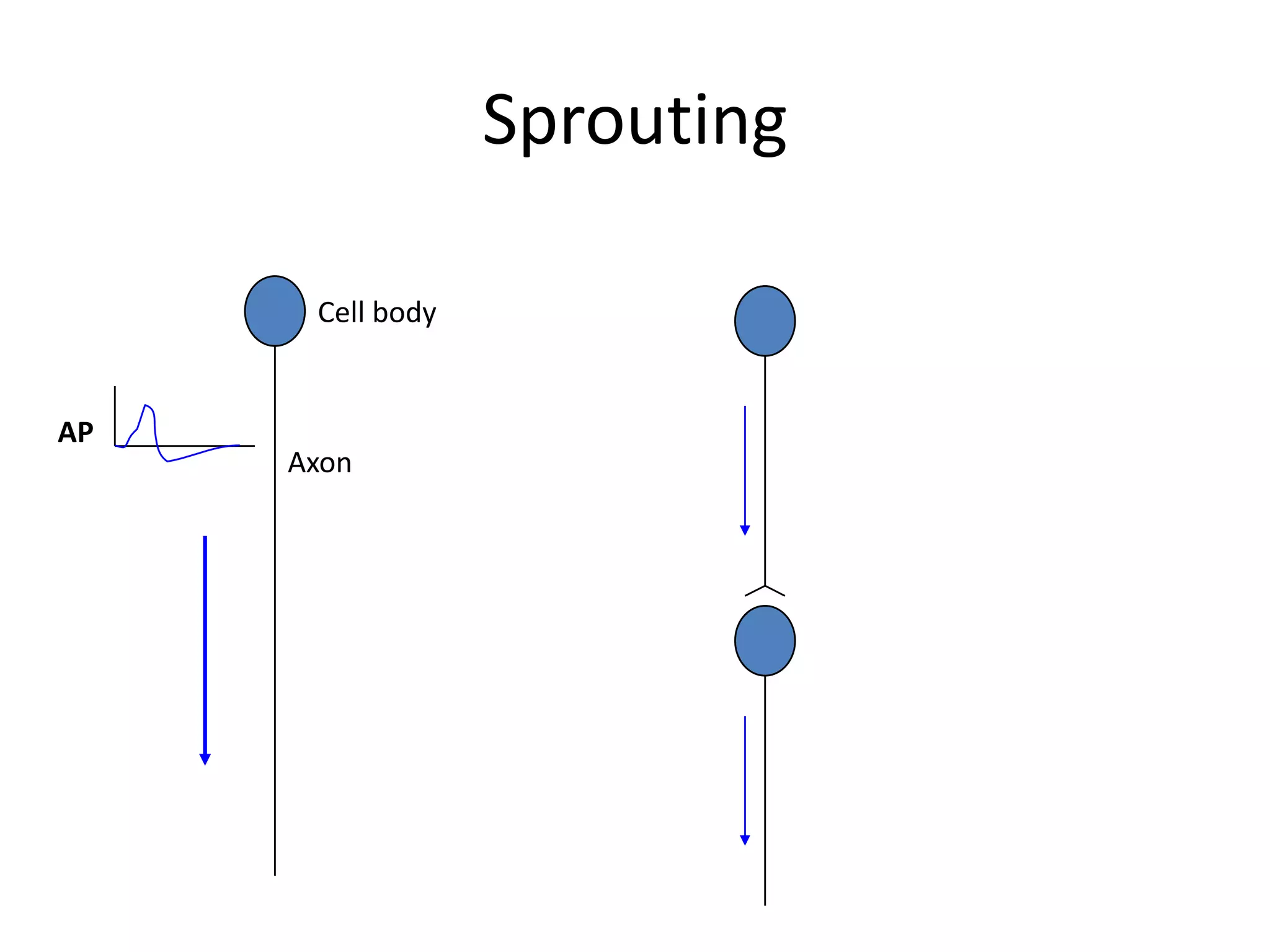
SproutingCell bodyAPAxon
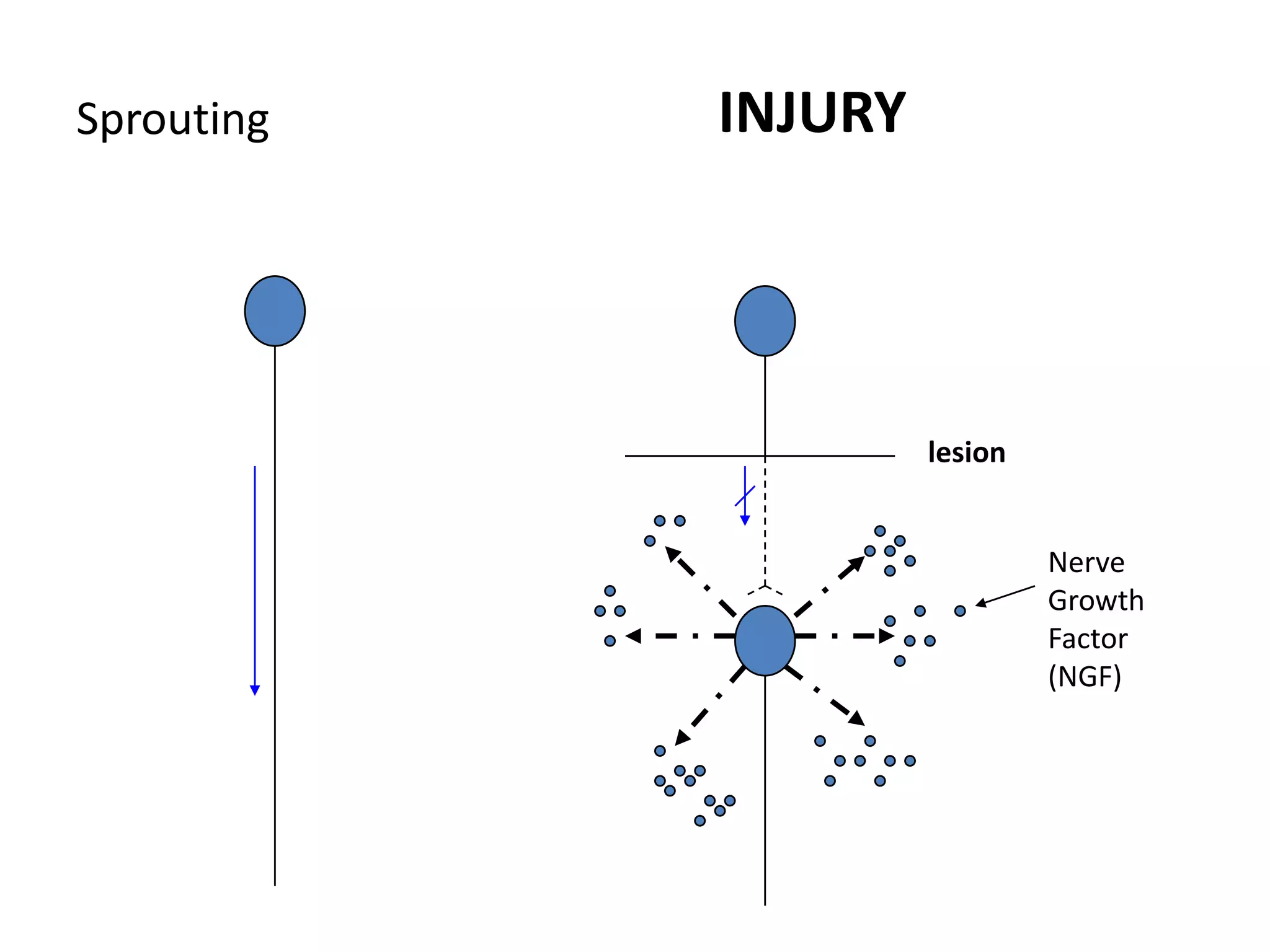
SproutingINJURYlesionNerve Growth Factor (NGF)
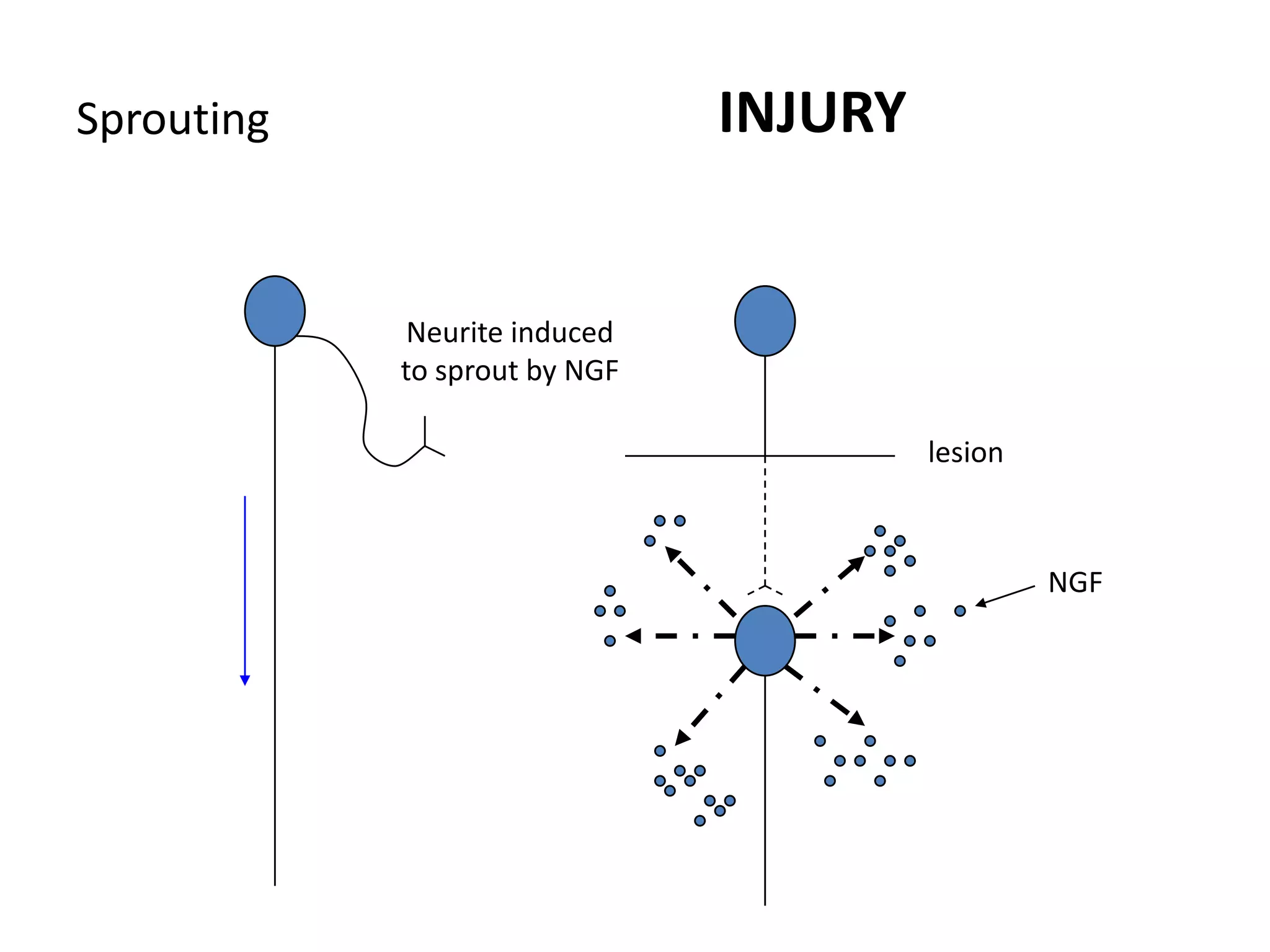
SproutingINJURYNeurite induced to sprout by NGFlesionNGF
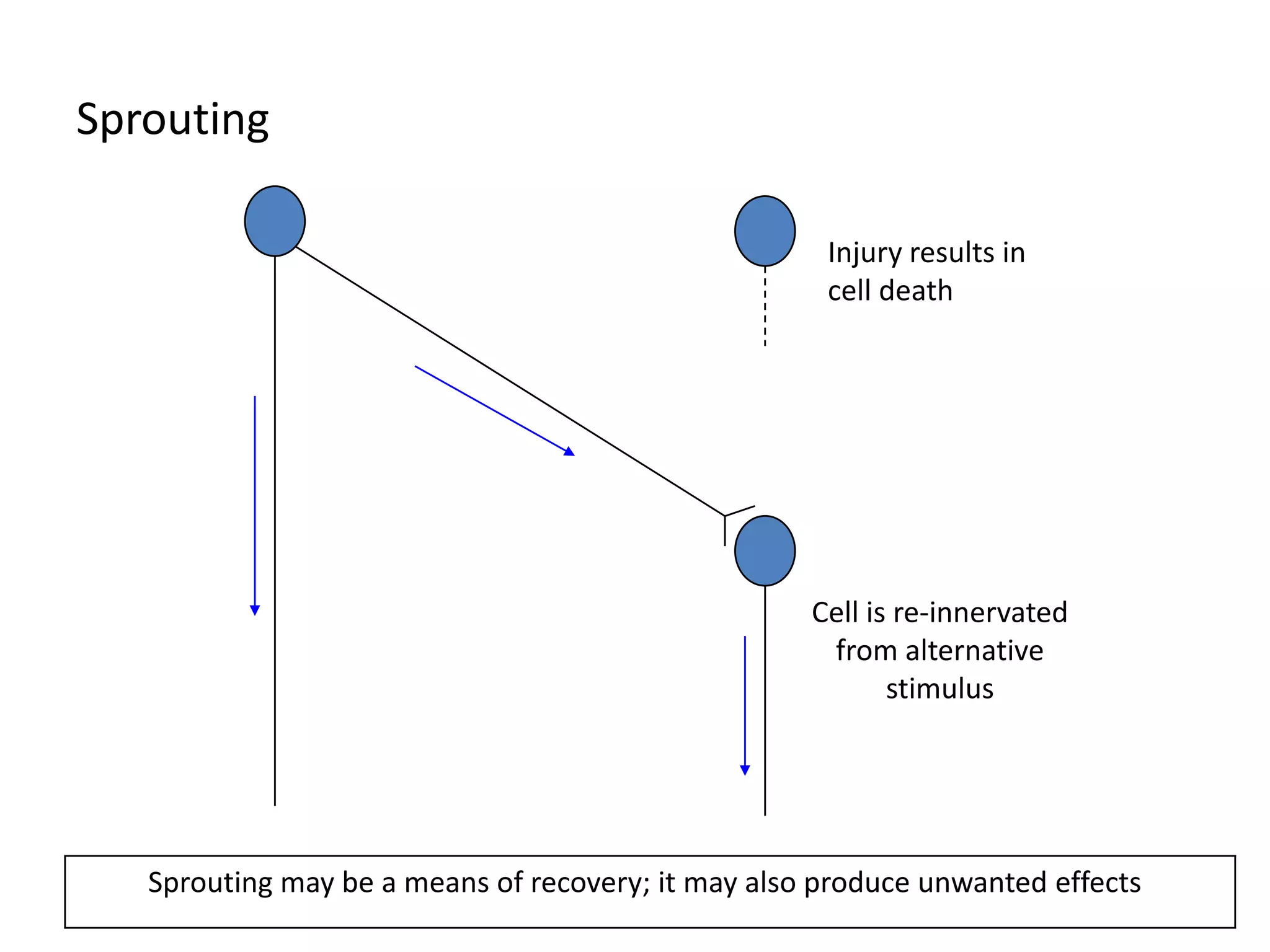
SproutingInjury results in cell deathCell is re-innervated from alternative stimulusSprouting may be a means of recovery; it may also produce unwanted effects
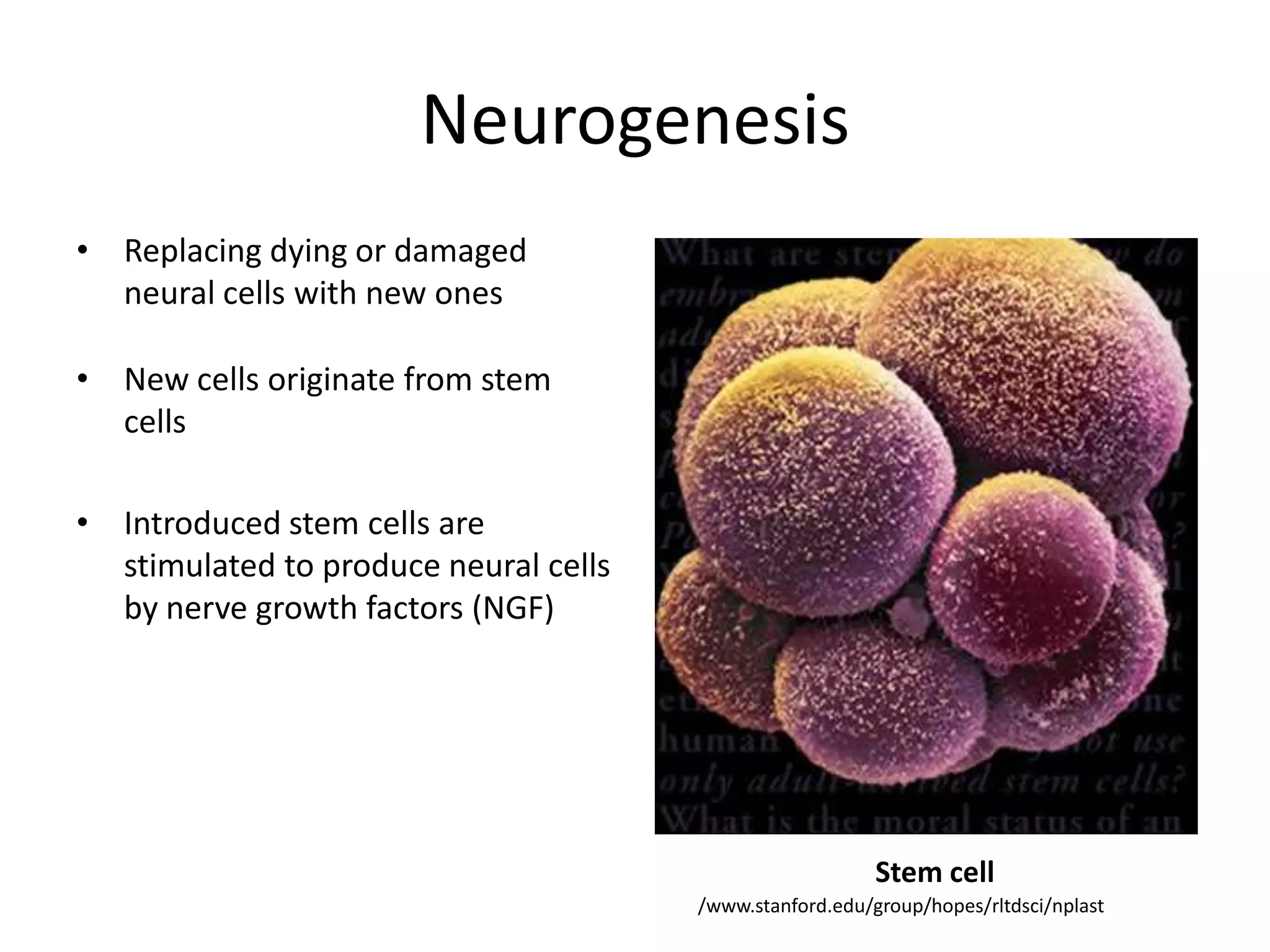
NeurogenesisReplacing dying or damaged neural cells with new onesNew cells originate from stem cells Introduced stem cells are stimulated to produce neural cells by nerve growth factors (NGF)Stem cell/www.stanford.edu/group/hopes/rltdsci/nplast
Cortical Re-MappingPeople born deaf
Cortical Re-MappingPeople born deafWhat happens?
Cortical Re-MappingPeople born deafWhat happens?Visual areas increase in size and “jobs”Cortical Re-MappingPeople born deafWhat happens?Visual areas increase in size and “jobs”
Auditory areas may be “taken over” for visual function Cortical Re-MappingPeople born deafWhat happens?Visual areas increase in size and “jobs”
Auditory areas may be “taken over” for visual function
Improved attention to movement in the peripheryThe Basis of Neuronal Plasticity	Hebb’s Rule :“Neurons that fire together, wire together.””Neurons that fire apart, wire apart.”
From The Organization of Behavior by Donald Hebb, 1949:"When one cell repeatedly assists in firing another, the axon of the first cell develops synaptic knobs (or enlarges them if they already exist) in contact with the soma of the second cell."Hebb postulated that this behavior of synapses in neuronal networks would permit the networks to store memories.
Synaptic StrengtheningFacilitation (10-100 ms)Augmentation (several seconds)Potentiation (seconds to minutes)
Long Term PotentiationIn neuroscience, long-term potentiation (LTP) is a long-lasting enhancement in signal transmission between two neurons that results from stimulating them synchronously.
Input specificityOnce induced, LTP at one synapse does not spread to other synapses; rather LTP is input specific.Cooperativity  LTP can be induced by strong stimulation at one synapseOR  Weak stimulation at multiple synapses which together depolarize the post synaptic membrane to induce LTP
Hippocampus  Function:  •  Consolidation of New Memories  •  Emotions•  Navigation•  Spatial Orientation
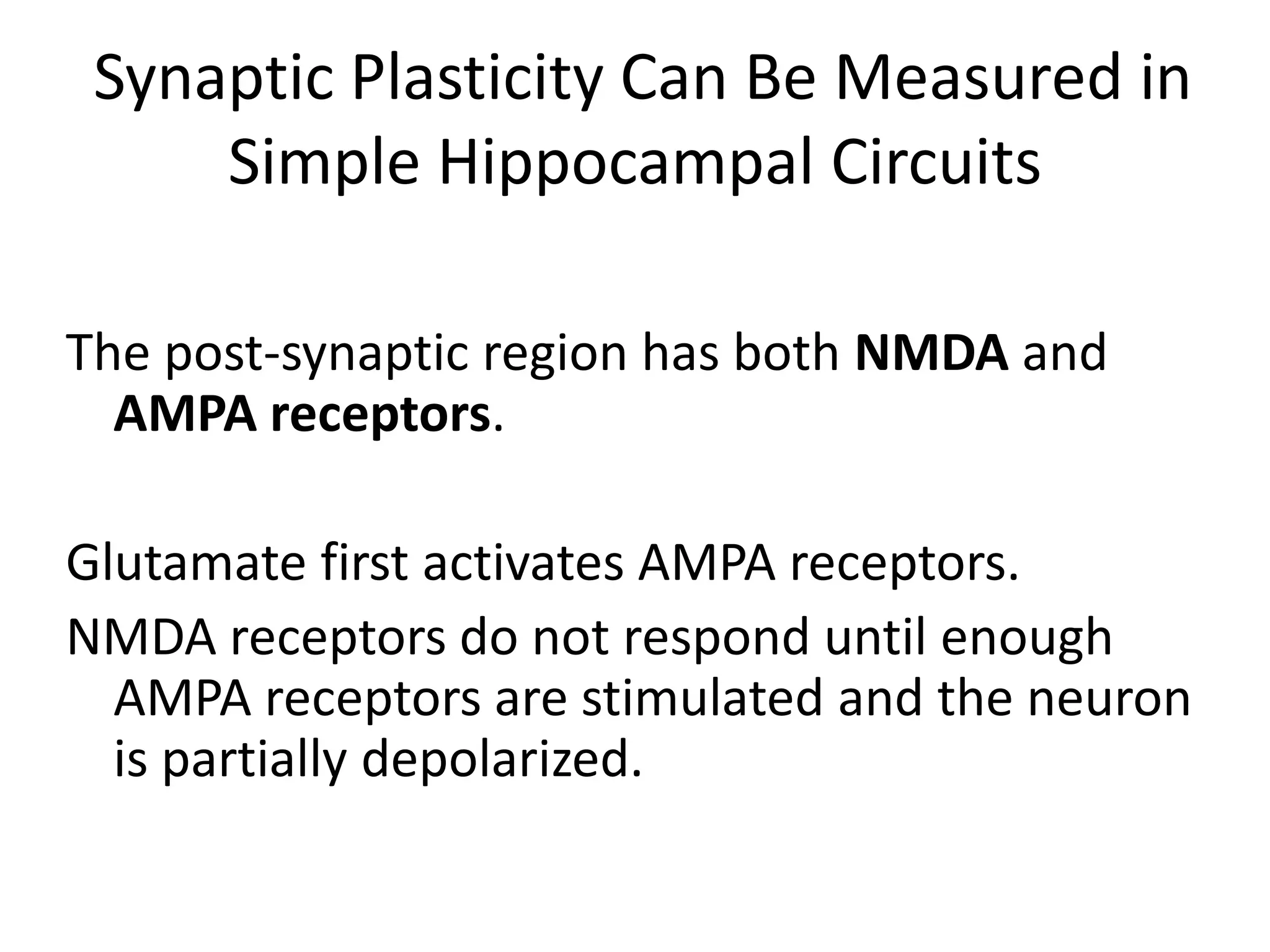
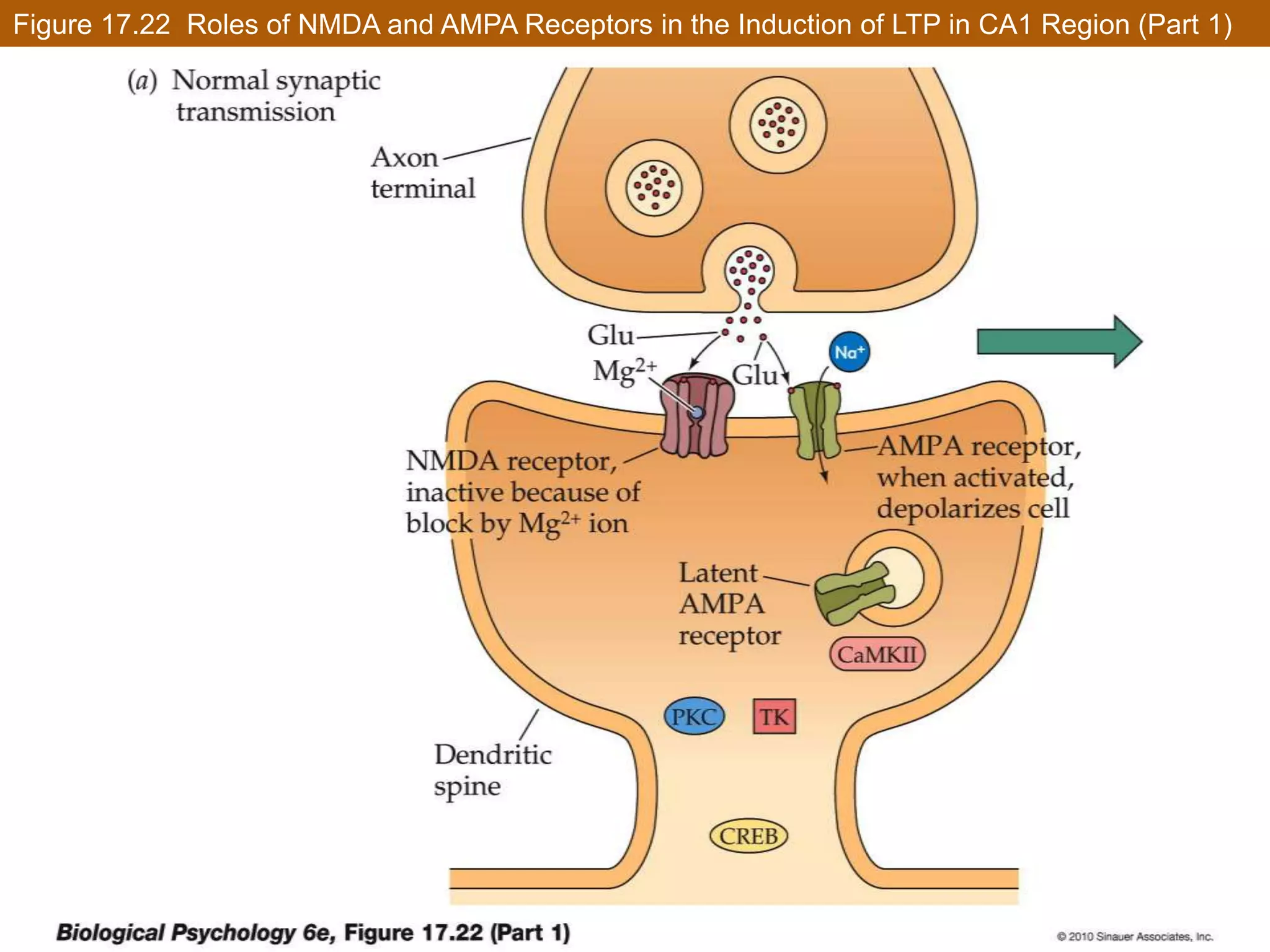
 Synaptic Plasticity Can Be Measured in Simple Hippocampal CircuitsThe post-synaptic region has both NMDA and AMPA receptors.Glutamate first activates AMPA receptors. NMDA receptors do not respond until enough AMPA receptors are stimulated and the neuron is partially depolarized.
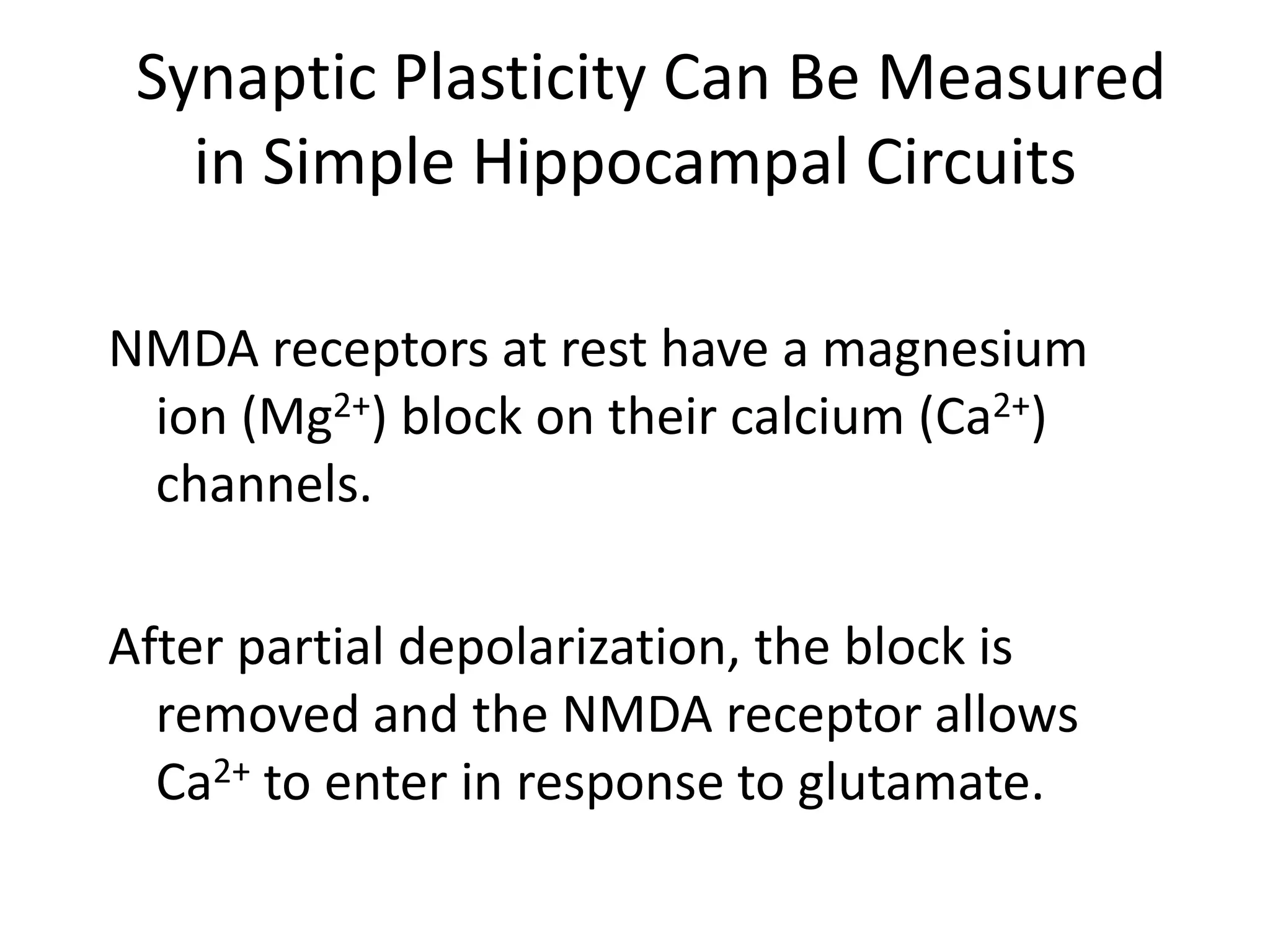
  Synaptic Plasticity Can Be Measured in Simple Hippocampal CircuitsNMDA receptors at rest have a magnesium ion (Mg2+) block on their calcium (Ca2+) channels.After partial depolarization, the block is removed and the NMDA receptor allows Ca2+ to enter in response to glutamate.
Figure 17.22  Roles of NMDA and AMPA Receptors in the Induction of LTP in CA1 Region (Part 1)
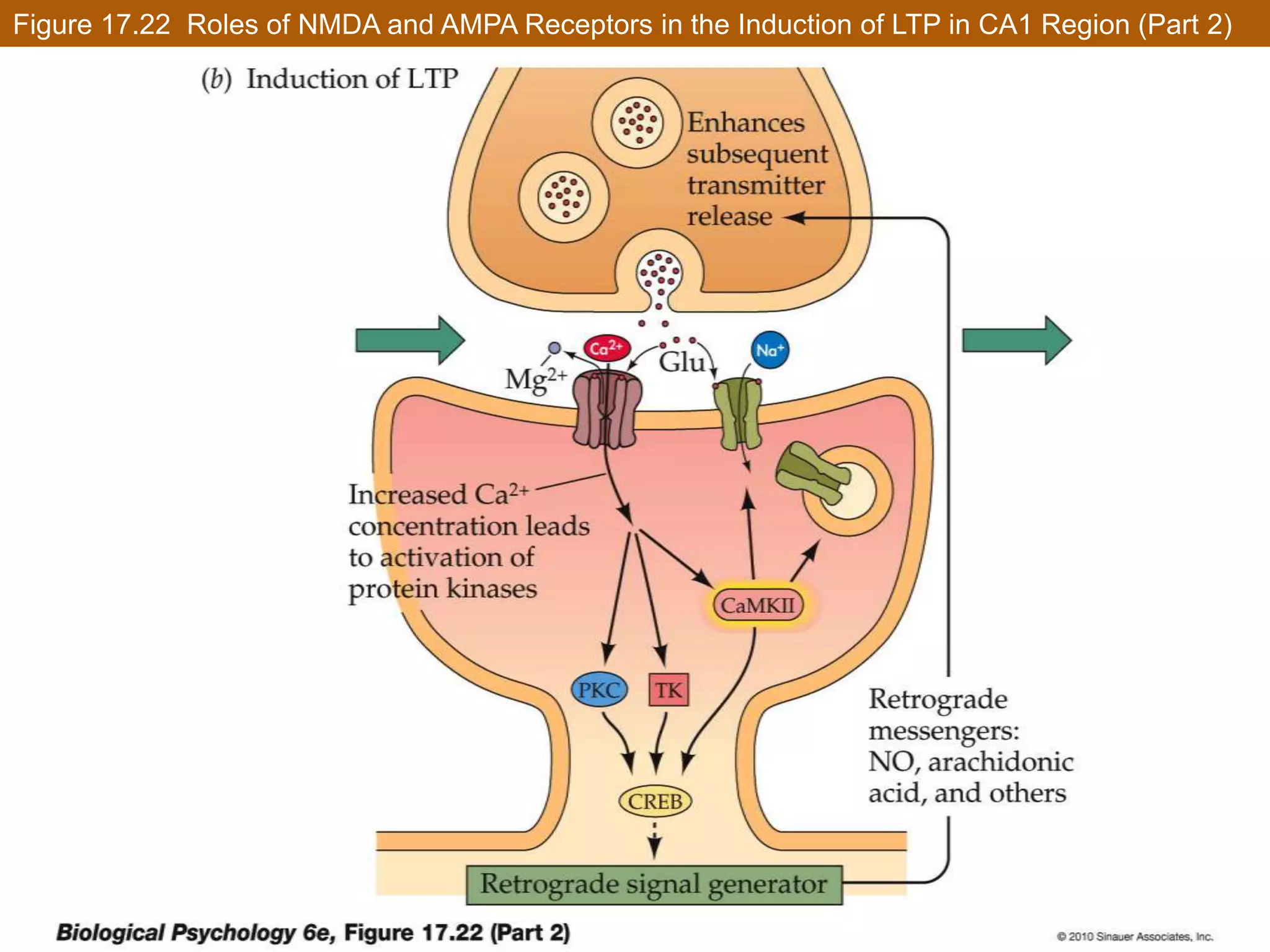
Figure 17.22  Roles of NMDA and AMPA Receptors in the Induction of LTP in CA1 Region (Part 2)
Figure 17.22  Roles of NMDA and AMPA Receptors in the Induction of LTP in CA1 Region (Part 3)
 Synaptic Plasticity Can Be Measured in Simple Hippocampal CircuitsThe large Ca2+ influx activates certain protein kinases – enzymes that add phosphate groups to protein molecules.One protein kinase is CaMKII – it affects AMPA receptors in several ways:Causes more AMPA receptors to be produced and inserted in the postsynaptic membrane.
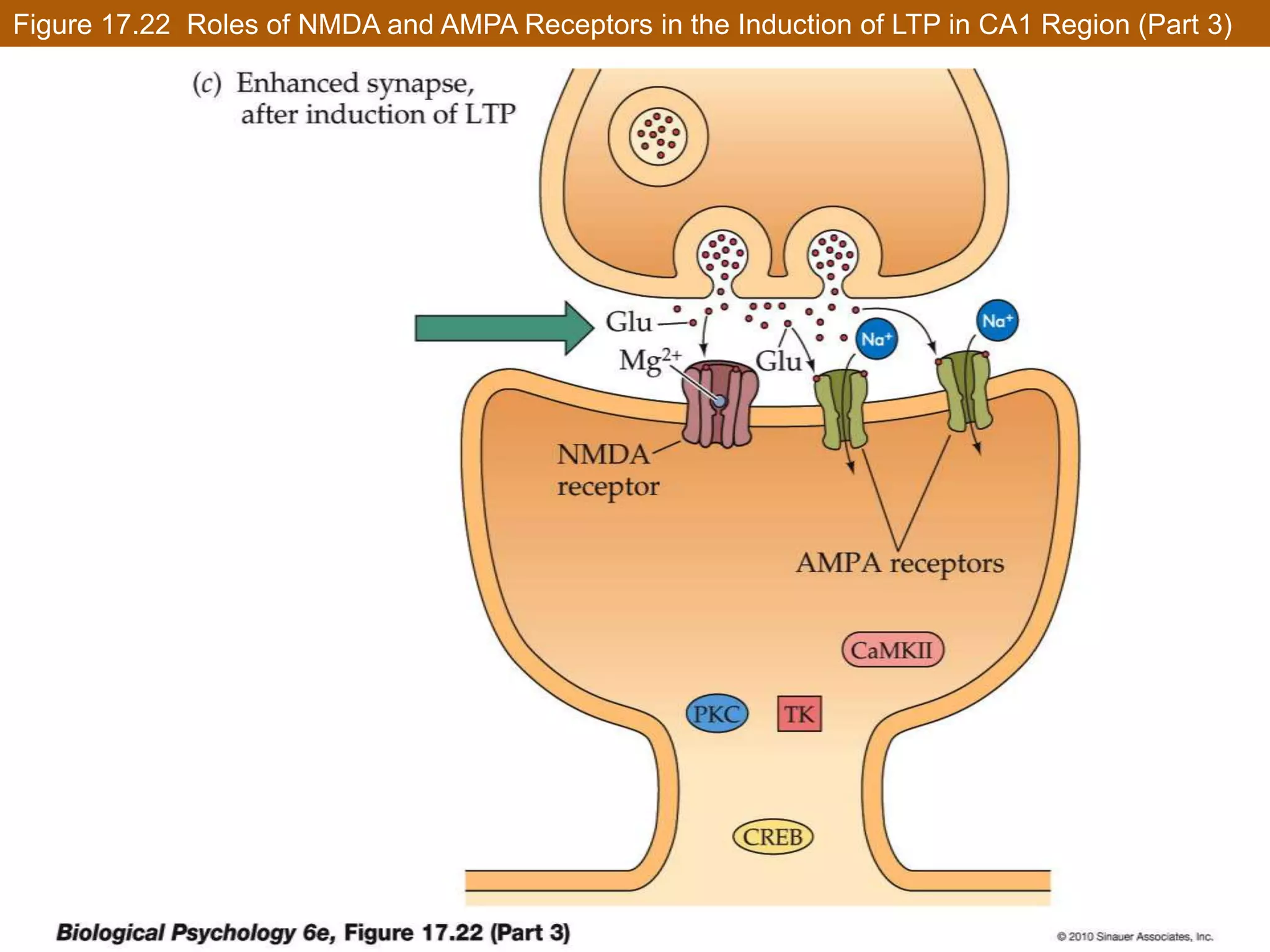
Synaptic Plasticity Can Be Measured in Simple Hippocampal CircuitsCaMKII :Moves existing nearby AMPA receptors into the active synapse.Increases conductance of Na+ and K+ ions in membrane-bound receptors.These effects all increase the synaptic sensitivity to glutamate.The activated protein kinases also trigger protein synthesis
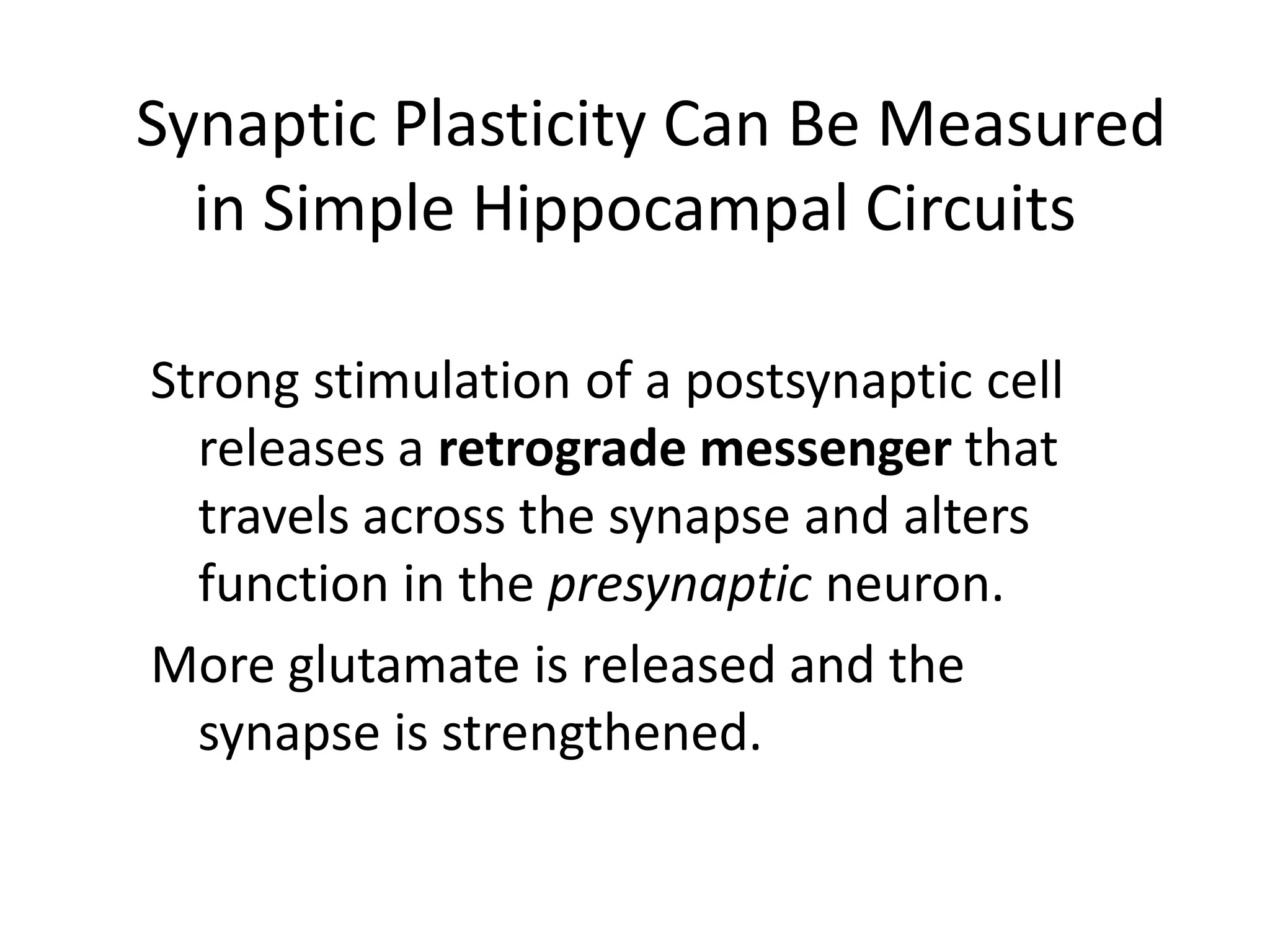
  Synaptic Plasticity Can Be Measured in Simple Hippocampal CircuitsStrong stimulation of a postsynaptic cell releases a retrograde messenger that travels across the synapse and alters function in the presynaptic neuron. More glutamate is released and the synapse is strengthened.
  Synaptic Plasticity Can Be Measured in Simple Hippocampal CircuitsSomatic intervention experiments – pharmacological treatments that block LTP impair learning.Behavioral intervention experiments – show that training an animal in a memory task can induce LTP.
Can YOU see with your tongue?
Neuronal plasticity
Neuronal plasticity
Neuronal plasticity

Neuronal plasticity

  • 1.
  • 2.
    What is neuronalplasticity?Plasticity is the quality of being ‘plastic’ or formative.Neuronal plasticity refers to the ability of the brain to change and adapt itself as a result of one’s experience.
  • 3.
    Applications of NeuronalPlasticity‘Learning new things’‘Making new memories’‘Rewiring circuits’
  • 4.
  • 5.
    The NS isa series of connectionsBirth = 100 billion neurons6 year old has twice as many synapses as an adultBy late adolescence, synapses begin to disappearhttp://www.eng.yale.edu/synapses.htm
  • 6.
    Types of NeuroplasticityTypeMechanismDuration1.Enhancement of existing connections Synapse development Physiological ms-1 to hours Synapse strengthening Biochemical hours to days2. Formation of new connections Unmasking Physiological minutes to days Sprouting Structural days to months3. Formation of new cells Self-replication stem cell variable
  • 7.
    Enhancement of existingconnectionsIncreased use of a synapse in existing pathways e.g. learning a new task Or alternative pathways following damageCortical re-mapping (phantom limb)
  • 8.
    Synapse developmentIncreased afferentinput+New synapses evolve leading to increased excitation++
  • 9.
    Synapse strengtheningTwo pointdiscrimination threshold in pianists index fingerRLRagert et al., 2004
  • 10.
    Synaptic StrengtheningFacilitation (10-100ms)Augmentation (several seconds)Potentiation (seconds to minutes)
  • 11.
    Formation of newconnectionsUnmasking of pre-existing pathwaysSprouting of new pathways
  • 12.
    Unmasking of silentsynapsesPossible reasons why some synapses could be ‘silent’On distal dendritesInhibited by dominant pathwaysToo little transmitterToo few receptorsDon’t fire with other inputs
  • 13.
    Unmasking – inhibitionof subservient pathway by dominant pathway Parallel pathway; neurons with a comparable roleSubservient pathwayDominant pathway++
  • 14.
    UnmaskingLesion to dominantpathwaySubservient pathway is unmasked++Activity is continued despite lesion
  • 15.
  • 16.
  • 17.
    SproutingINJURYNeurite induced tosprout by NGFlesionNGF
  • 18.
    SproutingInjury results incell deathCell is re-innervated from alternative stimulusSprouting may be a means of recovery; it may also produce unwanted effects
  • 19.
    NeurogenesisReplacing dying ordamaged neural cells with new onesNew cells originate from stem cells Introduced stem cells are stimulated to produce neural cells by nerve growth factors (NGF)Stem cell/www.stanford.edu/group/hopes/rltdsci/nplast
  • 20.
  • 21.
  • 22.
    Cortical Re-MappingPeople borndeafWhat happens?Visual areas increase in size and “jobs”Cortical Re-MappingPeople born deafWhat happens?Visual areas increase in size and “jobs”
  • 23.
    Auditory areas maybe “taken over” for visual function Cortical Re-MappingPeople born deafWhat happens?Visual areas increase in size and “jobs”
  • 24.
    Auditory areas maybe “taken over” for visual function
  • 25.
    Improved attention tomovement in the peripheryThe Basis of Neuronal Plasticity Hebb’s Rule :“Neurons that fire together, wire together.””Neurons that fire apart, wire apart.”
  • 26.
    From The Organizationof Behavior by Donald Hebb, 1949:"When one cell repeatedly assists in firing another, the axon of the first cell develops synaptic knobs (or enlarges them if they already exist) in contact with the soma of the second cell."Hebb postulated that this behavior of synapses in neuronal networks would permit the networks to store memories.
  • 27.
    Synaptic StrengtheningFacilitation (10-100ms)Augmentation (several seconds)Potentiation (seconds to minutes)
  • 28.
    Long Term PotentiationInneuroscience, long-term potentiation (LTP) is a long-lasting enhancement in signal transmission between two neurons that results from stimulating them synchronously.
  • 29.
    Input specificityOnce induced,LTP at one synapse does not spread to other synapses; rather LTP is input specific.Cooperativity LTP can be induced by strong stimulation at one synapseOR Weak stimulation at multiple synapses which together depolarize the post synaptic membrane to induce LTP
  • 30.
    Hippocampus  Function: • Consolidation of New Memories • Emotions• Navigation• Spatial Orientation
  • 31.
    Synaptic PlasticityCan Be Measured in Simple Hippocampal CircuitsThe post-synaptic region has both NMDA and AMPA receptors.Glutamate first activates AMPA receptors. NMDA receptors do not respond until enough AMPA receptors are stimulated and the neuron is partially depolarized.
  • 32.
    SynapticPlasticity Can Be Measured in Simple Hippocampal CircuitsNMDA receptors at rest have a magnesium ion (Mg2+) block on their calcium (Ca2+) channels.After partial depolarization, the block is removed and the NMDA receptor allows Ca2+ to enter in response to glutamate.
  • 33.
    Figure 17.22 Roles of NMDA and AMPA Receptors in the Induction of LTP in CA1 Region (Part 1)
  • 34.
    Figure 17.22 Roles of NMDA and AMPA Receptors in the Induction of LTP in CA1 Region (Part 2)
  • 35.
    Figure 17.22 Roles of NMDA and AMPA Receptors in the Induction of LTP in CA1 Region (Part 3)
  • 36.
    Synaptic PlasticityCan Be Measured in Simple Hippocampal CircuitsThe large Ca2+ influx activates certain protein kinases – enzymes that add phosphate groups to protein molecules.One protein kinase is CaMKII – it affects AMPA receptors in several ways:Causes more AMPA receptors to be produced and inserted in the postsynaptic membrane.
  • 37.
    Synaptic Plasticity CanBe Measured in Simple Hippocampal CircuitsCaMKII :Moves existing nearby AMPA receptors into the active synapse.Increases conductance of Na+ and K+ ions in membrane-bound receptors.These effects all increase the synaptic sensitivity to glutamate.The activated protein kinases also trigger protein synthesis
  • 38.
    SynapticPlasticity Can Be Measured in Simple Hippocampal CircuitsStrong stimulation of a postsynaptic cell releases a retrograde messenger that travels across the synapse and alters function in the presynaptic neuron. More glutamate is released and the synapse is strengthened.
  • 39.
    SynapticPlasticity Can Be Measured in Simple Hippocampal CircuitsSomatic intervention experiments – pharmacological treatments that block LTP impair learning.Behavioral intervention experiments – show that training an animal in a memory task can induce LTP.
  • 40.
    Can YOU seewith your tongue?

Editor's Notes

  • #31 LTP can be induced either by strong tetanic stimulation of a single pathway to a synapse, or cooperatively via the weaker stimulation of many. When one pathway into a synapse is stimulated weakly, it produces insufficient postsynaptic depolarization to induce LTP. In contrast, when weak stimuli are applied to many pathways that converge on a single patch of postsynaptic membrane, the individual postsynaptic depolarizations generated may collectively depolarize the postsynaptic cell enough to induce LTP cooperatively.
  • #43 Youtube link: http://www.youtube.com/watch?v=OKd56D2mvN0
  • #44 Youtube link : http://www.youtube.com/watch?v=OKd56D2mvN0