Max SerfatyTeacher for a dayNeuroplasticity: The Brain That Changes ItselfBy Norman Doidge
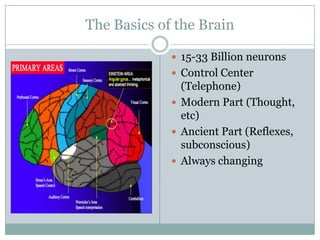
The Basics of the Brain15-33 Billion neuronsControl Center (Telephone)Modern Part (Thought, etc)Ancient Part (Reflexes, subconscious) Always changing
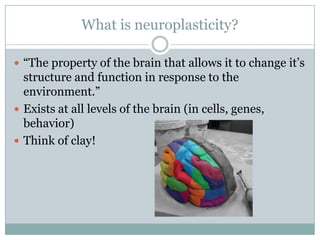
What is neuroplasticity?“The property of the brain that allows it to change it’s structure and function in response to the environment.” Exists at all levels of the brain (in cells, genes, behavior)Think of clay!
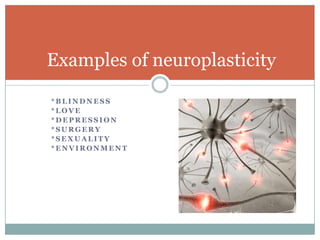
*Blindness*Love *Depression*surgery*Sexuality*EnvironmentExamples of neuroplasticity
Our brains are always changing and creating new paths. Neuroplasticity happens every day, and can be extreme, or minuteSo what is it?
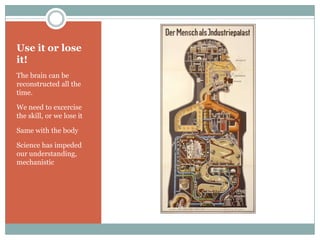
Use it or lose it!The brain can be reconstructed all the time.We need to excercise the skill, or we lose itSame with the bodyScience has impeded our understanding, mechanistic
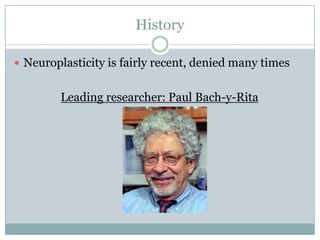
HistoryNeuroplasticity is fairly recent, denied many timesLeading researcher: Paul Bach-y-Rita
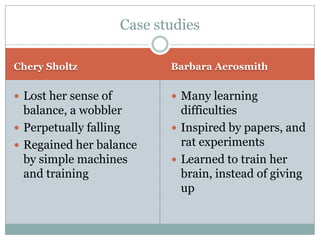
CherySholtzBarbara AerosmithLost her sense of balance, a wobblerPerpetually fallingRegained her balance by simple machines and trainingMany learning difficultiesInspired by papers, and rat experimentsLearned to train her brain, instead of giving upCase studies
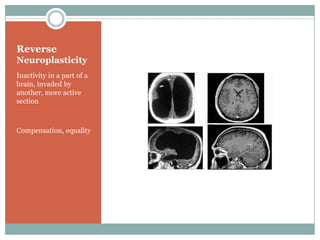
Reverse NeuroplasticityInactivity in a part of a brain, invaded by another, more active sectionCompensation, equality
We need to train our brain everyday! We take this skill for grantedShorter attention spans, think of it!!In summary...

Neuroplasticity

  • 1.
    Max SerfatyTeacher fora dayNeuroplasticity: The Brain That Changes ItselfBy Norman Doidge
  • 2.
    The Basics ofthe Brain15-33 Billion neuronsControl Center (Telephone)Modern Part (Thought, etc)Ancient Part (Reflexes, subconscious) Always changing
  • 3.
    What is neuroplasticity?“Theproperty of the brain that allows it to change it’s structure and function in response to the environment.” Exists at all levels of the brain (in cells, genes, behavior)Think of clay!
  • 4.
  • 5.
    Our brains arealways changing and creating new paths. Neuroplasticity happens every day, and can be extreme, or minuteSo what is it?
  • 6.
    Use it orlose it!The brain can be reconstructed all the time.We need to excercise the skill, or we lose itSame with the bodyScience has impeded our understanding, mechanistic
  • 7.
    HistoryNeuroplasticity is fairlyrecent, denied many timesLeading researcher: Paul Bach-y-Rita
  • 8.
    CherySholtzBarbara AerosmithLost hersense of balance, a wobblerPerpetually fallingRegained her balance by simple machines and trainingMany learning difficultiesInspired by papers, and rat experimentsLearned to train her brain, instead of giving upCase studies
  • 9.
    Reverse NeuroplasticityInactivity ina part of a brain, invaded by another, more active sectionCompensation, equality
  • 10.
    We need totrain our brain everyday! We take this skill for grantedShorter attention spans, think of it!!In summary...