A review of evidences for macroscopic reorganisation
                         from in vivo imaging studies

                                     Written by András Jakab
                         University of Debrecen / ETH Zürich

                           Contact: jakab@vision.ee.ethz.ch
Overview
 The recent advent of in vivo imaging
  techniques like diffusion tensor or
  functional magnetic resonance imaging
  gave rise to studies that „reinvent”
  classical or forgotten aspects of the human
  macroscopic brain anatomy

 One such topic is to investigate the
  structure of major white matter structures
  and their connections („hodology”- Catani,
  2007), this new-old aim was electrified by
  the diffusion weighted and diffusion
  tensor imaging (the former now                      An illustration of the arcuate fasciculus
  celebrating 25th anniversary: Johansen-              signifies the role of neuroimaging in
  Berg et al., 2012)                                             anatomical studies


Catani M (2007) From hodology to function. Brain 130: 602-605.

Le Bihan D, Johansen-Berg H (2012) Diffusion MRI at 25: Exploring brain tissue
structure and function. Neuroimage, in press
Overview
 The brain’s response to reinforced stimuli and adaptation to a changing
  environment is considered the backbone of neuroplasticity, which is predominantly
  understood as the synaptic reorganization within the cortex

 Significant effort is now carried out to reveal
  macroscopic changes to the brain structure
  after learning tasks, which vastly challenges
  the classical views of neuroplasticity as a
  phenomenon embedded in the electrical and
  chemical milieu

 We aimed at reviewing studies that convey
  evidence for the possible macroscopic change
  after extensive learning tasks or challenging
  environments. We focused on imaging studies
  describing changes to white matter structure
  and studies that try to elucidate the possible
  mechanisms that realize and modulate such
  an effect.
                                                          Illustration by H. Cushing
Plastic changes in grey matter thickness
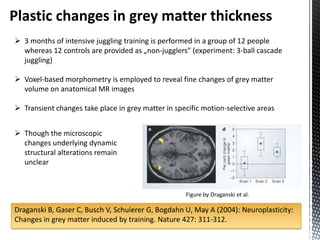
 3 months of intensive juggling training is performed in a group of 12 people
  whereas 12 controls are provided as „non-jugglers” (experiment: 3-ball cascade
  juggling)

 Voxel-based morphometry is employed to reveal fine changes of grey matter
  volume on anatomical MR images

 Transient changes take place in grey matter in specific motion-selective areas


 Though the microscopic
  changes underlying dynamic
  structural alterations remain
  unclear


                                                    Figure by Draganski et al.

Draganski B, Gaser C, Busch V, Schuierer G, Bogdahn U, May A (2004): Neuroplasticity:
Changes in grey matter induced by training. Nature 427: 311-312.
Plastic changes in grey matter thickness
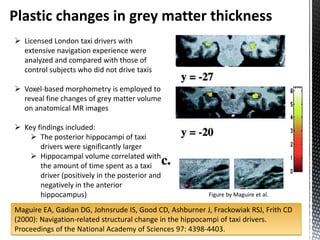
 Licensed London taxi drivers with
  extensive navigation experience were
  analyzed and compared with those of
  control subjects who did not drive taxis

 Voxel-based morphometry is employed to
  reveal fine changes of grey matter volume
  on anatomical MR images

 Key findings included:
     The posterior hippocampi of taxi
       drivers were significantly larger
     Hippocampal volume correlated with
       the amount of time spent as a taxi
       driver (positively in the posterior and
       negatively in the anterior
       hippocampus)                                       Figure by Maguire et al.

Maguire EA, Gadian DG, Johnsrude IS, Good CD, Ashburner J, Frackowiak RSJ, Frith CD
(2000): Navigation-related structural change in the hippocampi of taxi drivers.
Proceedings of the National Academy of Sciences 97: 4398-4403.
Plastic changes in white matter properties
 Experience-dependent structural changes have been found in adult gray matter,
  there is little evidence for such changes in white matter

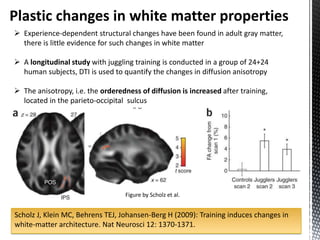
 A longitudinal study with juggling training is conducted in a group of 24+24
  human subjects, DTI is used to quantify the changes in diffusion anisotropy

 The anisotropy, i.e. the orderedness of diffusion is increased after training,
  located in the parieto-occipital sulcus


                                   Figure by Scholz et al.


Scholz J, Klein MC, Behrens TEJ, Johansen-Berg H (2009): Training induces changes in
white-matter architecture. Nat Neurosci 12: 1370-1371.
Plastic changes in white matter properties
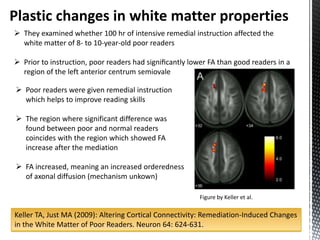
 They examined whether 100 hr of intensive remedial instruction affected the
  white matter of 8- to 10-year-old poor readers

 Prior to instruction, poor readers had significantly lower FA than good readers in a
  region of the left anterior centrum semiovale

 Poor readers were given remedial instruction
  which helps to improve reading skills

 The region where significant difference was
  found between poor and normal readers
  coincides with the region which showed FA
  increase after the mediation

 FA increased, meaning an increased orderedness
  of axonal diffusion (mechanism unkown)

                                                         Figure by Keller et al.

Keller TA, Just MA (2009): Altering Cortical Connectivity: Remediation-Induced Changes
in the White Matter of Poor Readers. Neuron 64: 624-631.
Learning-related white matter properties
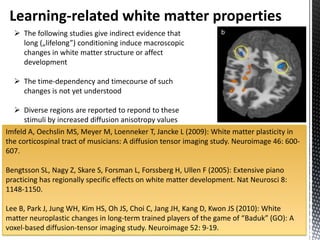
   The following studies give indirect evidence that
    long („lifelong”) conditioning induce macroscopic
    changes in white matter structure or affect
    development

   The time-dependency and timecourse of such
    changes is not yet understood

   Diverse regions are reported to repond to these
      stimuli by increased diffusion anisotropy values
Imfeld A, Oechslin MS, Meyer M, Loenneker T, Jancke L (2009): White matter plasticity in
the corticospinal tract of musicians: A diffusion tensor imaging study. Neuroimage 46: 600-
607.

Bengtsson SL, Nagy Z, Skare S, Forsman L, Forssberg H, Ullen F (2005): Extensive piano
practicing has regionally specific effects on white matter development. Nat Neurosci 8:
1148-1150.

Lee B, Park J, Jung WH, Kim HS, Oh JS, Choi C, Jang JH, Kang D, Kwon JS (2010): White
matter neuroplastic changes in long-term trained players of the game of “Baduk” (GO): A
voxel-based diffusion-tensor imaging study. Neuroimage 52: 9-19.
Plastic changes in white matter properties
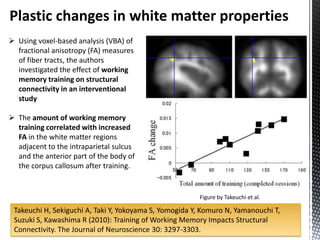
 Using voxel-based analysis (VBA) of
  fractional anisotropy (FA) measures
  of fiber tracts, the authors
  investigated the effect of working
  memory training on structural
  connectivity in an interventional
  study

 The amount of working memory
  training correlated with increased
  FA in the white matter regions
  adjacent to the intraparietal sulcus
  and the anterior part of the body of
  the corpus callosum after training.


                                                        Figure by Takeuchi et al.

 Takeuchi H, Sekiguchi A, Taki Y, Yokoyama S, Yomogida Y, Komuro N, Yamanouchi T,
 Suzuki S, Kawashima R (2010): Training of Working Memory Impacts Structural
 Connectivity. The Journal of Neuroscience 30: 3297-3303.
White matter plasticity in adults and the elderly?
 If the hypothesis is justifiable that anisotropy (FA)
  increase is the sign of plastic changes in white
  matter, it still remains unclear if this ability is
  available through the entire lifespan

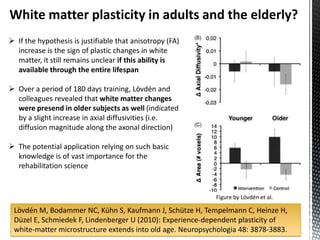
 Over a period of 180 days training, Lövdén and
  colleagues revealed that white matter changes
  were presend in older subjects as well (indicated
  by a slight increase in axial diffusivities (i.e.
  diffusion magnitude along the axonal direction)

 The potential application relying on such basic
  knowledge is of vast importance for the
  rehabilitation science


                                                            Figure by Lövdén et al.

 Lövdén M, Bodammer NC, Kühn S, Kaufmann J, Schütze H, Tempelmann C, Heinze H,
 Düzel E, Schmiedek F, Lindenberger U (2010): Experience-dependent plasticity of
 white-matter microstructure extends into old age. Neuropsychologia 48: 3878-3883.
Plastic changes affected diffusion anisotropy.
Where does anisotropy originate from?
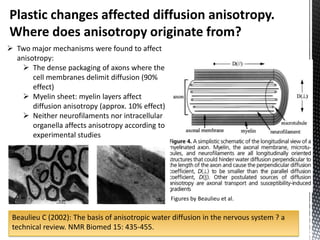
 Two major mechanisms were found to affect
  anisotropy:
     The dense packaging of axons where the
       cell membranes delimit diffusion (90%
       effect)
     Myelin sheet: myelin layers affect
       diffusion anisotropy (approx. 10% effect)
     Neither neurofilaments nor intracellular
       organella affects anisotropy according to
       experimental studies


                                                   Figures by Beaulieu et al.


 Beaulieu C (2002): The basis of anisotropic water diffusion in the nervous system ? a
 technical review. NMR Biomed 15: 435-455.
Age related changes of white matter anisotropy
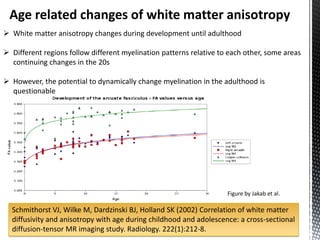
 White matter anisotropy changes during development until adulthood

 Different regions follow different myelination patterns relative to each other, some areas
  continuing changes in the 20s

 However, the potential to dynamically change myelination in the adulthood is
  questionable


                                                                     Figure by Jakab et al.

  Schmithorst VJ, Wilke M, Dardzinski BJ, Holland SK (2002) Correlation of white matter
  diffusivity and anisotropy with age during childhood and adolescence: a cross-sectional
  diffusion-tensor MR imaging study. Radiology. 222(1):212-8.
Possible mechanisms for white matter
neuroplastic chages
 Significant changes in the axonal membrane structure
  or new growth of axons are not viable and unproven
  mechanisms for neuroplastic changes in white
  matter

 It has been proposed that learning-associated
  myelination could be responsible for the
  observations

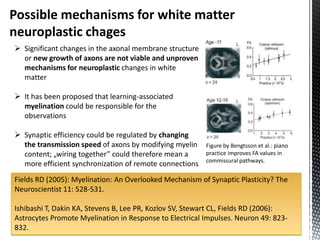
 Synaptic efficiency could be regulated by changing
  the transmission speed of axons by modifying myelin    Figure by Bengtsson et al.: piano
  content; „wiring together” could therefore mean a      practice improves FA values in
                                                         commissural pathways.
  more efficient synchronization of remote connections
Fields RD (2005): Myelination: An Overlooked Mechanism of Synaptic Plasticity? The
Neuroscientist 11: 528-531.

Ishibashi T, Dakin KA, Stevens B, Lee PR, Kozlov SV, Stewart CL, Fields RD (2006):
Astrocytes Promote Myelination in Response to Electrical Impulses. Neuron 49: 823-
832.
Possible mechanisms for white matter
neuroplastic chages
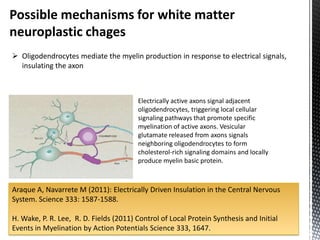
 Oligodendrocytes mediate the myelin production in response to electrical signals,
  insulating the axon


                                        Electrically active axons signal adjacent
                                        oligodendrocytes, triggering local cellular
                                        signaling pathways that promote specific
                                        myelination of active axons. Vesicular
                                        glutamate released from axons signals
                                        neighboring oligodendrocytes to form
                                        cholesterol-rich signaling domains and locally
                                        produce myelin basic protein.


Araque A, Navarrete M (2011): Electrically Driven Insulation in the Central Nervous
System. Science 333: 1587-1588.

H. Wake, P. R. Lee, R. D. Fields (2011) Control of Local Protein Synthesis and Initial
Events in Myelination by Action Potentials Science 333, 1647.
Perspectives
 In vivo imaging delivered interesting
  but contradictory results on the
  possible changes of white matter
  during neuroplasticity

 It is not yet obvious which
  mechanisms are most responsible for
  this effect

 Myelination is potentially modulated
  in the adulthood representing a
  meaningful way to retune and
  synchronize brain circuits

 Still far from the practical application
  of this knowledge, there is no mean to
  intervene into this mechanism to
  facilitate better brain regeneration
  after neuronal (axonal) loss
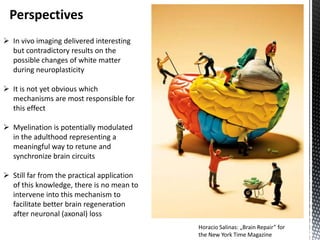
                                             Horacio Salinas: „Brain Repair” for
                                             the New York Time Magazine

Neuroplasticity

  • 1.
    A review ofevidences for macroscopic reorganisation from in vivo imaging studies Written by András Jakab University of Debrecen / ETH Zürich Contact: jakab@vision.ee.ethz.ch
  • 2.
    Overview  The recentadvent of in vivo imaging techniques like diffusion tensor or functional magnetic resonance imaging gave rise to studies that „reinvent” classical or forgotten aspects of the human macroscopic brain anatomy  One such topic is to investigate the structure of major white matter structures and their connections („hodology”- Catani, 2007), this new-old aim was electrified by the diffusion weighted and diffusion tensor imaging (the former now An illustration of the arcuate fasciculus celebrating 25th anniversary: Johansen- signifies the role of neuroimaging in Berg et al., 2012) anatomical studies Catani M (2007) From hodology to function. Brain 130: 602-605. Le Bihan D, Johansen-Berg H (2012) Diffusion MRI at 25: Exploring brain tissue structure and function. Neuroimage, in press
  • 3.
    Overview  The brain’sresponse to reinforced stimuli and adaptation to a changing environment is considered the backbone of neuroplasticity, which is predominantly understood as the synaptic reorganization within the cortex  Significant effort is now carried out to reveal macroscopic changes to the brain structure after learning tasks, which vastly challenges the classical views of neuroplasticity as a phenomenon embedded in the electrical and chemical milieu  We aimed at reviewing studies that convey evidence for the possible macroscopic change after extensive learning tasks or challenging environments. We focused on imaging studies describing changes to white matter structure and studies that try to elucidate the possible mechanisms that realize and modulate such an effect. Illustration by H. Cushing
  • 4.
    Plastic changes ingrey matter thickness  3 months of intensive juggling training is performed in a group of 12 people whereas 12 controls are provided as „non-jugglers” (experiment: 3-ball cascade juggling)  Voxel-based morphometry is employed to reveal fine changes of grey matter volume on anatomical MR images  Transient changes take place in grey matter in specific motion-selective areas  Though the microscopic changes underlying dynamic structural alterations remain unclear Figure by Draganski et al. Draganski B, Gaser C, Busch V, Schuierer G, Bogdahn U, May A (2004): Neuroplasticity: Changes in grey matter induced by training. Nature 427: 311-312.
  • 5.
    Plastic changes ingrey matter thickness  Licensed London taxi drivers with extensive navigation experience were analyzed and compared with those of control subjects who did not drive taxis  Voxel-based morphometry is employed to reveal fine changes of grey matter volume on anatomical MR images  Key findings included:  The posterior hippocampi of taxi drivers were significantly larger  Hippocampal volume correlated with the amount of time spent as a taxi driver (positively in the posterior and negatively in the anterior hippocampus) Figure by Maguire et al. Maguire EA, Gadian DG, Johnsrude IS, Good CD, Ashburner J, Frackowiak RSJ, Frith CD (2000): Navigation-related structural change in the hippocampi of taxi drivers. Proceedings of the National Academy of Sciences 97: 4398-4403.
  • 6.
    Plastic changes inwhite matter properties  Experience-dependent structural changes have been found in adult gray matter, there is little evidence for such changes in white matter  A longitudinal study with juggling training is conducted in a group of 24+24 human subjects, DTI is used to quantify the changes in diffusion anisotropy  The anisotropy, i.e. the orderedness of diffusion is increased after training, located in the parieto-occipital sulcus Figure by Scholz et al. Scholz J, Klein MC, Behrens TEJ, Johansen-Berg H (2009): Training induces changes in white-matter architecture. Nat Neurosci 12: 1370-1371.
  • 7.
    Plastic changes inwhite matter properties  They examined whether 100 hr of intensive remedial instruction affected the white matter of 8- to 10-year-old poor readers  Prior to instruction, poor readers had significantly lower FA than good readers in a region of the left anterior centrum semiovale  Poor readers were given remedial instruction which helps to improve reading skills  The region where significant difference was found between poor and normal readers coincides with the region which showed FA increase after the mediation  FA increased, meaning an increased orderedness of axonal diffusion (mechanism unkown) Figure by Keller et al. Keller TA, Just MA (2009): Altering Cortical Connectivity: Remediation-Induced Changes in the White Matter of Poor Readers. Neuron 64: 624-631.
  • 8.
    Learning-related white matterproperties  The following studies give indirect evidence that long („lifelong”) conditioning induce macroscopic changes in white matter structure or affect development  The time-dependency and timecourse of such changes is not yet understood  Diverse regions are reported to repond to these stimuli by increased diffusion anisotropy values Imfeld A, Oechslin MS, Meyer M, Loenneker T, Jancke L (2009): White matter plasticity in the corticospinal tract of musicians: A diffusion tensor imaging study. Neuroimage 46: 600- 607. Bengtsson SL, Nagy Z, Skare S, Forsman L, Forssberg H, Ullen F (2005): Extensive piano practicing has regionally specific effects on white matter development. Nat Neurosci 8: 1148-1150. Lee B, Park J, Jung WH, Kim HS, Oh JS, Choi C, Jang JH, Kang D, Kwon JS (2010): White matter neuroplastic changes in long-term trained players of the game of “Baduk” (GO): A voxel-based diffusion-tensor imaging study. Neuroimage 52: 9-19.
  • 9.
    Plastic changes inwhite matter properties  Using voxel-based analysis (VBA) of fractional anisotropy (FA) measures of fiber tracts, the authors investigated the effect of working memory training on structural connectivity in an interventional study  The amount of working memory training correlated with increased FA in the white matter regions adjacent to the intraparietal sulcus and the anterior part of the body of the corpus callosum after training. Figure by Takeuchi et al. Takeuchi H, Sekiguchi A, Taki Y, Yokoyama S, Yomogida Y, Komuro N, Yamanouchi T, Suzuki S, Kawashima R (2010): Training of Working Memory Impacts Structural Connectivity. The Journal of Neuroscience 30: 3297-3303.
  • 10.
    White matter plasticityin adults and the elderly?  If the hypothesis is justifiable that anisotropy (FA) increase is the sign of plastic changes in white matter, it still remains unclear if this ability is available through the entire lifespan  Over a period of 180 days training, Lövdén and colleagues revealed that white matter changes were presend in older subjects as well (indicated by a slight increase in axial diffusivities (i.e. diffusion magnitude along the axonal direction)  The potential application relying on such basic knowledge is of vast importance for the rehabilitation science Figure by Lövdén et al. Lövdén M, Bodammer NC, Kühn S, Kaufmann J, Schütze H, Tempelmann C, Heinze H, Düzel E, Schmiedek F, Lindenberger U (2010): Experience-dependent plasticity of white-matter microstructure extends into old age. Neuropsychologia 48: 3878-3883.
  • 11.
    Plastic changes affecteddiffusion anisotropy. Where does anisotropy originate from?  Two major mechanisms were found to affect anisotropy:  The dense packaging of axons where the cell membranes delimit diffusion (90% effect)  Myelin sheet: myelin layers affect diffusion anisotropy (approx. 10% effect)  Neither neurofilaments nor intracellular organella affects anisotropy according to experimental studies Figures by Beaulieu et al. Beaulieu C (2002): The basis of anisotropic water diffusion in the nervous system ? a technical review. NMR Biomed 15: 435-455.
  • 12.
    Age related changesof white matter anisotropy  White matter anisotropy changes during development until adulthood  Different regions follow different myelination patterns relative to each other, some areas continuing changes in the 20s  However, the potential to dynamically change myelination in the adulthood is questionable Figure by Jakab et al. Schmithorst VJ, Wilke M, Dardzinski BJ, Holland SK (2002) Correlation of white matter diffusivity and anisotropy with age during childhood and adolescence: a cross-sectional diffusion-tensor MR imaging study. Radiology. 222(1):212-8.
  • 13.
    Possible mechanisms forwhite matter neuroplastic chages  Significant changes in the axonal membrane structure or new growth of axons are not viable and unproven mechanisms for neuroplastic changes in white matter  It has been proposed that learning-associated myelination could be responsible for the observations  Synaptic efficiency could be regulated by changing the transmission speed of axons by modifying myelin Figure by Bengtsson et al.: piano content; „wiring together” could therefore mean a practice improves FA values in commissural pathways. more efficient synchronization of remote connections Fields RD (2005): Myelination: An Overlooked Mechanism of Synaptic Plasticity? The Neuroscientist 11: 528-531. Ishibashi T, Dakin KA, Stevens B, Lee PR, Kozlov SV, Stewart CL, Fields RD (2006): Astrocytes Promote Myelination in Response to Electrical Impulses. Neuron 49: 823- 832.
  • 14.
    Possible mechanisms forwhite matter neuroplastic chages  Oligodendrocytes mediate the myelin production in response to electrical signals, insulating the axon Electrically active axons signal adjacent oligodendrocytes, triggering local cellular signaling pathways that promote specific myelination of active axons. Vesicular glutamate released from axons signals neighboring oligodendrocytes to form cholesterol-rich signaling domains and locally produce myelin basic protein. Araque A, Navarrete M (2011): Electrically Driven Insulation in the Central Nervous System. Science 333: 1587-1588. H. Wake, P. R. Lee, R. D. Fields (2011) Control of Local Protein Synthesis and Initial Events in Myelination by Action Potentials Science 333, 1647.
  • 15.
    Perspectives  In vivoimaging delivered interesting but contradictory results on the possible changes of white matter during neuroplasticity  It is not yet obvious which mechanisms are most responsible for this effect  Myelination is potentially modulated in the adulthood representing a meaningful way to retune and synchronize brain circuits  Still far from the practical application of this knowledge, there is no mean to intervene into this mechanism to facilitate better brain regeneration after neuronal (axonal) loss Horacio Salinas: „Brain Repair” for the New York Time Magazine