What is
Neuron?
Presented by:
Attroba Adan (01)
Hina Liaqat (10)
Neuron
 It is the basic structural and functional unit of
Nervous System.
 Neurons are specialized to transmit
information throughout the body.
 There are about 100 billion neurons in human
brain.
Structure of Neuron
 Like other body cells, Neurons have:
• a Cell Membrane.
• a Nucleus that contains DNA.
• some working parts known as Organelles.
Structure of Neuron
 Unlike other cells, Neurons have:
• Irregular shape.
• Specialized extensions called Dendrites and Axons.
• Chemicals for communication called
Neurotransmitters.
Dendrites
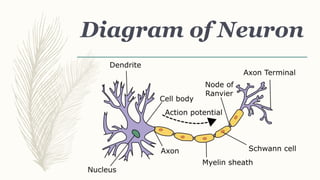
 A dendrite is a structure of the neuron that
brings information to the cell body from
another neuron.
 It has rough surface, with little bumps called
dendritic spines that increase the surface area
of the dendrite so that it can receive more
information from the neighboring neuron.
Axon
 An axon carries information away from the cell
body to the dendrites of a neighboring neuron.
 Axons have smooth surfaces and no spines like
dendrites have.
Myelin and Nodes of
Ranvier
 There are some other structures in neurons
called Myelin and Nodes of Ranvier:
• Myelin is a fatty substance that covers some
axon.
• There are breaks at various points in myelin,
known as Nodes of Ranvier.
Diagram of Neuron
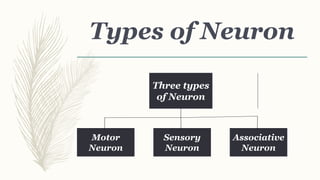
Types of Neuron
Three types
of Neuron
Motor
Neuron
Sensory
Neuron
Associative
Neuron
Motor Neuron
 Motor Neurons carry signals from Central
Nervous System to the peripheral parts
(muscles, skin and glands) of the body.
 They have very long axons.
Sensory Neuron
 Sensory Neurons carry signals from the
peripheral parts of body to the Central Nervous
System.
 They transmit impulses from the receptors in
our sense organs (nose, ear etc.) to the brain.
Associative Neuron
 Associative Neurons connect various neurons
within the brain and spinal cord.
 Only found in the brain, spinal cord and eye.
 They have short axon.
Electrochemical Process
 The process through which a neuron carries
information from one part of brain to another
is called Electrochemical Process.
 The electro part happens in the neuron itself.
 The chemical part takes place at the junction
between two neurons called Synapse.
Function
 The function of neurons is to allow you to think
and behave.
Neuron

Neuron

  • 2.
    What is Neuron? Presented by: AttrobaAdan (01) Hina Liaqat (10)
  • 3.
    Neuron  It isthe basic structural and functional unit of Nervous System.  Neurons are specialized to transmit information throughout the body.  There are about 100 billion neurons in human brain.
  • 4.
    Structure of Neuron Like other body cells, Neurons have: • a Cell Membrane. • a Nucleus that contains DNA. • some working parts known as Organelles.
  • 5.
    Structure of Neuron Unlike other cells, Neurons have: • Irregular shape. • Specialized extensions called Dendrites and Axons. • Chemicals for communication called Neurotransmitters.
  • 6.
    Dendrites  A dendriteis a structure of the neuron that brings information to the cell body from another neuron.  It has rough surface, with little bumps called dendritic spines that increase the surface area of the dendrite so that it can receive more information from the neighboring neuron.
  • 7.
    Axon  An axoncarries information away from the cell body to the dendrites of a neighboring neuron.  Axons have smooth surfaces and no spines like dendrites have.
  • 8.
    Myelin and Nodesof Ranvier  There are some other structures in neurons called Myelin and Nodes of Ranvier: • Myelin is a fatty substance that covers some axon. • There are breaks at various points in myelin, known as Nodes of Ranvier.
  • 9.
  • 10.
    Types of Neuron Threetypes of Neuron Motor Neuron Sensory Neuron Associative Neuron
  • 11.
    Motor Neuron  MotorNeurons carry signals from Central Nervous System to the peripheral parts (muscles, skin and glands) of the body.  They have very long axons.
  • 12.
    Sensory Neuron  SensoryNeurons carry signals from the peripheral parts of body to the Central Nervous System.  They transmit impulses from the receptors in our sense organs (nose, ear etc.) to the brain.
  • 13.
    Associative Neuron  AssociativeNeurons connect various neurons within the brain and spinal cord.  Only found in the brain, spinal cord and eye.  They have short axon.
  • 14.
    Electrochemical Process  Theprocess through which a neuron carries information from one part of brain to another is called Electrochemical Process.  The electro part happens in the neuron itself.  The chemical part takes place at the junction between two neurons called Synapse.
  • 15.
    Function  The functionof neurons is to allow you to think and behave.