Presented by:
Gebusion Rhoan, Mendoza, Porras Franzel, Sarito.
MUSCULAR
DYSTROPHY
WHAT IS MUSCULAR
DYSTROPHY?
❑ Muscular dystrophy (MD) is a group of genetic
diseases causing progressive weakness and
degeneration of skeletal muscles.
❑ There are more than 30 variations of these disorders,
differing in age of onset, severity, and the pattern of
affected muscles.
❑ All forms of MD worsen over time as muscles
degenerate, often leading to the loss of walking ability.
WHAT IS MUSCULAR
DYSTROPHY?
❑ Certain types of MD can also affect the heart, lungs,
gastrointestinal system, endocrine glands, spine, eyes,
brain, or other organs.

❑ Some individuals with MD may develop a swallowing
disorder.
❑ It's important to note that MD is not contagious and
cannot be caused by injury or activity.
THE IMPACT OF
MUSCULAR DYSTROPHY
Within the muscle fiber membrane, the dystrophin-glycoprotein
complex, a group of proteins, safeguards against damage during
muscle contractions and relaxations.When this protective
membrane is compromised, muscle fibers release creatine kinase
and accumulate excess calcium, leading to damage and eventual
degeneration.
Some muscular dystrophies result from defects in the
dystrophin-glycoprotein complex, others from issues in
connective tissue, and still others from the expression of
harmful gene products in muscle fibers.
○ Muscle degeneration
○ Progressive weakness
○ Fiber death and phagocytosis (wherein muscle
fibers are broken down and destroyed by
scavenger cells)
○ Fiber branching and splitting
○ Replacement of muscle tissue with fibrous
tissue and fat
This damage can cause:
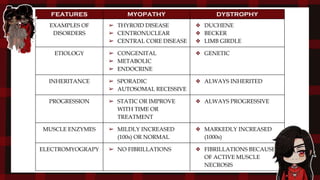
CONDITIONS SIMILAR TO
MuSCULAR DYSTROPHY
FEATURES MYOPATHY DYSTROPHY
EXAMPLES OF
DISORDERS
➢ THYROID DISEASE
➢ CENTRONUCLEAR
➢ CENTRAL CORE DISEASE
❖ DUCHENE
❖ BECKER
❖ LIMB GIRDLE
ETIOLOGY ➢ CONGENITAL
➢ METABOLIC
➢ ENDOCRINE
❖ GENETIC
INHERITANCE ➢ SPORADIC
➢ AUTOSOMAL RECESSIVE
❖ ALWAYS INHERITED
PROGRESSION ➢ STATIC OR IMPROVE
WITH TIME OR
TREATMENT
❖ ALWAYS PROGRESSIVE
MUSCLE ENZYMES ➢ MILDLY INCREASED
(100s) OR NORMAL
❖ MARKEDLY INCREASED
(1000s)
ELECTROMYOGRAPY ➢ NO FIBRILLATIONS ❖ FIBRILLATIONS BECAUSE
OF ACTIVE MUSCLE
NECROSIS
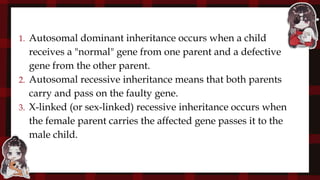
Muscular Dystrophy
Can be inherited in
Three ways
1. Autosomal dominant inheritance occurs when a child
receives a "normal" gene from one parent and a defective
gene from the other parent.
2. Autosomal recessive inheritance means that both parents
carry and pass on the faulty gene.
3. X-linked (or sex-linked) recessive inheritance occurs when
the female parent carries the affected gene passes it to the
male child.
TYPES, CAUSE AND
SYMPTOMS OF
MuSCULAR DYSTROPHY
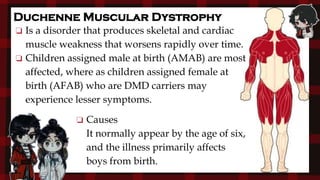
Duchenne Muscular Dystrophy
❏ Causes
It normally appear by the age of six,
and the illness primarily affects
boys from birth.
❏ Is a disorder that produces skeletal and cardiac
muscle weakness that worsens rapidly over time.
❏ Children assigned male at birth (AMAB) are most
affected, where as children assigned female at
birth (AFAB) who are DMD carriers may
experience lesser symptoms.
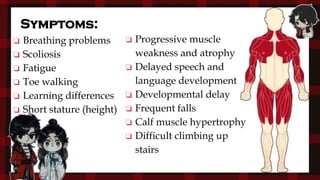
Symptoms:
❏ Breathing problems
❏ Scoliosis
❏ Fatigue
❏ Toe walking
❏ Learning differences
❏ Short stature (height)
❏ Progressive muscle
weakness and atrophy
❏ Delayed speech and
language development
❏ Developmental delay
❏ Frequent falls
❏ Calf muscle hypertrophy
❏ Difficult climbing up
stairs
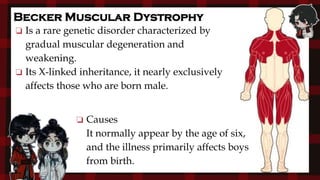
❏ Is a rare genetic disorder characterized by
gradual muscular degeneration and
weakening.
❏ Its X-linked inheritance, it nearly exclusively
affects those who are born male.
Becker Muscular Dystrophy
❏ Causes
It normally appear by the age of six,
and the illness primarily affects boys
from birth.
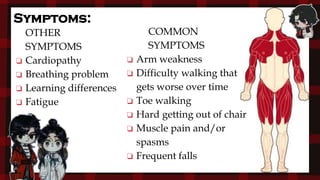
Symptoms:
OTHER
SYMPTOMS
❏ Cardiopathy
❏ Breathing problem
❏ Learning differences
❏ Fatigue
COMMON
SYMPTOMS
❏ Arm weakness
❏ Difficulty walking that
gets worse over time
❏ Toe walking
❏ Hard getting out of chair
❏ Muscle pain and/or
spasms
❏ Frequent falls
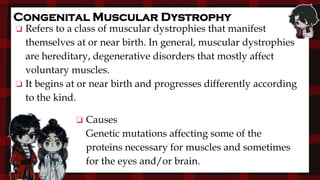
❏ Refers to a class of muscular dystrophies that manifest
themselves at or near birth. In general, muscular dystrophies
are hereditary, degenerative disorders that mostly affect
voluntary muscles.
❏ It begins at or near birth and progresses differently according
to the kind.
Congenital Muscular Dystrophy
❏ Causes
Genetic mutations affecting some of the
proteins necessary for muscles and sometimes
for the eyes and/or brain.
Overall muscle weakness with possible joint stiffness or
looseness. Depending on the type, may involve spinal
curvature, respiratory insufficiency, intellectual
disabilities, learning disabilities, eye defects or seizures.
Symptoms:
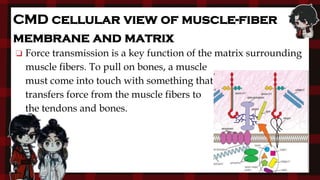
❏ Force transmission is a key function of the matrix surrounding
muscle fibers. To pull on bones, a muscle
must come into touch with something that
transfers force from the muscle fibers to
the tendons and bones.
CMD cellular view of muscle-fiber
membrane and matrix
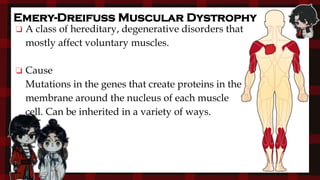
Emery-Dreifuss Muscular Dystrophy
❏ A class of hereditary, degenerative disorders that
mostly affect voluntary muscles.
❏ Cause
Mutations in the genes that create proteins in the
membrane around the nucleus of each muscle
cell. Can be inherited in a variety of ways.
Symptoms:
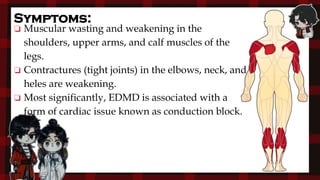
❏ Muscular wasting and weakening in the
shoulders, upper arms, and calf muscles of the
legs.
❏ Contractures (tight joints) in the elbows, neck, and
heles are weakening.
❏ Most significantly, EDMD is associated with a
form of cardiac issue known as conduction block.
Facioscapulohumeral MD
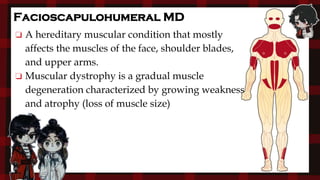
❏ A hereditary muscular condition that mostly
affects the muscles of the face, shoulder blades,
and upper arms.
❏ Muscular dystrophy is a gradual muscle
degeneration characterized by growing weakness
and atrophy (loss of muscle size)
Symptoms:
❏ Cause
Inherited from either the father or the mother, or it
might develop spontaneously. A genetic fault
(mutation) that results in incorrect expression is
the most likely cause of FSHD.
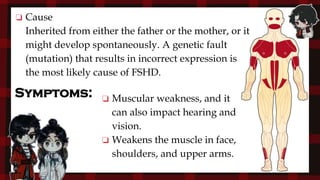
❏ Muscular weakness, and it
can also impact hearing and
vision.
❏ Weakens the muscle in face,
shoulders, and upper arms.
❏ Cause
Manufacture the various proteins
needed by the body.
Limb-girdle Muscular Dystrophy
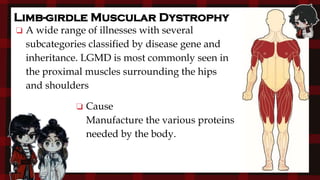
❏ A wide range of illnesses with several
subcategories classified by disease gene and
inheritance. LGMD is most commonly seen in
the proximal muscles surrounding the hips
and shoulders
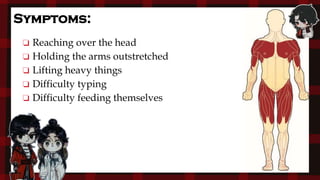
❏ Reaching over the head
❏ Holding the arms outstretched
❏ Lifting heavy things
❏ Difficulty typing
❏ Difficulty feeding themselves
Symptoms:
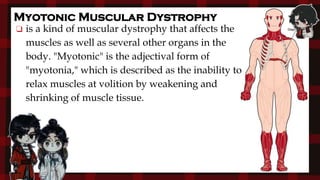
Myotonic Muscular Dystrophy
❏ is a kind of muscular dystrophy that affects the
muscles as well as several other organs in the
body. "Myotonic" is the adjectival form of
"myotonia," which is described as the inability to
relax muscles at volition by weakening and
shrinking of muscle tissue.
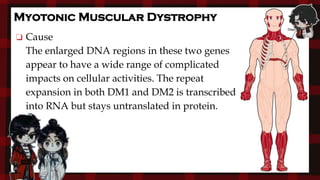
Myotonic Muscular Dystrophy
❏ Cause
The enlarged DNA regions in these two genes
appear to have a wide range of complicated
impacts on cellular activities. The repeat
expansion in both DM1 and DM2 is transcribed
into RNA but stays untranslated in protein.
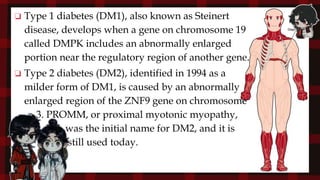
❏ Type 1 diabetes (DM1), also known as Steinert
disease, develops when a gene on chromosome 19
called DMPK includes an abnormally enlarged
portion near the regulatory region of another gene.
❏ Type 2 diabetes (DM2), identified in 1994 as a
milder form of DM1, is caused by an abnormally
enlarged region of the ZNF9 gene on chromosome
3. PROMM, or proximal myotonic myopathy,
was the initial name for DM2, and it is
still used today.
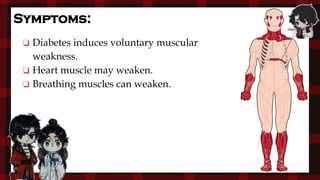
❏ Diabetes induces voluntary muscular
weakness.
❏ Heart muscle may weaken.
❏ Breathing muscles can weaken.
Symptoms:
❏ Cause
A genetic defect in the PABPN1
gene, which leads to the production
of a nonfunctional protein that
forms clumps in the muscle cells.
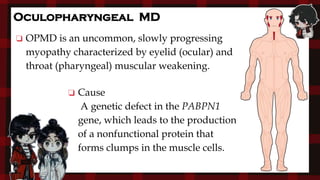
❏ OPMD is an uncommon, slowly progressing
myopathy characterized by eyelid (ocular) and
throat (pharyngeal) muscular weakening.
Oculopharyngeal MD
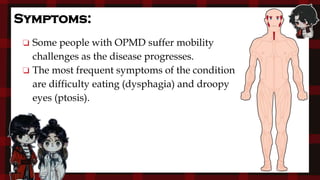
❏ Some people with OPMD suffer mobility
challenges as the disease progresses.
❏ The most frequent symptoms of the condition
are difficulty eating (dysphagia) and droopy
eyes (ptosis).
Symptoms:
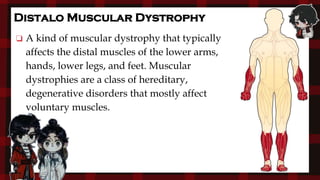
Distalo Muscular Dystrophy
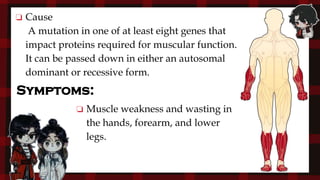
❏ A kind of muscular dystrophy that typically
affects the distal muscles of the lower arms,
hands, lower legs, and feet. Muscular
dystrophies are a class of hereditary,
degenerative disorders that mostly affect
voluntary muscles.
❏ Muscle weakness and wasting in
the hands, forearm, and lower
legs.
Symptoms:
❏ Cause
A mutation in one of at least eight genes that
impact proteins required for muscular function.
It can be passed down in either an autosomal
dominant or recessive form.
How Common is Muscle Dystrophy?
According to the Cleveland Clinic, muscular dystrophy
is relatively rare. All of the different types combined
effect about 16 to 25 per 100,000 people in the U.S. The
most common childhood form is Duchenne muscular
dystrophy.
In the Philippines, the MDAP(Muscular Dystrophy
Association of the Philippines) estimates that over 200
individuals are affected by the disease, constituting
about 0.0002% of the entire population.
Management and Treatment
❏ People with muscular dystrophy should have a team
of doctors and therapists to monitor their condition
and provide care.
❏ Medications like corticosteroids can help with muscle
strength, but they can have side effects. Newer drugs
have been approved for certain types of muscular
dystrophy. Therapy, such as stretching exercises and
low-impact aerobic exercise, can improve mobility
and quality of life.
Management and Treatment
❏ It's important to prevent respiratory infections by
getting vaccinated and avoiding sick people.
❏ These mutations are usually inherited from parents
who carry the faulty genes.
Diagnosis and Test
To diagnose muscular dystrophy, doctors will conduct a
physical exam, ask about family medical history, and
inquire about the specific symptoms observed in the
child. They may also use various tests, such as blood
tests to check enzyme levels, electromyography to
measure electrical activity in the muscles, muscle
biopsy to examine muscle tissue, and tests of
muscle strength, reflexes, and coordination.
Diagnosis and Test
Additionally, an electrocardiogram and imaging
techniques like MRI or ultrasound may be used to
assess the heart and muscles. Genetic testing can
also be performed to identify the specific genes
responsible for muscular dystrophy. It is important
to consult with a doctor or genetics counselor to
understand the implications of the test results,
especially for individuals planning to have
children.
THANK YOU!

-MUSCULAR-DYSTROPHY- as a disease(focus on DEV BIO).pptx

  • 1.
    Presented by: Gebusion Rhoan,Mendoza, Porras Franzel, Sarito. MUSCULAR DYSTROPHY
  • 2.
    WHAT IS MUSCULAR DYSTROPHY? ❑Muscular dystrophy (MD) is a group of genetic diseases causing progressive weakness and degeneration of skeletal muscles. ❑ There are more than 30 variations of these disorders, differing in age of onset, severity, and the pattern of affected muscles. ❑ All forms of MD worsen over time as muscles degenerate, often leading to the loss of walking ability.
  • 3.
    WHAT IS MUSCULAR DYSTROPHY? ❑Certain types of MD can also affect the heart, lungs, gastrointestinal system, endocrine glands, spine, eyes, brain, or other organs. ❑ Some individuals with MD may develop a swallowing disorder. ❑ It's important to note that MD is not contagious and cannot be caused by injury or activity.
  • 4.
  • 5.
    Within the musclefiber membrane, the dystrophin-glycoprotein complex, a group of proteins, safeguards against damage during muscle contractions and relaxations.When this protective membrane is compromised, muscle fibers release creatine kinase and accumulate excess calcium, leading to damage and eventual degeneration. Some muscular dystrophies result from defects in the dystrophin-glycoprotein complex, others from issues in connective tissue, and still others from the expression of harmful gene products in muscle fibers.
  • 6.
    ○ Muscle degeneration ○Progressive weakness ○ Fiber death and phagocytosis (wherein muscle fibers are broken down and destroyed by scavenger cells) ○ Fiber branching and splitting ○ Replacement of muscle tissue with fibrous tissue and fat This damage can cause:
  • 7.
  • 8.
    FEATURES MYOPATHY DYSTROPHY EXAMPLESOF DISORDERS ➢ THYROID DISEASE ➢ CENTRONUCLEAR ➢ CENTRAL CORE DISEASE ❖ DUCHENE ❖ BECKER ❖ LIMB GIRDLE ETIOLOGY ➢ CONGENITAL ➢ METABOLIC ➢ ENDOCRINE ❖ GENETIC INHERITANCE ➢ SPORADIC ➢ AUTOSOMAL RECESSIVE ❖ ALWAYS INHERITED PROGRESSION ➢ STATIC OR IMPROVE WITH TIME OR TREATMENT ❖ ALWAYS PROGRESSIVE MUSCLE ENZYMES ➢ MILDLY INCREASED (100s) OR NORMAL ❖ MARKEDLY INCREASED (1000s) ELECTROMYOGRAPY ➢ NO FIBRILLATIONS ❖ FIBRILLATIONS BECAUSE OF ACTIVE MUSCLE NECROSIS
  • 9.
    Muscular Dystrophy Can beinherited in Three ways
  • 10.
    1. Autosomal dominantinheritance occurs when a child receives a "normal" gene from one parent and a defective gene from the other parent. 2. Autosomal recessive inheritance means that both parents carry and pass on the faulty gene. 3. X-linked (or sex-linked) recessive inheritance occurs when the female parent carries the affected gene passes it to the male child.
  • 11.
    TYPES, CAUSE AND SYMPTOMSOF MuSCULAR DYSTROPHY
  • 12.
    Duchenne Muscular Dystrophy ❏Causes It normally appear by the age of six, and the illness primarily affects boys from birth. ❏ Is a disorder that produces skeletal and cardiac muscle weakness that worsens rapidly over time. ❏ Children assigned male at birth (AMAB) are most affected, where as children assigned female at birth (AFAB) who are DMD carriers may experience lesser symptoms.
  • 13.
    Symptoms: ❏ Breathing problems ❏Scoliosis ❏ Fatigue ❏ Toe walking ❏ Learning differences ❏ Short stature (height) ❏ Progressive muscle weakness and atrophy ❏ Delayed speech and language development ❏ Developmental delay ❏ Frequent falls ❏ Calf muscle hypertrophy ❏ Difficult climbing up stairs
  • 14.
    ❏ Is arare genetic disorder characterized by gradual muscular degeneration and weakening. ❏ Its X-linked inheritance, it nearly exclusively affects those who are born male. Becker Muscular Dystrophy ❏ Causes It normally appear by the age of six, and the illness primarily affects boys from birth.
  • 15.
    Symptoms: OTHER SYMPTOMS ❏ Cardiopathy ❏ Breathingproblem ❏ Learning differences ❏ Fatigue COMMON SYMPTOMS ❏ Arm weakness ❏ Difficulty walking that gets worse over time ❏ Toe walking ❏ Hard getting out of chair ❏ Muscle pain and/or spasms ❏ Frequent falls
  • 17.
    ❏ Refers toa class of muscular dystrophies that manifest themselves at or near birth. In general, muscular dystrophies are hereditary, degenerative disorders that mostly affect voluntary muscles. ❏ It begins at or near birth and progresses differently according to the kind. Congenital Muscular Dystrophy ❏ Causes Genetic mutations affecting some of the proteins necessary for muscles and sometimes for the eyes and/or brain.
  • 18.
    Overall muscle weaknesswith possible joint stiffness or looseness. Depending on the type, may involve spinal curvature, respiratory insufficiency, intellectual disabilities, learning disabilities, eye defects or seizures. Symptoms:
  • 19.
    ❏ Force transmissionis a key function of the matrix surrounding muscle fibers. To pull on bones, a muscle must come into touch with something that transfers force from the muscle fibers to the tendons and bones. CMD cellular view of muscle-fiber membrane and matrix
  • 20.
    Emery-Dreifuss Muscular Dystrophy ❏A class of hereditary, degenerative disorders that mostly affect voluntary muscles. ❏ Cause Mutations in the genes that create proteins in the membrane around the nucleus of each muscle cell. Can be inherited in a variety of ways.
  • 21.
    Symptoms: ❏ Muscular wastingand weakening in the shoulders, upper arms, and calf muscles of the legs. ❏ Contractures (tight joints) in the elbows, neck, and heles are weakening. ❏ Most significantly, EDMD is associated with a form of cardiac issue known as conduction block.
  • 22.
    Facioscapulohumeral MD ❏ Ahereditary muscular condition that mostly affects the muscles of the face, shoulder blades, and upper arms. ❏ Muscular dystrophy is a gradual muscle degeneration characterized by growing weakness and atrophy (loss of muscle size)
  • 23.
    Symptoms: ❏ Cause Inherited fromeither the father or the mother, or it might develop spontaneously. A genetic fault (mutation) that results in incorrect expression is the most likely cause of FSHD. ❏ Muscular weakness, and it can also impact hearing and vision. ❏ Weakens the muscle in face, shoulders, and upper arms.
  • 24.
    ❏ Cause Manufacture thevarious proteins needed by the body. Limb-girdle Muscular Dystrophy ❏ A wide range of illnesses with several subcategories classified by disease gene and inheritance. LGMD is most commonly seen in the proximal muscles surrounding the hips and shoulders
  • 25.
    ❏ Reaching overthe head ❏ Holding the arms outstretched ❏ Lifting heavy things ❏ Difficulty typing ❏ Difficulty feeding themselves Symptoms:
  • 26.
    Myotonic Muscular Dystrophy ❏is a kind of muscular dystrophy that affects the muscles as well as several other organs in the body. "Myotonic" is the adjectival form of "myotonia," which is described as the inability to relax muscles at volition by weakening and shrinking of muscle tissue.
  • 27.
    Myotonic Muscular Dystrophy ❏Cause The enlarged DNA regions in these two genes appear to have a wide range of complicated impacts on cellular activities. The repeat expansion in both DM1 and DM2 is transcribed into RNA but stays untranslated in protein.
  • 28.
    ❏ Type 1diabetes (DM1), also known as Steinert disease, develops when a gene on chromosome 19 called DMPK includes an abnormally enlarged portion near the regulatory region of another gene. ❏ Type 2 diabetes (DM2), identified in 1994 as a milder form of DM1, is caused by an abnormally enlarged region of the ZNF9 gene on chromosome 3. PROMM, or proximal myotonic myopathy, was the initial name for DM2, and it is still used today.
  • 29.
    ❏ Diabetes inducesvoluntary muscular weakness. ❏ Heart muscle may weaken. ❏ Breathing muscles can weaken. Symptoms:
  • 30.
    ❏ Cause A geneticdefect in the PABPN1 gene, which leads to the production of a nonfunctional protein that forms clumps in the muscle cells. ❏ OPMD is an uncommon, slowly progressing myopathy characterized by eyelid (ocular) and throat (pharyngeal) muscular weakening. Oculopharyngeal MD
  • 31.
    ❏ Some peoplewith OPMD suffer mobility challenges as the disease progresses. ❏ The most frequent symptoms of the condition are difficulty eating (dysphagia) and droopy eyes (ptosis). Symptoms:
  • 32.
    Distalo Muscular Dystrophy ❏A kind of muscular dystrophy that typically affects the distal muscles of the lower arms, hands, lower legs, and feet. Muscular dystrophies are a class of hereditary, degenerative disorders that mostly affect voluntary muscles.
  • 33.
    ❏ Muscle weaknessand wasting in the hands, forearm, and lower legs. Symptoms: ❏ Cause A mutation in one of at least eight genes that impact proteins required for muscular function. It can be passed down in either an autosomal dominant or recessive form.
  • 34.
    How Common isMuscle Dystrophy? According to the Cleveland Clinic, muscular dystrophy is relatively rare. All of the different types combined effect about 16 to 25 per 100,000 people in the U.S. The most common childhood form is Duchenne muscular dystrophy. In the Philippines, the MDAP(Muscular Dystrophy Association of the Philippines) estimates that over 200 individuals are affected by the disease, constituting about 0.0002% of the entire population.
  • 35.
    Management and Treatment ❏People with muscular dystrophy should have a team of doctors and therapists to monitor their condition and provide care. ❏ Medications like corticosteroids can help with muscle strength, but they can have side effects. Newer drugs have been approved for certain types of muscular dystrophy. Therapy, such as stretching exercises and low-impact aerobic exercise, can improve mobility and quality of life.
  • 36.
    Management and Treatment ❏It's important to prevent respiratory infections by getting vaccinated and avoiding sick people. ❏ These mutations are usually inherited from parents who carry the faulty genes.
  • 37.
    Diagnosis and Test Todiagnose muscular dystrophy, doctors will conduct a physical exam, ask about family medical history, and inquire about the specific symptoms observed in the child. They may also use various tests, such as blood tests to check enzyme levels, electromyography to measure electrical activity in the muscles, muscle biopsy to examine muscle tissue, and tests of muscle strength, reflexes, and coordination.
  • 38.
    Diagnosis and Test Additionally,an electrocardiogram and imaging techniques like MRI or ultrasound may be used to assess the heart and muscles. Genetic testing can also be performed to identify the specific genes responsible for muscular dystrophy. It is important to consult with a doctor or genetics counselor to understand the implications of the test results, especially for individuals planning to have children.
  • 39.