Presented By :
Ms. Dorjee Dolkar
Multiple Sclerosis
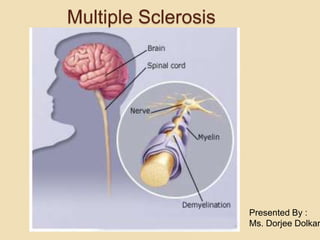
Multiple Sclerosis
 Chronic, progressive, degenerative
disorder of the CNS characterized
by
disseminated demyelination of
nerve
fibers of the brain and spinal cord
INCIDENCE
Usually affects young to middle-
aged adults, with onset
between 15 and 50 years of
age
Women affected more than
men
Etiology
 Unknown cause
 Related to infectious, immunologic, and
genetic factors
Etiology
 Possible precipitating factors include
Infection
 Environmental factor-Vitamin D
 Immunologic reaction
 Sex hormone
 Genetic factor
Poor state of health
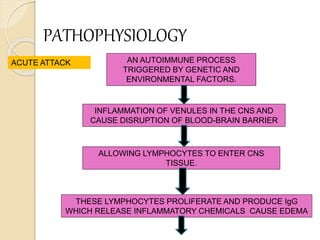
PATHOPHYSIOLOGY
AN AUTOIMMUNE PROCESS
TRIGGERED BY GENETIC AND
ENVIRONMENTAL FACTORS.
INFLAMMATION OF VENULES IN THE CNS AND
CAUSE DISRUPTION OF BLOOD-BRAIN BARRIER
ALLOWING LYMPHOCYTES TO ENTER CNS
TISSUE.
THESE LYMPHOCYTES PROLIFERATE AND PRODUCE IgG
WHICH RELEASE INFLAMMATORY CHEMICALS CAUSE EDEMA
ACUTE ATTACK
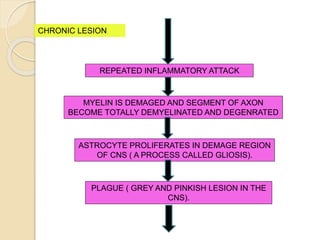
PATHOPHYSIOLOGY
REPEATED INFLAMMATORY ATTACK
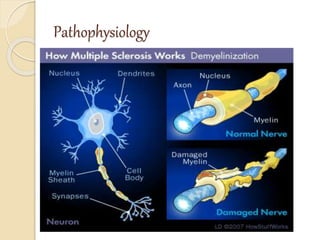
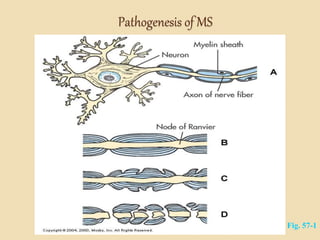
MYELIN IS DEMAGED AND SEGMENT OF AXON
BECOME TOTALLY DEMYELINATED AND DEGENRATED
ASTROCYTE PROLIFERATES IN DEMAGE REGION
OF CNS ( A PROCESS CALLED GLIOSIS).
PLAGUE ( GREY AND PINKISH LESION IN THE
CNS).
CHRONIC LESION
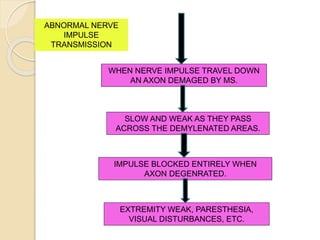
WHEN NERVE IMPULSE TRAVEL DOWN
AN AXON DEMAGED BY MS.
SLOW AND WEAK AS THEY PASS
ACROSS THE DEMYLENATED AREAS.
IMPULSE BLOCKED ENTIRELY WHEN
AXON DEGENRATED.
EXTREMITY WEAK, PARESTHESIA,
VISUAL DISTURBANCES, ETC.
ABNORMAL NERVE
IMPULSE
TRANSMISSION
Pathophysiology
Pathogenesis of MS
Fig. 57-1
Multiple Sclerosis
Clinical Manifestations
 Vague symptoms occur intermittently
over months and years
 MS may not be diagnosed until long
after the onset of the first symptom
Multiple Sclerosis
Clinical Manifestations
 Common signs and symptoms
include
Visual, motor, sensory, cerebellar,
and
emotional problems
Multiple Sclerosis
Clinical Manifestations
 Motor manifestations
◦ Weakness or paralysis of limbs,
trunk, and head.
◦ Diplopia (double vision)
◦ Scanning speech
◦ Spasticity of muscles
Multiple Sclerosis
Clinical Manifestations
Sensory manifestations
◦Numbness and tingling
◦Blurred vision
◦Vertigo and tinnitus
◦Decreased hearing
◦Chronic neuropathic pain
Multiple Sclerosis
Clinical Manifestations
 Cerebellar manifestations
◦ Nystagmus
Involuntary eye movements
◦ Ataxia
◦ Dysarthria
Lack of coordination in
articulating speech
◦ Dysphagia
Difficulty swallowing
Multiple Sclerosis
Clinical Manifestations
Emotional manifestations
◦Anger
◦Depression
◦Euphoria
Multiple Sclerosis
Other Clinical Manifestations
Bowel and bladder functions
◦Constipation
◦Spastic bladder: small
capacity for urine results in
incontinenceFlaccid bladder:
large capacity for urine and
no sensation to urinate
Multiple Sclerosis
Other Clinical Manifestations
Sexual dysfunction
Erectile dysfunction
Decreased libido
Difficulty with orgasmic
response
Painful intercourse
Decreased lubrication
Clinical Courses Of MS
 Relapsing- Remitting MS
 Primary Progressive MS
 Secondary Progressive MS
 Progressive Relapsing MS
Multiple Sclerosis
Diagnostic Studies
 Based primarily on history, clinical
manifestations, and physical
examination.
 Certain laboratory tests are used as
adjuncts to clinical exam
Multiple Sclerosis
Diagnostic Studies
 MRI – demonstrates presence of
plaques
 Spinal Tap / Lumbar Puncture: tested
for infection.
 Evoked Potential Test: Monitor brain
wave respond to what you see and
hear.
Multiple Sclerosis
Pharmacological Management
Drug Therapy
◦ Corticosteroids
Treat acute exacerbations by
reducing edema and
inflammation at the site of
demyelination
Do not affect the ultimate
outcome or degree of residual
neurologic impairment from
Cont….
◦ Immunosuppressive Therapy
 Azathioprine (Imuran)
 Cyclophosphamide ( cytoxan)
Because MS is considered an
autoimmune disease
Potential benefits
counterbalanced against
potentially serious side effects
Cont…..
 Antispasmotics (muscle relaxants)
 Baclofen (Lioresal)
 Dantrolene ( Dantrium)
 Diazepam (Valium)
To relieve muscle spasm.
Multiple Sclerosis
Collaborative Care
 Physical therapy helps
 Relieve spasticity
 Increase coordination
 Train the patient to substitute unaffected
muscles for impaired ones
Multiple Sclerosis
Collaborative Care
 Nutritional therapy includes
megavitamins and diets consisting of
low- fat, gluten-free food, and raw
vegetables
 High-protein diet with supplementary
vitamins is often prescribed
PLASMAPHERESIS:
 This therapy is to remove
inflammatory agents such as T-
lymphocytes through exchange
plasma while suppressing immune
response and inflammation.
Surgical Management:
 ACHILLES TENOTOMY:
Indicated to severe spasticity and
deformity.
Relieve foot drop from sever plantar
flexion by transected the achilles
tendon.
Multiple Sclerosis
Nursing Assessment
 Health History
Risk factors
Precipitation factors
Clinical manifestations
Multiple Sclerosis
Nursing Diagnoses
 Ineffective airway clearance r/t
decreased cough mechanism.
 Risk for injury r/t blurred vision as
evidenced by unable to see clearily.
 Altered nutrition less than body
requirement r/t dysphagia as evidenced
by inability to control spasticity.
 Activity intolerence r/t fatigue as
evidenced by unable to perform ADLs.
Myasthenia Gravis
“Grave Muscle Weakness”
Myasthenia Gravis
Autoimmune disease affecting the
neuromuscular junction
Not a brain disorder – brain
functions normally
Characterized by fluctuating muscle
weakness and fatigability
Disease may be generalized or
ocular specific
INCIDENCE
Occurs in all races
MG affects 14 per 100,000 people in
the United States
Can affect any age group
Women – peak incidence 20's to 30's
Men – peak incidence 50's to 60's
Three times more common in women
than men
More common in asian race than other
CAUSES
No single cause has been identified
Abnormal thymus tissue found in
most patients with MG
Thymic tumors found in 15% of
patients
Virus infections have been found in
some cases and are a suspected
cause
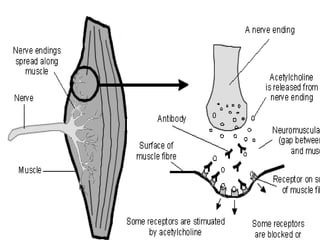
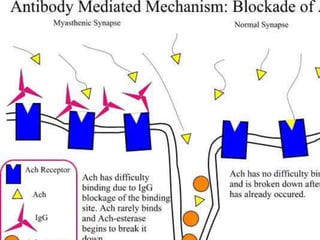
 Antibodies blocking Acetylcholine.
Genetic Factors
Myasthenia Gravis is not a
genetically inherited disease
Some families appear to carry a
gene that increases the risk for
developing the disease
No specific gene has been identified
and there are no tests for genetic
screening
Exacerbation Trigger Factors
Infection
Stress
Fatigue
Cathartics (laxatives)
Heat (sauna, hot tubs, sunbathing)
Pathophysiology
Signs and Symptoms
 Affects any of the muscles that you control
voluntarily, certain muscle groups are more
commonly affected than others
 OCULAR AND FACIAL MUSCLE:
 Difficulty speaking (dysarthria)
 Difficulty swallowing (dysphagia),
 Drooping eyelids (ptosis)
 Double vision (diplopia)
 Nasal-sounding speech and weak neck
muscles that give the head a tendency to fall
forward or backward.
Musculoskeletal System:
o Weakness and Fatigue
 Immobility
 Decreased function of limbs
Respiratory System
Weakening of intercostal
muscle.
 Decreased diaphragm
movement
 Breathlessness and dyspnea
 Poor gas exchange
Nutritional
 Dysphagia
 Decreased ability to move
tongue
 Inability to feed self
 Weight loss
 Dehydration
 Aspiration
Cont…..
Symptoms tend to progress over
time, usually reaching their worst
within a few years after the onset of
the disease
Worsening muscle weakness with
repeat activity
Diagnosis test
Edrophonium test (Tensilon)
 Antiacetylcholine receptor antibody serum
level
 Pulmonary Function Test
Single-fiber electromyography (EMG)
Imaging scans Eg: CT or MRI
Tensilon Test
Injection may result in a sudden,
although temporary, improvement in
muscle strength — an indication of
myasthenia gravis. Acts to block an
enzyme that breaks down
acetylcholine, the chemical that
transmits signals from nerve
endings to muscle receptor sites.
Diet/Nutrition
Eat small meals and snacks five to six
times a day
Avoid using low fat or diet products
when possible
Avoid eating lemons or tonic water
Eat warm rather than hot food
Runny or puree diet when swallowing
is difficult
Alternate sips of liquid to avoid food
from sticking
AVOID eating chewy or dry crumbly
foods
Medications/Treatment
Immunosuppressive Therapy
Prednisone
Azathioprine
Acetylcholinesterase Inhibitors
First line of therapy
Neostigmine bromide
(Pyridostigmine)
Edrophonium chloride (Tensilon)
Surgical Management
Thymectomy
Removal of thymus gland.
• Recommended to those
who gets dysphagia due
to thymus gland.
• Thymus tumor
Nursing Diagnosis:
 Risk for injury r/t ptosis as
evidenced by loss os motor
control.
 Ineffective airway clearance r/t
nonproductive cough as
manifested by decreased rib
cage movement.
 Impaired swallowing r/t fatigue
and dysphagia as manifested
by unable to swallow food.
Cont..
Impaired social interaction r/t change in
body image as evidenced by decreased
motor function.
 Fatigue r/t increased energy need for
muscle movement as evidenced by
unable to perform ADL’s.
 Ineffective therapeutic regimen r/t
insufficient knowledge as evidenced by
depression and potential for
complication.
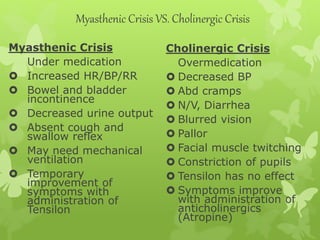
Myasthenic Crisis VS. Cholinergic Crisis
Myasthenic Crisis
Under medication
 Increased HR/BP/RR
 Bowel and bladder
incontinence
 Decreased urine output
 Absent cough and
swallow reflex
 May need mechanical
ventilation
 Temporary
improvement of
symptoms with
administration of
Tensilon
Cholinergic Crisis
Overmedication
 Decreased BP
 Abd cramps
 N/V, Diarrhea
 Blurred vision
 Pallor
 Facial muscle twitching
 Constriction of pupils
 Tensilon has no effect
 Symptoms improve
with administration of
anticholinergics
(Atropine)
Patient Teaching
 Teach patient/family disease process,
complications, and treatments
 Teach patient about their medications uses
dosage etc
 Teach medications to use with caution d/t
muscle exacerbation
Beta blockers, calcium channel
blockers, quinine, quinidine,
procainamide, some antibiotics,
neuromuscular blocking agents
 Avoid certain medications
D-penicillinamine, A-interferon,
botulinum toxin
Cont……..
Teach of both Myasthenic Crisis and
Cholinergic Crisis
Help patient plan daily activity to coincide
with energy peaks
Stress need for rest periods
Explain that exacerbations, remissions,
and daily fluctuations are common
Avoid strenuous exercise, stress, infection,
exposure to hot or cold temperatures
Teach patient to wear medic-alert bracelet
Prognosis
Chronic disease with periods of
exacerbation and sometimes
remissions
Disease course is highly variable
Symptoms respond well to
treatment and in most cases the
patient can live a normal or nearly
normal life
Ocular Myasthenia has the best
prognosis
SUMMARY
Neurology(multiple sclerosis)

Neurology(multiple sclerosis)

  • 2.
    Presented By : Ms.Dorjee Dolkar Multiple Sclerosis
  • 3.
    Multiple Sclerosis  Chronic,progressive, degenerative disorder of the CNS characterized by disseminated demyelination of nerve fibers of the brain and spinal cord
  • 4.
    INCIDENCE Usually affects youngto middle- aged adults, with onset between 15 and 50 years of age Women affected more than men
  • 5.
    Etiology  Unknown cause Related to infectious, immunologic, and genetic factors
  • 6.
    Etiology  Possible precipitatingfactors include Infection  Environmental factor-Vitamin D  Immunologic reaction  Sex hormone  Genetic factor Poor state of health
  • 7.
  • 8.
    AN AUTOIMMUNE PROCESS TRIGGEREDBY GENETIC AND ENVIRONMENTAL FACTORS. INFLAMMATION OF VENULES IN THE CNS AND CAUSE DISRUPTION OF BLOOD-BRAIN BARRIER ALLOWING LYMPHOCYTES TO ENTER CNS TISSUE. THESE LYMPHOCYTES PROLIFERATE AND PRODUCE IgG WHICH RELEASE INFLAMMATORY CHEMICALS CAUSE EDEMA ACUTE ATTACK PATHOPHYSIOLOGY
  • 9.
    REPEATED INFLAMMATORY ATTACK MYELINIS DEMAGED AND SEGMENT OF AXON BECOME TOTALLY DEMYELINATED AND DEGENRATED ASTROCYTE PROLIFERATES IN DEMAGE REGION OF CNS ( A PROCESS CALLED GLIOSIS). PLAGUE ( GREY AND PINKISH LESION IN THE CNS). CHRONIC LESION
  • 10.
    WHEN NERVE IMPULSETRAVEL DOWN AN AXON DEMAGED BY MS. SLOW AND WEAK AS THEY PASS ACROSS THE DEMYLENATED AREAS. IMPULSE BLOCKED ENTIRELY WHEN AXON DEGENRATED. EXTREMITY WEAK, PARESTHESIA, VISUAL DISTURBANCES, ETC. ABNORMAL NERVE IMPULSE TRANSMISSION
  • 11.
  • 12.
  • 13.
    Multiple Sclerosis Clinical Manifestations Vague symptoms occur intermittently over months and years  MS may not be diagnosed until long after the onset of the first symptom
  • 14.
    Multiple Sclerosis Clinical Manifestations Common signs and symptoms include Visual, motor, sensory, cerebellar, and emotional problems
  • 15.
    Multiple Sclerosis Clinical Manifestations Motor manifestations ◦ Weakness or paralysis of limbs, trunk, and head. ◦ Diplopia (double vision) ◦ Scanning speech ◦ Spasticity of muscles
  • 16.
    Multiple Sclerosis Clinical Manifestations Sensorymanifestations ◦Numbness and tingling ◦Blurred vision ◦Vertigo and tinnitus ◦Decreased hearing ◦Chronic neuropathic pain
  • 17.
    Multiple Sclerosis Clinical Manifestations Cerebellar manifestations ◦ Nystagmus Involuntary eye movements ◦ Ataxia ◦ Dysarthria Lack of coordination in articulating speech ◦ Dysphagia Difficulty swallowing
  • 18.
    Multiple Sclerosis Clinical Manifestations Emotionalmanifestations ◦Anger ◦Depression ◦Euphoria
  • 19.
    Multiple Sclerosis Other ClinicalManifestations Bowel and bladder functions ◦Constipation ◦Spastic bladder: small capacity for urine results in incontinenceFlaccid bladder: large capacity for urine and no sensation to urinate
  • 20.
    Multiple Sclerosis Other ClinicalManifestations Sexual dysfunction Erectile dysfunction Decreased libido Difficulty with orgasmic response Painful intercourse Decreased lubrication
  • 21.
    Clinical Courses OfMS  Relapsing- Remitting MS  Primary Progressive MS  Secondary Progressive MS  Progressive Relapsing MS
  • 22.
    Multiple Sclerosis Diagnostic Studies Based primarily on history, clinical manifestations, and physical examination.  Certain laboratory tests are used as adjuncts to clinical exam
  • 23.
    Multiple Sclerosis Diagnostic Studies MRI – demonstrates presence of plaques  Spinal Tap / Lumbar Puncture: tested for infection.  Evoked Potential Test: Monitor brain wave respond to what you see and hear.
  • 24.
    Multiple Sclerosis Pharmacological Management DrugTherapy ◦ Corticosteroids Treat acute exacerbations by reducing edema and inflammation at the site of demyelination Do not affect the ultimate outcome or degree of residual neurologic impairment from
  • 25.
    Cont…. ◦ Immunosuppressive Therapy Azathioprine (Imuran)  Cyclophosphamide ( cytoxan) Because MS is considered an autoimmune disease Potential benefits counterbalanced against potentially serious side effects
  • 26.
    Cont…..  Antispasmotics (musclerelaxants)  Baclofen (Lioresal)  Dantrolene ( Dantrium)  Diazepam (Valium) To relieve muscle spasm.
  • 27.
    Multiple Sclerosis Collaborative Care Physical therapy helps  Relieve spasticity  Increase coordination  Train the patient to substitute unaffected muscles for impaired ones
  • 28.
    Multiple Sclerosis Collaborative Care Nutritional therapy includes megavitamins and diets consisting of low- fat, gluten-free food, and raw vegetables  High-protein diet with supplementary vitamins is often prescribed
  • 29.
    PLASMAPHERESIS:  This therapyis to remove inflammatory agents such as T- lymphocytes through exchange plasma while suppressing immune response and inflammation.
  • 30.
    Surgical Management:  ACHILLESTENOTOMY: Indicated to severe spasticity and deformity. Relieve foot drop from sever plantar flexion by transected the achilles tendon.
  • 31.
    Multiple Sclerosis Nursing Assessment Health History Risk factors Precipitation factors Clinical manifestations
  • 32.
    Multiple Sclerosis Nursing Diagnoses Ineffective airway clearance r/t decreased cough mechanism.  Risk for injury r/t blurred vision as evidenced by unable to see clearily.  Altered nutrition less than body requirement r/t dysphagia as evidenced by inability to control spasticity.  Activity intolerence r/t fatigue as evidenced by unable to perform ADLs.
  • 34.
  • 36.
    Myasthenia Gravis Autoimmune diseaseaffecting the neuromuscular junction Not a brain disorder – brain functions normally Characterized by fluctuating muscle weakness and fatigability Disease may be generalized or ocular specific
  • 37.
    INCIDENCE Occurs in allraces MG affects 14 per 100,000 people in the United States Can affect any age group Women – peak incidence 20's to 30's Men – peak incidence 50's to 60's Three times more common in women than men More common in asian race than other
  • 38.
    CAUSES No single causehas been identified Abnormal thymus tissue found in most patients with MG Thymic tumors found in 15% of patients Virus infections have been found in some cases and are a suspected cause  Antibodies blocking Acetylcholine.
  • 39.
    Genetic Factors Myasthenia Gravisis not a genetically inherited disease Some families appear to carry a gene that increases the risk for developing the disease No specific gene has been identified and there are no tests for genetic screening
  • 40.
  • 41.
  • 44.
    Signs and Symptoms Affects any of the muscles that you control voluntarily, certain muscle groups are more commonly affected than others  OCULAR AND FACIAL MUSCLE:  Difficulty speaking (dysarthria)  Difficulty swallowing (dysphagia),  Drooping eyelids (ptosis)  Double vision (diplopia)  Nasal-sounding speech and weak neck muscles that give the head a tendency to fall forward or backward.
  • 45.
    Musculoskeletal System: o Weaknessand Fatigue  Immobility  Decreased function of limbs
  • 46.
    Respiratory System Weakening ofintercostal muscle.  Decreased diaphragm movement  Breathlessness and dyspnea  Poor gas exchange
  • 47.
    Nutritional  Dysphagia  Decreasedability to move tongue  Inability to feed self  Weight loss  Dehydration  Aspiration
  • 48.
    Cont….. Symptoms tend toprogress over time, usually reaching their worst within a few years after the onset of the disease Worsening muscle weakness with repeat activity
  • 49.
    Diagnosis test Edrophonium test(Tensilon)  Antiacetylcholine receptor antibody serum level  Pulmonary Function Test Single-fiber electromyography (EMG) Imaging scans Eg: CT or MRI
  • 50.
    Tensilon Test Injection mayresult in a sudden, although temporary, improvement in muscle strength — an indication of myasthenia gravis. Acts to block an enzyme that breaks down acetylcholine, the chemical that transmits signals from nerve endings to muscle receptor sites.
  • 51.
    Diet/Nutrition Eat small mealsand snacks five to six times a day Avoid using low fat or diet products when possible Avoid eating lemons or tonic water Eat warm rather than hot food Runny or puree diet when swallowing is difficult Alternate sips of liquid to avoid food from sticking AVOID eating chewy or dry crumbly foods
  • 52.
    Medications/Treatment Immunosuppressive Therapy Prednisone Azathioprine Acetylcholinesterase Inhibitors Firstline of therapy Neostigmine bromide (Pyridostigmine) Edrophonium chloride (Tensilon)
  • 53.
    Surgical Management Thymectomy Removal ofthymus gland. • Recommended to those who gets dysphagia due to thymus gland. • Thymus tumor
  • 54.
    Nursing Diagnosis:  Riskfor injury r/t ptosis as evidenced by loss os motor control.  Ineffective airway clearance r/t nonproductive cough as manifested by decreased rib cage movement.  Impaired swallowing r/t fatigue and dysphagia as manifested by unable to swallow food.
  • 55.
    Cont.. Impaired social interactionr/t change in body image as evidenced by decreased motor function.  Fatigue r/t increased energy need for muscle movement as evidenced by unable to perform ADL’s.  Ineffective therapeutic regimen r/t insufficient knowledge as evidenced by depression and potential for complication.
  • 56.
    Myasthenic Crisis VS.Cholinergic Crisis Myasthenic Crisis Under medication  Increased HR/BP/RR  Bowel and bladder incontinence  Decreased urine output  Absent cough and swallow reflex  May need mechanical ventilation  Temporary improvement of symptoms with administration of Tensilon Cholinergic Crisis Overmedication  Decreased BP  Abd cramps  N/V, Diarrhea  Blurred vision  Pallor  Facial muscle twitching  Constriction of pupils  Tensilon has no effect  Symptoms improve with administration of anticholinergics (Atropine)
  • 57.
    Patient Teaching  Teachpatient/family disease process, complications, and treatments  Teach patient about their medications uses dosage etc  Teach medications to use with caution d/t muscle exacerbation Beta blockers, calcium channel blockers, quinine, quinidine, procainamide, some antibiotics, neuromuscular blocking agents  Avoid certain medications D-penicillinamine, A-interferon, botulinum toxin
  • 58.
    Cont…….. Teach of bothMyasthenic Crisis and Cholinergic Crisis Help patient plan daily activity to coincide with energy peaks Stress need for rest periods Explain that exacerbations, remissions, and daily fluctuations are common Avoid strenuous exercise, stress, infection, exposure to hot or cold temperatures Teach patient to wear medic-alert bracelet
  • 59.
    Prognosis Chronic disease withperiods of exacerbation and sometimes remissions Disease course is highly variable Symptoms respond well to treatment and in most cases the patient can live a normal or nearly normal life Ocular Myasthenia has the best prognosis
  • 60.