



By: Ankit Khandelwal
*MYASTHENIA GRAVIS
*
*Myasthenia gravis is a neuromuscular disorder
characterised by weakness and fatigability of skeletal
muscle.
*It is caused by autoantibodies against neuromuscular
junction proteins, either the nicotinic acetylcholine receptor
(AChR) or the muscle specific tyrosine kinase (MuSK)
*The hallmark of myasthenia gravis is muscle weakness that
worsen after period of activity and improves after period of
rest.
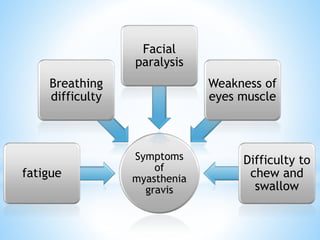
*Certain muscles such as those that control eye and eyelid
movement, facial expression, chewing, talking, and
swallowing are often (but not always) involved in the
disorder.
*The muscle that control breathing and neck and limb
movements may also be affected
*
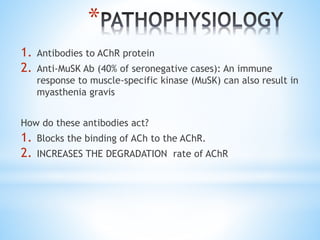
1. Antibodies to AChR protein
2. Anti-MuSK Ab (40% of seronegative cases): An immune
response to muscle-specific kinase (MuSK) can also result in
myasthenia gravis
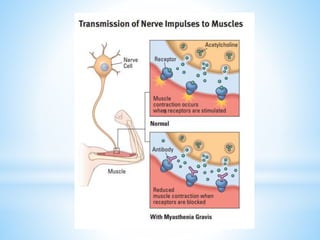
How do these antibodies act?
1. Blocks the binding of ACh to the AChR.
2. INCREASES THE DEGRADATION rate of AChR
Symptoms
of
myasthenia
gravis
fatigue
Breathing
difficulty
Facial
paralysis
Weakness of
eyes muscle
Difficulty to
chew and
swallow
*
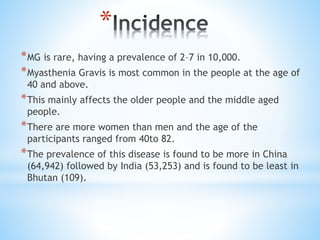
*MG is rare, having a prevalence of 2–7 in 10,000.
*Myasthenia Gravis is most common in the people at the age of
40 and above.
*This mainly affects the older people and the middle aged
people.
*There are more women than men and the age of the
participants ranged from 40to 82.
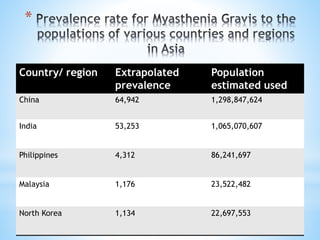
*The prevalence of this disease is found to be more in China
(64,942) followed by India (53,253) and is found to be least in
Bhutan (109).
*
*A combination of corticosteroids (prednisone or
prednisolone) and azathioprine remains the first-choice
immunosuppressive drug alternative for most MG patients
*
Country/ region Extrapolated
prevalence
Population
estimated used
China 64,942 1,298,847,624
India 53,253 1,065,070,607
Philippines 4,312 86,241,697
Malaysia 1,176 23,522,482
North Korea 1,134 22,697,553
*
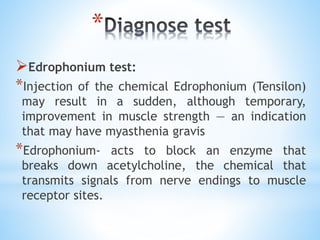
Edrophonium test:
*Injection of the chemical Edrophonium (Tensilon)
may result in a sudden, although temporary,
improvement in muscle strength — an indication
that may have myasthenia gravis
*Edrophonium- acts to block an enzyme that
breaks down acetylcholine, the chemical that
transmits signals from nerve endings to muscle
receptor sites.
 Single-fiber electromyography (EMG):
EMG measures the electrical activity traveling
between brain and muscle.
It involves inserting a very fine wire electrode
through skin and into a muscle. In singlefiber
EMGs, a single muscle fiber is tested.
 Imaging scans:
CT scan or an MRI to confirm a tumor or other
abnormality in thymus.
*
There are four basic therapies used to treat MG:
1. symptomatic treatment
(A)Acetylcholinesterase inhibitors
2. rapid short-term immunomodulating treatment
(A) plasmapheresis
(B)IVIG
3. chronic long-term immunomodulating treatment
A) glucocorticoids
(B) immunosuppressive drugs
4. surgical treatment
*
*Plasma exchange and intravenous
immunoglobulin
*They have rapid onset of action with
improvement within days.
*Disadvantage: transient effect.
*
*It improves strength in most patients with MG by
directly removing AChR from the circulation . Typically
one exchange is done every other day for a total of
four to six times.
*Adverse effects of plasmapheres is:
 hypotension,
Paraesthesia
Infections
*This therapy provides body with normal antibodies, which
alters immune system response.
* lower risk of side effects than do plasmapheresis and
immune-suppressing
*But it can take a week or two to start working and the benefits
usually last less than a month or two
*
*Corticosteroids were the first and most commonly
used immunosuppressant medications in MG.
*Prednisone is generally used when symptoms of MG
are not adequately controlled by cholinesterase
inhibitors alone.
*Prolonged use of corticosteroids, can lead to serious
side effects, like bone thinning, weight gain,
diabetes, increased risk of some infections, and
increase and redistribution of body fat.
*
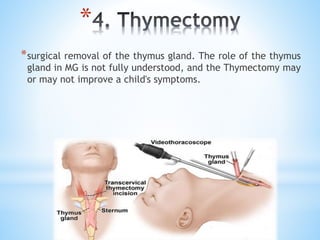
*surgical removal of the thymus gland. The role of the thymus
gland in MG is not fully understood, and the Thymectomy may
or may not improve a child's symptoms.

Myasthenia gravis

  • 1.
  • 2.
    * *Myasthenia gravis isa neuromuscular disorder characterised by weakness and fatigability of skeletal muscle. *It is caused by autoantibodies against neuromuscular junction proteins, either the nicotinic acetylcholine receptor (AChR) or the muscle specific tyrosine kinase (MuSK) *The hallmark of myasthenia gravis is muscle weakness that worsen after period of activity and improves after period of rest.
  • 3.
    *Certain muscles suchas those that control eye and eyelid movement, facial expression, chewing, talking, and swallowing are often (but not always) involved in the disorder. *The muscle that control breathing and neck and limb movements may also be affected
  • 4.
    * 1. Antibodies toAChR protein 2. Anti-MuSK Ab (40% of seronegative cases): An immune response to muscle-specific kinase (MuSK) can also result in myasthenia gravis How do these antibodies act? 1. Blocks the binding of ACh to the AChR. 2. INCREASES THE DEGRADATION rate of AChR
  • 6.
  • 7.
    * *MG is rare,having a prevalence of 2–7 in 10,000. *Myasthenia Gravis is most common in the people at the age of 40 and above. *This mainly affects the older people and the middle aged people. *There are more women than men and the age of the participants ranged from 40to 82. *The prevalence of this disease is found to be more in China (64,942) followed by India (53,253) and is found to be least in Bhutan (109).
  • 8.
    * *A combination ofcorticosteroids (prednisone or prednisolone) and azathioprine remains the first-choice immunosuppressive drug alternative for most MG patients
  • 9.
    * Country/ region Extrapolated prevalence Population estimatedused China 64,942 1,298,847,624 India 53,253 1,065,070,607 Philippines 4,312 86,241,697 Malaysia 1,176 23,522,482 North Korea 1,134 22,697,553
  • 10.
    * Edrophonium test: *Injection ofthe chemical Edrophonium (Tensilon) may result in a sudden, although temporary, improvement in muscle strength — an indication that may have myasthenia gravis *Edrophonium- acts to block an enzyme that breaks down acetylcholine, the chemical that transmits signals from nerve endings to muscle receptor sites.
  • 11.
     Single-fiber electromyography(EMG): EMG measures the electrical activity traveling between brain and muscle. It involves inserting a very fine wire electrode through skin and into a muscle. In singlefiber EMGs, a single muscle fiber is tested.  Imaging scans: CT scan or an MRI to confirm a tumor or other abnormality in thymus.
  • 12.
    * There are fourbasic therapies used to treat MG: 1. symptomatic treatment (A)Acetylcholinesterase inhibitors 2. rapid short-term immunomodulating treatment (A) plasmapheresis (B)IVIG 3. chronic long-term immunomodulating treatment A) glucocorticoids (B) immunosuppressive drugs 4. surgical treatment
  • 13.
    * *Plasma exchange andintravenous immunoglobulin *They have rapid onset of action with improvement within days. *Disadvantage: transient effect.
  • 14.
    * *It improves strengthin most patients with MG by directly removing AChR from the circulation . Typically one exchange is done every other day for a total of four to six times. *Adverse effects of plasmapheres is:  hypotension, Paraesthesia Infections
  • 15.
    *This therapy providesbody with normal antibodies, which alters immune system response. * lower risk of side effects than do plasmapheresis and immune-suppressing *But it can take a week or two to start working and the benefits usually last less than a month or two
  • 16.
    * *Corticosteroids were thefirst and most commonly used immunosuppressant medications in MG. *Prednisone is generally used when symptoms of MG are not adequately controlled by cholinesterase inhibitors alone. *Prolonged use of corticosteroids, can lead to serious side effects, like bone thinning, weight gain, diabetes, increased risk of some infections, and increase and redistribution of body fat.
  • 17.
    * *surgical removal ofthe thymus gland. The role of the thymus gland in MG is not fully understood, and the Thymectomy may or may not improve a child's symptoms.