MYASTHENIA
GRAVIS
Presented By –
Harshika S. Tembhurne
MSc. 1st Year , SCON
Introduction
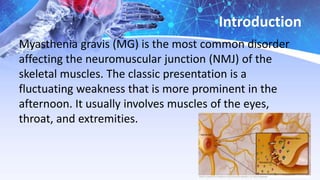
Myasthenia gravis (MG) is the most common disorder
affecting the neuromuscular junction (NMJ) of the
skeletal muscles. The classic presentation is a
fluctuating weakness that is more prominent in the
afternoon. It usually involves muscles of the eyes,
throat, and extremities.
Anatomy and physiology of Brain
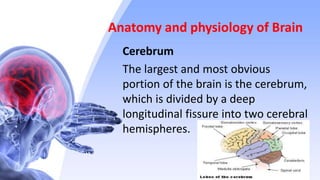
Cerebrum
The largest and most obvious
portion of the brain is the cerebrum,
which is divided by a deep
longitudinal fissure into two cerebral
hemispheres.
Diencephalon
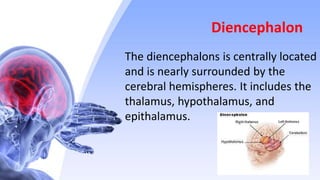
The diencephalons is centrally located
and is nearly surrounded by the
cerebral hemispheres. It includes the
thalamus, hypothalamus, and
epithalamus.
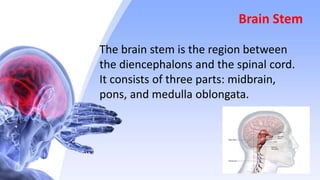
Brain Stem
The brain stem is the region between
the diencephalons and the spinal cord.
It consists of three parts: midbrain,
pons, and medulla oblongata.
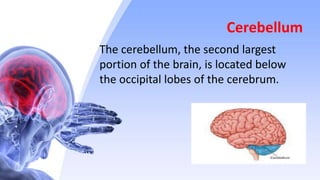
Cerebellum
The cerebellum, the second largest
portion of the brain, is located below
the occipital lobes of the cerebrum.
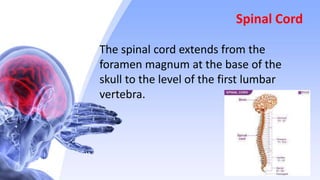
Spinal Cord
The spinal cord extends from the
foramen magnum at the base of the
skull to the level of the first lumbar
vertebra.
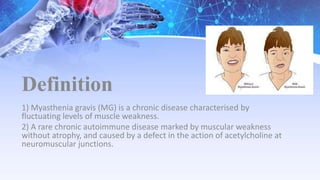
Definition
1) Myasthenia gravis (MG) is a chronic disease characterised by
fluctuating levels of muscle weakness.
2) A rare chronic autoimmune disease marked by muscular weakness
without atrophy, and caused by a defect in the action of acetylcholine at
neuromuscular junctions.
Incidence
It is uncommon, affecting only 15 per 100,000 individuals, and although it
can be a very serious condition, 90 per cent of patients live a near-
normal life while continuing medical treatment.
Classification
• Class I: Any eye muscle weakness, possible
ptosis, no other evidence of muscle weakness
elsewhere
• Class II: Eye muscle weakness of any severity,
mild weakness of other muscles
– Class IIa: Predominantly limb or axial
muscles
– Class IIb: Predominantly bulbar and/or
respiratory muscles
• Class III: Eye muscle weakness of any
severity, moderate weakness of other
muscles
– Class IIIa: Predominantly limb or axial
muscles
– Class IIIb: Predominantly bulbar
and/or respiratory muscles
• Class V: Intubation needed to maintain
airway
Causes and risk factors
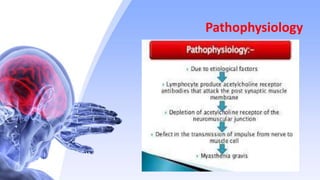
• It is an autoimmune disorder, in which
weakness is caused by circulating antibodies
that block acetylcholine receptors at the
postsynaptic neuromuscular junction,
inhibiting the excitatory effects of the
neurotransmitter acetylcholine on nicotinic
receptors throughout neuromuscular
junctions.
• Myasthenia is treated medically with
cholinesterase inhibitors or
immunosuppressants, and, in selected cases,
thymectomy.
• Unknown
• Aging Factors
Pathophysiology
Signs and symptoms
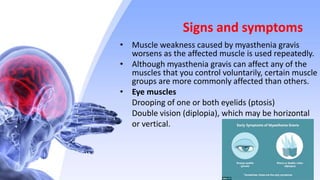
• Muscle weakness caused by myasthenia gravis
worsens as the affected muscle is used repeatedly.
• Although myasthenia gravis can affect any of the
muscles that you control voluntarily, certain muscle
groups are more commonly affected than others.
• Eye muscles
Drooping of one or both eyelids (ptosis)
Double vision (diplopia), which may be horizontal
or vertical.
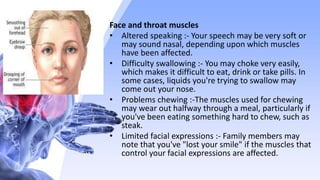
Face and throat muscles
• Altered speaking :- Your speech may be very soft or
may sound nasal, depending upon which muscles
have been affected.
• Difficulty swallowing :- You may choke very easily,
which makes it difficult to eat, drink or take pills. In
some cases, liquids you're trying to swallow may
come out your nose.
• Problems chewing :-The muscles used for chewing
may wear out halfway through a meal, particularly if
you've been eating something hard to chew, such as
steak.
• Limited facial expressions :- Family members may
note that you've "lost your smile" if the muscles that
control your facial expressions are affected.
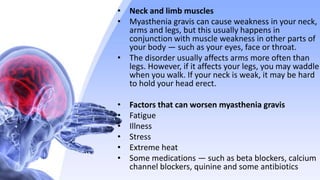
• Neck and limb muscles
• Myasthenia gravis can cause weakness in your neck,
arms and legs, but this usually happens in
conjunction with muscle weakness in other parts of
your body — such as your eyes, face or throat.
• The disorder usually affects arms more often than
legs. However, if it affects your legs, you may waddle
when you walk. If your neck is weak, it may be hard
to hold your head erect.
• Factors that can worsen myasthenia gravis
• Fatigue
• Illness
• Stress
• Extreme heat
• Some medications — such as beta blockers, calcium
channel blockers, quinine and some antibiotics
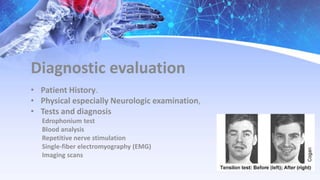
Diagnostic evaluation
• Patient History.
• Physical especially Neurologic examination,
• Tests and diagnosis
Edrophonium test
Blood analysis
Repetitive nerve stimulation
Single-fiber electromyography (EMG)
Imaging scans
Treatment
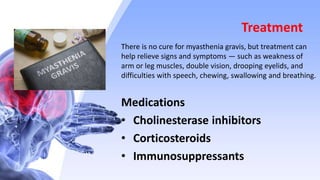
There is no cure for myasthenia gravis, but treatment can
help relieve signs and symptoms — such as weakness of
arm or leg muscles, double vision, drooping eyelids, and
difficulties with speech, chewing, swallowing and breathing.
Medications
• Cholinesterase inhibitors
• Corticosteroids
• Immunosuppressants
Therapy
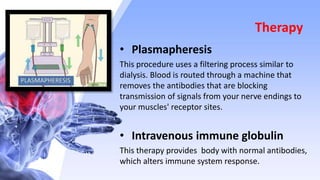
• Plasmapheresis
This procedure uses a filtering process similar to
dialysis. Blood is routed through a machine that
removes the antibodies that are blocking
transmission of signals from your nerve endings to
your muscles' receptor sites.
• Intravenous immune globulin
This therapy provides body with normal antibodies,
which alters immune system response.
Surgery
• About 15 percent of the people who have
myasthenia gravis have a tumor in their thymus,
a gland under the breastbone that is involved
with the immune system. need to have thymus
removed.
• For people with myasthenia gravis who don't
have a tumor in the thymus, it's unclear
whether the potential benefit of removing the
thymus outweighs the risks of surgery.
• Surgery is not recommended by most doctors if:
Your symptoms are mild
Your symptoms involve only your eyes
You're older than 60
Nursing Management
• Pain Management: Alleviation of pain or a reduction in
pain to a level of comfort that is acceptable to the patient
• Analgesic Administration: Use of pharmacologic agents to
reduce or eliminate pain
• Environmental Management: Comfort: Manipulation of
the patient’s surroundings for promotion of optimal
comfort
• Anxiety Reduction: Minimizing apprehension, dread,
foreboding, or uneasiness related to an unidentified
source or anticipated danger
• Provision of a modified environment for the patient who
is experiencing a chronic confusion state
• Calming Technique: Reducing anxiety in patient
experiencing acute distress
• Delusion Management: Promoting the comfort, safety,
and reality orientation of a patient experiencing false,
fixed beliefs that have little or no basis in reality
Nursing diagnosis
• Acute pain
• Anxiety
• Disturbed thought processes
• Hyperthermia
• Imbalanced nutrition: Less than body
requirements
• Impaired gas exchange
• Impaired physical mobility
• Risk for deficient fluid volume
Prognosis
The prognosis of MG has improved
significantly with the introduction of
immunosuppressive therapy. The
majority of patients become symptom
free if they take adequate doses of
steroids. However, most patients do
have to remain on tablets for an
indefinite period as the symptoms
generally return if they stop the
medication.
Complications
Myasthenic crisis
Myasthenic crisis is a life-threatening condition, which occurs when the muscles that control breathing become too
weak to do their jobs. Emergency treatment is needed to provide mechanical assistance with breathing.
Medications and blood-filtering therapies help people recover from myasthenic crisis, so they can again breathe on
their own.
Thymus tumors
About 15 percent of the people who have myasthenia gravis have a tumor in their thymus, a gland under the
breastbone that is involved with the immune system. Most of these tumors are noncancerous.
Summary
• Myasthenia gravis is a disease that causes weakness
in your voluntary muscles. These are the muscles that
you control. For example, you may have weakness in
the muscles for eye movement, facial expressions,
and swallowing. You can also have weakness in other
muscles. This weakness gets worse with activity, and
better with rest.
• Myasthenia gravis is an autoimmune disease. Your
body's immune system makes antibodies that block
or change some of the nerve signals to your muscles.
This makes your muscles weaker.
• Other conditions can cause muscle weakness, so
myasthenia gravis can be hard to diagnose. Tests
used to make a diagnosis include blood, nerve,
muscle, and imaging tests.
CONCLUSION
So, here we can conclude by saying that as brain is the regulating
centre of the body and infection can lead to deadly complications.
Hence, prompt treatment and wise decision on time is very
important for the patient. So as a nurse we should anticipate in
providing quality nursing care to a patient in the clinical practice.
BIBLIOGRAPHY
1. B.D. Chaurasia’s (2004). Human Anatomy, 4th edition CBS publisher and distributer NEW DELHI; volume -1; Pp.265-272.
2. Brunner & Suddarth (2009), Text book of Medical Surgical Nursing : 11th edition Wolters kluwer, Lippincott Williams &
Wilkins, Volume-1; Pp.723-739.
3. Joycee M. Black ,Jane Hokinson, Howks (2005), Medical surgical nursing: 7th edition Philadelphia : W.B. Saunders.
4. Lewis, Heilkemper, Dirksen, O’Brien, Buchers (2007), Medical Surgical Nursing , 7th edition Mosby Elsevier ; Pp. 543-55
5. Lippincott (2006), Mannual of Nursing Practice, 8th edition JP Indian edition Lippincott Williams & wilkins ; Pp-216-219
6. Lewis, S.L., Dirksen, S.R., Heitkemper, M.M., Bucher, L., & Harding, M.M. (2017). Medical-Surgical Nursing: Assessment
and Management of Clinical Problems (10th ed.). St. Louis: Elsevier.
7. Potter, P.A., Perry, A.G., Stockert, P.A., & Hall, A.M. (2019). Essentials for Nursing Practice (9th ed.). St. Louis: Elsevier.
8. Hinkle, J.L. & Cheever, K.H. (2018). Brunner & Suddarth's Textbook of Medical-Surgical Nursing (14th ed.). Philadelphia:
Wolters Kluwer.
9. Grossman, S.C. & Porth, C.M. (2014). Porth’s Pathophysiology: Concepts of Altered Health States (9th ed.). Philadelphia:
Wolters Kluwer.
10. American Journal of Nursing, MEDSURG Nursing Journal, Nursing Clinics of North America, Nursing 201X.

myasthenia gravis ppt.pptx

  • 1.
    MYASTHENIA GRAVIS Presented By – HarshikaS. Tembhurne MSc. 1st Year , SCON
  • 2.
    Introduction Myasthenia gravis (MG)is the most common disorder affecting the neuromuscular junction (NMJ) of the skeletal muscles. The classic presentation is a fluctuating weakness that is more prominent in the afternoon. It usually involves muscles of the eyes, throat, and extremities.
  • 3.
    Anatomy and physiologyof Brain Cerebrum The largest and most obvious portion of the brain is the cerebrum, which is divided by a deep longitudinal fissure into two cerebral hemispheres.
  • 4.
    Diencephalon The diencephalons iscentrally located and is nearly surrounded by the cerebral hemispheres. It includes the thalamus, hypothalamus, and epithalamus.
  • 5.
    Brain Stem The brainstem is the region between the diencephalons and the spinal cord. It consists of three parts: midbrain, pons, and medulla oblongata.
  • 6.
    Cerebellum The cerebellum, thesecond largest portion of the brain, is located below the occipital lobes of the cerebrum.
  • 7.
    Spinal Cord The spinalcord extends from the foramen magnum at the base of the skull to the level of the first lumbar vertebra.
  • 8.
    Definition 1) Myasthenia gravis(MG) is a chronic disease characterised by fluctuating levels of muscle weakness. 2) A rare chronic autoimmune disease marked by muscular weakness without atrophy, and caused by a defect in the action of acetylcholine at neuromuscular junctions.
  • 9.
    Incidence It is uncommon,affecting only 15 per 100,000 individuals, and although it can be a very serious condition, 90 per cent of patients live a near- normal life while continuing medical treatment.
  • 10.
    Classification • Class I:Any eye muscle weakness, possible ptosis, no other evidence of muscle weakness elsewhere • Class II: Eye muscle weakness of any severity, mild weakness of other muscles – Class IIa: Predominantly limb or axial muscles – Class IIb: Predominantly bulbar and/or respiratory muscles • Class III: Eye muscle weakness of any severity, moderate weakness of other muscles – Class IIIa: Predominantly limb or axial muscles – Class IIIb: Predominantly bulbar and/or respiratory muscles • Class V: Intubation needed to maintain airway
  • 11.
    Causes and riskfactors • It is an autoimmune disorder, in which weakness is caused by circulating antibodies that block acetylcholine receptors at the postsynaptic neuromuscular junction, inhibiting the excitatory effects of the neurotransmitter acetylcholine on nicotinic receptors throughout neuromuscular junctions. • Myasthenia is treated medically with cholinesterase inhibitors or immunosuppressants, and, in selected cases, thymectomy. • Unknown • Aging Factors
  • 12.
  • 13.
    Signs and symptoms •Muscle weakness caused by myasthenia gravis worsens as the affected muscle is used repeatedly. • Although myasthenia gravis can affect any of the muscles that you control voluntarily, certain muscle groups are more commonly affected than others. • Eye muscles Drooping of one or both eyelids (ptosis) Double vision (diplopia), which may be horizontal or vertical.
  • 14.
    Face and throatmuscles • Altered speaking :- Your speech may be very soft or may sound nasal, depending upon which muscles have been affected. • Difficulty swallowing :- You may choke very easily, which makes it difficult to eat, drink or take pills. In some cases, liquids you're trying to swallow may come out your nose. • Problems chewing :-The muscles used for chewing may wear out halfway through a meal, particularly if you've been eating something hard to chew, such as steak. • Limited facial expressions :- Family members may note that you've "lost your smile" if the muscles that control your facial expressions are affected.
  • 15.
    • Neck andlimb muscles • Myasthenia gravis can cause weakness in your neck, arms and legs, but this usually happens in conjunction with muscle weakness in other parts of your body — such as your eyes, face or throat. • The disorder usually affects arms more often than legs. However, if it affects your legs, you may waddle when you walk. If your neck is weak, it may be hard to hold your head erect. • Factors that can worsen myasthenia gravis • Fatigue • Illness • Stress • Extreme heat • Some medications — such as beta blockers, calcium channel blockers, quinine and some antibiotics
  • 16.
    Diagnostic evaluation • PatientHistory. • Physical especially Neurologic examination, • Tests and diagnosis Edrophonium test Blood analysis Repetitive nerve stimulation Single-fiber electromyography (EMG) Imaging scans
  • 17.
    Treatment There is nocure for myasthenia gravis, but treatment can help relieve signs and symptoms — such as weakness of arm or leg muscles, double vision, drooping eyelids, and difficulties with speech, chewing, swallowing and breathing. Medications • Cholinesterase inhibitors • Corticosteroids • Immunosuppressants
  • 18.
    Therapy • Plasmapheresis This procedureuses a filtering process similar to dialysis. Blood is routed through a machine that removes the antibodies that are blocking transmission of signals from your nerve endings to your muscles' receptor sites. • Intravenous immune globulin This therapy provides body with normal antibodies, which alters immune system response.
  • 19.
    Surgery • About 15percent of the people who have myasthenia gravis have a tumor in their thymus, a gland under the breastbone that is involved with the immune system. need to have thymus removed. • For people with myasthenia gravis who don't have a tumor in the thymus, it's unclear whether the potential benefit of removing the thymus outweighs the risks of surgery. • Surgery is not recommended by most doctors if: Your symptoms are mild Your symptoms involve only your eyes You're older than 60
  • 20.
    Nursing Management • PainManagement: Alleviation of pain or a reduction in pain to a level of comfort that is acceptable to the patient • Analgesic Administration: Use of pharmacologic agents to reduce or eliminate pain • Environmental Management: Comfort: Manipulation of the patient’s surroundings for promotion of optimal comfort • Anxiety Reduction: Minimizing apprehension, dread, foreboding, or uneasiness related to an unidentified source or anticipated danger • Provision of a modified environment for the patient who is experiencing a chronic confusion state • Calming Technique: Reducing anxiety in patient experiencing acute distress • Delusion Management: Promoting the comfort, safety, and reality orientation of a patient experiencing false, fixed beliefs that have little or no basis in reality
  • 21.
    Nursing diagnosis • Acutepain • Anxiety • Disturbed thought processes • Hyperthermia • Imbalanced nutrition: Less than body requirements • Impaired gas exchange • Impaired physical mobility • Risk for deficient fluid volume
  • 22.
    Prognosis The prognosis ofMG has improved significantly with the introduction of immunosuppressive therapy. The majority of patients become symptom free if they take adequate doses of steroids. However, most patients do have to remain on tablets for an indefinite period as the symptoms generally return if they stop the medication.
  • 23.
    Complications Myasthenic crisis Myasthenic crisisis a life-threatening condition, which occurs when the muscles that control breathing become too weak to do their jobs. Emergency treatment is needed to provide mechanical assistance with breathing. Medications and blood-filtering therapies help people recover from myasthenic crisis, so they can again breathe on their own. Thymus tumors About 15 percent of the people who have myasthenia gravis have a tumor in their thymus, a gland under the breastbone that is involved with the immune system. Most of these tumors are noncancerous.
  • 24.
    Summary • Myasthenia gravisis a disease that causes weakness in your voluntary muscles. These are the muscles that you control. For example, you may have weakness in the muscles for eye movement, facial expressions, and swallowing. You can also have weakness in other muscles. This weakness gets worse with activity, and better with rest. • Myasthenia gravis is an autoimmune disease. Your body's immune system makes antibodies that block or change some of the nerve signals to your muscles. This makes your muscles weaker. • Other conditions can cause muscle weakness, so myasthenia gravis can be hard to diagnose. Tests used to make a diagnosis include blood, nerve, muscle, and imaging tests.
  • 25.
    CONCLUSION So, here wecan conclude by saying that as brain is the regulating centre of the body and infection can lead to deadly complications. Hence, prompt treatment and wise decision on time is very important for the patient. So as a nurse we should anticipate in providing quality nursing care to a patient in the clinical practice.
  • 26.
    BIBLIOGRAPHY 1. B.D. Chaurasia’s(2004). Human Anatomy, 4th edition CBS publisher and distributer NEW DELHI; volume -1; Pp.265-272. 2. Brunner & Suddarth (2009), Text book of Medical Surgical Nursing : 11th edition Wolters kluwer, Lippincott Williams & Wilkins, Volume-1; Pp.723-739. 3. Joycee M. Black ,Jane Hokinson, Howks (2005), Medical surgical nursing: 7th edition Philadelphia : W.B. Saunders. 4. Lewis, Heilkemper, Dirksen, O’Brien, Buchers (2007), Medical Surgical Nursing , 7th edition Mosby Elsevier ; Pp. 543-55 5. Lippincott (2006), Mannual of Nursing Practice, 8th edition JP Indian edition Lippincott Williams & wilkins ; Pp-216-219 6. Lewis, S.L., Dirksen, S.R., Heitkemper, M.M., Bucher, L., & Harding, M.M. (2017). Medical-Surgical Nursing: Assessment and Management of Clinical Problems (10th ed.). St. Louis: Elsevier. 7. Potter, P.A., Perry, A.G., Stockert, P.A., & Hall, A.M. (2019). Essentials for Nursing Practice (9th ed.). St. Louis: Elsevier. 8. Hinkle, J.L. & Cheever, K.H. (2018). Brunner & Suddarth's Textbook of Medical-Surgical Nursing (14th ed.). Philadelphia: Wolters Kluwer. 9. Grossman, S.C. & Porth, C.M. (2014). Porth’s Pathophysiology: Concepts of Altered Health States (9th ed.). Philadelphia: Wolters Kluwer. 10. American Journal of Nursing, MEDSURG Nursing Journal, Nursing Clinics of North America, Nursing 201X.