Motor Accident
2
MANAGING AN INCIDENT
 The scene of any incident can present many potential dangers,
whether someone has become ill or has been injured, whether
in the home or outside at the scene of an incident.
 Before any first aid is provided you must make sure that
approaching the scene of the incident does not present
unacceptable danger to the casualty, or to you or anyone else
who is helping.
3
 This chapter provides advice for first aiders on how to ensure
safety in an emergency situation.
 There are specific guidelines for emergencies that pose a
particular risk.
 These include fires, traffic accidents, and incidents involving
electricity and drowning.
 The procedures that are used by the emergency services for
major incidents, where particular precautions are necessary and
where first aiders may be called on to help, are also described
here.
4
AIMS AND OBJECTIVES
 ■ To protect yourself from danger and make the area safe.
 ■ To assess the situation quickly and calmly and summon help if
necessary.
 ■ To assist any casualties and provide necessary treatment with
the help of bystanders.
 ■ To call 911 for emergency help if you suspect serious injury or
illness.
 ■ To be aware of your own needs.
5
ACTION AT AN EMERGENCY
 In any emergency it is important that you follow a clear plan
of action.
 This will enable you to prioritize the demands that may be made
upon you, and help you decide on your best response.
6
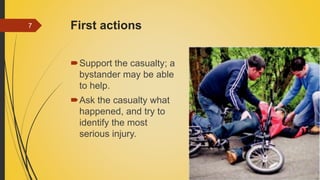
First actions
Support the casualty; a
bystander may be able
to help.
Ask the casualty what
happened, and try to
identify the most
serious injury.
7
The principle steps are:
 to assess the situation,
 to make the area safe (if possible)
 to give first aid.
 Use the primary survey
 identify the most seriously injured casualties
 treat them in the order of priority.
8
ASSESSING THE SITUATION
 Evaluating the scene accurately is one of the most
important factors in the management of an incident.
 You should stay calm.
 State that you have first aid training and, if there are no
medical personnel in attendance, calmly take charge.
All incidents should be managed in a similar
manner.
9
Consider the following:
 ■ Safety
 What are the dangers and do they still exist? Are you wearing
protective equipment?
 Is it safe for you to approach?
 ■ Scene
 What factors are involved at the incident? What are the
mechanisms of the injuries? How many casualties are there? What
are the potential injuries?
 ■ Situation
 What happened? How many people are involved and what ages
are they? Are any of them children or elderly?
10
MAKING AN AREA SAFE
 The conditions that give rise to an incident may still present a
danger and must be eliminated if possible.
 When approaching a casualty, make sure you protect yourself:
wear high-visibility clothing, gloves, and head protection if you
have them.
If you cannot make an area safe, call 112/103 for
emergency help before performing first aid.
Stand clear until the emergency services have secured
the scene.
11
TRAFFIC ACCIDENTS
 The severity of traffic accidents can range from a fall
from a bicycle to a major vehicle crash involving many
casualties.
 Often, the accident site will present serious risks to safety,
largely because of passing traffic.
 It is essential to make the accident area safe before
attending any casualties.
 This protects you, the casualties, and other road users.
12
 Once the area is safe, quickly assess the casualties and prioritize
treatment.
 Give first aid to those with life-threatening injuries before treating
anyone else.
 Call 103/112 for emergency help, giving as much detail as
you can about the accident, indicating number and age of the
casualties, and types of injury.
13
MAKING THE ACCIDENT AREA SAFE
 Do not put yourself or others in further danger.
 Take the following precautions:
1) ■ Park safely
2) ■ Set up warning triangles or flares
3) ■ Make vehicles safe.
4) ■ Watch out for physical dangers
5) ■ Alert the emergency services
14
 Warn other road users Ask a
bystander to set up warning
triangles in both directions.
 Advise the person to watch
for other vehicles while she is
doing this.
15
16
GIVING EMERGENCY HELP
 Once an area has been made safe, use the primary survey to
quickly carry out an initial assessment of the casualty or
casualties to establish treatment priorities.
 If there is more than one casualty, attend to those with life-
threatening conditions first.
 If possible, treat casualties in the position in which you find
them; move them only if they are in immediate danger or if it is
necessary in order to provide life-saving treatment.
17
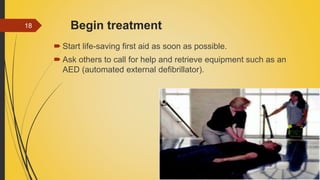
Begin treatment
 Start life-saving first aid as soon as possible.
 Ask others to call for help and retrieve equipment such as an
AED (automated external defibrillator).
18
Applying CPR(video)19
METHODS OF ASSESSMENT
When you assess a casualty you first need to identify
and deal with any life-threatening conditions or injuries—
the primary survey.
Deal with each life-threatening condition as you find it,
working in the following order— airway, breathing,
circulation—before you progress to the next stage.
20
THE PRIMARY SURVEY
This is an initial rapid assessment of a casualty to establish
and treat conditions that are an immediate threat to life.
If a casualty is conscious, suffering from minor injuries and is
talking to you, then this survey will be completed very
quickly.
If, however, a casualty is more seriously injured (for
example, unconscious), this assessment will take longer.
21
Follow the principle:
1. Airway,
2. Breathing
3. Circulation
22
Airway
 ■ Airway Is the airway open and clear?
 The airway is not open and clear if the casualty is unable
to speak.
 An obstructed airway will prevent breathing, causing
hypoxia and, ultimately, death.
 The airway is open and clear if the casualty is talking to
you.
23
Breathing
■ Breathing Is the casualty breathing normally?
If the casualty is not breathing normally, call 911 for
emergency help, then start chest compressions with
rescue breaths (cardiopulmonary resuscitation/CPR).
24
Circulation
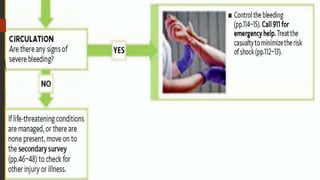
■ Circulation Is the casualty bleeding severely?
If he is bleeding this must be treated immediately
because it can lead to a life threatening condition known
as shock.
25
THE SECONDARY SURVEY
This is a detailed examination of a casualty to look for
other injuries or conditions that may not be readily
apparent on the primary survey.
To do this, carry out a head-to-toe examination.
26
Your aim is to find out:
■ History What actually happened and any relevant
medical history.
■ Symptoms Injuries or abnormalities that the casualty
tells you about.
■ Signs Injuries or abnormalities that you can see.
27
LEVEL OF RESPONSE
You will initially have noted whether or not a casualty is
conscious.
He may have spoken to you or made eye contact or
some other gesture.
Or perhaps there has been no response to your
questions such as “Are you all right?” or “What
happened?” Now you need to establish the level of
response using the AVPU scale.
28
MECHANISMS OF INJURY
The type of injury that a person sustains is directly
related to how the injury is caused.
Whether a casualty sustains a single injury or multiple
injuries is also determined by the mechanisms that
caused it.
This is the reason why a history of the incident is
important.
29
The information is useful because it also helps the
emergency services and medical team predict the type
and severity of injury, as well as the treatment.
This therefore helps the diagnosis, treatment, and likely
outcome for the casualty.
CIRCUMSTANCES OF INJURY
The extent and type of injuries sustained due to impact—
for example, a fall from a height or the impact of a car
crash—can be predicted if you know exactly how the
incident happened.
30
Whiplash
The head may be whipped
backward and then rapidly
forward, or vice versa, due to
sudden forces on the body,
such as in a car crash.
This produces a whiplash
injury, with strained muscles
and stretched ligaments in
the neck.
31
FORCES EXERTED ON THE BODY
The energy forces exerted during an impact are another
important indicator of the type or severity of any injury.
For example, if a man falls from a height of 3 feet (1 m) or
less onto hard ground, he will probably suffer bruising but
no serious injury.
A fall from a height of more than 10 feet (3 m), however, is
more likely to produce more serious injuries, such as a
pelvic fracture or internal bleeding.
32
Most serious injury may
be hidden.
A first aider should
keep the casualty still,
ask someone to
support her head, and
call 112/103 for
emergency help.
33
QUESTIONS TO ASK AT THE SCENE
 When you are attending a casualty, ask the casualty, or any
witnesses, questions to try to find out the mechanism of the
injury.
 Witnesses are especially important if the casualty is unable
to talk to you.
34
Possible questions include:
1. ■ Was the casualty ejected from a vehicle?
2. ■ Was the casualty wearing a seat belt?
3. ■ Did the vehicle roll over?
4. ■ Was the casualty wearing a helmet?
5. ■ How far did the casualty fall?
6. ■ What type of surface did she land on?
7. ■ Is there evidence of body contact with a solid object?
8. ■ How did she fall?
35
PRIMARY SURVEY
The primary survey is a quick, systematic assessment
of a casualty to establish if any conditions or injuries
sustained are life threatening.
36
RESPONSE
At this point you need to make a quick assessment to find
out whether a casualty is conscious or unconscious.
Observe the casualty as you approach.
Introduce yourself even if he does not appear to be
responding to you.
Ask the casualty some questions, such as, “
What happened?” or “Are you all right?” or give a
command, such as “Open your eyes!”
37
If there is no initial response, gently shake the casualty’s
shoulders.
If the casualty is a child, tap his shoulder.
if he is an infant, tap his foot.
If there is still no response, he is unconscious.
If the casualty responds and makes eye contact or
some other gesture, he is conscious.
38
AIRWAY
The first step is to check that a casualty’s airway is open
and clear.
If a casualty is alert and talking to you, it follows that the
airway is open and clear.
If, however, a casualty is unconscious, the airway may
be obstructed.
You need to open and clear the airway.
39
BREATHING
Is the casualty breathing normally? Look, listen, and feel
for breaths.
If he is alert and/or talking to you, he will be breathing.
However, it is important to note the rate, depth, and ease
with which he is breathing.
40
For example, conditions such as asthma that cause
breathing difficulty require urgent treatment.
If an unconscious casualty is not breathing, the heart will
stop.
Chest compressions and rescue breaths
(cardiopulmonary resuscitation/ CPR) must be started
immediately.
41
CIRCULATION
Conditions that affect the circulation of blood can be life
threatening.
Injuries that result in severe bleeding can cause blood
loss from the circulatory system.
They must be treated immediately to minimize the risk of
a life-threatening condition known as shock.
42
SPECIAL CASE
SUDDEN CARDIAC ARREST
If you see the casualty suddenly lose consciousness
and fall to the ground, or other witnesses describe those
symptoms, assume sudden cardiac arrest and
immediately start CPR with chest compressions.
43
Only when life-threatening conditions have been
stabilized, or there are none present, should you make a
detailed secondary survey of the casualty.
44
45
46
ASSISTING THE EMERGENCY
SERVICES
 Hand over any notes you have made to the emergency
services when they arrive.
 Answer any questions they may have and follow any
instructions.
 As a first aider you may be asked to help, for example, to
move a casualty using specialist equipment.
 If so, you should always follow their instructions.
47
ASSESSING THE CASUALTIES
 Quickly assess any casualties by carrying out a primary
survey.
 Deal first with those who have life-threatening injuries.
 Assume that any casualty who has been involved in a traffic
accident may have a neck or spinal injury.
 If possible, treat casualties in the position in which you find
them, supporting the head and neck at all times, and wait for
the emergency services.
48
CAUTION
 ■ Do not cross a highway to attend to an accident or casualty.
 ■ At night, wear or carry something light or reflective, such as a
high-visibility jacket, and use a flashlight.
 ■ Do not move the casualty unless it is absolutely necessary.
 If you do have to move her, the method will depend on the
casualty’s condition and available help.
49
 ■ Find out as much as you can about the accident and relay
this information to the emergency services when they arrive.
 ■ Be aware that road surfaces may be slippery because of
fuel, oil, or even ice.
 ■ Be aware that undeployed air bags and unactivated seat-
belt tensioners may be a hazard.
50
Casualty in a vehicle
 Assume that any injured
casualty in a vehicle has a
neck injury.
 Support the head while
you await help.
 Reassure her and keep
her ears uncovered so that
she can hear you.
51
52

Reanimation(motor accident)

  • 2.
  • 3.
    MANAGING AN INCIDENT The scene of any incident can present many potential dangers, whether someone has become ill or has been injured, whether in the home or outside at the scene of an incident.  Before any first aid is provided you must make sure that approaching the scene of the incident does not present unacceptable danger to the casualty, or to you or anyone else who is helping. 3
  • 4.
     This chapterprovides advice for first aiders on how to ensure safety in an emergency situation.  There are specific guidelines for emergencies that pose a particular risk.  These include fires, traffic accidents, and incidents involving electricity and drowning.  The procedures that are used by the emergency services for major incidents, where particular precautions are necessary and where first aiders may be called on to help, are also described here. 4
  • 5.
    AIMS AND OBJECTIVES ■ To protect yourself from danger and make the area safe.  ■ To assess the situation quickly and calmly and summon help if necessary.  ■ To assist any casualties and provide necessary treatment with the help of bystanders.  ■ To call 911 for emergency help if you suspect serious injury or illness.  ■ To be aware of your own needs. 5
  • 6.
    ACTION AT ANEMERGENCY  In any emergency it is important that you follow a clear plan of action.  This will enable you to prioritize the demands that may be made upon you, and help you decide on your best response. 6
  • 7.
    First actions Support thecasualty; a bystander may be able to help. Ask the casualty what happened, and try to identify the most serious injury. 7
  • 8.
    The principle stepsare:  to assess the situation,  to make the area safe (if possible)  to give first aid.  Use the primary survey  identify the most seriously injured casualties  treat them in the order of priority. 8
  • 9.
    ASSESSING THE SITUATION Evaluating the scene accurately is one of the most important factors in the management of an incident.  You should stay calm.  State that you have first aid training and, if there are no medical personnel in attendance, calmly take charge. All incidents should be managed in a similar manner. 9
  • 10.
    Consider the following: ■ Safety  What are the dangers and do they still exist? Are you wearing protective equipment?  Is it safe for you to approach?  ■ Scene  What factors are involved at the incident? What are the mechanisms of the injuries? How many casualties are there? What are the potential injuries?  ■ Situation  What happened? How many people are involved and what ages are they? Are any of them children or elderly? 10
  • 11.
    MAKING AN AREASAFE  The conditions that give rise to an incident may still present a danger and must be eliminated if possible.  When approaching a casualty, make sure you protect yourself: wear high-visibility clothing, gloves, and head protection if you have them. If you cannot make an area safe, call 112/103 for emergency help before performing first aid. Stand clear until the emergency services have secured the scene. 11
  • 12.
    TRAFFIC ACCIDENTS  Theseverity of traffic accidents can range from a fall from a bicycle to a major vehicle crash involving many casualties.  Often, the accident site will present serious risks to safety, largely because of passing traffic.  It is essential to make the accident area safe before attending any casualties.  This protects you, the casualties, and other road users. 12
  • 13.
     Once thearea is safe, quickly assess the casualties and prioritize treatment.  Give first aid to those with life-threatening injuries before treating anyone else.  Call 103/112 for emergency help, giving as much detail as you can about the accident, indicating number and age of the casualties, and types of injury. 13
  • 14.
    MAKING THE ACCIDENTAREA SAFE  Do not put yourself or others in further danger.  Take the following precautions: 1) ■ Park safely 2) ■ Set up warning triangles or flares 3) ■ Make vehicles safe. 4) ■ Watch out for physical dangers 5) ■ Alert the emergency services 14
  • 15.
     Warn otherroad users Ask a bystander to set up warning triangles in both directions.  Advise the person to watch for other vehicles while she is doing this. 15
  • 16.
  • 17.
    GIVING EMERGENCY HELP Once an area has been made safe, use the primary survey to quickly carry out an initial assessment of the casualty or casualties to establish treatment priorities.  If there is more than one casualty, attend to those with life- threatening conditions first.  If possible, treat casualties in the position in which you find them; move them only if they are in immediate danger or if it is necessary in order to provide life-saving treatment. 17
  • 18.
    Begin treatment  Startlife-saving first aid as soon as possible.  Ask others to call for help and retrieve equipment such as an AED (automated external defibrillator). 18
  • 19.
  • 20.
    METHODS OF ASSESSMENT Whenyou assess a casualty you first need to identify and deal with any life-threatening conditions or injuries— the primary survey. Deal with each life-threatening condition as you find it, working in the following order— airway, breathing, circulation—before you progress to the next stage. 20
  • 21.
    THE PRIMARY SURVEY Thisis an initial rapid assessment of a casualty to establish and treat conditions that are an immediate threat to life. If a casualty is conscious, suffering from minor injuries and is talking to you, then this survey will be completed very quickly. If, however, a casualty is more seriously injured (for example, unconscious), this assessment will take longer. 21
  • 22.
    Follow the principle: 1.Airway, 2. Breathing 3. Circulation 22
  • 23.
    Airway  ■ AirwayIs the airway open and clear?  The airway is not open and clear if the casualty is unable to speak.  An obstructed airway will prevent breathing, causing hypoxia and, ultimately, death.  The airway is open and clear if the casualty is talking to you. 23
  • 24.
    Breathing ■ Breathing Isthe casualty breathing normally? If the casualty is not breathing normally, call 911 for emergency help, then start chest compressions with rescue breaths (cardiopulmonary resuscitation/CPR). 24
  • 25.
    Circulation ■ Circulation Isthe casualty bleeding severely? If he is bleeding this must be treated immediately because it can lead to a life threatening condition known as shock. 25
  • 26.
    THE SECONDARY SURVEY Thisis a detailed examination of a casualty to look for other injuries or conditions that may not be readily apparent on the primary survey. To do this, carry out a head-to-toe examination. 26
  • 27.
    Your aim isto find out: ■ History What actually happened and any relevant medical history. ■ Symptoms Injuries or abnormalities that the casualty tells you about. ■ Signs Injuries or abnormalities that you can see. 27
  • 28.
    LEVEL OF RESPONSE Youwill initially have noted whether or not a casualty is conscious. He may have spoken to you or made eye contact or some other gesture. Or perhaps there has been no response to your questions such as “Are you all right?” or “What happened?” Now you need to establish the level of response using the AVPU scale. 28
  • 29.
    MECHANISMS OF INJURY Thetype of injury that a person sustains is directly related to how the injury is caused. Whether a casualty sustains a single injury or multiple injuries is also determined by the mechanisms that caused it. This is the reason why a history of the incident is important. 29 The information is useful because it also helps the emergency services and medical team predict the type and severity of injury, as well as the treatment. This therefore helps the diagnosis, treatment, and likely outcome for the casualty.
  • 30.
    CIRCUMSTANCES OF INJURY Theextent and type of injuries sustained due to impact— for example, a fall from a height or the impact of a car crash—can be predicted if you know exactly how the incident happened. 30
  • 31.
    Whiplash The head maybe whipped backward and then rapidly forward, or vice versa, due to sudden forces on the body, such as in a car crash. This produces a whiplash injury, with strained muscles and stretched ligaments in the neck. 31
  • 32.
    FORCES EXERTED ONTHE BODY The energy forces exerted during an impact are another important indicator of the type or severity of any injury. For example, if a man falls from a height of 3 feet (1 m) or less onto hard ground, he will probably suffer bruising but no serious injury. A fall from a height of more than 10 feet (3 m), however, is more likely to produce more serious injuries, such as a pelvic fracture or internal bleeding. 32
  • 33.
    Most serious injurymay be hidden. A first aider should keep the casualty still, ask someone to support her head, and call 112/103 for emergency help. 33
  • 34.
    QUESTIONS TO ASKAT THE SCENE  When you are attending a casualty, ask the casualty, or any witnesses, questions to try to find out the mechanism of the injury.  Witnesses are especially important if the casualty is unable to talk to you. 34
  • 35.
    Possible questions include: 1.■ Was the casualty ejected from a vehicle? 2. ■ Was the casualty wearing a seat belt? 3. ■ Did the vehicle roll over? 4. ■ Was the casualty wearing a helmet? 5. ■ How far did the casualty fall? 6. ■ What type of surface did she land on? 7. ■ Is there evidence of body contact with a solid object? 8. ■ How did she fall? 35
  • 36.
    PRIMARY SURVEY The primarysurvey is a quick, systematic assessment of a casualty to establish if any conditions or injuries sustained are life threatening. 36
  • 37.
    RESPONSE At this pointyou need to make a quick assessment to find out whether a casualty is conscious or unconscious. Observe the casualty as you approach. Introduce yourself even if he does not appear to be responding to you. Ask the casualty some questions, such as, “ What happened?” or “Are you all right?” or give a command, such as “Open your eyes!” 37
  • 38.
    If there isno initial response, gently shake the casualty’s shoulders. If the casualty is a child, tap his shoulder. if he is an infant, tap his foot. If there is still no response, he is unconscious. If the casualty responds and makes eye contact or some other gesture, he is conscious. 38
  • 39.
    AIRWAY The first stepis to check that a casualty’s airway is open and clear. If a casualty is alert and talking to you, it follows that the airway is open and clear. If, however, a casualty is unconscious, the airway may be obstructed. You need to open and clear the airway. 39
  • 40.
    BREATHING Is the casualtybreathing normally? Look, listen, and feel for breaths. If he is alert and/or talking to you, he will be breathing. However, it is important to note the rate, depth, and ease with which he is breathing. 40
  • 41.
    For example, conditionssuch as asthma that cause breathing difficulty require urgent treatment. If an unconscious casualty is not breathing, the heart will stop. Chest compressions and rescue breaths (cardiopulmonary resuscitation/ CPR) must be started immediately. 41
  • 42.
    CIRCULATION Conditions that affectthe circulation of blood can be life threatening. Injuries that result in severe bleeding can cause blood loss from the circulatory system. They must be treated immediately to minimize the risk of a life-threatening condition known as shock. 42
  • 43.
    SPECIAL CASE SUDDEN CARDIACARREST If you see the casualty suddenly lose consciousness and fall to the ground, or other witnesses describe those symptoms, assume sudden cardiac arrest and immediately start CPR with chest compressions. 43 Only when life-threatening conditions have been stabilized, or there are none present, should you make a detailed secondary survey of the casualty.
  • 44.
  • 45.
  • 46.
  • 47.
    ASSISTING THE EMERGENCY SERVICES Hand over any notes you have made to the emergency services when they arrive.  Answer any questions they may have and follow any instructions.  As a first aider you may be asked to help, for example, to move a casualty using specialist equipment.  If so, you should always follow their instructions. 47
  • 48.
    ASSESSING THE CASUALTIES Quickly assess any casualties by carrying out a primary survey.  Deal first with those who have life-threatening injuries.  Assume that any casualty who has been involved in a traffic accident may have a neck or spinal injury.  If possible, treat casualties in the position in which you find them, supporting the head and neck at all times, and wait for the emergency services. 48
  • 49.
    CAUTION  ■ Donot cross a highway to attend to an accident or casualty.  ■ At night, wear or carry something light or reflective, such as a high-visibility jacket, and use a flashlight.  ■ Do not move the casualty unless it is absolutely necessary.  If you do have to move her, the method will depend on the casualty’s condition and available help. 49
  • 50.
     ■ Findout as much as you can about the accident and relay this information to the emergency services when they arrive.  ■ Be aware that road surfaces may be slippery because of fuel, oil, or even ice.  ■ Be aware that undeployed air bags and unactivated seat- belt tensioners may be a hazard. 50
  • 51.
    Casualty in avehicle  Assume that any injured casualty in a vehicle has a neck injury.  Support the head while you await help.  Reassure her and keep her ears uncovered so that she can hear you. 51
  • 52.