Neurologic Emergencies
‘In the streets’
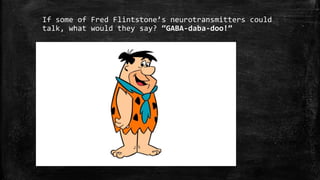
If some of Fred Flintstone’s neurotransmitters could
talk, what would they say? “GABA-daba-doo!”
Introduction
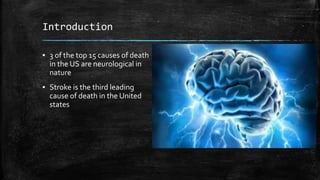
▪ 3 of the top 15 causes of death
in the US are neurological in
nature
▪ Stroke is the third leading
cause of death in the United
states
Anatomy Stuff
▪ The Nervous system is comprised of two major structures: the brain
and the spinal cord.And also thousands of nerves that allow every
part of the body to communicate.
▪ Breathing, pulse rate, and blood pressure are just a few functions
that the nervous system controls.
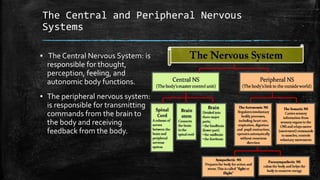
▪ The Central Nervous System: is responsible for thought, perception,
feeling, and autonomic body functions.
▪ The peripheral nervous system: is responsible for transmitting
commands from the brain to the body and receiving feedback from
the body.
▪ The Central Nervous System: is
responsible for thought,
perception, feeling, and
autonomic body functions.
▪ The peripheral nervous system:
is responsible for transmitting
commands from the brain to
the body and receiving
feedback from the body.
The Central and Peripheral Nervous
Systems
What is the Diencephalon? Why is it
important?
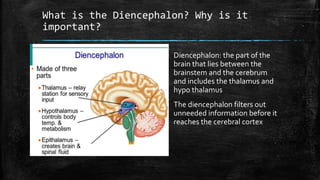
▪ Diencephalon: the part of the
brain that lies between the
brainstem and the cerebrum
and includes the thalamus and
hypo thalamus
▪ The diencephalon filters out
unneeded information before it
reaches the cerebral cortex
Brainstem, Cerebellum, Hypothalamus, and
the Pituitary Gland
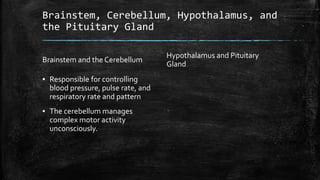
Brainstem and the Cerebellum
▪ Responsible for controlling
blood pressure, pulse rate, and
respiratory rate and pattern
▪ The cerebellum manages
complex motor activity
unconsciously.
Hypothalamus and Pituitary
Gland
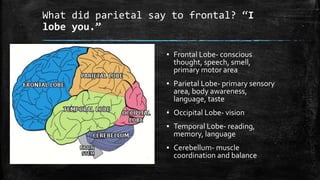
What did parietal say to frontal? “I
lobe you.”
▪ Frontal Lobe- conscious
thought, speech, smell,
primary motor area
▪ Parietal Lobe- primary sensory
area, body awareness,
language, taste
▪ Occipital Lobe- vision
▪ Temporal Lobe- reading,
memory, language
▪ Cerebellum- muscle
coordination and balance
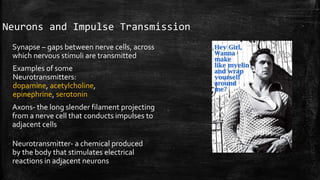
Neurons and Impulse Transmission
Synapse – gaps between nerve cells, across
which nervous stimuli are transmitted
Examples of some
Neurotransmitters:
dopamine, acetylcholine,
epinephrine, serotonin
Axons- the long slender filament projecting
from a nerve cell that conducts impulses to
adjacent cells
Neurotransmitter- a chemical produced
by the body that stimulates electrical
reactions in adjacent neurons
Stroke
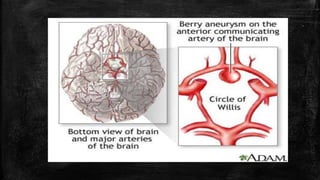
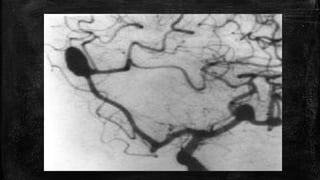
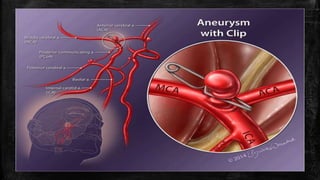
Hemorrhagic Stroke (25%)
• Broken artery
• Tend to get worse over time. Bleeding can
cause increased ICP and brainstem
herniation.
• “worst headache of my life” is a hallmark
sign of a hemorrhagic stroke
Ischemic Stroke (75%)
• Blocked artery
• Aka “occlusive strokes” because
they are caused by an occlusion;
thrombus or embolus.
• Damage depends on where the
blockage is and how long its been
there.
• In an ischemic stroke a blood
vessel is blocked so the tissue
distal to the blockage becomes
ischemic and will eventually die if
blood flow is not returned.
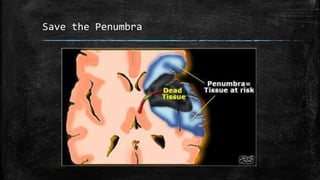
Save the Penumbra
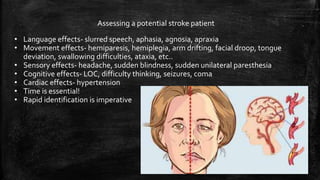
Assessing a potential stroke patient
• Language effects- slurred speech, aphasia, agnosia, apraxia
• Movement effects- hemiparesis, hemiplegia, arm drifting, facial droop, tongue
deviation, swallowing difficulties, ataxia, etc..
• Sensory effects- headache, sudden blindness, sudden unilateral paresthesia
• Cognitive effects- LOC, difficulty thinking, seizures, coma
• Cardiac effects- hypertension
• Time is essential!
• Rapid identification is imperative
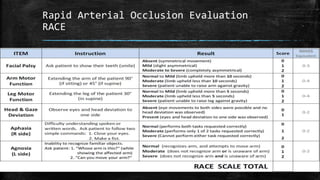
Rapid Arterial Occlusion Evaluation
RACE
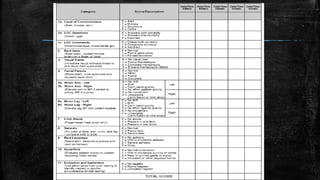
National Institutes of Health Stroke
Scale NIHSS
▪ http://www.activase.com/resource-center/video-library.jsp?tab=0
▪ http://atlanticneurosurgical.com/services/stroke_treatment.php
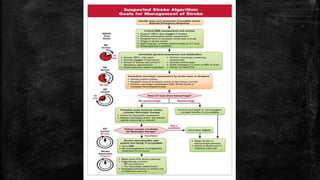
Management of stroke patients
• Administer fluids as needed
• Elevate the patients head 30 degrees (this will create a
slight decrease in ICP)
• Ensure the airway is clear but do not suction vigorously
because stimulating the cough and gag reflexes will
increase ICP.
• Be prepared for seizures
• Monitor BP closely- systolic needs to be at least 110-120
• Do not hyperventilate your patient! A high oxygen level
causes constriction of the cerebral arteries…this
vasoconstriction further impairs perfusion to the brain.
• Do not give more than 30 breaths a minute
• Remember that time is essential!
Transient Ischemic Attacks
• TIAs- are episodes of cerebral ischemia
without any permanent damage.
• What makesTIAs different from a stroke?
They resolve all signs and symptoms
within 24 hours.
Managing aTIA:
• Follow stroke guidelines
• Strongly encourage
transportation
Coma
• Evaluate the speed of onset of the patient’s altered
LOC.
• Getting a good history is vital because LOC is a
very common call to go on. Getting a good HX can
help distinguish what kind of underlying medical
problems could be causing it.
Assessment:
• Cognitive effects- decreasing LOC, confusion,
hallucinations, delusions, psychosis, difficulty
thinking and sleepiness.
• Speech effects- slurred speech, agnosia, apraxia,
aphasisa
• Movement/General CNS effects- ataxia, seizures,
posturing, total unresponsiveness
Seizures
• A seizure is the sudden, erratic firing of neurons
• During a seizure, neurons are in a hyper metabolic
state using large amounts of glucose.
Common causes of seizures:
• Abscess
• Alcohol
• Brain infections/trauma
• Diabetes
• Recreational drug use
• Stroke/TIA
• Tumor
• Inappropriate medication dosage
• Systemic infections
• Uremia (kidney failure)
Seizures cont.
Signs/Symptoms:
• Muscle spasms
• Increased secretions
• Diaphoresis
• Cyanosis
• Fainting
Postictal Signs:
• Aphasic
• Confused
• Emotional
• tired/sleeping
• HA
• Gradual return to normal
Seizures cont cont…
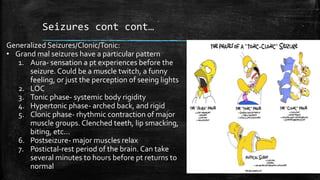
Generalized Seizures/Clonic/Tonic:
• Grand mal seizures have a particular pattern
1. Aura- sensation a pt experiences before the
seizure. Could be a muscle twitch, a funny
feeling, or just the perception of seeing lights
2. LOC
3. Tonic phase- systemic body rigidity
4. Hypertonic phase- arched back, and rigid
5. Clonic phase- rhythmic contraction of major
muscle groups. Clenched teeth, lip smacking,
biting, etc…
6. Postseizure- major muscles relax
7. Postictal-rest period of the brain. Can take
several minutes to hours before pt returns to
normal
Seizures cont cont cont…
Absence Seizures:
• Present with little to no
movement
• Only lasts a few seconds
• No postictal period
Partial Seizures:
• Affect a limited portion of the brain
• Involve either movement of one part of
the body (frontal lobe) or sensations in
one part of the body (parietal lobe)
Postictal Signs:
• Aphasic
• Confused
• Emotional
• tired/sleeping
• HA
• Gradual return to normal
Status Epilepticus
• Can be defined as a seizure that lasts longer than 4 to 5 minutes or consecutive
seizures without a return to consciousness between seizures.
• Refer to local protocols for guidelines related to how long a seizure san continue
before you intervene
• Nearly 20% of patients in status epilepticus will die
• Administer a benzodiazepine
• Be prepared to control airway and ventilation completely because benzos can cause
respiratory depression - arrest
Syncope
• Syncope is the sudden and temporary loss of consciousness with accompanying loss
of postural tone
• The brain uses glucose at an astounding rate and has no ability to store glucose. So
even the briefest interruption in blood flow causes LOC.This is the underlying cause
for syncope
• In younger adults the most common reason for syncope is vasovagal… aka they
experience fear or emotional stress ( like a blood draw) and pass out
• In older adults the most common cause of syncope is a cardiac dysrhythmia.
• s/s of impending syncope: dizziness, weakness, blurred vision, SOB, chest pain, or a
headache.
• When managing a syncopal pt make sure to determine whether or not trauma
happened during the pt’s fall. Make sure to check the pt’s vitals to try to narrow down
why they passed out.
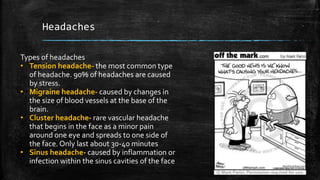
Headaches
Types of headaches
• Tension headache- the most common type
of headache. 90% of headaches are caused
by stress.
• Migraine headache- caused by changes in
the size of blood vessels at the base of the
brain.
• Cluster headache- rare vascular headache
that begins in the face as a minor pain
around one eye and spreads to one side of
the face. Only last about 30-40 minutes
• Sinus headache- caused by inflammation or
infection within the sinus cavities of the face
Dementia
Dementia is the chronic deterioration of memory, personality, language skills,
perception, reasoning, or judgement with no loss of consciousness.
Patients can become aggressive and violent because the disease damages their
judgement centers.
Confusion is a hallmark sign.
Different types of dementia
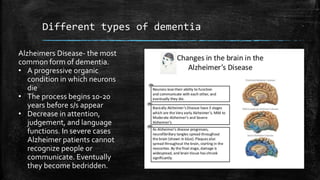
.Alzheimers Disease- the most
common form of dementia.
• A progressive organic
condition in which neurons
die
• The process begins 10-20
years before s/s appear
• Decrease in attention,
judgement, and language
functions. In severe cases
Alzheimer patients cannot
recognize people or
communicate. Eventually
they become bedridden.
Different types of Dementia
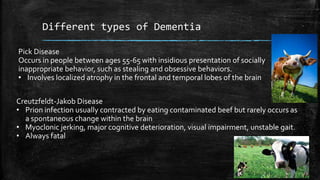
Pick Disease
Occurs in people between ages 55-65 with insidious presentation of socially
inappropriate behavior, such as stealing and obsessive behaviors.
• Involves localized atrophy in the frontal and temporal lobes of the brain
Creutzfeldt-Jakob Disease
• Prion infection usually contracted by eating contaminated beef but rarely occurs as
a spontaneous change within the brain
• Myoclonic jerking, major cognitive deterioration, visual impairment, unstable gait.
• Always fatal
Different types of dementia
Huntington Disease
An adult onset genetic disorder marked by
severe loss of neurons.
• Initially patients may present with
fidgetiness, abnormal eye movements,
tics, and loss of interest.
• As the disease progresses; bradykinesia,
difficulty in standing, ataxa, slowing of
thinking and memory loss
Different types of dementia
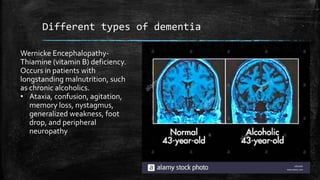
Wernicke Encephalopathy-
Thiamine (vitamin B) deficiency.
Occurs in patients with
longstanding malnutrition, such
as chronic alcoholics.
• Ataxia, confusion, agitation,
memory loss, nystagmus,
generalized weakness, foot
drop, and peripheral
neuropathy
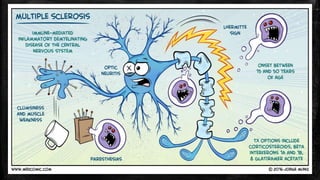
Multiple Sclerosis
An autoimmune condition in which the body attacks the myelin of the brain and
spinal cord.
• In an autoimmune disorder the body begins to attack its own cells because
the immune system can no longer distinguish friend from foe.
• Patients can experience: muscle weakness, impairment of: pain, temperature,
and touch sensations, pain, vertigo, bladder and bowl dysfunction, sexual
dysfunction, depression, euphoria, cognitive abnormalities, and fatigue.
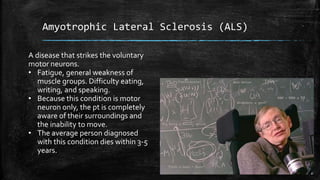
Amyotrophic Lateral Sclerosis (ALS)
A disease that strikes the voluntary
motor neurons.
• Fatigue, general weakness of
muscle groups. Difficulty eating,
writing, and speaking.
• Because this condition is motor
neuron only, the pt is completely
aware of their surroundings and
the inability to move.
• The average person diagnosed
with this condition dies within 3-5
years.
Parkinson’s disease
A neurologic condition in which past injuries to the brain can have an influence.
The substantia nigra- the portion of the brain that produces dopamine, has
damage and no longer works well.
In some patients the damage is linked to past injuries and in other patients the
damage is unexplainable.
Dopamine- a neurotransmitter that is
needed for muscles to contract smoothly.
This video is super helpful in understanding
Parkinson’s disease
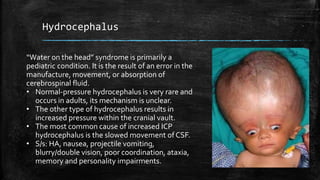
Hydrocephalus
“Water on the head” syndrome is primarily a
pediatric condition. It is the result of an error in the
manufacture, movement, or absorption of
cerebrospinal fluid.
• Normal-pressure hydrocephalus is very rare and
occurs in adults, its mechanism is unclear.
• The other type of hydrocephalus results in
increased pressure within the cranial vault.
• The most common cause of increased ICP
hydrocephalus is the slowed movement of CSF.
• S/s: HA, nausea, projectile vomiting,
blurry/double vision, poor coordination, ataxia,
memory and personality impairments.
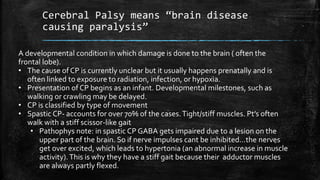
Cerebral Palsy means “brain disease
causing paralysis”
A developmental condition in which damage is done to the brain ( often the
frontal lobe).
• The cause of CP is currently unclear but it usually happens prenatally and is
often linked to exposure to radiation, infection, or hypoxia.
• Presentation of CP begins as an infant. Developmental milestones, such as
walking or crawling may be delayed.
• CP is classified by type of movement
• Spastic CP- accounts for over 70% of the cases.Tight/stiff muscles. Pt’s often
walk with a stiff scissor-like gait
• Pathophys note: in spastic CP GABA gets impaired due to a lesion on the
upper part of the brain. So if nerve impulses cant be inhibited…the nerves
get over excited, which leads to hypertonia (an abnormal increase in muscle
activity). This is why they have a stiff gait because their adductor muscles
are always partly flexed.
Cerebral Palsy cont…
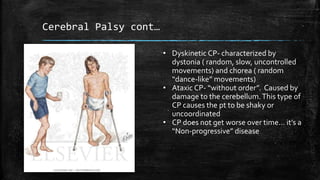
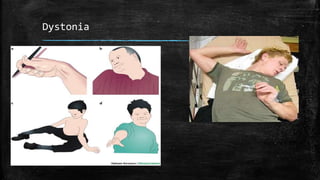
• Dyskinetic CP- characterized by
dystonia ( random, slow, uncontrolled
movements) and chorea ( random
“dance-like” movements)
• Ataxic CP- “without order”. Caused by
damage to the cerebellum.This type of
CP causes the pt to be shaky or
uncoordinated
• CP does not get worse over time… it’s a
“Non-progressive” disease
Dystonia
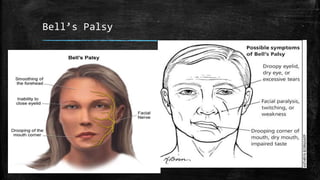
Bell’s Palsy
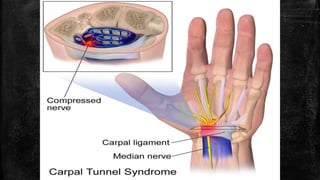
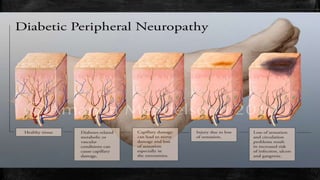
Neuropathy
▪ Mononeuropathy
▪ Polyneuropathy
Neuro Medications
▪ https://quizlet.com/303462839/neurological-medications-paramedic-
flash-cards/
A note:
As it was nearly impossible for me to
put everything from this chapter on
the slide show I highly encourage each
and everyone of you to read this
chapter. Especially the assessment
section because I didn’t touch much on
that at all.

Neurological emergencies nc

  • 1.
  • 2.
    If some ofFred Flintstone’s neurotransmitters could talk, what would they say? “GABA-daba-doo!”
  • 3.
    Introduction ▪ 3 ofthe top 15 causes of death in the US are neurological in nature ▪ Stroke is the third leading cause of death in the United states
  • 4.
    Anatomy Stuff ▪ TheNervous system is comprised of two major structures: the brain and the spinal cord.And also thousands of nerves that allow every part of the body to communicate. ▪ Breathing, pulse rate, and blood pressure are just a few functions that the nervous system controls. ▪ The Central Nervous System: is responsible for thought, perception, feeling, and autonomic body functions. ▪ The peripheral nervous system: is responsible for transmitting commands from the brain to the body and receiving feedback from the body.
  • 5.
    ▪ The CentralNervous System: is responsible for thought, perception, feeling, and autonomic body functions. ▪ The peripheral nervous system: is responsible for transmitting commands from the brain to the body and receiving feedback from the body. The Central and Peripheral Nervous Systems
  • 6.
    What is theDiencephalon? Why is it important? ▪ Diencephalon: the part of the brain that lies between the brainstem and the cerebrum and includes the thalamus and hypo thalamus ▪ The diencephalon filters out unneeded information before it reaches the cerebral cortex
  • 7.
    Brainstem, Cerebellum, Hypothalamus,and the Pituitary Gland Brainstem and the Cerebellum ▪ Responsible for controlling blood pressure, pulse rate, and respiratory rate and pattern ▪ The cerebellum manages complex motor activity unconsciously. Hypothalamus and Pituitary Gland
  • 8.
    What did parietalsay to frontal? “I lobe you.” ▪ Frontal Lobe- conscious thought, speech, smell, primary motor area ▪ Parietal Lobe- primary sensory area, body awareness, language, taste ▪ Occipital Lobe- vision ▪ Temporal Lobe- reading, memory, language ▪ Cerebellum- muscle coordination and balance
  • 9.
    Neurons and ImpulseTransmission Synapse – gaps between nerve cells, across which nervous stimuli are transmitted Examples of some Neurotransmitters: dopamine, acetylcholine, epinephrine, serotonin Axons- the long slender filament projecting from a nerve cell that conducts impulses to adjacent cells Neurotransmitter- a chemical produced by the body that stimulates electrical reactions in adjacent neurons
  • 10.
    Stroke Hemorrhagic Stroke (25%) •Broken artery • Tend to get worse over time. Bleeding can cause increased ICP and brainstem herniation. • “worst headache of my life” is a hallmark sign of a hemorrhagic stroke Ischemic Stroke (75%) • Blocked artery • Aka “occlusive strokes” because they are caused by an occlusion; thrombus or embolus. • Damage depends on where the blockage is and how long its been there. • In an ischemic stroke a blood vessel is blocked so the tissue distal to the blockage becomes ischemic and will eventually die if blood flow is not returned.
  • 11.
  • 12.
    Assessing a potentialstroke patient • Language effects- slurred speech, aphasia, agnosia, apraxia • Movement effects- hemiparesis, hemiplegia, arm drifting, facial droop, tongue deviation, swallowing difficulties, ataxia, etc.. • Sensory effects- headache, sudden blindness, sudden unilateral paresthesia • Cognitive effects- LOC, difficulty thinking, seizures, coma • Cardiac effects- hypertension • Time is essential! • Rapid identification is imperative
  • 13.
    Rapid Arterial OcclusionEvaluation RACE
  • 14.
    National Institutes ofHealth Stroke Scale NIHSS
  • 20.
  • 21.
    Management of strokepatients • Administer fluids as needed • Elevate the patients head 30 degrees (this will create a slight decrease in ICP) • Ensure the airway is clear but do not suction vigorously because stimulating the cough and gag reflexes will increase ICP. • Be prepared for seizures • Monitor BP closely- systolic needs to be at least 110-120 • Do not hyperventilate your patient! A high oxygen level causes constriction of the cerebral arteries…this vasoconstriction further impairs perfusion to the brain. • Do not give more than 30 breaths a minute • Remember that time is essential!
  • 22.
    Transient Ischemic Attacks •TIAs- are episodes of cerebral ischemia without any permanent damage. • What makesTIAs different from a stroke? They resolve all signs and symptoms within 24 hours. Managing aTIA: • Follow stroke guidelines • Strongly encourage transportation
  • 23.
    Coma • Evaluate thespeed of onset of the patient’s altered LOC. • Getting a good history is vital because LOC is a very common call to go on. Getting a good HX can help distinguish what kind of underlying medical problems could be causing it. Assessment: • Cognitive effects- decreasing LOC, confusion, hallucinations, delusions, psychosis, difficulty thinking and sleepiness. • Speech effects- slurred speech, agnosia, apraxia, aphasisa • Movement/General CNS effects- ataxia, seizures, posturing, total unresponsiveness
  • 24.
    Seizures • A seizureis the sudden, erratic firing of neurons • During a seizure, neurons are in a hyper metabolic state using large amounts of glucose. Common causes of seizures: • Abscess • Alcohol • Brain infections/trauma • Diabetes • Recreational drug use • Stroke/TIA • Tumor • Inappropriate medication dosage • Systemic infections • Uremia (kidney failure)
  • 25.
    Seizures cont. Signs/Symptoms: • Musclespasms • Increased secretions • Diaphoresis • Cyanosis • Fainting Postictal Signs: • Aphasic • Confused • Emotional • tired/sleeping • HA • Gradual return to normal
  • 26.
    Seizures cont cont… GeneralizedSeizures/Clonic/Tonic: • Grand mal seizures have a particular pattern 1. Aura- sensation a pt experiences before the seizure. Could be a muscle twitch, a funny feeling, or just the perception of seeing lights 2. LOC 3. Tonic phase- systemic body rigidity 4. Hypertonic phase- arched back, and rigid 5. Clonic phase- rhythmic contraction of major muscle groups. Clenched teeth, lip smacking, biting, etc… 6. Postseizure- major muscles relax 7. Postictal-rest period of the brain. Can take several minutes to hours before pt returns to normal
  • 27.
    Seizures cont contcont… Absence Seizures: • Present with little to no movement • Only lasts a few seconds • No postictal period Partial Seizures: • Affect a limited portion of the brain • Involve either movement of one part of the body (frontal lobe) or sensations in one part of the body (parietal lobe) Postictal Signs: • Aphasic • Confused • Emotional • tired/sleeping • HA • Gradual return to normal
  • 28.
    Status Epilepticus • Canbe defined as a seizure that lasts longer than 4 to 5 minutes or consecutive seizures without a return to consciousness between seizures. • Refer to local protocols for guidelines related to how long a seizure san continue before you intervene • Nearly 20% of patients in status epilepticus will die • Administer a benzodiazepine • Be prepared to control airway and ventilation completely because benzos can cause respiratory depression - arrest
  • 29.
    Syncope • Syncope isthe sudden and temporary loss of consciousness with accompanying loss of postural tone • The brain uses glucose at an astounding rate and has no ability to store glucose. So even the briefest interruption in blood flow causes LOC.This is the underlying cause for syncope • In younger adults the most common reason for syncope is vasovagal… aka they experience fear or emotional stress ( like a blood draw) and pass out • In older adults the most common cause of syncope is a cardiac dysrhythmia. • s/s of impending syncope: dizziness, weakness, blurred vision, SOB, chest pain, or a headache. • When managing a syncopal pt make sure to determine whether or not trauma happened during the pt’s fall. Make sure to check the pt’s vitals to try to narrow down why they passed out.
  • 30.
    Headaches Types of headaches •Tension headache- the most common type of headache. 90% of headaches are caused by stress. • Migraine headache- caused by changes in the size of blood vessels at the base of the brain. • Cluster headache- rare vascular headache that begins in the face as a minor pain around one eye and spreads to one side of the face. Only last about 30-40 minutes • Sinus headache- caused by inflammation or infection within the sinus cavities of the face
  • 31.
    Dementia Dementia is thechronic deterioration of memory, personality, language skills, perception, reasoning, or judgement with no loss of consciousness. Patients can become aggressive and violent because the disease damages their judgement centers. Confusion is a hallmark sign.
  • 32.
    Different types ofdementia .Alzheimers Disease- the most common form of dementia. • A progressive organic condition in which neurons die • The process begins 10-20 years before s/s appear • Decrease in attention, judgement, and language functions. In severe cases Alzheimer patients cannot recognize people or communicate. Eventually they become bedridden.
  • 33.
    Different types ofDementia Pick Disease Occurs in people between ages 55-65 with insidious presentation of socially inappropriate behavior, such as stealing and obsessive behaviors. • Involves localized atrophy in the frontal and temporal lobes of the brain Creutzfeldt-Jakob Disease • Prion infection usually contracted by eating contaminated beef but rarely occurs as a spontaneous change within the brain • Myoclonic jerking, major cognitive deterioration, visual impairment, unstable gait. • Always fatal
  • 34.
    Different types ofdementia Huntington Disease An adult onset genetic disorder marked by severe loss of neurons. • Initially patients may present with fidgetiness, abnormal eye movements, tics, and loss of interest. • As the disease progresses; bradykinesia, difficulty in standing, ataxa, slowing of thinking and memory loss
  • 35.
    Different types ofdementia Wernicke Encephalopathy- Thiamine (vitamin B) deficiency. Occurs in patients with longstanding malnutrition, such as chronic alcoholics. • Ataxia, confusion, agitation, memory loss, nystagmus, generalized weakness, foot drop, and peripheral neuropathy
  • 36.
    Multiple Sclerosis An autoimmunecondition in which the body attacks the myelin of the brain and spinal cord. • In an autoimmune disorder the body begins to attack its own cells because the immune system can no longer distinguish friend from foe. • Patients can experience: muscle weakness, impairment of: pain, temperature, and touch sensations, pain, vertigo, bladder and bowl dysfunction, sexual dysfunction, depression, euphoria, cognitive abnormalities, and fatigue.
  • 38.
    Amyotrophic Lateral Sclerosis(ALS) A disease that strikes the voluntary motor neurons. • Fatigue, general weakness of muscle groups. Difficulty eating, writing, and speaking. • Because this condition is motor neuron only, the pt is completely aware of their surroundings and the inability to move. • The average person diagnosed with this condition dies within 3-5 years.
  • 39.
    Parkinson’s disease A neurologiccondition in which past injuries to the brain can have an influence. The substantia nigra- the portion of the brain that produces dopamine, has damage and no longer works well. In some patients the damage is linked to past injuries and in other patients the damage is unexplainable. Dopamine- a neurotransmitter that is needed for muscles to contract smoothly. This video is super helpful in understanding Parkinson’s disease
  • 40.
    Hydrocephalus “Water on thehead” syndrome is primarily a pediatric condition. It is the result of an error in the manufacture, movement, or absorption of cerebrospinal fluid. • Normal-pressure hydrocephalus is very rare and occurs in adults, its mechanism is unclear. • The other type of hydrocephalus results in increased pressure within the cranial vault. • The most common cause of increased ICP hydrocephalus is the slowed movement of CSF. • S/s: HA, nausea, projectile vomiting, blurry/double vision, poor coordination, ataxia, memory and personality impairments.
  • 41.
    Cerebral Palsy means“brain disease causing paralysis” A developmental condition in which damage is done to the brain ( often the frontal lobe). • The cause of CP is currently unclear but it usually happens prenatally and is often linked to exposure to radiation, infection, or hypoxia. • Presentation of CP begins as an infant. Developmental milestones, such as walking or crawling may be delayed. • CP is classified by type of movement • Spastic CP- accounts for over 70% of the cases.Tight/stiff muscles. Pt’s often walk with a stiff scissor-like gait • Pathophys note: in spastic CP GABA gets impaired due to a lesion on the upper part of the brain. So if nerve impulses cant be inhibited…the nerves get over excited, which leads to hypertonia (an abnormal increase in muscle activity). This is why they have a stiff gait because their adductor muscles are always partly flexed.
  • 42.
    Cerebral Palsy cont… •Dyskinetic CP- characterized by dystonia ( random, slow, uncontrolled movements) and chorea ( random “dance-like” movements) • Ataxic CP- “without order”. Caused by damage to the cerebellum.This type of CP causes the pt to be shaky or uncoordinated • CP does not get worse over time… it’s a “Non-progressive” disease
  • 43.
  • 44.
  • 45.
  • 49.
  • 52.
    A note: As itwas nearly impossible for me to put everything from this chapter on the slide show I highly encourage each and everyone of you to read this chapter. Especially the assessment section because I didn’t touch much on that at all.