Neurologic Emergencies

      Nelia B. Perez RN, MSN
                 PCU- MJCN
                     BSN 2012
CEREBROVASCULAR DISORDERS

      An umbrella term that refers to
       any functional abnormality of
      the central nervous system that
       occurs when the normal blood
      supply to the brain is disrupted.
STROKE
 a sudden neurological
 event which results in
    the new onset of
neurological symptoms.
TYPES of
STROKE
ISCHEMIC
STROKE
 “BRAIN ATTACK”
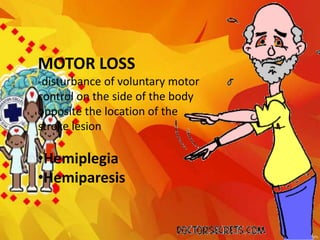
MOTOR LOSS
-disturbance of voluntary motor
control on the side of the body
opposite the location of the
stroke lesion

•Hemiplegia
•Hemiparesis
COMMUNICATION LOSS
•Dysarthria
•Apraxia
•Agnosia
•Dysphasia or Aphasia
PERCEPTUAL DISTURBANCES
•Homonymous Hemianopsia
•Disturbance in Visual-Spatial Relations
      - Unilateral Neglect
•Loss of Peripheral Vision
•Night Blindness
•Diplopia
•Horner’s Syndrome
SENSORY LOSS
•Slight Impairment of Touch
•Loss of Proprioception
•Difficulty in interpreting
visual, tactile, and auditory stimuli
COGNITIVE IMPAIRMENT &
 PSYCHOLOGICAL EFFECTS
Memory Loss              Emotional Lability
Poor Comprehension       Hostility
Limited Attention Span   Frustration
Forgetfulness            Resentment
Lack of Motivation       Lack of Cooperation
Depression
ASSESSMENT & DIAGNOSTICS


•Patient History
•Complete Physical and Neurologic Examination
•Initial Assessment: Airway Patency, Cardiovascular
Status, Gross Neurologic Losses
•Stroke Time Course Classification
STROKE TIME COURSE CLASSIFICATION


Stage 1: Transient Ischemic Attack

Stage 2: Reversible Ischemic Neurologic Deficits

Stage 3: Stroke in Evolution

Stage 4: Completed Stroke
DIAGNOSTIC TESTS
•CT Scan
•12-Lead ECG
•Carotid ultrasound
•Cerebral Angiography
•Transcranial Doppler Flow Studies
•Transthoracic or Transesophageal Echocardiography
•MRI of the brain and/or neck
•Xenon CT
•Single Photon Emission CT
MEDICAL MANAGEMENT
1. Treatment of TIA from atrial fibrillation or
   suspected embolic or thrombotic causes
2. Thrombolytic Therapy for Ischemic Stroke
3. Therapy for Patients with Ischemic Stroke NOT
   Receiving Thrombolytic Therapy
4. Managing Potential Complications
SURGICAL MANAGEMENT

              CAROTID ENDARTERECTOMY
- Main surgical procedure for the management of TIAs
and small stroke
- Indicated for patients with symptoms of TIA or mild
stroke found to be due to carotid stenosis
- Complications: stroke, cranial nerve
injuries, infection, hematoma at the incision
site, carotid artery disruption
NURSING MANAGEMENT

•Improving Mobility and Preventing Joint Deformities
•Managing Sensory-Perceptual Difficulties
•Attaining Bowel and Bladder Control
•Improving Thought Processes
•Improving Communication
•Maintaining Skin Integrity
•Improving Family Coping
•Helping the Patient Cope with Sexual Dysfunction
HEMMORHAGIC
STROKE
CEREBRAL ANEURYSM
SUBARACHNOID HEMORRHAGE
Neurologic emergencies

Neurologic emergencies