Traction
Radhika Chintamani
Contents
1. Definition
2. History
3. Types of Traction
4. Treatment application technique: Cervical,
Thoracic and Lumbar traction application
methods
Definition
• It is a mechanical force applied to the body so as to separate
the structures forming joint thus stretching the soft tissues
around it.
• Traction can be applied :
i. Manually by physiotherapist
ii. Mechanical device:
iii. Gravity assisted pull of human body
• It is a mechanical force applied to the body so as to separate
the structures forming joint thus stretching the soft tissues
around it.
• Traction can be applied :
i. Manually by physiotherapist
ii. Mechanical device:
iii. Gravity assisted pull of human body
History
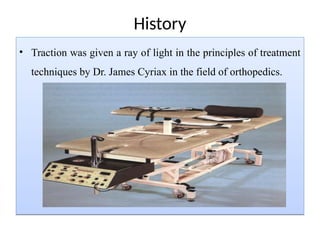
• Traction was given a ray of light in the principles of treatment
techniques by Dr. James Cyriax in the field of orthopedics.
• Traction was given a ray of light in the principles of treatment
techniques by Dr. James Cyriax in the field of orthopedics.
Types of Traction
• Mechanical
• Self
• Positional
• Manual
• Mechanical
• Self
• Positional
• Manual
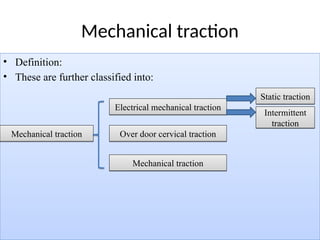
Mechanical traction
• Definition:
• These are further classified into:
• Definition:
• These are further classified into:
Mechanical tractionMechanical traction
Over door cervical tractionOver door cervical traction
Electrical mechanical tractionElectrical mechanical traction
Static tractionStatic traction
Intermittent
traction
Intermittent
traction
• Usually used in physiotherapy clinics
• Provides traction induced via motor to the body parts: Lumbar
and cervical via a belt/collar respectively.
• Allows fine and accurate control of force being applied to the
human body.
• Disadvantages:
- unable to achieve specific segment traction
- Subject needs to lie down for the traction
• Usually used in physiotherapy clinics
• Provides traction induced via motor to the body parts: Lumbar
and cervical via a belt/collar respectively.
• Allows fine and accurate control of force being applied to the
human body.
• Disadvantages:
- unable to achieve specific segment traction
- Subject needs to lie down for the traction
Electrical mechanical tractionElectrical mechanical traction
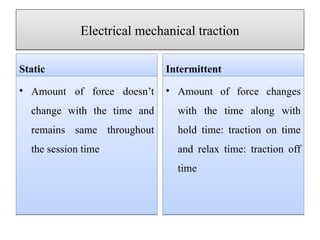
StaticStatic
• Amount of force doesn’t
change with the time and
remains same throughout
the session time
• Amount of force doesn’t
change with the time and
remains same throughout
the session time
IntermittentIntermittent
• Amount of force changes
with the time along with
hold time: traction on time
and relax time: traction off
time
• Amount of force changes
with the time along with
hold time: traction on time
and relax time: traction off
time
Electrical mechanical tractionElectrical mechanical traction
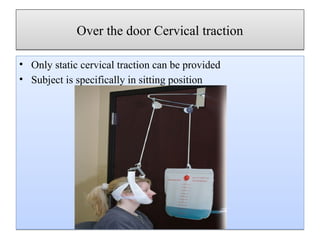
• Only static cervical traction can be provided
• Subject is specifically in sitting position
• Only static cervical traction can be provided
• Subject is specifically in sitting position
Over the door Cervical tractionOver the door Cervical traction
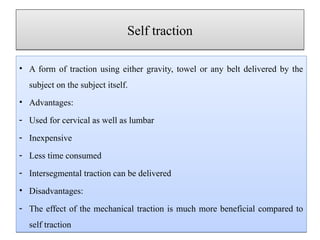
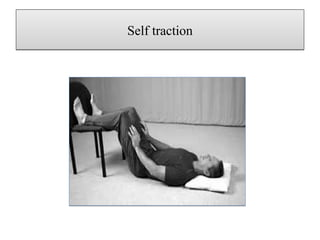
• A form of traction using either gravity, towel or any belt delivered by the
subject on the subject itself.
• Advantages:
- Used for cervical as well as lumbar
- Inexpensive
- Less time consumed
- Intersegmental traction can be delivered
• Disadvantages:
- The effect of the mechanical traction is much more beneficial compared to
self traction
• A form of traction using either gravity, towel or any belt delivered by the
subject on the subject itself.
• Advantages:
- Used for cervical as well as lumbar
- Inexpensive
- Less time consumed
- Intersegmental traction can be delivered
• Disadvantages:
- The effect of the mechanical traction is much more beneficial compared to
self traction
Self tractionSelf traction
• Involves prolonged placement of the subject in certain position
such that position induced tension is generated giving the effect of
traction.
• Advantages:
- Effectively decrease muscle spasm by stretching soft tissues
- Inexpensive
• Disadvantages:
- The force induced during mechanical traction is much more
beneficial compared to positional traction
• Involves prolonged placement of the subject in certain position
such that position induced tension is generated giving the effect of
traction.
• Advantages:
- Effectively decrease muscle spasm by stretching soft tissues
- Inexpensive
• Disadvantages:
- The force induced during mechanical traction is much more
beneficial compared to positional traction
Positional tractionPositional traction
• Involves application of force manually using bear hands or belts so that traction is
induced either at particular region of spine or at intersegmental region respectively.
• Advantages:
- Effectively decrease muscle spasm by stretching soft tissues
- Inexpensive
- Traction can be delivered in pain free range
- Can be modified to all the level or specific level
• Disadvantages:
- The time of traction and force induced during mechanical traction is much more
beneficial compared to manual traction
• Involves application of force manually using bear hands or belts so that traction is
induced either at particular region of spine or at intersegmental region respectively.
• Advantages:
- Effectively decrease muscle spasm by stretching soft tissues
- Inexpensive
- Traction can be delivered in pain free range
- Can be modified to all the level or specific level
• Disadvantages:
- The time of traction and force induced during mechanical traction is much more
beneficial compared to manual traction
Manual tractionManual traction
Cervical, Thoracic and Lumbar
Traction: Treatment application
• Application of longitudinal force to the cervical spine either
manually, mechanically or self methods- Demonstrated in pictures
• Points to remember during cervical traction application
mechanically:
• Force: starts with 15lbs, increases to 25lbs and never crosses 50lbs
• Level of traction varies with angle placement of cervical region
• Preferred position of subject: supine
Cervical tractionCervical traction
• Has been linked to 5 mechanical factors:
1. Position of the neck
2. Force applied during traction
3. Duration of traction
4. Angle of pull
5. Position of subject
Cervical tractionCervical traction
1. Position of the neck:
• Different angles of neck induces traction at different levels.
The table is as follows:
Cervical tractionCervical traction
Position of neck Level of effect
Neutral Complete traction for entire
cervical region
25-30 degree flexion Straightens the cervical
lordosis
15 degree flexion Facet joint seperation
2. Force applied during traction:
• Usually the force applied during traction starts from weight
divide by 5, but if the force is painful, then the force of
traction can be reduced.
Cervical tractionCervical traction
3. Duration of traction:
• Initially, acute condition first day: 2-3 minute preferred: non-
painful: continue for 10 minutes
• Maximum duration given: 10-15 minutes
• Intermittent traction:
• On: Off sequence= 3:1 or 4:1 ratio
Cervical tractionCervical traction
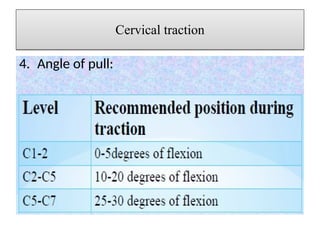
4. Angle of pull:
Cervical tractionCervical traction
5. Position of subject:
• Preferred position supine: complete cervical traction in
relaxed position
• Sitting: antigravity traction
Cervical tractionCervical traction
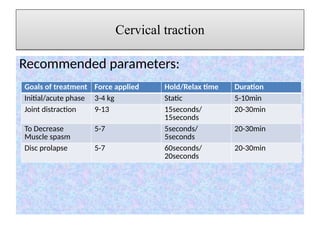
Recommended parameters:
Cervical tractionCervical traction
Goals of treatment Force applied Hold/Relax time Duration
Initial/acute phase 3-4 kg Static 5-10min
Joint distraction 9-13 15seconds/
15seconds
20-30min
To Decrease
Muscle spasm
5-7 5seconds/
5seconds
20-30min
Disc prolapse 5-7 60seconds/
20seconds
20-30min
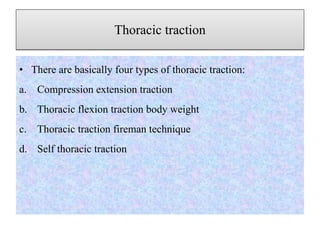
• There are basically four types of thoracic traction:
a. Compression extension traction
b. Thoracic flexion traction body weight
c. Thoracic traction fireman technique
d. Self thoracic traction
Thoracic tractionThoracic traction
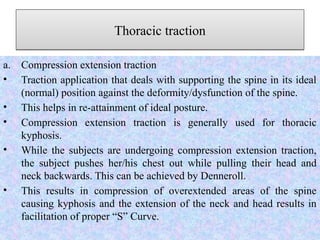
a. Compression extension traction
• Traction application that deals with supporting the spine in its ideal
(normal) position against the deformity/dysfunction of the spine.
• This helps in re-attainment of ideal posture.
• Compression extension traction is generally used for thoracic
kyphosis.
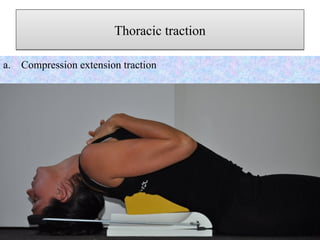
• While the subjects are undergoing compression extension traction,
the subject pushes her/his chest out while pulling their head and
neck backwards. This can be achieved by Denneroll.
• This results in compression of overextended areas of the spine
causing kyphosis and the extension of the neck and head results in
facilitation of proper “S” Curve.
Thoracic tractionThoracic traction
a. Compression extension traction
Thoracic tractionThoracic traction
b. Thoracic flexion traction body weight
• Traction application deals with pre stressing the upper
thoracic spine into kyphosis while the patient is in seated
cervical extension traction.
Thoracic tractionThoracic traction
b. Thoracic flexion traction body weight
Thoracic tractionThoracic traction
c. Thoracic traction fireman technique
• Patient is asked to sit comfortable with hands crossed against
the chest and kept on the opposite shoulder. The therapist is
standing behind the subject in a minimal squat position and
grasping the subjects forearm by passing his/her (therapist’s
hand) under the axilla of subject, thus locking the spine. The
therapist gives downward pressure on the forearm directing
towards spine and elevating the subject by straightening his
knee. Thus the traction at thoracic spine is delivered.
Thoracic tractionThoracic traction
c. Thoracic traction fireman technique
Thoracic tractionThoracic traction
d. Self Thoracic traction
• Therapist is in standing position in between two chairs.
Hands are placed on the upper rim of the back rest of the
chair and the subject is asked to bend his knees. This
technique is mentioned to deliver thoracic spine traction.
• This technique can also be used for lower and mid-back pain.
Thoracic tractionThoracic traction
d. Self Thoracic traction
Thoracic tractionThoracic traction
• Application of longitudinal force to the lumbar spine either
manually, mechanically or self methods- Demonstrated in pictures
• Points to remember during cervical traction application
mechanically:
• Force: weight/3
• Level of traction varies with angle placement of lumbar region
• Preferred position of subject: supine
Lumbar tractionLumbar traction
• Application of longitudinal force to the lumbar spine either
manually, mechanically or self methods- Demonstrated in pictures
• Points to remember during cervical traction application
mechanically:
• Force: starts with 25% of body weight up to 50% of body weight.
Never crosses 50% of body weight
• Level of traction varies with angle placement of lumbar region
• Preferred position of subject: supine
Lumbar tractionLumbar traction
• Has been linked to 4 mechanical factors:
1. Force applied during traction
2. Duration of traction
3. Angle of pull
4. Position of subject
Lumbar tractionLumbar traction
1. Force applied during traction:
• Usually the force applied during traction starts from weight
divide by 3, but if the force is painful, then the force of
traction can be reduced.
Lumbar tractionLumbar traction
2. Duration of traction:
• Initially, acute condition first day: 2-3 minute preferred: non-
painful: continue for 10 minutes
• Maximum duration given: 10-15 minutes
• Intermittent traction:
• On: Off sequence= 3:1 or 4:1 ratio
Lumbar tractionLumbar traction
3. Angle of pull:
Lumbar tractionLumbar traction
4. Position of subject:
• Preferred position supine: complete lumbar traction in
relaxed position
Lumbar tractionLumbar traction
Recommended parameters:
Lumbar tractionLumbar traction
Goals of treatment Force applied Hold/Relax time Duration
Initial/acute phase 13-20 Static 5-10min
Joint distraction 22.55, 50% of body
weight
15seconds/
15seconds
20-30min
To Decrease
Muscle spasm
25% of body
weight
5seconds/
5seconds
20-30min
Disc prolapse 25% of body
weight
60seconds/
20seconds
20-30min
Thank YouThank You

Traction

  • 1.
  • 2.
    Contents 1. Definition 2. History 3.Types of Traction 4. Treatment application technique: Cervical, Thoracic and Lumbar traction application methods
  • 3.
    Definition • It isa mechanical force applied to the body so as to separate the structures forming joint thus stretching the soft tissues around it. • Traction can be applied : i. Manually by physiotherapist ii. Mechanical device: iii. Gravity assisted pull of human body • It is a mechanical force applied to the body so as to separate the structures forming joint thus stretching the soft tissues around it. • Traction can be applied : i. Manually by physiotherapist ii. Mechanical device: iii. Gravity assisted pull of human body
  • 4.
    History • Traction wasgiven a ray of light in the principles of treatment techniques by Dr. James Cyriax in the field of orthopedics. • Traction was given a ray of light in the principles of treatment techniques by Dr. James Cyriax in the field of orthopedics.
  • 5.
    Types of Traction •Mechanical • Self • Positional • Manual • Mechanical • Self • Positional • Manual
  • 6.
    Mechanical traction • Definition: •These are further classified into: • Definition: • These are further classified into: Mechanical tractionMechanical traction Mechanical tractionMechanical traction Over door cervical tractionOver door cervical traction Electrical mechanical tractionElectrical mechanical traction Static tractionStatic traction Intermittent traction Intermittent traction
  • 7.
    • Usually usedin physiotherapy clinics • Provides traction induced via motor to the body parts: Lumbar and cervical via a belt/collar respectively. • Allows fine and accurate control of force being applied to the human body. • Disadvantages: - unable to achieve specific segment traction - Subject needs to lie down for the traction • Usually used in physiotherapy clinics • Provides traction induced via motor to the body parts: Lumbar and cervical via a belt/collar respectively. • Allows fine and accurate control of force being applied to the human body. • Disadvantages: - unable to achieve specific segment traction - Subject needs to lie down for the traction Electrical mechanical tractionElectrical mechanical traction
  • 8.
  • 9.
    StaticStatic • Amount offorce doesn’t change with the time and remains same throughout the session time • Amount of force doesn’t change with the time and remains same throughout the session time IntermittentIntermittent • Amount of force changes with the time along with hold time: traction on time and relax time: traction off time • Amount of force changes with the time along with hold time: traction on time and relax time: traction off time Electrical mechanical tractionElectrical mechanical traction
  • 10.
    • Only staticcervical traction can be provided • Subject is specifically in sitting position • Only static cervical traction can be provided • Subject is specifically in sitting position Over the door Cervical tractionOver the door Cervical traction
  • 11.
    • A formof traction using either gravity, towel or any belt delivered by the subject on the subject itself. • Advantages: - Used for cervical as well as lumbar - Inexpensive - Less time consumed - Intersegmental traction can be delivered • Disadvantages: - The effect of the mechanical traction is much more beneficial compared to self traction • A form of traction using either gravity, towel or any belt delivered by the subject on the subject itself. • Advantages: - Used for cervical as well as lumbar - Inexpensive - Less time consumed - Intersegmental traction can be delivered • Disadvantages: - The effect of the mechanical traction is much more beneficial compared to self traction Self tractionSelf traction
  • 12.
  • 13.
    • Involves prolongedplacement of the subject in certain position such that position induced tension is generated giving the effect of traction. • Advantages: - Effectively decrease muscle spasm by stretching soft tissues - Inexpensive • Disadvantages: - The force induced during mechanical traction is much more beneficial compared to positional traction • Involves prolonged placement of the subject in certain position such that position induced tension is generated giving the effect of traction. • Advantages: - Effectively decrease muscle spasm by stretching soft tissues - Inexpensive • Disadvantages: - The force induced during mechanical traction is much more beneficial compared to positional traction Positional tractionPositional traction
  • 14.
  • 15.
    • Involves applicationof force manually using bear hands or belts so that traction is induced either at particular region of spine or at intersegmental region respectively. • Advantages: - Effectively decrease muscle spasm by stretching soft tissues - Inexpensive - Traction can be delivered in pain free range - Can be modified to all the level or specific level • Disadvantages: - The time of traction and force induced during mechanical traction is much more beneficial compared to manual traction • Involves application of force manually using bear hands or belts so that traction is induced either at particular region of spine or at intersegmental region respectively. • Advantages: - Effectively decrease muscle spasm by stretching soft tissues - Inexpensive - Traction can be delivered in pain free range - Can be modified to all the level or specific level • Disadvantages: - The time of traction and force induced during mechanical traction is much more beneficial compared to manual traction Manual tractionManual traction
  • 16.
  • 18.
    Cervical, Thoracic andLumbar Traction: Treatment application
  • 19.
    • Application oflongitudinal force to the cervical spine either manually, mechanically or self methods- Demonstrated in pictures • Points to remember during cervical traction application mechanically: • Force: starts with 15lbs, increases to 25lbs and never crosses 50lbs • Level of traction varies with angle placement of cervical region • Preferred position of subject: supine Cervical tractionCervical traction
  • 20.
  • 21.
    • Has beenlinked to 5 mechanical factors: 1. Position of the neck 2. Force applied during traction 3. Duration of traction 4. Angle of pull 5. Position of subject Cervical tractionCervical traction
  • 22.
    1. Position ofthe neck: • Different angles of neck induces traction at different levels. The table is as follows: Cervical tractionCervical traction Position of neck Level of effect Neutral Complete traction for entire cervical region 25-30 degree flexion Straightens the cervical lordosis 15 degree flexion Facet joint seperation
  • 23.
    2. Force appliedduring traction: • Usually the force applied during traction starts from weight divide by 5, but if the force is painful, then the force of traction can be reduced. Cervical tractionCervical traction
  • 24.
    3. Duration oftraction: • Initially, acute condition first day: 2-3 minute preferred: non- painful: continue for 10 minutes • Maximum duration given: 10-15 minutes • Intermittent traction: • On: Off sequence= 3:1 or 4:1 ratio Cervical tractionCervical traction
  • 25.
    4. Angle ofpull: Cervical tractionCervical traction
  • 26.
    5. Position ofsubject: • Preferred position supine: complete cervical traction in relaxed position • Sitting: antigravity traction Cervical tractionCervical traction
  • 27.
    Recommended parameters: Cervical tractionCervicaltraction Goals of treatment Force applied Hold/Relax time Duration Initial/acute phase 3-4 kg Static 5-10min Joint distraction 9-13 15seconds/ 15seconds 20-30min To Decrease Muscle spasm 5-7 5seconds/ 5seconds 20-30min Disc prolapse 5-7 60seconds/ 20seconds 20-30min
  • 28.
    • There arebasically four types of thoracic traction: a. Compression extension traction b. Thoracic flexion traction body weight c. Thoracic traction fireman technique d. Self thoracic traction Thoracic tractionThoracic traction
  • 29.
    a. Compression extensiontraction • Traction application that deals with supporting the spine in its ideal (normal) position against the deformity/dysfunction of the spine. • This helps in re-attainment of ideal posture. • Compression extension traction is generally used for thoracic kyphosis. • While the subjects are undergoing compression extension traction, the subject pushes her/his chest out while pulling their head and neck backwards. This can be achieved by Denneroll. • This results in compression of overextended areas of the spine causing kyphosis and the extension of the neck and head results in facilitation of proper “S” Curve. Thoracic tractionThoracic traction
  • 30.
    a. Compression extensiontraction Thoracic tractionThoracic traction
  • 31.
    b. Thoracic flexiontraction body weight • Traction application deals with pre stressing the upper thoracic spine into kyphosis while the patient is in seated cervical extension traction. Thoracic tractionThoracic traction
  • 32.
    b. Thoracic flexiontraction body weight Thoracic tractionThoracic traction
  • 33.
    c. Thoracic tractionfireman technique • Patient is asked to sit comfortable with hands crossed against the chest and kept on the opposite shoulder. The therapist is standing behind the subject in a minimal squat position and grasping the subjects forearm by passing his/her (therapist’s hand) under the axilla of subject, thus locking the spine. The therapist gives downward pressure on the forearm directing towards spine and elevating the subject by straightening his knee. Thus the traction at thoracic spine is delivered. Thoracic tractionThoracic traction
  • 34.
    c. Thoracic tractionfireman technique Thoracic tractionThoracic traction
  • 35.
    d. Self Thoracictraction • Therapist is in standing position in between two chairs. Hands are placed on the upper rim of the back rest of the chair and the subject is asked to bend his knees. This technique is mentioned to deliver thoracic spine traction. • This technique can also be used for lower and mid-back pain. Thoracic tractionThoracic traction
  • 36.
    d. Self Thoracictraction Thoracic tractionThoracic traction
  • 37.
    • Application oflongitudinal force to the lumbar spine either manually, mechanically or self methods- Demonstrated in pictures • Points to remember during cervical traction application mechanically: • Force: weight/3 • Level of traction varies with angle placement of lumbar region • Preferred position of subject: supine Lumbar tractionLumbar traction
  • 38.
    • Application oflongitudinal force to the lumbar spine either manually, mechanically or self methods- Demonstrated in pictures • Points to remember during cervical traction application mechanically: • Force: starts with 25% of body weight up to 50% of body weight. Never crosses 50% of body weight • Level of traction varies with angle placement of lumbar region • Preferred position of subject: supine Lumbar tractionLumbar traction
  • 39.
  • 40.
    • Has beenlinked to 4 mechanical factors: 1. Force applied during traction 2. Duration of traction 3. Angle of pull 4. Position of subject Lumbar tractionLumbar traction
  • 41.
    1. Force appliedduring traction: • Usually the force applied during traction starts from weight divide by 3, but if the force is painful, then the force of traction can be reduced. Lumbar tractionLumbar traction
  • 42.
    2. Duration oftraction: • Initially, acute condition first day: 2-3 minute preferred: non- painful: continue for 10 minutes • Maximum duration given: 10-15 minutes • Intermittent traction: • On: Off sequence= 3:1 or 4:1 ratio Lumbar tractionLumbar traction
  • 43.
    3. Angle ofpull: Lumbar tractionLumbar traction
  • 44.
    4. Position ofsubject: • Preferred position supine: complete lumbar traction in relaxed position Lumbar tractionLumbar traction
  • 45.
    Recommended parameters: Lumbar tractionLumbartraction Goals of treatment Force applied Hold/Relax time Duration Initial/acute phase 13-20 Static 5-10min Joint distraction 22.55, 50% of body weight 15seconds/ 15seconds 20-30min To Decrease Muscle spasm 25% of body weight 5seconds/ 5seconds 20-30min Disc prolapse 25% of body weight 60seconds/ 20seconds 20-30min
  • 46.