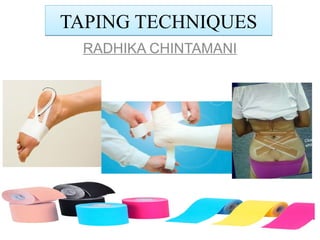
TAPING TECHNIQUESTAPING TECHNIQUES
RADHIKA CHINTAMANI
CONTENTS
• History of taping and Definition
• Types of taping:
a. Kinesio-taping
b. McConnell taping
c. Rigid taping
d. Neutral taping
• Evidence Based Practice
HISTORY OF TAPINGHISTORY OF TAPING
• Definition : taping is a technique which applies either inhibits or facilitates
movement with its application.
• There are various types of taping techniques; namely;
a. Kinesio-taping
b. McConnell taping
c. Rigid taping
d. Mulligan taping
e. Neutral taping
• Every taping technique holds separate history along with separate author
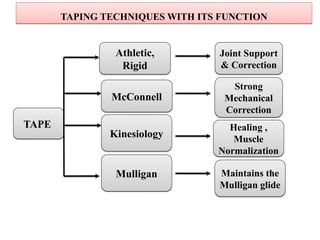
TAPING TECHNIQUES WITH ITS FUNCTIONTAPING TECHNIQUES WITH ITS FUNCTION
TAPETAPE
Athletic,
Rigid
Athletic,
Rigid
McConnellMcConnell
KinesiologyKinesiology
Joint Support
& Correction
Joint Support
& Correction
Strong
Mechanical
Correction
Strong
Mechanical
Correction
Healing ,
Muscle
Normalization
Healing ,
Muscle
Normalization
MulliganMulligan Maintains the
Mulligan glide
Maintains the
Mulligan glide
 HISTORY :
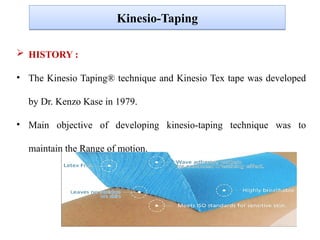
• The Kinesio Taping® technique and Kinesio Tex tape was developed
by Dr. Kenzo Kase in 1979.
• Main objective of developing kinesio-taping technique was to
maintain the Range of motion.
Kinesio-TapingKinesio-Taping
 INTRODUCTION:
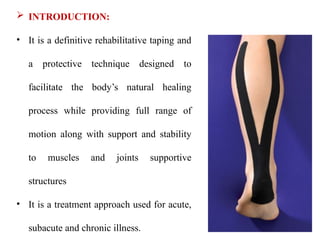
• It is a definitive rehabilitative taping and
a protective technique designed to
facilitate the body’s natural healing
process while providing full range of
motion along with support and stability
to muscles and joints supportive
structures
• It is a treatment approach used for acute,
subacute and chronic illness.
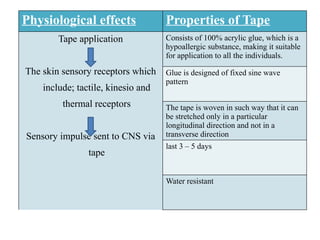
Physiological effects Properties of Tape
Tape application
The skin sensory receptors which
include; tactile, kinesio and
thermal receptors
Sensory impulse sent to CNS via
tape
Consists of 100% acrylic glue, which is a
hypoallergic substance, making it suitable
for application to all the individuals.
Glue is designed of fixed sine wave
pattern
The tape is woven in such way that it can
be stretched only in a particular
longitudinal direction and not in a
transverse direction
last 3 – 5 days
Water resistant
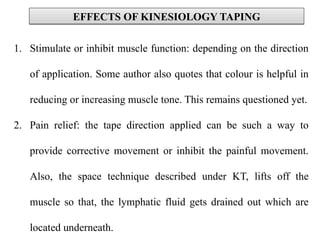
1. Stimulate or inhibit muscle function: depending on the direction
of application. Some author also quotes that colour is helpful in
reducing or increasing muscle tone. This remains questioned yet.
2. Pain relief: the tape direction applied can be such a way to
provide corrective movement or inhibit the painful movement.
Also, the space technique described under KT, lifts off the
muscle so that, the lymphatic fluid gets drained out which are
located underneath.
EFFECTS OF KINESIOLOGY TAPINGEFFECTS OF KINESIOLOGY TAPING
3. Improvement of circulation: the tape creates space between muscle
and fascia, also between skin and fascia thus improving blood
circulation.
4. Enhances proprioception: correct movement at the attained by KT
application induces proprioceptive enhancement.
5. Increase in muscle strength: Exercises carried out with KT
application (provided the application of tape is taken into
consideration) will enhance the strengthening.
6. Fascial correction: the fascia correction technique of taping induces
the fascial mobility so that they myofascial adhesions are reduced
in number.
7. Enhances lymphatic drainage: A technique of KT known as
lymphatic drainage technique creates and maintains interosseous
space, thus providing a way for drainage.
8. Supports joints: by supporting the ligaments and fascia
surrounding it.
9. Prevent injuries: it can also be used as a preventive measures in
order to support the joint and muscle before re-injury of the
muscle/fascia/tendon/ligament.
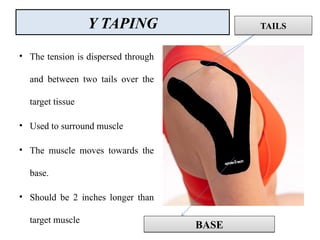
Y TAPING
• The tension is dispersed through
and between two tails over the
target tissue
• Used to surround muscle
• The muscle moves towards the
base.
• Should be 2 inches longer than
target muscle
BASEBASE
TAILSTAILS
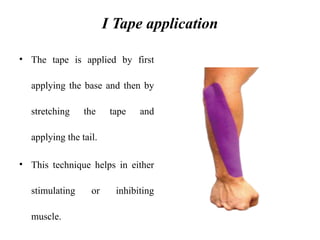
I Tape application
• The tape is applied by first
applying the base and then by
stretching the tape and
applying the tail.
• This technique helps in either
stimulating or inhibiting
muscle.
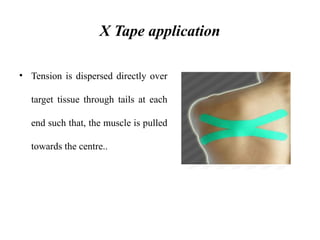
X Tape application
• Tension is dispersed directly over
target tissue through tails at each
end such that, the muscle is pulled
towards the centre..
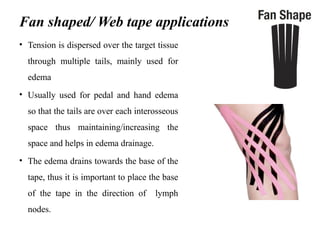
Fan shaped/ Web tape applications
• Tension is dispersed over the target tissue
through multiple tails, mainly used for
edema
• Usually used for pedal and hand edema
so that the tails are over each interosseous
space thus maintaining/increasing the
space and helps in edema drainage.
• The edema drains towards the base of the
tape, thus it is important to place the base
of the tape in the direction of lymph
nodes.
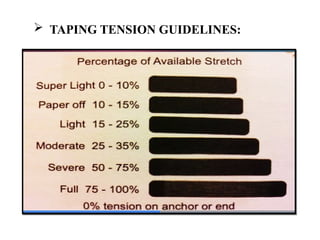
 TAPING TENSION GUIDELINES:
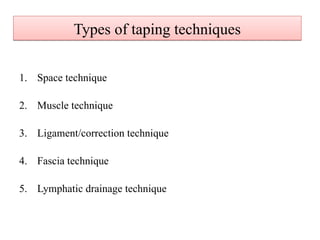
Types of taping techniquesTypes of taping techniques
1. Space technique
2. Muscle technique
3. Ligament/correction technique
4. Fascia technique
5. Lymphatic drainage technique
SPACE TECHNIQUESSPACE TECHNIQUES
• Space taping technique is a pain
relieving technique used to treat
the myofascial trigger points.
• Provides suction which helps in
skin lifting just above the trigger
points, thus increasing the space
between the muscle and fascia
and draining out the lactic acid.
Technique of application of space taping
1. Evaluate the pain and ROM initially
2. Create space with your hands around the lesion and evaluate pain and ROM
again. If pain decreases and the ROM improves, this technique is effective in
treating such pain
3. Cut the tapes into various small “I strips”
4. By ripping the tape in centre (so that it has two base); stretch the tape in the
centre for 50%
5. Do not stretch the tape at the base
6. After stretching for 50%, place the centre part of the tape, and leave the base
freely, rip off the paper of the base and place the base freely on the skin
without application of any tension to it
7. Place the rest “I strips” one over the other so that centre is at the same spot.
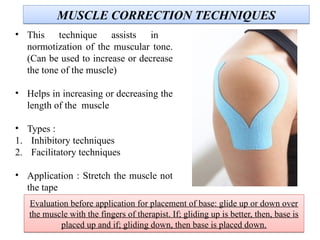
MUSCLE CORRECTION TECHNIQUESMUSCLE CORRECTION TECHNIQUES
• This technique assists in
normotization of the muscular tone.
(Can be used to increase or decrease
the tone of the muscle)
• Helps in increasing or decreasing the
length of the muscle
• Types :
1. Inhibitory techniques
2. Facilitatory techniques
• Application : Stretch the muscle not
the tape
Evaluation before application for placement of base: glide up or down over
the muscle with the fingers of therapist. If; gliding up is better, then, base is
placed up and if; gliding down, then base is placed down.
Evaluation before application for placement of base: glide up or down over
the muscle with the fingers of therapist. If; gliding up is better, then, base is
placed up and if; gliding down, then base is placed down.
Technique of application
1. Stretch the respective muscle
2. Evaluate glides: glide up and own
3. Neutralise the subject.
4. Prepare the I or Y strips
5. Stretch the muscle to be taped.
6. Rip of the tape at the 1/3rd
end of the tape, place the base towards
whichever direction of the glide gave good result.
7. Place the rest tape with just removing the back paper and without
stretching it.
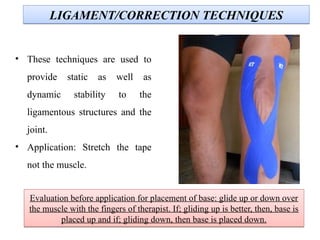
LIGAMENT/CORRECTION TECHNIQUESLIGAMENT/CORRECTION TECHNIQUES
• These techniques are used to
provide static as well as
dynamic stability to the
ligamentous structures and the
joint.
• Application: Stretch the tape
not the muscle.
Evaluation before application for placement of base: glide up or down over
the muscle with the fingers of therapist. If; gliding up is better, then, base is
placed up and if; gliding down, then base is placed down.
Evaluation before application for placement of base: glide up or down over
the muscle with the fingers of therapist. If; gliding up is better, then, base is
placed up and if; gliding down, then base is placed down.
Technique of application
1. Evaluate glides: glide up and down
2. Prepare the I or Y strips
3. Rip of as the same way described in muscle technique
4. Place the base without any stretch.
5. Stretch the tape and place it on the muscle without application of any
stretch to the muscle.
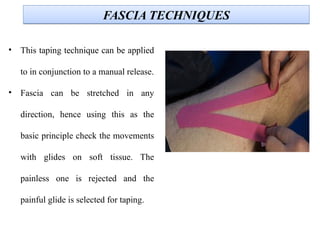
FASCIA TECHNIQUESFASCIA TECHNIQUES
• This taping technique can be applied
to in conjunction to a manual release.
• Fascia can be stretched in any
direction, hence using this as the
basic principle check the movements
with glides on soft tissue. The
painless one is rejected and the
painful glide is selected for taping.
Technique of application
1. Evaluate glides in every direction: glide up, down and sides.
2. Prepare the I or Y strips
3. Rip of as the same way described in muscle technique
4. Place the base without any stretch.
5. Stretch the tape and place it on the muscle while oscillating the tape
and apply it without any stretch of the muscle and even at the end of
the tape.
• Muscle imbalances: tight, short muscles, muscle cross syndromes.
• Postural faults
• Circulatory and lymphatic conditions
• Fascial adhesions and scars
• Musculoskeletal conditions ( Frozen shoulder, Shoulder impingement
syndrome, bicipital tendinitis, Carpal-tunnel syndrome , Olecranon bursitis ,
chondromalacie patellae, rib fractures etc. )
• Stroke
• Bell’s and fascial palsy
• Pedal and palmar edema
INDICATIONS FOR KINESIO TAPING
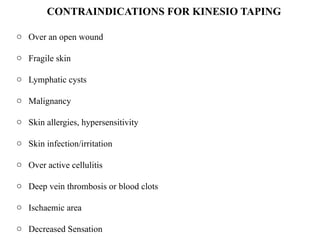
o Over an open wound
o Fragile skin
o Lymphatic cysts
o Malignancy
o Skin allergies, hypersensitivity
o Skin infection/irritation
o Over active cellulitis
o Deep vein thrombosis or blood clots
o Ischaemic area
o Decreased Sensation
CONTRAINDICATIONS FOR KINESIO TAPING
TO CONTINUED…..TO CONTINUED…..

Kinesiotaping

  • 1.
  • 2.
    CONTENTS • History oftaping and Definition • Types of taping: a. Kinesio-taping b. McConnell taping c. Rigid taping d. Neutral taping • Evidence Based Practice
  • 3.
    HISTORY OF TAPINGHISTORYOF TAPING • Definition : taping is a technique which applies either inhibits or facilitates movement with its application. • There are various types of taping techniques; namely; a. Kinesio-taping b. McConnell taping c. Rigid taping d. Mulligan taping e. Neutral taping • Every taping technique holds separate history along with separate author
  • 4.
    TAPING TECHNIQUES WITHITS FUNCTIONTAPING TECHNIQUES WITH ITS FUNCTION TAPETAPE Athletic, Rigid Athletic, Rigid McConnellMcConnell KinesiologyKinesiology Joint Support & Correction Joint Support & Correction Strong Mechanical Correction Strong Mechanical Correction Healing , Muscle Normalization Healing , Muscle Normalization MulliganMulligan Maintains the Mulligan glide Maintains the Mulligan glide
  • 5.
     HISTORY : •The Kinesio Taping® technique and Kinesio Tex tape was developed by Dr. Kenzo Kase in 1979. • Main objective of developing kinesio-taping technique was to maintain the Range of motion. Kinesio-TapingKinesio-Taping
  • 6.
     INTRODUCTION: • Itis a definitive rehabilitative taping and a protective technique designed to facilitate the body’s natural healing process while providing full range of motion along with support and stability to muscles and joints supportive structures • It is a treatment approach used for acute, subacute and chronic illness.
  • 7.
    Physiological effects Propertiesof Tape Tape application The skin sensory receptors which include; tactile, kinesio and thermal receptors Sensory impulse sent to CNS via tape Consists of 100% acrylic glue, which is a hypoallergic substance, making it suitable for application to all the individuals. Glue is designed of fixed sine wave pattern The tape is woven in such way that it can be stretched only in a particular longitudinal direction and not in a transverse direction last 3 – 5 days Water resistant
  • 8.
    1. Stimulate orinhibit muscle function: depending on the direction of application. Some author also quotes that colour is helpful in reducing or increasing muscle tone. This remains questioned yet. 2. Pain relief: the tape direction applied can be such a way to provide corrective movement or inhibit the painful movement. Also, the space technique described under KT, lifts off the muscle so that, the lymphatic fluid gets drained out which are located underneath. EFFECTS OF KINESIOLOGY TAPINGEFFECTS OF KINESIOLOGY TAPING
  • 9.
    3. Improvement ofcirculation: the tape creates space between muscle and fascia, also between skin and fascia thus improving blood circulation. 4. Enhances proprioception: correct movement at the attained by KT application induces proprioceptive enhancement. 5. Increase in muscle strength: Exercises carried out with KT application (provided the application of tape is taken into consideration) will enhance the strengthening. 6. Fascial correction: the fascia correction technique of taping induces the fascial mobility so that they myofascial adhesions are reduced in number.
  • 10.
    7. Enhances lymphaticdrainage: A technique of KT known as lymphatic drainage technique creates and maintains interosseous space, thus providing a way for drainage. 8. Supports joints: by supporting the ligaments and fascia surrounding it. 9. Prevent injuries: it can also be used as a preventive measures in order to support the joint and muscle before re-injury of the muscle/fascia/tendon/ligament.
  • 11.
    Y TAPING • Thetension is dispersed through and between two tails over the target tissue • Used to surround muscle • The muscle moves towards the base. • Should be 2 inches longer than target muscle BASEBASE TAILSTAILS
  • 12.
    I Tape application •The tape is applied by first applying the base and then by stretching the tape and applying the tail. • This technique helps in either stimulating or inhibiting muscle.
  • 13.
    X Tape application •Tension is dispersed directly over target tissue through tails at each end such that, the muscle is pulled towards the centre..
  • 14.
    Fan shaped/ Webtape applications • Tension is dispersed over the target tissue through multiple tails, mainly used for edema • Usually used for pedal and hand edema so that the tails are over each interosseous space thus maintaining/increasing the space and helps in edema drainage. • The edema drains towards the base of the tape, thus it is important to place the base of the tape in the direction of lymph nodes.
  • 15.
     TAPING TENSIONGUIDELINES:
  • 16.
    Types of tapingtechniquesTypes of taping techniques 1. Space technique 2. Muscle technique 3. Ligament/correction technique 4. Fascia technique 5. Lymphatic drainage technique
  • 17.
    SPACE TECHNIQUESSPACE TECHNIQUES •Space taping technique is a pain relieving technique used to treat the myofascial trigger points. • Provides suction which helps in skin lifting just above the trigger points, thus increasing the space between the muscle and fascia and draining out the lactic acid.
  • 18.
    Technique of applicationof space taping 1. Evaluate the pain and ROM initially 2. Create space with your hands around the lesion and evaluate pain and ROM again. If pain decreases and the ROM improves, this technique is effective in treating such pain 3. Cut the tapes into various small “I strips” 4. By ripping the tape in centre (so that it has two base); stretch the tape in the centre for 50% 5. Do not stretch the tape at the base 6. After stretching for 50%, place the centre part of the tape, and leave the base freely, rip off the paper of the base and place the base freely on the skin without application of any tension to it 7. Place the rest “I strips” one over the other so that centre is at the same spot.
  • 19.
    MUSCLE CORRECTION TECHNIQUESMUSCLECORRECTION TECHNIQUES • This technique assists in normotization of the muscular tone. (Can be used to increase or decrease the tone of the muscle) • Helps in increasing or decreasing the length of the muscle • Types : 1. Inhibitory techniques 2. Facilitatory techniques • Application : Stretch the muscle not the tape Evaluation before application for placement of base: glide up or down over the muscle with the fingers of therapist. If; gliding up is better, then, base is placed up and if; gliding down, then base is placed down. Evaluation before application for placement of base: glide up or down over the muscle with the fingers of therapist. If; gliding up is better, then, base is placed up and if; gliding down, then base is placed down.
  • 20.
    Technique of application 1.Stretch the respective muscle 2. Evaluate glides: glide up and own 3. Neutralise the subject. 4. Prepare the I or Y strips 5. Stretch the muscle to be taped. 6. Rip of the tape at the 1/3rd end of the tape, place the base towards whichever direction of the glide gave good result. 7. Place the rest tape with just removing the back paper and without stretching it.
  • 21.
    LIGAMENT/CORRECTION TECHNIQUESLIGAMENT/CORRECTION TECHNIQUES •These techniques are used to provide static as well as dynamic stability to the ligamentous structures and the joint. • Application: Stretch the tape not the muscle. Evaluation before application for placement of base: glide up or down over the muscle with the fingers of therapist. If; gliding up is better, then, base is placed up and if; gliding down, then base is placed down. Evaluation before application for placement of base: glide up or down over the muscle with the fingers of therapist. If; gliding up is better, then, base is placed up and if; gliding down, then base is placed down.
  • 22.
    Technique of application 1.Evaluate glides: glide up and down 2. Prepare the I or Y strips 3. Rip of as the same way described in muscle technique 4. Place the base without any stretch. 5. Stretch the tape and place it on the muscle without application of any stretch to the muscle.
  • 23.
    FASCIA TECHNIQUESFASCIA TECHNIQUES •This taping technique can be applied to in conjunction to a manual release. • Fascia can be stretched in any direction, hence using this as the basic principle check the movements with glides on soft tissue. The painless one is rejected and the painful glide is selected for taping.
  • 24.
    Technique of application 1.Evaluate glides in every direction: glide up, down and sides. 2. Prepare the I or Y strips 3. Rip of as the same way described in muscle technique 4. Place the base without any stretch. 5. Stretch the tape and place it on the muscle while oscillating the tape and apply it without any stretch of the muscle and even at the end of the tape.
  • 25.
    • Muscle imbalances:tight, short muscles, muscle cross syndromes. • Postural faults • Circulatory and lymphatic conditions • Fascial adhesions and scars • Musculoskeletal conditions ( Frozen shoulder, Shoulder impingement syndrome, bicipital tendinitis, Carpal-tunnel syndrome , Olecranon bursitis , chondromalacie patellae, rib fractures etc. ) • Stroke • Bell’s and fascial palsy • Pedal and palmar edema INDICATIONS FOR KINESIO TAPING
  • 26.
    o Over anopen wound o Fragile skin o Lymphatic cysts o Malignancy o Skin allergies, hypersensitivity o Skin infection/irritation o Over active cellulitis o Deep vein thrombosis or blood clots o Ischaemic area o Decreased Sensation CONTRAINDICATIONS FOR KINESIO TAPING
  • 27.