INFORMATION SECURITY
Asymmetric Encryption
Public-key Encryption structure
 Public-key encryption, first publicly
proposed by Diffie and Hellman in 1976, is
the first truly revolutionary advance in
encryption in literally thousands of years.
 Public-key algorithms are based on
mathematical functions rather than on simple
operations on bit patterns, such as are used in
symmetric encryption algorithms.
Public-key Encryption structure
cont.
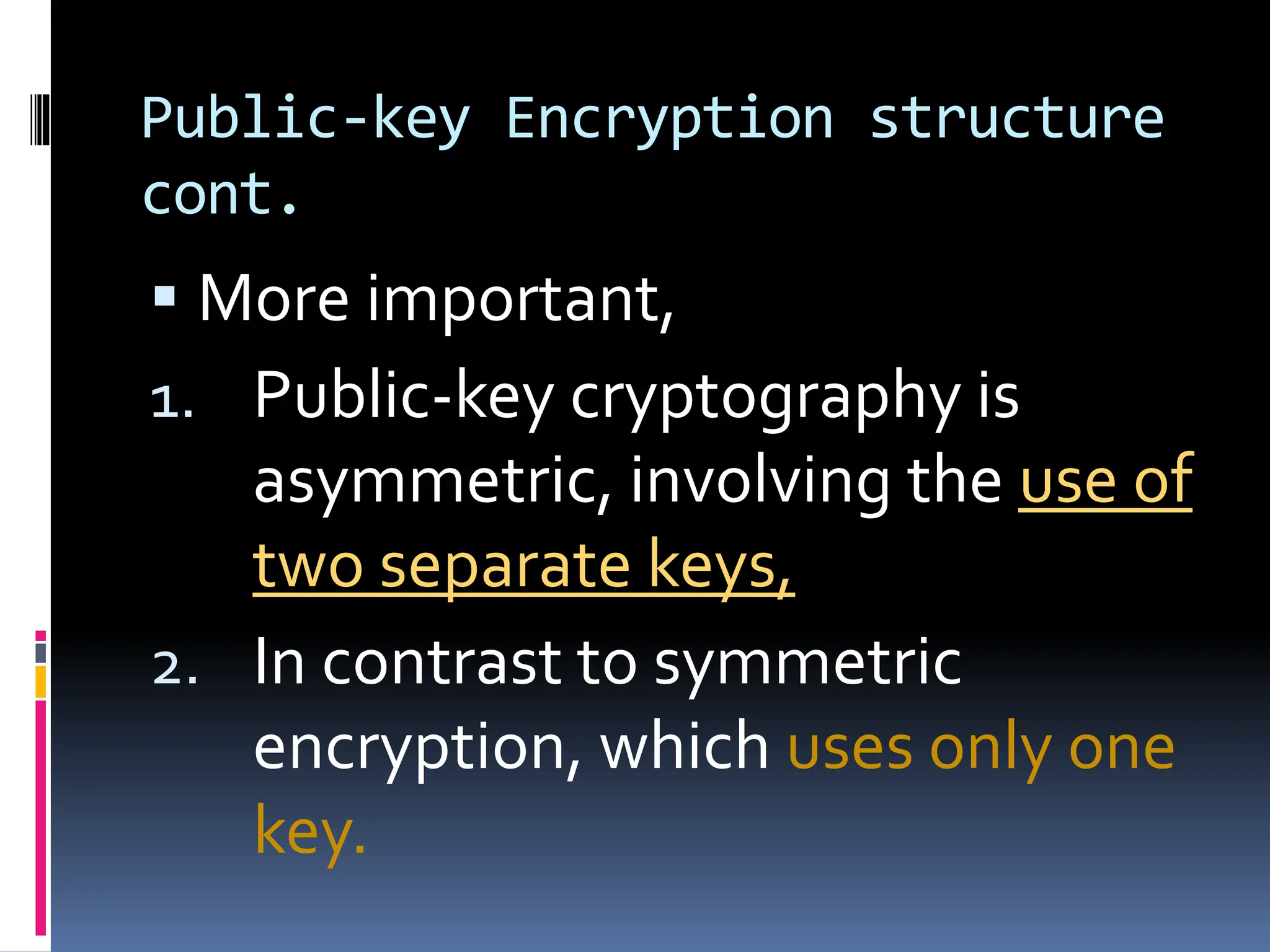
 More important,
1. Public-key cryptography is
asymmetric, involving the use of
two separate keys,
2. In contrast to symmetric
encryption, which uses only one
key.
Misconceptions about both
encryptions
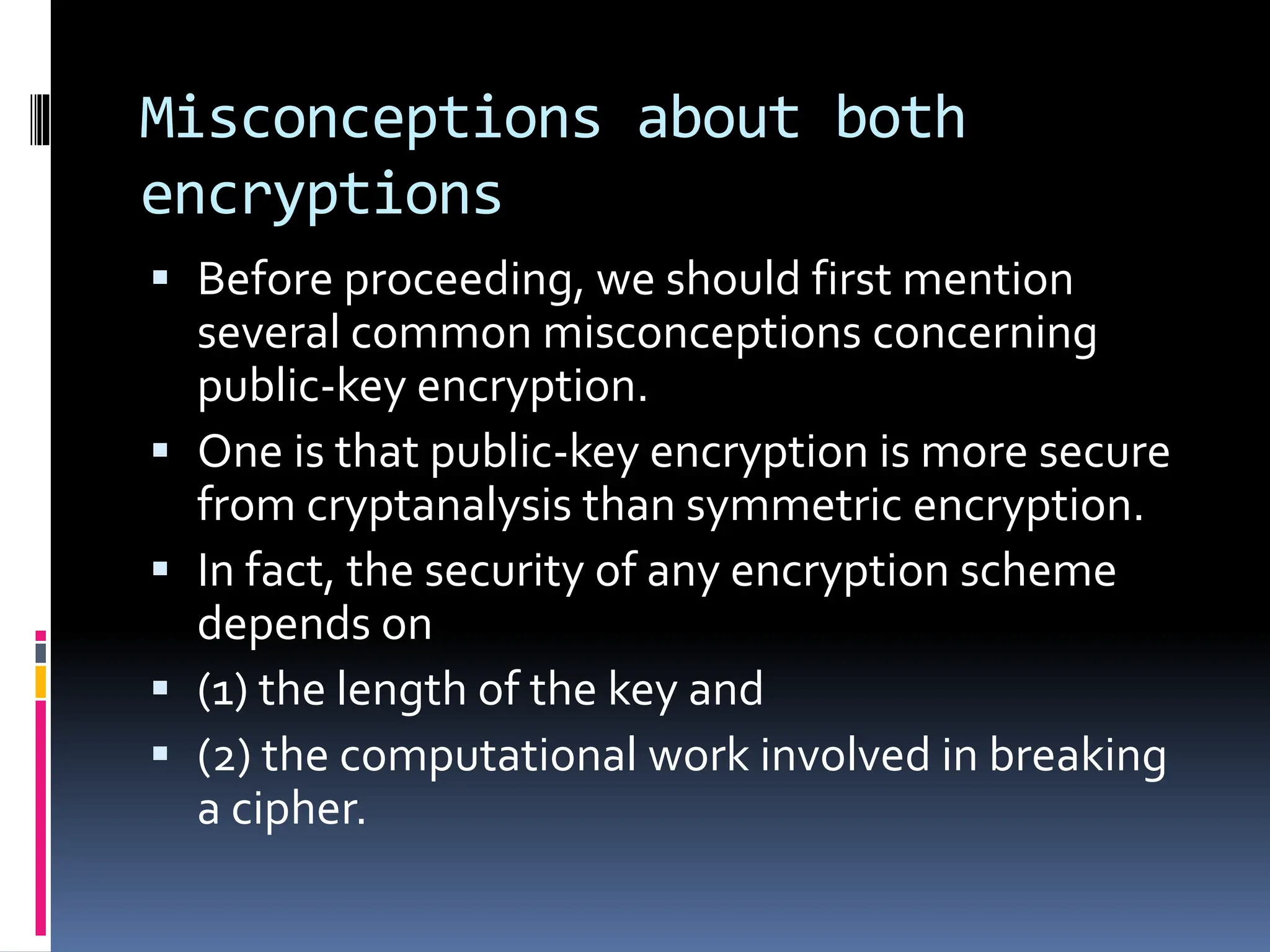
 Before proceeding, we should first mention
several common misconceptions concerning
public-key encryption.
 One is that public-key encryption is more secure
from cryptanalysis than symmetric encryption.
 In fact, the security of any encryption scheme
depends on
 (1) the length of the key and
 (2) the computational work involved in breaking
a cipher.
Misconceptions about both
encryptions
 There is nothing in principle about either
symmetric or public-key encryption that
makes one superior to another from the point
of view of resisting cryptanalysis.
 A second misconception is that public-key
encryption is a general-purpose technique
that has made symmetric encryption
obsolete.
Misconceptions about both
encryptions cont.
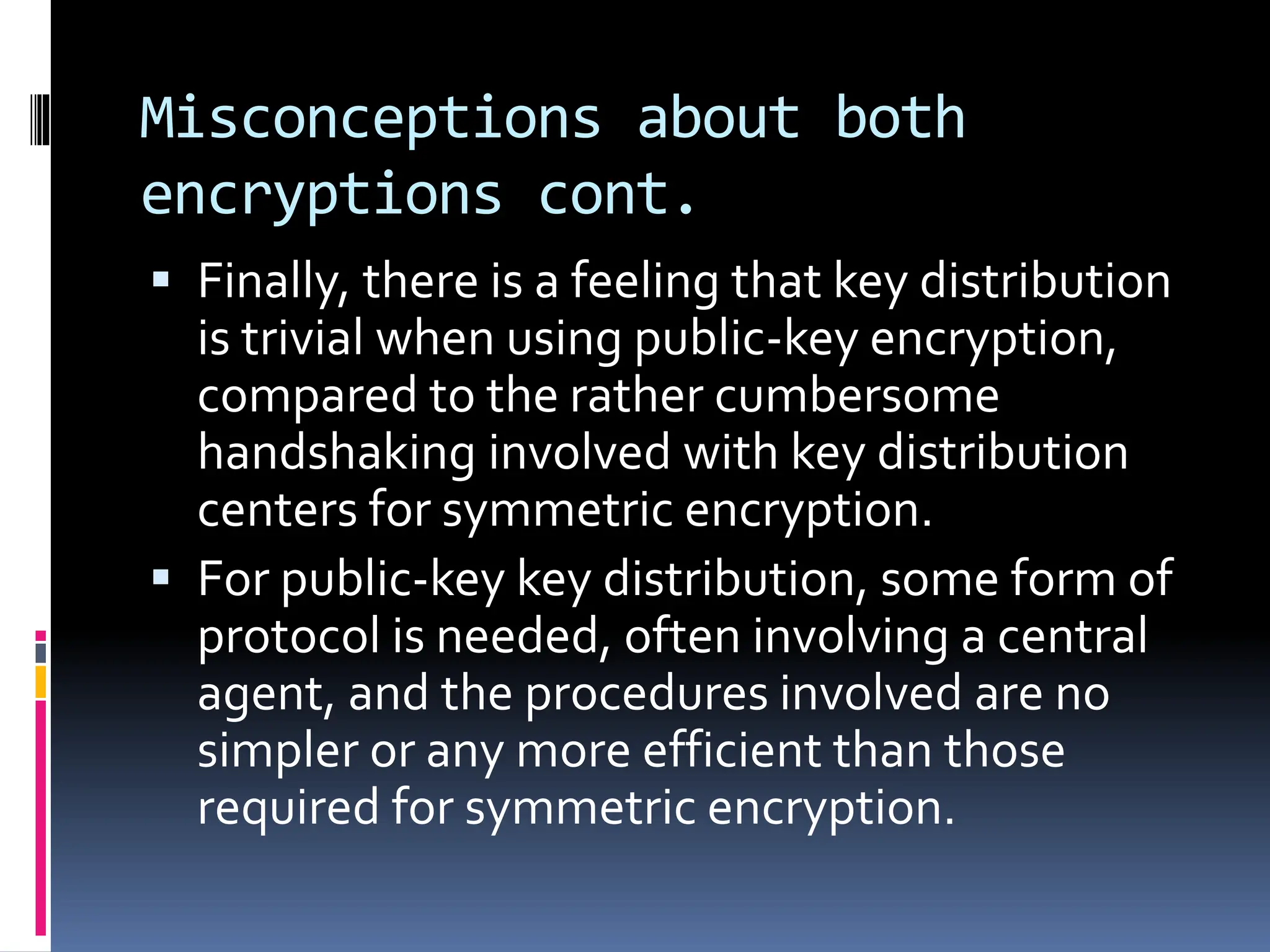
 Finally, there is a feeling that key distribution
is trivial when using public-key encryption,
compared to the rather cumbersome
handshaking involved with key distribution
centers for symmetric encryption.
 For public-key key distribution, some form of
protocol is needed, often involving a central
agent, and the procedures involved are no
simpler or any more efficient than those
required for symmetric encryption.
Public-key Encryption Structure
cont.
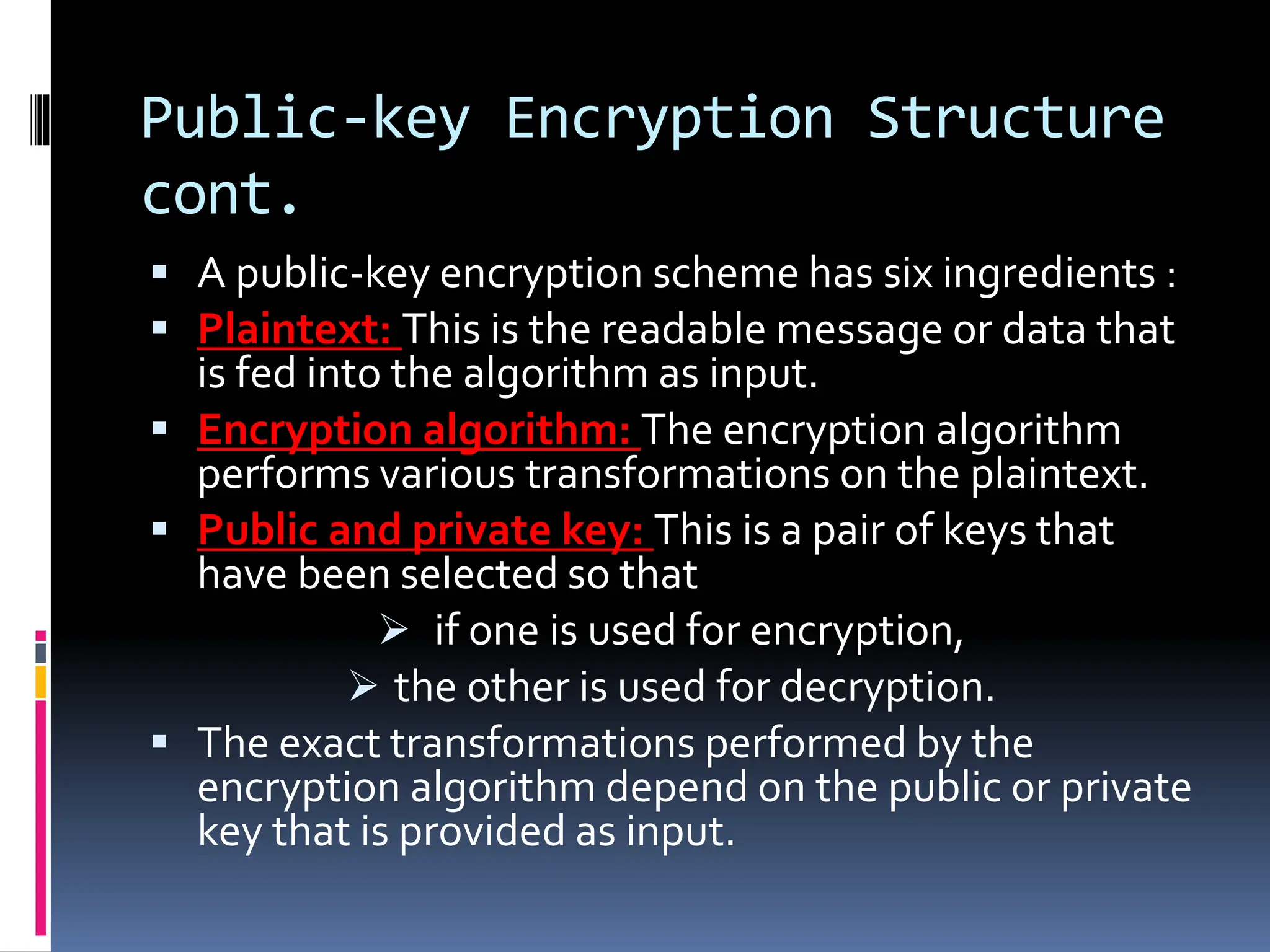
 A public-key encryption scheme has six ingredients :
 Plaintext: This is the readable message or data that
is fed into the algorithm as input.
 Encryption algorithm: The encryption algorithm
performs various transformations on the plaintext.
 Public and private key: This is a pair of keys that
have been selected so that
 if one is used for encryption,
 the other is used for decryption.
 The exact transformations performed by the
encryption algorithm depend on the public or private
key that is provided as input.
Public-key Encryption Structure
cont.
 Cipher-text:This is the scrambled message
produced as output. It depends on the
plaintext and the key. For a given message,
two different keys will produce two different
cipher-texts.
 Decryption algorithm:This algorithm
accepts the cipher-text and the matching key
and produces the original plaintext.
Public-key Encryption Structure
cont.
Public-key Encryption Structure
cont.
 As the names suggest,
the public key of the pair is made public for
others to use,
while the private key is known only to its
owner.
 A general-purpose public-key cryptographic
algorithm relies on one key for encryption
and a different but related key for decryption
Public-key Encryption Structure
cont.
 The essential steps are the following:
 1. Each user generates a pair of keys to be
used for the encryption and decryption of
messages.
 2. Each user places one of the two keys in a
public register or other accessible file.This is
the public key.The companion key is kept
private.
Public-key Encryption Structure
cont.
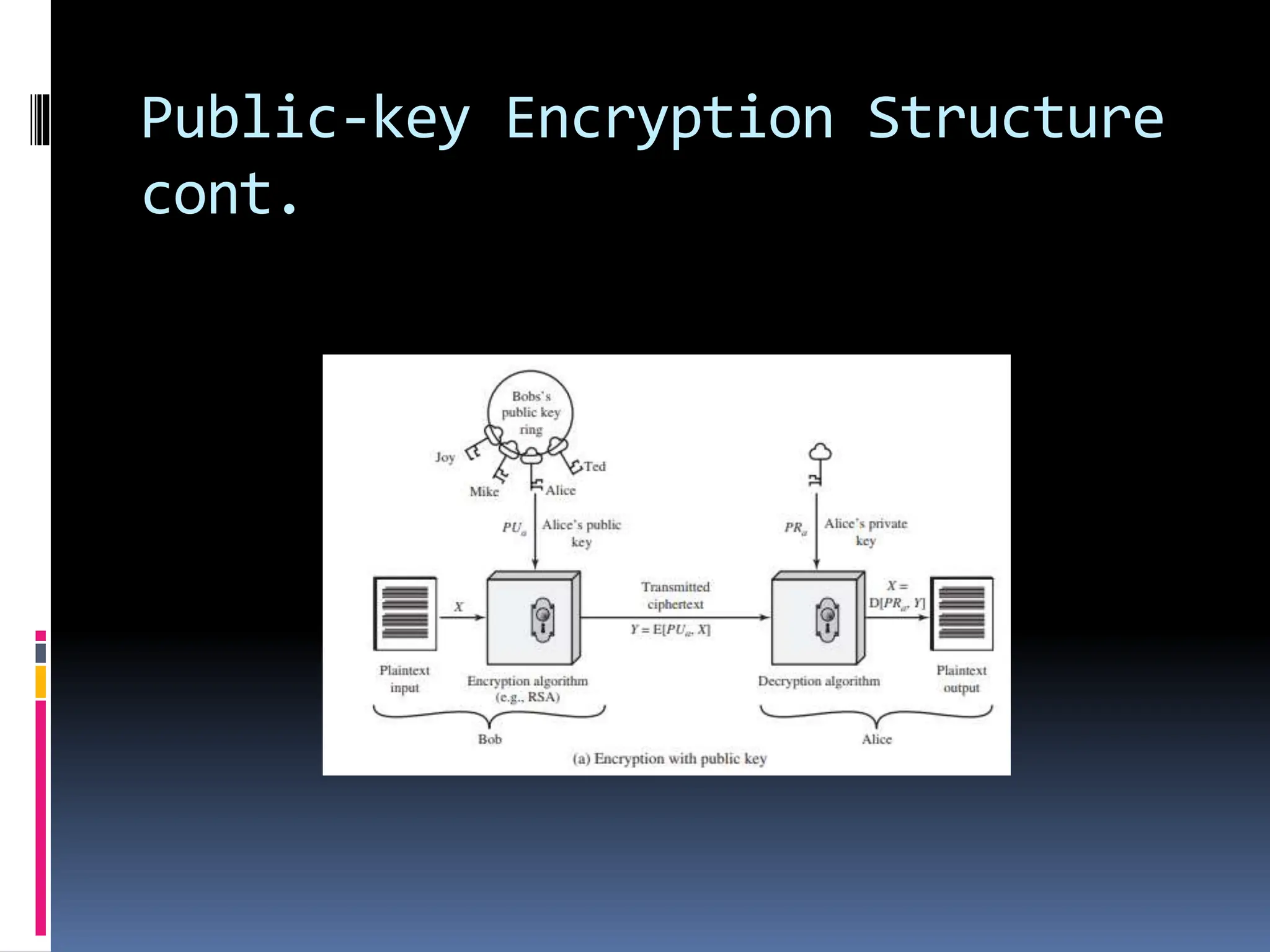
 3. If Bob wishes to send a private message to
Alice, Bob encrypts the message using Alice’s
public key.
 4.When Alice receives the message, she
decrypts it using her private key. No other
recipient can decrypt the message because
only Alice knows Alice’s private key
Public-key Encryption Structure
cont.
 With this approach, all participants have
access to public keys, and private keys are
generated locally by each participant and
therefore need never be distributed.
 As long as a user protects his or her private
key, incoming communication is secure.
 At any time, a user can change the private
key and publish the companion public key to
replace the old public key.
Public-key Encryption Structure
cont.
Public-key Encryption Structure
cont.
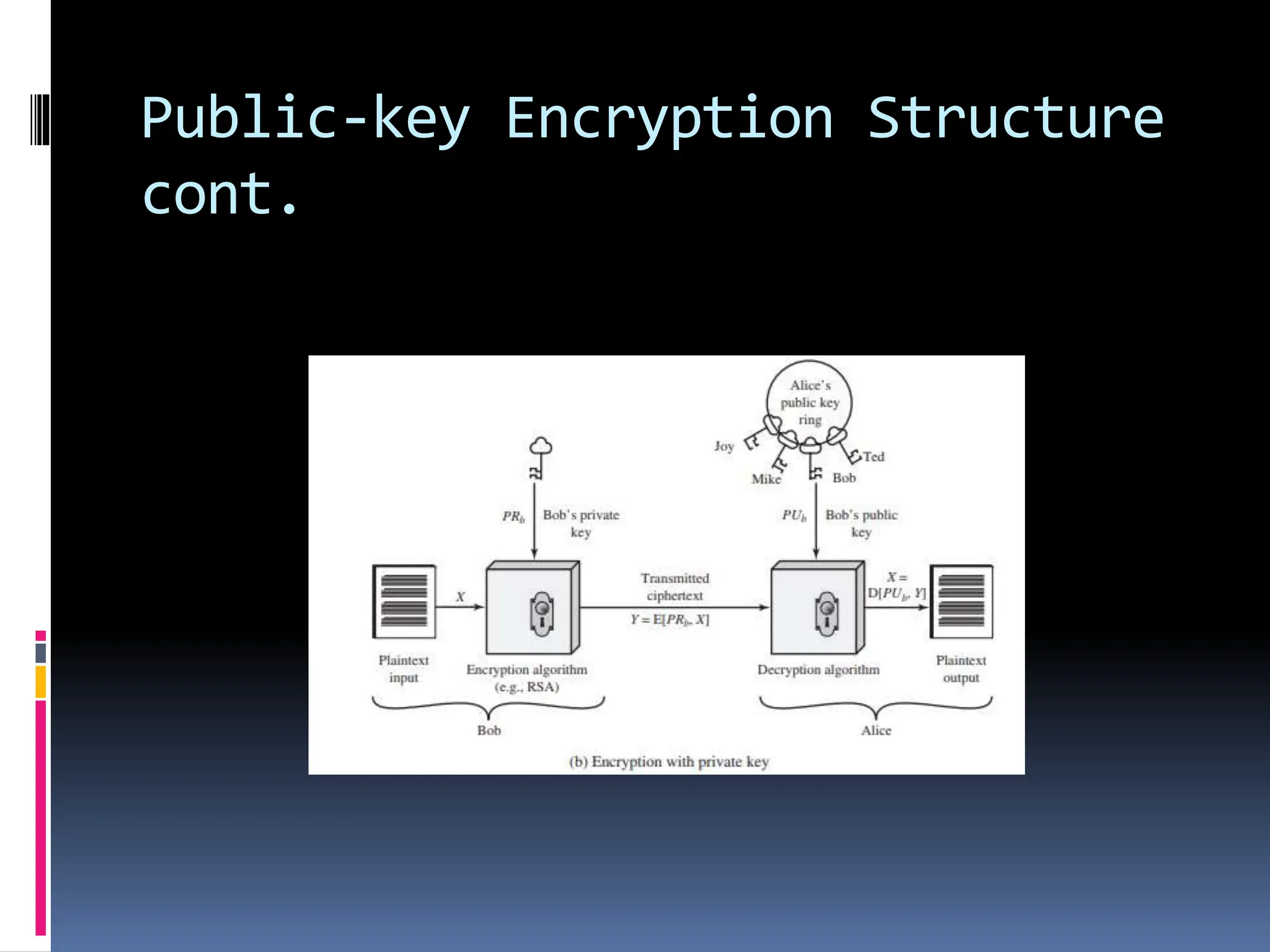
 In this scheme, a user encrypts data using his or
her own private key.
 Anyone who knows the corresponding public key
will then be able to decrypt the message.
Public-key Encryption Structure
cont.
 Note that the scheme of Figure (a) is directed
toward providing
 confidentiality: Only the intended recipient
should be able to decrypt the cipher-text because
only the intended recipient is in possession of the
required private key.
 Whether in fact confidentiality is provided
depends on a number of factors, including the
security of the algorithm, whether the private key
is kept secure, and the security of any protocol of
which the encryption function is a part.
Public-key Encryption Structure
cont.
 The scheme of Figure (b) is directed toward
providing authentication and/or data integrity.
 If a user is able to successfully recover the
plaintext from Bob’s cipher-text using Bob’s
public key, this indicates that only Bob could
have encrypted the plaintext, thus providing
authentication.
 Further, no one but Bob would be able to modify
the plaintext because only Bob could encrypt the
plaintext with Bob’s private key.

asymmetric encryption.pptx

  • 1.
  • 2.
    Public-key Encryption structure Public-key encryption, first publicly proposed by Diffie and Hellman in 1976, is the first truly revolutionary advance in encryption in literally thousands of years.  Public-key algorithms are based on mathematical functions rather than on simple operations on bit patterns, such as are used in symmetric encryption algorithms.
  • 3.
    Public-key Encryption structure cont. More important, 1. Public-key cryptography is asymmetric, involving the use of two separate keys, 2. In contrast to symmetric encryption, which uses only one key.
  • 4.
    Misconceptions about both encryptions Before proceeding, we should first mention several common misconceptions concerning public-key encryption.  One is that public-key encryption is more secure from cryptanalysis than symmetric encryption.  In fact, the security of any encryption scheme depends on  (1) the length of the key and  (2) the computational work involved in breaking a cipher.
  • 5.
    Misconceptions about both encryptions There is nothing in principle about either symmetric or public-key encryption that makes one superior to another from the point of view of resisting cryptanalysis.  A second misconception is that public-key encryption is a general-purpose technique that has made symmetric encryption obsolete.
  • 6.
    Misconceptions about both encryptionscont.  Finally, there is a feeling that key distribution is trivial when using public-key encryption, compared to the rather cumbersome handshaking involved with key distribution centers for symmetric encryption.  For public-key key distribution, some form of protocol is needed, often involving a central agent, and the procedures involved are no simpler or any more efficient than those required for symmetric encryption.
  • 7.
    Public-key Encryption Structure cont. A public-key encryption scheme has six ingredients :  Plaintext: This is the readable message or data that is fed into the algorithm as input.  Encryption algorithm: The encryption algorithm performs various transformations on the plaintext.  Public and private key: This is a pair of keys that have been selected so that  if one is used for encryption,  the other is used for decryption.  The exact transformations performed by the encryption algorithm depend on the public or private key that is provided as input.
  • 8.
    Public-key Encryption Structure cont. Cipher-text:This is the scrambled message produced as output. It depends on the plaintext and the key. For a given message, two different keys will produce two different cipher-texts.  Decryption algorithm:This algorithm accepts the cipher-text and the matching key and produces the original plaintext.
  • 9.
  • 10.
    Public-key Encryption Structure cont. As the names suggest, the public key of the pair is made public for others to use, while the private key is known only to its owner.  A general-purpose public-key cryptographic algorithm relies on one key for encryption and a different but related key for decryption
  • 11.
    Public-key Encryption Structure cont. The essential steps are the following:  1. Each user generates a pair of keys to be used for the encryption and decryption of messages.  2. Each user places one of the two keys in a public register or other accessible file.This is the public key.The companion key is kept private.
  • 12.
    Public-key Encryption Structure cont. 3. If Bob wishes to send a private message to Alice, Bob encrypts the message using Alice’s public key.  4.When Alice receives the message, she decrypts it using her private key. No other recipient can decrypt the message because only Alice knows Alice’s private key
  • 13.
    Public-key Encryption Structure cont. With this approach, all participants have access to public keys, and private keys are generated locally by each participant and therefore need never be distributed.  As long as a user protects his or her private key, incoming communication is secure.  At any time, a user can change the private key and publish the companion public key to replace the old public key.
  • 14.
  • 15.
    Public-key Encryption Structure cont. In this scheme, a user encrypts data using his or her own private key.  Anyone who knows the corresponding public key will then be able to decrypt the message.
  • 16.
    Public-key Encryption Structure cont. Note that the scheme of Figure (a) is directed toward providing  confidentiality: Only the intended recipient should be able to decrypt the cipher-text because only the intended recipient is in possession of the required private key.  Whether in fact confidentiality is provided depends on a number of factors, including the security of the algorithm, whether the private key is kept secure, and the security of any protocol of which the encryption function is a part.
  • 17.
    Public-key Encryption Structure cont. The scheme of Figure (b) is directed toward providing authentication and/or data integrity.  If a user is able to successfully recover the plaintext from Bob’s cipher-text using Bob’s public key, this indicates that only Bob could have encrypted the plaintext, thus providing authentication.  Further, no one but Bob would be able to modify the plaintext because only Bob could encrypt the plaintext with Bob’s private key.