From Network Beginner to Network Programmer
with the Help of Open Source Networking
Aris Cahyadi Risdianto
Bandung, October 18th 2017
Who am I?
• Bachelor degree from Tel-U (a.k.a. STT Telkom) in 2002
• System/Research Engineer at PT. NCI in 2003 – 2005
• System/Network Engineer at PT. DDI (a.k.a. DCI) in 2005 – 2007
• Network Administrator/Engineer at Ooredoo Telecom in 2007 –
2010
• Master degree from ITB in 2012
• PhD candidate and Research Assistant at GIST (Gwangju Institute of
Science and Technology) from 2013
• TBD
Outline
• Self Story - The journey from network beginner to
network programmer
• Open Source Networking - Basic Introduction and
example use cases
• OF@TEIN Project - Build the network and
“networking” through collaboration
Network Beginner (2000 - 2003)
The journey from network beginner
to network programmer
What I did?
• Joined senior member at C&C Laboratory in Tel-U
• Learn about operating systems (Redhat Linux, Windows NT,
SUN Solaris and FreeBSD)
• Learn basic networking (Ethernet BNC/UTP, Hub/Switch, and
PC Router)
• Maintain student servers (Web, mail, DNS, FTP, …)
• Linux and networking trainer at C&C
• Final Project about IPv6 implementation
What I learned?
“Do any trial and error for everything in the campus, no
chance if you we are out”
“RTFM (read the ****ing manual), it needs sacrifice to
make it”
“Learn something open is more useful, you can see all
manual, codes, comments, etc.”
Network Engineer (2003 - 2010)
The journey from network beginner
to network programmer
What I did?
• Joined IP network-focus company instead
telecommunication company
• CCNA in 3 months in work
• CCNP less than year in work
• Learn multiple networks (IP, Mobile networks, etc.)
• Bridge between the networks (Sigtrans = SS7 over IP)
What I learned?
“Learn the concept, never remember the command”
“Networking is important than the network itself”
“Trust the ‘Wireshark’, he will tell us the truth ”
Network Administrator (2007 - 2010)
The journey from network beginner
to network programmer
What I did?
• Maintain IP network for Mobile network
• Testing and verification amongst the vendors
• Operate and maintain complex network
• Work with multiple languages and time zones
What I learned?
“Automate our routine works to avoid wasting of our
valuable time”
“Work as team with other networks operators
(collaborations), we are are equal”
“Prepare the roll back plan and always has alternative
plans”
Network Programmer (2010 - TBD)
The journey from network beginner
to network programmer
What I did?
• Found something interesting or new about the
network (SDN, NFV, …)
• Explore the available and open solutions
• Join collaboration discussion or groups
• Try to contribute from the simple/basic things
What I learned?
“Collaborate or Die”
“Forget who we are and where we are from, the most
important is ‘where is our codes?’”
“Define our own applications/requirements, make our
unique network deployment/implementation”
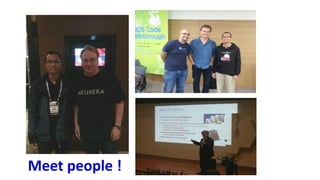
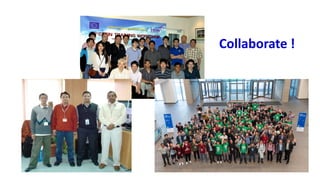
Meet people !
Collaborate !
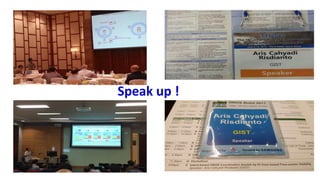
Speak up !
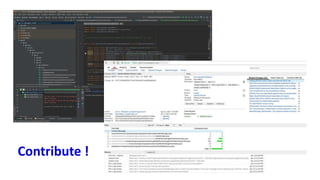
Contribute !
Basic Introduction and Use Cases
Open Source Networking
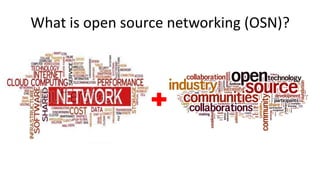
What is open source networking (OSN)?
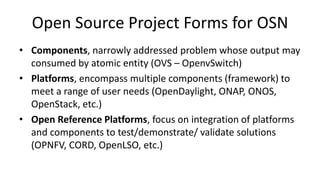
Open Source Project Forms for OSN
• Components, narrowly addressed problem whose output may
consumed by atomic entity (OVS – OpenvSwitch)
• Platforms, encompass multiple components (framework) to
meet a range of user needs (OpenDaylight, ONAP, ONOS,
OpenStack, etc.)
• Open Reference Platforms, focus on integration of platforms
and components to test/demonstrate/ validate solutions
(OPNFV, CORD, OpenLSO, etc.)
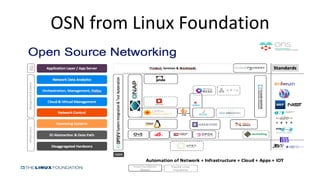
OSN from Linux Foundation
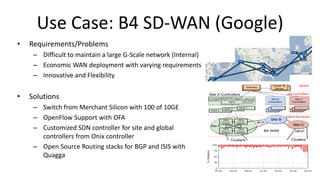
Use Case: B4 SD-WAN (Google)
• Requirements/Problems
– Difficult to maintain a large G-Scale network (Internal)
– Economic WAN deployment with varying requirements
– Innovative and Flexibility
• Solutions
– Switch from Merchant Silicon with 100 of 10GE
– OpenFlow Support with OFA
– Customized SDN controller for site and global
controllers from Onix controller
– Open Source Routing stacks for BGP and ISIS with
Quagga
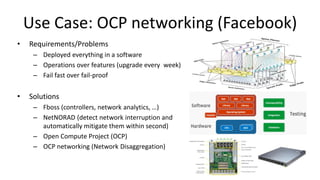
Use Case: OCP networking (Facebook)
• Requirements/Problems
– Deployed everything in a software
– Operations over features (upgrade every week)
– Fail fast over fail-proof
• Solutions
– Fboss (controllers, network analytics, …)
– NetNORAD (detect network interruption and
automatically mitigate them within second)
– Open Compute Project (OCP)
– OCP networking (Network Disaggregation)
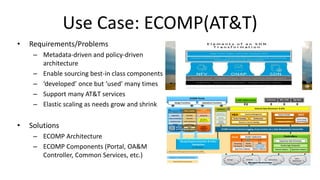
Use Case: ECOMP(AT&T)
• Requirements/Problems
– Metadata-driven and policy-driven
architecture
– Enable sourcing best-in class components
– ‘developed’ once but ‘used’ many times
– Support many AT&T services
– Elastic scaling as needs grow and shrink
• Solutions
– ECOMP Architecture
– ECOMP Components (Portal, OA&M
Controller, Common Services, etc.)
What is main challenge for OSN?
We are not Google, Facebook, AT&T, … who has
hundred/thousand engineer/programmers.
We also not Google, Facebook, AT&T, … who need to
serve million/billion subscribers/customers.
Scale our network problems !!!
What we can do with OSN?
• Research to produce papers and journals
• Increase programming skills especially for
networking
• Collaborate/contribute to open source project
• Build a testbed as POC of OSN in real world
environment and scenarios
OF@TEIN Project under Asi@Connect Funding
Build the network and networking
through collaboration
Demo

From network beginner to network programmer.v2

  • 1.
    From Network Beginnerto Network Programmer with the Help of Open Source Networking Aris Cahyadi Risdianto Bandung, October 18th 2017
  • 2.
    Who am I? •Bachelor degree from Tel-U (a.k.a. STT Telkom) in 2002 • System/Research Engineer at PT. NCI in 2003 – 2005 • System/Network Engineer at PT. DDI (a.k.a. DCI) in 2005 – 2007 • Network Administrator/Engineer at Ooredoo Telecom in 2007 – 2010 • Master degree from ITB in 2012 • PhD candidate and Research Assistant at GIST (Gwangju Institute of Science and Technology) from 2013 • TBD
  • 3.
    Outline • Self Story- The journey from network beginner to network programmer • Open Source Networking - Basic Introduction and example use cases • OF@TEIN Project - Build the network and “networking” through collaboration
  • 4.
    Network Beginner (2000- 2003) The journey from network beginner to network programmer
  • 5.
    What I did? •Joined senior member at C&C Laboratory in Tel-U • Learn about operating systems (Redhat Linux, Windows NT, SUN Solaris and FreeBSD) • Learn basic networking (Ethernet BNC/UTP, Hub/Switch, and PC Router) • Maintain student servers (Web, mail, DNS, FTP, …) • Linux and networking trainer at C&C • Final Project about IPv6 implementation
  • 6.
    What I learned? “Doany trial and error for everything in the campus, no chance if you we are out” “RTFM (read the ****ing manual), it needs sacrifice to make it” “Learn something open is more useful, you can see all manual, codes, comments, etc.”
  • 7.
    Network Engineer (2003- 2010) The journey from network beginner to network programmer
  • 8.
    What I did? •Joined IP network-focus company instead telecommunication company • CCNA in 3 months in work • CCNP less than year in work • Learn multiple networks (IP, Mobile networks, etc.) • Bridge between the networks (Sigtrans = SS7 over IP)
  • 9.
    What I learned? “Learnthe concept, never remember the command” “Networking is important than the network itself” “Trust the ‘Wireshark’, he will tell us the truth ”
  • 10.
    Network Administrator (2007- 2010) The journey from network beginner to network programmer
  • 11.
    What I did? •Maintain IP network for Mobile network • Testing and verification amongst the vendors • Operate and maintain complex network • Work with multiple languages and time zones
  • 12.
    What I learned? “Automateour routine works to avoid wasting of our valuable time” “Work as team with other networks operators (collaborations), we are are equal” “Prepare the roll back plan and always has alternative plans”
  • 13.
    Network Programmer (2010- TBD) The journey from network beginner to network programmer
  • 14.
    What I did? •Found something interesting or new about the network (SDN, NFV, …) • Explore the available and open solutions • Join collaboration discussion or groups • Try to contribute from the simple/basic things
  • 15.
    What I learned? “Collaborateor Die” “Forget who we are and where we are from, the most important is ‘where is our codes?’” “Define our own applications/requirements, make our unique network deployment/implementation”
  • 16.
  • 17.
  • 18.
  • 19.
  • 21.
    Basic Introduction andUse Cases Open Source Networking
  • 22.
    What is opensource networking (OSN)?
  • 23.
    Open Source ProjectForms for OSN • Components, narrowly addressed problem whose output may consumed by atomic entity (OVS – OpenvSwitch) • Platforms, encompass multiple components (framework) to meet a range of user needs (OpenDaylight, ONAP, ONOS, OpenStack, etc.) • Open Reference Platforms, focus on integration of platforms and components to test/demonstrate/ validate solutions (OPNFV, CORD, OpenLSO, etc.)
  • 24.
    OSN from LinuxFoundation
  • 25.
    Use Case: B4SD-WAN (Google) • Requirements/Problems – Difficult to maintain a large G-Scale network (Internal) – Economic WAN deployment with varying requirements – Innovative and Flexibility • Solutions – Switch from Merchant Silicon with 100 of 10GE – OpenFlow Support with OFA – Customized SDN controller for site and global controllers from Onix controller – Open Source Routing stacks for BGP and ISIS with Quagga
  • 26.
    Use Case: OCPnetworking (Facebook) • Requirements/Problems – Deployed everything in a software – Operations over features (upgrade every week) – Fail fast over fail-proof • Solutions – Fboss (controllers, network analytics, …) – NetNORAD (detect network interruption and automatically mitigate them within second) – Open Compute Project (OCP) – OCP networking (Network Disaggregation)
  • 27.
    Use Case: ECOMP(AT&T) •Requirements/Problems – Metadata-driven and policy-driven architecture – Enable sourcing best-in class components – ‘developed’ once but ‘used’ many times – Support many AT&T services – Elastic scaling as needs grow and shrink • Solutions – ECOMP Architecture – ECOMP Components (Portal, OA&M Controller, Common Services, etc.)
  • 28.
    What is mainchallenge for OSN? We are not Google, Facebook, AT&T, … who has hundred/thousand engineer/programmers. We also not Google, Facebook, AT&T, … who need to serve million/billion subscribers/customers. Scale our network problems !!!
  • 29.
    What we cando with OSN? • Research to produce papers and journals • Increase programming skills especially for networking • Collaborate/contribute to open source project • Build a testbed as POC of OSN in real world environment and scenarios
  • 31.
    OF@TEIN Project underAsi@Connect Funding Build the network and networking through collaboration
  • 33.